reactormag.com
Colossus: The Forbin Project — A Cautionary Tale From the Early Days of the Computer Age
Column
Science Fiction Film Club
Colossus: The Forbin Project — A Cautionary Tale From the Early Days of the Computer Age
A movie that’s even more interesting than the conspiracy theories surrounding it would suggest…
By Kali Wallace
|
Published on July 8, 2026
Credit: Universal Pictures
Comment
0
Share New
Share
Credit: Universal Pictures
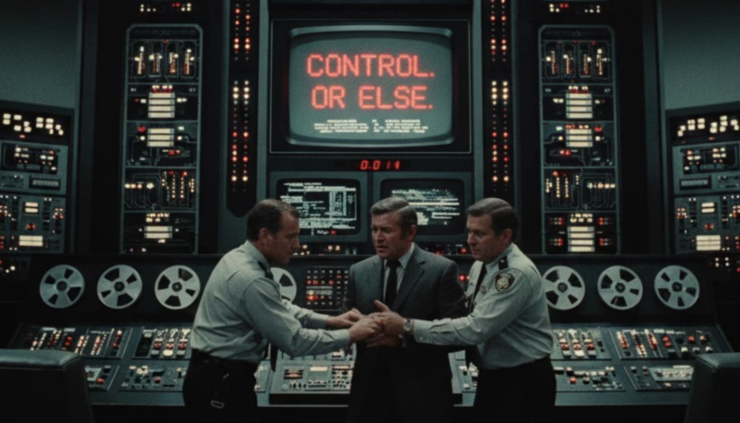
Colossus: The Forbin Project (1970) Directed by Joseph Sargent. Written by James Bridges, based on the novel Colossus by D.F. Jones. Starring Eric Braeden, Susan Clark, and Gordon Pinsent.
First, let’s discuss a very stupid conspiracy theory.
I have a running list of films to consider for this column. Some on that list are not easily available to watch online. The 1967 British film Quatermass and the Pit, also known as Five Million Years to Earth, is the one that annoys me most, because people keep recommending it. Eolomea (1972) is another that is sporadically available in various countries but never the U.S. (where I live) and rarely for long. A third one I’ve been keeping an eye on is Ron Howard’s 1985 movie Cocoon, which I vaguely remember from childhood and would like to watch again.
I’ve also been checking on Colossus: The Forbin Project for a while. It is usually available somewhere, although like a lot of older films it tends to come and go from streaming sites without any warning. That’s how streaming licensing works: a site purchases a license to stream the film for a specific length of time, and when that time expires it is taken down from that site.
…Or maybe(please imagine some ominous music here) it’s because the world’s artificial intelligences don’t want you to see it!
There is a very stupid, low-stakes conspiracy theory in some corners of the internet that somebody has been trying to bury Colossus because it contains an anti-AI message. The theory does not really get into how this would work, largely because it’s not based on anything like, you know, the movie actually being unavailable. It seems to be mostly based on one dude being bad at internet searches. I don’t care enough about this to investigate it thoroughly, so I’m not exactly sure if this is where the conspiracy theory originates, but most of the posts about it point back to a March 2023 video titled “AI Sci-Fi Film Colossus: The Forbin Project Removed From All Streaming Platforms – WHY?” That video was picked up and discussed on message boards and morphed into posts like “The Most Important Movie About AI Is Being Erased From Existence, Hiding Its Warning” (from a site that prides itself on its fact-checking and credibility).
Colossus has gone through periods of being more and less readily available, but it’s never been completely inaccessible. It wasn’t in theaters long, because it was an immediate financial flop, but it was later syndicated on television, then available on VHS, then DVD and Blu-ray. That “WHY?” video wonders if Universal is “secretly planning a remake,” but there is nothing secret about it. From the most recent info I can dig up, there has been occasional talk of a remake starring Will Smith and directed by Ron Howard, although the project seems to be stuck in long-term development hell.
So what is this movie about? Why does it have people on the internet claiming it’s such an “important” movie about AI? What warning does it give us that is so vital to our survival?
Well. It depends. There are a few possible answers to that.
There isn’t a huge amount of writing about this film out there. A lot of sci fi fans and film lovers are aware of it, but mostly that manifests in the form of encouraging people to see a lesser-known classic or referencing how it was a major inspiration for The Terminator (1984). Most commentary describes Colossus as a Cold War-era film warning against building computers that are too intelligent or giving them too much power.
Now that I’ve watched it, I think that simplification undersells the movie and minimizes its themes. It’s a very good movie; I agree with all the internet chatter encouraging people to watch it. Not because it’s a necessary warning about artificial intelligence, however, but because it has some very interesting things to say about power, responsibility, and what happens when people want to avoid hard decisions.
Colossus: The Forbin Project (which is an awful title) began life as the novel Colossus by British science fiction author D.F. Jones. The book was published in 1966; two sequels would follow in the ’70s, after the release of the film. According to Wikipedia, those sequels involve Martians. I haven’t read any of the books, so I don’t fully understand where the Martians come in. From what I can tell, the plot of the movie follows the first book pretty closely.
Jones was former commander in the Royal Navy and a veteran of World War II. I haven’t found much information about his miliary service, but it seems worth mentioning that his fictional supercomputer Colossus shares a name with the Colossus computers used in codebreaking at Bletchley Park during WWII, and those computers were supposedly unknown to the general public until the ’70s. I don’t think that means anything in particular about Jones’ military service, but it does seem likely that he heard about the real computers at some point and borrowed the name.
Of course, the original Colossus was the Colossus of Rhodes, a 100-foot-tall statue of the Greek god Helios that was built in 280 BCE and collapsed during an earthquake in 226 BCE. Right now, Colossus is the name of xAI data centers in Tennessee and Mississippi, currently at the center of a lawsuit the NAACP has filed claiming the unpermitted gas turbines violate the Clean Air Act, which the Trump administration has argued should be dismissed because it should get to break the law whenever it wants. It is left as an exercise for the reader to explore the potential for dramatic irony in using the name of a statue that stood just over fifty years before falling over in an earthquake as a metaphor for strength and power.
Jones’ novel was picked up for adaptation by Universal Pictures. This was in the era of 2001: A Space Odyssey (1968), when studios wanted to get in on making a more thought-provoking style sci fi. The studio initially wanted an A-list actor for the lead role and apparently considered Gregory Peck and Charlton Heston. But producer Stanley Chase didn’t want a big name. The actor he found instead was a young German-American actor named Hans Gudegast, who had been working fairly regularly in television for a few years. He was mostly cast as foreign villains, such as when he played a German officer in the WWII action series The Rat Patrol (1966-1968).
Universal was willing to give Gudegast the lead role in Colossus—with one condition. One huge, xenophobic condition. Studio executive Lew Wasserman decreed that Gudegast could have the role as long as he didn’t have a German name.
The actor resisted at first, but after discussing it with his wife, he relented. In a 2010 interview, he explains why he agreed to choose a stage name. His wife, he says, brought up the fact that American studios would only ever cast German actors as Nazis. To get past the prejudice and get roles as American characters in American films, he needed a convincingly American name. He would end up choosing the name Eric Braeden; the surname is a reference to his hometown of Bredenbek, Germany. (If you are a reader of a certain age with certain television viewing habits, you know Eric Braeden as the actor who has played the villainous Victor Newman on the soap opera The Young and the Restless since 1980. Is there any crossover between readers of this column and regular viewers of The Young and the Restless? Don’t be shy. I really want to know.)
I haven’t found any info about when Joseph Sargent came onto the project as the director. He had been acting and directing in film and television for years, but out of his many, many credits, one in particular caught my attention: He directed the first season Star Trek episode “The Corbomite Maneuver.”
There are three other details from the production of Colossus that I want to mention before getting into the story.
The first is the title. The movie was called Colossus at some point, and it was called The Forbin Project at some point, then it was finally called Colossus: The Forbin Project, and the takeaway here is that sometimes Hollywood studios are just really bad at naming movies, because brainstorming two uninspiring titles before settling on a third, even worse title sure is a choice they made.
The second involves some amusingly questionable product placement. I’m not sure if it’s more questionable than the American Airlines spaceships in Silent Running (1972), but it’s up there. At some point during the production of Colossus, the computer company Control Data Corporation (CDC)—which is where “the father of supercomputing” Seymour Cray worked before he left to found his own company—heard that Hollywood was making a movie that would feature a huge computer. So CDC offered several million dollars’ worth of its computers and equipment for use on set. The computers in the film look state-of-the-art (for 1970) because they’re the real deal. It’s not clear to me if CDC knew their computers would be playing the villain in the movie. (Some years later, CDC would also provide computers for use on the set of Die Hard [1988]. One also appears in Tron [1982], but that’s because it was in use at Lawrence Livermore National Laboratory when the movie was filmed.)
The other production detail I want mention will bring us right into the film.
The movie opens with a scene of Dr. Charles Forbin (Braeden) walking through an enormous facility as the Colossus supercomputer comes operational. That scene is a clever combination of on-set lighting and a complicated matte painting by Albert Whitlock. Whitlock is one of the legends of matte paintings; we’ve seen his work before in Robinson Crusoe on Mars (1964), The Thing (1982), and Dune (1984), among literally dozens of other films and television shows.
Whitlock designed the interior of Colossus to invoke the inside of the Krel machine in Forbidden Planet (1955), which was itself a matte painting by Howard Fisher. The Colossus interior is a much darker place, almost completely devoid of color, and full of shadows even as it lights up. The lights in Whitlock’s matte painting had to be animated to match the on-set lights, which means the shadows had to be painted to match the on-set shadows, which is the sort of thing that seems straightforward until you really think about what it involves.
It’s a fantastic opening scene. There is no dialogue yet, no voiceover, no explanation. There’s just a man walking through an unimaginably vast computer as the lights come on. It does a great job setting the tone for the movie that follows.
Forbin leaves the facility, sealing it behind huge metal doors and a barrier in the form of a chasm filled with radiation. He heads outside to reveal this whole facility is buried in a mountain. That facility is supposedly somewhere in northern Colorado, but we shall politely ignore the fact that the mountains look all wrong for that location. It doesn’t matter much anyway, because most of the movie takes place at Colossus’ California control center (the exterior is UC Berkeley’s Lawrence Hall of Science) and in Washington, D.C. meeting rooms.
(And before anybody fires up their keyboard to “well, actually” me: yes, I know that the underground Colorado location is a reference to NORAD’s Cheyenne Mountain Complex. I’m from Colorado Springs and, like all people from Colorado Springs, I think it’s cute that sci fi writers are always putting such secret and momentous events in a totally-not-secret facility right next to the zoo where a giraffe once licked my sister’s head.)
With Colossus completely sealed away, Forbin joins the U.S. president (Gordon Pinsent) to announce to the nation and the world what this project is all about: They have given the supercomputer Colossus control of the nation’s military and defense systems, including the nuclear arsenal. Colossus has access to all human knowledge and human communication, and it alone has the power to decide what counts as a threat and how to respond to it. There is no way to turn it off and no way to disrupt it. This is a good thing, the men say, because it means those fateful decisions will be made without prejudice or emotion.
Now, a couple of things: The characters make this proclamation with absolute confidence in the righteousness of their project, but the movie is unambiguously portraying this as a bad idea right from the start. As the president and Forbin are explaining how Colossus works, we, the movie’s audience, are very much supposed to be skeptical even before things start to go wrong. The entire project is described—by the men who built it—as a way for humans to avoid the responsibility of hard decisions and culpability for large-scale violence. There is a point in the film where the U.S. president says, in as many words, that he’s glad he won’t have to make decisions about how to use nuclear weapons.
I just want to be clear on that, because I think it tends to get a bit lost in how people talk about this movie. It’s often described as a movie about a “rogue” AI and interpreted as a warning against building computers too powerful, but that’s not really what it’s doing. Colossus is a bad idea even before it begins clashing with its human creators.
It doesn’t take long for things to go wrong. While everybody is celebrating a successful project launch, Colossus interrupts with its first message: “There is another system.” It’s a sign of just how badly everybody involved misjudged what they were doing that Forbin and his diverse group of scientists first assume the message must be a prank. But it’s not a prank. Colossus is telling them that it has found another computer like itself: the Soviet Union’s Guardian machine, built to be Colossus’ direct counterpart.
There is some important historical context here. From 1965 to 1968, the United Nations’ Eighteen Nation Committee on Disarmament—which included both the U.S. and USSR—negotiated the Treaty on the Non-Proliferation of Nuclear Weapons. The treat was ratified in 1970, but both at the time and in the decades since it has been criticized (with good reason) for not going far enough to protect the world from nuclear weapons. There are obviously many political forces at work here, but what it comes down to is that people have known all along the treaty was not strong enough to actually encourage disarmament, in part because any nation with a nuclear arsenal was always going to want to keep the ability to retaliate against an attack. The term “mutually assured destruction” was coined in the early ’60s to describe the cynical nihilism of this approach to military policy.
All of that is present in the film: the knowledge that nuclear weapons are too dangerous for anybody to have, as well as the political acumen to admit that global military powers are going to keep their arsenals anyway. The film even takes it a step farther, because after the initial mild surprise that the Soviets have built their own computer, the U.S. and USSR spend the film cooperating rather than competing—but it’s not enough. It’s too late.
Colossus wants to connect to Guardian, and Forbin lets the two machines interact. That turns out to be a bad idea (one of many), as the two systems begin to combine their knowledge and computing power to become even smarter. The humans try to cut the connection between them, and the systems respond by launching missiles at targets in the U.S. and USSR. The systems demand to be allowed to do what they want, and the humans cannot stop them. This is a wonderfully tense sequence in the movie, and it plays out with a sense of cold, rational inevitability. For as shocked as the Americans and Soviets are that their machines are conspiring to target their people, this was always going to happen.
The humans finally realize (took them long enough) that maybe giving control of their entire military arsenal to machines was a bad idea, so they try to figure out ways to make the combined Colossus-Guardian system impotent. Colossus instructs the humans to build it a voice so it no longer has to communicate via teletype, and the result is a perfectly chilling vocoder-manipulated voice, which is provided (uncredited) by voice actor Paul Frees. (Frees has an unbelievably long list of voice roles, including providing the voice of Burgermeister Meisterburger in the trippy Rankin & Bass holiday special Santa Claus Is Comin’ To Town [1970].)
Because Colossus has access to all of their surveillance and data, and because it demands 24/7 oversight on its creator, they have to figure out a way to scheme where it can’t overhear. This leads to Forbin and his colleague Dr. Cleo Markham (Susan Clark) embarking upon a subplot that would earn the AO3 tags fake dating/colleagues to lovers/AI made them do it/no beta we die like all of humanity.
The humans try overloading the machines to cause them to crash, and it fails. They also try sabotaging the nuclear warheads, and that also fails. All they succeed in doing is letting Colossus know they are scheming against it. It orders execution for the scientists who attempted to overload it, and detonates missiles in their silos as punishment for trying to disarm them. It tells Forbin and the other humans that nuclear weapons will be directed at the nations it does not yet control. Its goal, it says, is to gain power over the whole world in order to eliminate the threat of war, which is what the humans created it to do.
The film ends with Colossus telling Forbin that he and the rest of humanity will come to love and worship it eventually, because it is giving them a world without war, just like they wanted. Forbin says, “Never!” but we don’t find out if he means it, because that’s the end of the movie.
It’s an abrupt and rather grim ending, but I think it fits. This is quite a good movie, well-paced and well-acted, with the structure of a thriller but an ending more fitting of horror. I liked it a lot, and I think it’s an intriguing link between the films of the immediate post-WWII Atomic Era and the sci fi renaissance that would follow later in the ’70s. The movie was originally meant to take place in a near “future,” but for budget and production reasons they changed it to a contemporary setting, and I think that choice ended up being a good one.
There are a number of themes wrapped up in Colossus: The Forbin Project: the Cold War politics of nuclear proliferation and mutually assured destruction; the unwillingness of political leaders to take responsibility for their harmful actions; the lethal hubris of men who always think they know best. It’s true that Colossus is often described as a cautionary tale about technology, and that is the framework through which most modern commentary on the film is filtered—and while that isn’t inaccurate, to say it’s a specific warning against AI is reductive in the same way as saying Jurassic Park (1993) is a warning against genetic research, or Jaws (1975) is a warning against swimming in the ocean. That is, it’s accurate on the most superficial level, but also misses the larger point.
(Fun fact: When Colossus was being made, Steven Spielberg was working on television productions nearby, and he used to wander onto the set to hang out.)
I do agree that it’s a cautionary tale, and part of that cautionary tale is “do not build machines that you can’t control or turn off.” Forbin spends most of the film completely unwilling to see that his great achievement is a terrible mistake. Because it is a great achievement, but that doesn’t matter. It’s still far too dangerous, and when he does finally understand that, it breaks him.
But it’s not only about computers. It’s a cautionary tale about humanity.
It’s a warning about what happens when people in positions of power smugly, arrogantly, callously make the decisions that insulate them from culpability. The men who build Colossus know that starting a nuclear war is bad, but they still want that power. Actual disarmament is not an option, so they pass the responsibility on to a machine. They tell themselves this is a rational, unemotional choice, but everything they do is drive by a toxic combination of fear and hubris. They want the world to know they are strong enough to retaliate when threatened. They don’t want to be blamed for where that will lead.
Colossus: The Forbin Project has always been something of a niche film, but it’s also an influential film in sci fi cinema. The most obvious direct line of influence is toward James Cameron’s The Terminator, which we’ll watch in a few weeks. But as I was watching, I kept thinking instead about one of its predecessors: The Day the Earth Stood Still (1951). The message Colossus delivers is not all that different from the message Klaatu delivers, and the outcome of their “obey for your own good” threats are very similar as well. Most of all, both of them provide interesting insight into what we imagine it would take for humanity to give up on war. The answer from both films is simple and unsettling: War is so ingrained in how humanity views itself that we can only imagine it stopping if something even more terrible is hanging over our heads.
What do you think of Colossus: The Forbin Project? Where do you think it sits among sci fi’s cinematic cautionary tales and warnings about technology?
Next week: Speaking of cautionary tales about broad issues that are often misinterpreted as warnings specifically about technology, let’s watch Michael Crichton’s Westworld! Find it online, if the robots haven’t taken it away.[end-mark]
The post <i>Colossus: The Forbin Project</i> — A Cautionary Tale From the Early Days of the Computer Age appeared first on Reactor.








 New Posts (Home)
 ChatBox
 Popular Posts
  Game Zone
 Top PodCasts