www.upworthy.com
The fascinating origin story of the hashtag, pound sign, or whatever you call the # symbol
Gen Xers in the United States grew up calling it a pound sign. Gen Z has always known it as a hashtag. The symbol that can be a shortcut for “number,” make a note sharp in music, and looks like a Tic-Tac-Toe board has multiple names and uses. It also has a surprising origin story that starts with the Ancient Romans.
As language expert and content creator RobWords explains, the # symbol comes from an abbreviation of the word “libra,” which the Romans used for a pound of weight. Libra is what gave us the abbreviation for our own pound measurement (lb) as well as the currency symbol for the British pound (£).
Fast-forward a bit to the time of the printing press, when it became a habit to put a line through the “lb,” signifying that it was an abbreviation. (So something akin to lb.) And that’s where a certain famous scientist influenced history in a non-scientific way.
How Sir Isaac Newton helped create the modern # sign
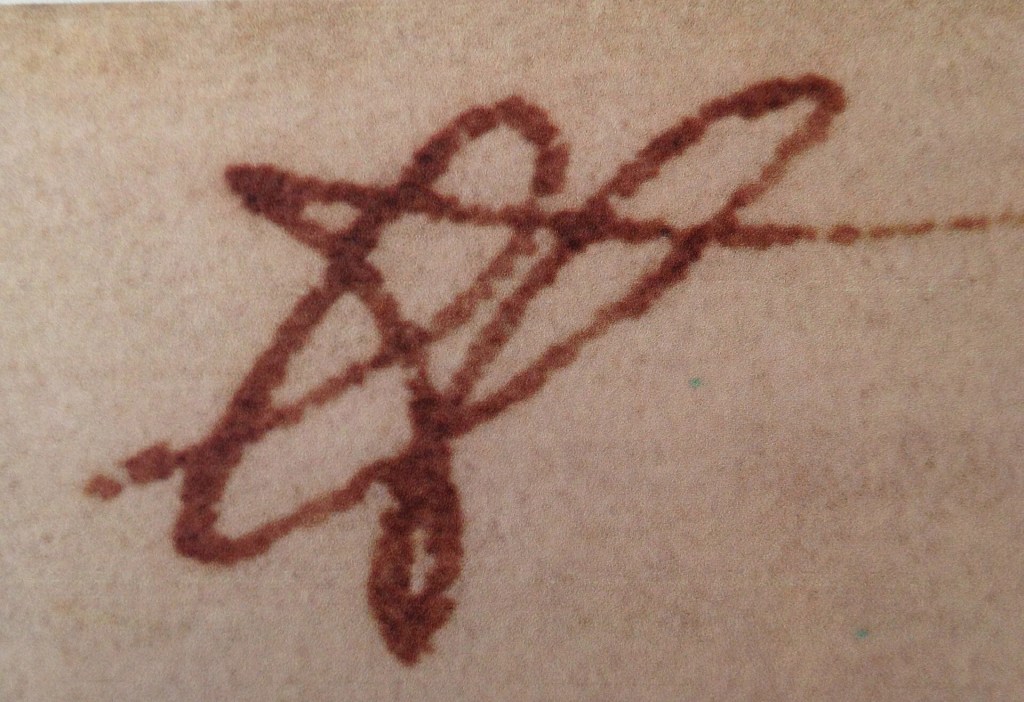
Writing “lb” by hand, scribes would often draw a line above the letters to indicate it was an abbreviation, sometimes elegantly connecting the rounded part of the “b” to the line above in one fluid movement. But not everyone wrote so neatly. When Newton scribbled it out, it looked like this:
How Sir Isaac Newton wrote the pound sign by hand. Photo credit: Public domain
“It is this scrawled attempt at the ‘lb’ pound symbol that is thought to be the origin of our hatched number sign,” said RobWords.
In time, Newton’s scribble was simplified into two vertical and two horizontal lines. And thus, the # was born.
The multiple names and uses for the # symbol
Many a Gen X parent has encountered the question, “What does ‘press pound’ mean?” from their Gen Z kids while walking them through customer service calls. “Press hashtag” would actually mean something to them. But the # symbol is also called a number sign, a hash (especially in the United Kingdom), a sharp symbol, and an octothorpe.
To be fair, you’ve probably never actually called it an octothorpe. But that is its technical name. “Octo” comes from the symbol’s eight points, formed by the ends of its four lines. The “thorpe” is a bit of a mystery. Some think it’s a tribute to Jim Thorpe, the first Native American to win an Olympic gold medal for the U.S. Others believe it goes back to the Old English word “thorp,” meaning “village,” because cartographers used the symbol to mark villages on maps. Still others think it’s simply meaningless.
I just called # a pound sign instead of a hashtag and a group of teenagers appeared and started beating me up with skateboards and hammers— Alison Burke (@TiredActor) February 20, 2024
As for the sharp sign in music, it’s pure coincidence that it looks like the pound sign; it evolved completely independently. It has nothing to do with libras, pounds, numbers, or hashtags.
(Fun fact: The # symbol isn’t actually called a hashtag in Internet usage. It’s simply called a “hash.” The “tag” is the word or phrase that follows it.)
What about other common symbols? How did & and @ come to be?
Ah, the classy ampersand, or &. Did you know it’s actually a word in and of itself? We know it means “and,” but the symbol is actually a ligature of the Latin word “et.” Once again, its story begins in Ancient Rome.
However, it only came to be called the ampersand because of the English alphabet. The symbol was once included at the end of the alphabet, after the letter Z. When children recited the alphabet, they would tack on “and per se and” after saying all the letters. (“Per se” means “by itself” or “in itself” in Latin.) Over time, that phrase morphed into the word “ampersand.”
The @ symbol had fallen into obscurity before email revived it. Photo credit: Canva
The @ symbol may seem totally unnecessary. After all, a symbol is meant to save time, and the word “at” doesn’t really take any longer to write than @, does it? The origins of the symbol, as RobWords explains, are a bit uncertain. Originally, it was used in accounting to indicate a per-unit price. It had all but become obsolete until 1971, when the first email was sent using the @ symbol. Now, billions of email addresses around the world rely on it.
Every symbol has its story
RobWords also delves into the history of § and ¶, but there’s a story behind every symbol we use. Finding shortcuts is a very human thing to do, and our reliance on symbols to represent words and ideas reflects that. But symbols evolve over time, which raises an interesting question: Which ones might still morph and change? (Maybe we should start a petition to make @ stand for “approximately” instead of “at.” That would at least save us all some time.)
You can follow RobWords on YouTube for more fun and fascinating linguistic content.
The post The fascinating origin story of the hashtag, pound sign, or whatever you call the # symbol appeared first on Upworthy.








 New Posts (Home)
 ChatBox
 Popular Posts
  Game Zone
 Top PodCasts