reactormag.com
A New Villain Shimmies Into the Dance: House of the Dragon, Season 3 Episode 4
Movies & TV
House of the Dragon
A New Villain Shimmies Into the Dance: House of the Dragon, Season 3 Episode 4
Notes on Hightower ethno-supremacy, surprise pregnancies, and a focus on the smallfolk in Tumbleton…
By Tyler Dean
|
Published on July 13, 2026
Credit: Ollie Upton/HBO
Comment
0
Share New
Share
Credit: Ollie Upton/HBO
After spending the majority of our time with Rhaenyra and the Blacks in the first three episodes, we get an in-depth look at the state of Team Green, with a special focus on a new key location in the ongoing Dance of the Dragons. We’ll get into the ins and outs of the episode below. Be warned there are spoilers, as always, for the episode below.
The Title
The episode is entitled “Tumbleton.” This is for obvious reasons, as Tumbleton is the newest focal point of the Dance, as we’ll discuss below. The town warrants its starring role in the title not just because it’s important to the episode but because it is relatively unimportant as a location through most of Westeros’ history. It would be nonsensical to name an episode “King’s Landing” or “Dragonstone,” as those are places where the narrative nearly always has some crucial plot afoot. But Tumbleton has not played any part in the game of thrones until this moment. And George R.R. Martin is rarely starry-eyed or idealistic when it comes to telling us about the fate of tiny backwaters that suddenly come to the attention of the great and powerful…
Unraveling the Opening Credits
Tonight’s opening tapestry features a new panel that appears to have two figures, one whispering in the other’s ear. The figure being whispered to might be Torrhen Manderly and the one on the left seems to be Corlys Velaryon, maybe… but I am not entirely sure. Honestly, after staring at it for hours, I’m stumped. Does it represent the machinations of Rhaenyra’s small council? Perhaps we’ll find out more in the weeks to come. Another detail: this time the rent in the tapestry neatly decapitates the rat lurking beneath the throne.
Embodying Ormund
Credit: Theo Whiteman/HBO
Scholar, historian, art collector, balladeer, and intellectual: these are the ways Alicent characterizes her cousin Ormund to Rhaenyra. She also mentions his deep aversion to strong odors and the fact that her brother Gwayne thought him cruel. All of this is new to the show as Archmaester Gyldayn doesn’t say much about Ormund Hightower save his role as the current head of House Hightower (as the son of Hobert, Otto’s elder brother) and commander of the Hightower army during the Dance of the Dragons.
The show, clearly needing a compelling villain for this season, has woven Ormund from whole cloth. James Norton is great at making him imperious, posh, and cultured while masking a barely concealed rage. Given how much Alicent has blamed her own mothering instincts for the corruptibility of her older sons, this episode reminds us that Oldtown was not a perfect place to raise a child and that Daeron’s fundamental decency is more nature than nurture.
The reveal of Ormund’s desire to crown Daeron is also new for the show. It makes sense as an extension of his own anti-Targaryen bigotry, which does somewhat track with the ways that the Hightowers have been portrayed in Martin’s books.
Stewards of Culture
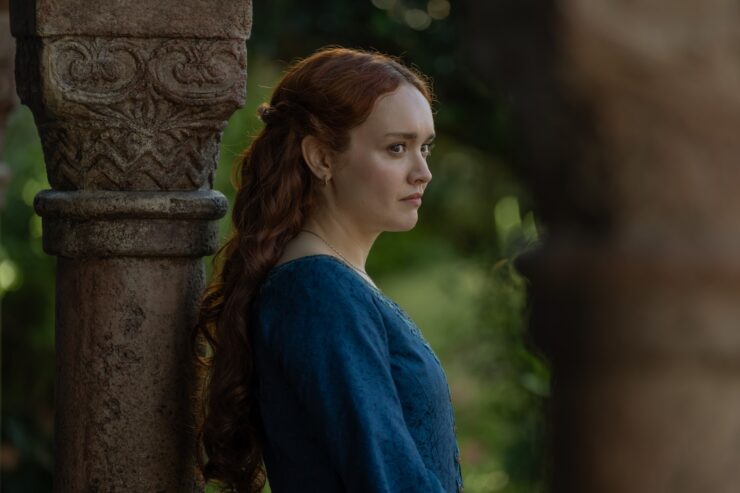
Credit: Ollie Upton/HBO
The Hightowers are among the oldest families in Westeros (more on that later), having been, for thousands of years, the rulers of Oldtown, which is likely the first city on the continent. As a result, some of the most significant cultural markers of Westeros are housed there. It is famously home to the Citadel—the cloistered university that trains the order of maesters and boasts one of the largest libraries in the world. It is also home to the Starry Sept which, during the House of the Dragon era is the largest and most important Sept in the faith. That would not be changed until the building of the Great Sept of Baelor, which served as the center of the faith from about 30 or so years after the events of House of the Dragon until Cersei blows it up in season 6 of Game of Thrones. In fact, Aegon I had his coronation at the Starry Sept, seeing as King’s Landing did not yet exist. It is also home to the Hightower itself, the tallest building in Westeros, which gives the family their name.
Given the significance of these three buildings, alongside Oldtown’s status as the most important center of trade on the continent (prior to the construction of King’s Landing), and you get an idea of the Hightowers’ view of history—they are a family that believes themselves to have been synonymous with the Seven Kingdoms and displaced by the Targaryens, even if they had not ruled as Kings themselves for several thousand years. All of this is embodied in their house motto: “We Light the Way.” Yes, it refers to the lighthouse brazier atop the Hightower, but it also positions them as the light of civilization.
The Oldest People in Westeros?
Credit: Theo Whiteman/HBO
While the Hightowers are generally thought to be descendants of the First Men (the same Bronze Age ethnic group as the Starks, Royces, Blackwoods, and most Northern houses) and wholeheartedly adopted the religion of the Andals (the ethnic group from Western Essos that brought the Seven Gods to Westeros), there may be more to the story. There is evidence in Martin’s work (through the writings of Maester Yandel, who is a similarly unreliable narrator like Gyldayn) that the Hightowers are part of a group of men that came to Westeros even before the First Men (along with the equally mysterious House Dayne in Western Dorne).
The fan theories about this pre-First Men group are numerous, though many subscribe to the idea that they are part of “the Great Empire of the Dawn”: a group from Asshai that had dragons before Valyria and may be responsible for the construction of the foundations of Hightower, the Five Forts in Essos, and even the Wall itself (maybe).
None of that is canon, per se, but the in-world belief that it might be true points to a sort of self-righteous, ethno-nationalist pride that the Hightowers are the “true” people of Westeros—even more so than the Starks or the Green Men or anyone, save the Children of the Forest and the Giants. House of the Dragon probably won’t get into any of this (besides, a lot of it is very, very speculative) but there is a possibility that they aren’t just traditional stewards of Westerosi culture but the descendants of an ancient people, among the very first to occupy the continent.
So Ormund seems to be an effete prig, an ethno-supremacist, and a bitter foe of the Targaryens for the crime of having snatched away not simply temporal power, but cultural clout from his family. None of this is in the original text of Fire & Blood, but it works rather well as distillations of all the flaws in the general Hightower character.
Tumbleton
Credit: Ollie Upton/HBO
Tonight’s episode opens with some establishing shots of Tumbleton, on the banks of the Mander. It is an important location in season 3, even though it is a relatively unimportant location in Westeros generally, and the show has clearly built out the sets to make it feel real, so let’s talk about it!
The town sits at the headwaters of the Mander, the major river that flows down from the northeast through the Reach and Highgarden before emptying into the Sunset Sea. It is described by Gyldayn as a prosperous market town sixty leagues (120 miles) from King’s Landing. It is the seat of House Footly. We actually meet Lord Glendon and Lady Sharis Footly in this episode, played by Adam Brown (Ori from The Hobbit trilogy) and Alexandra Moen (who you might know from Dickensian or as Lucy Saxton on Doctor Who). It is also the childhood home of Kat (Ellora Torchia), Hugh Hammer’s wife and we see her this episode with her brother (Abhin Galeya), sister-in-law (Jessica Temple), and niece and nephews. Kat and her family are original characters to the show but ever since Kat mentioned Tumbleton last season, book readers have always assumed (correctly) that she was there to give audiences a street-level view of the town.
From the moment HBO first revealed Winterfell’s stout, round towers, there has been something of a tradition in these shows of leaning into architectural designs that looks far different from the Medieval English inspiration of Westeros. Tumbleton seems to be mostly made of brown stone and features distinctive roofs that have what look to be tiered ziggurat or pagoda-like flourishes. The only Westerosi location that has anything similar is Dragonstone, implying that House of the Dragon’s version of Tumbleton may have originally been a Targaryen settlement (even though the Footlys and the people of Tumbleton are definitely subjects of the Tyrells). I suspect that the flourishes are there to make sure that, with its narrow stone streets, Tumbleton is instantly recognizable this season and audiences don’t mistake it for a poorer district in King’s Landing.
Most of the plot that Gyldayn mentions in Tumbleton concerns events we have not yet seen—though clearly, we are being set up for them, with Hugh and Ulf keeping watch on the former’s wife’s home and the moral predicament in which Ormund Hightower has placed Rhaenyra (suffer a hostile army near your capitol because you won’t slaughter your own innocent citizens). But what we are getting so far is an object lesson in the toll war takes on the smallfolk. Gyldayn rarely concerns himself with commoners save when they directly affect a flashpoint in history, so it’s welcome to have the show take the time to include them in the proceedings.
For us Americans, we also get handy refresher on why the Third Amendment is so important. It’s not one of the ones that gets regularly discussed these days but it’s clear why it was so important that citizens not be press-ganged into housing soldiers for, among other things, all the lurid reasons the show depicts. There is also a near-dovetailing between the ways in which Kat’s family and the Footlys face the same unpleasant circumstances with wildly different stakes and dangers.
Upstairs/Downstairs
Credit: Ollie Upton/HBO
Gyldayn famously does not concern himself with the smallfolk during his narration of the Dance of the Dragons beyond his mentions of the rising or falling tide of public opinion. If Ormund Hightower is the embodiment of that sort of class erasure and feudal prejudice, then we get an interesting counter-example in Criston Cole. The internet loves to hate Criston Cole and I’m not here to offer an encomium for his behavior over the course of the series. But it is fascinating that the show sticks to its guns about the ways in which Cole is the product of Westeros’ messed-up class politics.
Despondent since the Battle of Rook’s Rest last season, Cole continues to anticipate and welcome death, having lost his chance to advance under Rhaenyra and then Alicent. It makes sense—as a knight from a lineage that began with his father, who’d lived at the pleasure of lords like the Dondarrions, Cole has no prospects for advancement outside the value he can demonstrate to others. He’s not so very different A Knight of the Seven Kingdom’s Arlan of Pennytree or Dunk (who also had trouble with their own Lord Dondarrion) in that regard. Unlike Arlan and Dunk, however, Cole, at least at one point, wholly bought into the seductive mythos of noble knights and the chivalric code. While he has never lived up to those ideals, back in season one, he felt they were the only system through which he could achieve stability. In that way, he is just a touch like Sansa Stark, albeit with all the toxic male privilege that allows his disappointment to turn deadly and grim.
It’s been an interesting and uncomfortable choice to have Cole, bitter and now resigned to a dark fate, provide some of our main insights into Westeros’ smallfolk. And now that he’s joined by Ulf, Hugh, Addam, and Alyn as fellow former serfs raised high by the whims of the nobility, we’ll see if the show gives us alternative responses or perspectives (though, it is always worth noting that as noble bastards, those four have always had more claim to legitimacy than Cole ever had). We also get all of this in an episode where Ulf is denied the right to carouse with Cley and Mujja, Aegon finds himself at the mercy of the Rook’s Rest garrison and its captain playing at lordship, and Rhaenyra authorizes a raid by the City Watch to ferret out malcontents. All in all, it’s not a great look for Westerosi nobility.
DragonWatch
Credit: Ollie Upton/HBO
We get our first look at Sunfyre since the middle of last season. King Aegon’s dragon’s corpse sits in the same clearing near Rook’s Rest. Aegon insists that Sunfyre is still alive but that seems to be Princely grief. Sunfyre is described as the most beautiful of all the Targaryen dragons, a fact reflected in his delicate, canine snout. I really appreciate the show giving both Sunfyre and Silverwing little iridescent patches of scales that account for them being described as “golden” and “silver” in Gyldayn’s history without going too far in a high fantasy direction. Also, there are little motes in the sunlight that are hard to parse as either flies swarming the corpse or ash coming off of a magical fiery beast. While, on repeated viewing, I’m pretty sure it’s ash, the visual language of fires burnt out looking like flies is perversely delightful.
We also get a grotesque shot of Meleys’ corpse, still slumped over the side of Rook’s Rest’s curtain wall. Remember that Criston Cole had Meleys beheaded postmortem, the better to celebrate his otherwise Pyrrhic victory.
Caraxes and Sheepstealer get some screen time tonight. Everyone’s favorite noodle boi and the internet’s newly beloved stray dog really show off the range of dragon body types.
We get our best look at Vermithor so far this season. Love those bull horns.
But it is Tessarion, the Blue Queen, that gets the spotlight tonight. We’ve seen Daeron’s dragon from a distance in earlier episodes but she gets some close-ups tonight. She’s been given a much stockier, more compact design—short legs, thick neck, smaller wings, and a stubbier snout. I love the four finned ridges on her neck and her relatively long teeth. It’s neat to have a dragon small enough to fit inside the Tumbleton Sept. Also, great to see her being protective of Daeron, snarling when Ormund lays an unfriendly hand on his shoulder.
Odds & Ends
Credit: Ollie Upton/HBO
Some nice early set-up here (and new characterization written for the show, but compatible with the original plot) where Sharis Footly is a proud Black while her husband takes a more unctuous and cautious approach when it comes to declaring himself for either side.
Norton has such a great, droll delivery of “…or is she a bitch with a dragon?” In interviews he has stated that he couldn’t believe that was the take they used.
Ser Jon Roxton brings excuses from Borros Baratheon at Storm’s End, refusing to commit troops to the war effort. We last saw Borros in the season 1 finale when he promised one of his daughters to Aemond and Lucerys arrived just too late to secure an alliance. We also haven’t seen any of Borros’ daughters (including Aemond’s intended) since season one. But given his mommy issues (both recent and historical) it seems unlikely that the show is going to double down on Aemond’s Baratheon courtship.
Rhaenyra claims that if she attacked Tumbleton and murdered her own supporters to get at Ormund, the gentry would name her “Maegor Returned.” It’s another reference to Gyldayn’s reported sobriquet for her, “Maegor with Teats”—a title the show changed to “Rhaenyra the Cruel” (Maegor is most often called “the Cruel”). Maegor remains the Targaryen that all others live in fear of becoming. He was the first of the Westerosi-era dynasty to definitively fall on the madness side of the coin flip and, until Aerys II becomes the Mad King in the Game of Thrones era, the clearest evidence that the Targaryens are unfit to rule.
In reinstating Grand Maester Orwyle, Rhaenyra calls the clocking-in orbs “relics of a dead regime.” Slowly but surely, the show is giving us the erosion of the old Targaryen rituals that are absent by the time Game of Thrones starts. This is further accomplished when Alyn of Hull suggests Rhaenyra put cats in the Red Keep to take care of the rat problem. By the time of King Robert, the Keep is full of feral cats (some of whom, according to fan theories, may be dead Targaryens permanently warged into their familiars).
Torrhen Manderly being named Master of Coin by Rhaenyra is a new development for the series. In Fire & Blood she merely brings Lord Celtigar (Nicholas Jones) over from Dragonstone. Having left all of her advisors behind on the show, they use Manderly in this capacity because he has an upcoming role in certain events that will play out a bit later on, and this show is nothing if not judicious in making the most of a reduced cast.
Having Alicent imprisoned in the Keep this season is something of a relief as it gives her and Rhaenyra a chance to regularly interact. Whenever the two of them are able to share a scene, it’s the best this show gets, and I’m so glad they are able to keep doing it.
Alicent picking at her skin returns this episode. It’s a great detail and gives the audience a visceral understanding of when this famously difficult-to-read character is truly breaking down or simply playing politics.
Cole comparing himself to a scorpion is another gentle reminder that he is thoroughly Dornish and, in serving in Lord Dondarrion’s household, he was always an outsider kept at the pleasure of those who despised him.
Viserys’ model returns this episode! It’s interesting where both House of the Dragon and A Knight of the Seven Kingdoms choose to simply elide rather than invent important information. Rhaenyra calls the model’s namesake “the seat of Old Valyria.” Martin is a bit cagey about the name of the city. It is most likely just called Valyria and the Freehold that expanded from it was named after the original city state. But that might also be a modern convention seeing as the entire peninsula is also sometimes referred to as Valyria. I assume that Rhaenyra phrases it like this to leave the possibility open that the capitol had another name open for Martin to write about. It’s also possible that “the seat” refers to the equivalent of Valyria’s high town or central forum. Either way we are a long way from Benioff and Weiss randomly making the Valyrian capitol into a greyscale colony (in the books that colony is the ruins of the city of Chroyane and the city of Valyria is almost entirely inaccessible because it’s cursed or magically irradiated or something worse).
Last season I wondered why they had Aemond and Vhagar randomly burn the town of Sharp Point to the ground (not an event in the book). We get an answer to it here—Aegon can pose as a survivor of the town, accounting for his burned face. Again, not to keep making the unflattering comparison, but this feels like a much more thoughtful and deliberate version of showrunning. Benioff and Weiss may not have had Martin’s last two books to work with, but they had an idea of the ending and the number of plot points they teased and then simply dropped was pretty ridiculous by the end.
Garrick of Whitegrove (Douglas Russell) tells his fellow soldier that their time in Tumbleton will be “better than Honeyholt.” That’s the seat of House Beesbury. So they did take the castle back during the rebellion sometime last season!
The Queen of Bastards graffiti has a crude facsimile of the House Strong sigil (three lines—painted red, blue, and green—representing the three forks of the river Trident. Remember that Jace, Luke, and Joffrey’s father was Ser Harwin Strong, Larys’ brother and Ser Simon’s second cousin. Even as acting Queen, Rhaenyra can’t escape the (true) rumors of her children’s parentage.
Giving Lady Jeyne Arryn an Afghan Hound is such a delightfully weird and fitting choice.
Obviously, there are both practical concerns and a legacy of previous designs to deal with when showing us iconic places in Westeros, but the Game of Thrones design of the Eyrie never felt quite right to me. The interior shots are gorgeous as always and are very much in keeping with the descriptions of anemic, cold halls built too far above the timberline. But from the outside, the Eyrie never seems to be perched on the top of the tallest mountain in Westeros. I appreciate that, in general, these shows usually attempt a more grounded design than what Martin describes, but the sense of the Eyrie being remote, unassailable, and absolutely towering over everything else in the Vale of Arryn just never quite hits home.
While we’re at it, the Welsh countryside that the show uses as a stand-in for the Vale of Arryn is gorgeous but it feels more like misty highlands rather than the series of alpine mountain valleys that Martin describes in his books.
Rhaena continues her Nettles-as-lonely-fire-witch journey in this episode. Important to note is that those beats with Nettles are the character’s epilogue, set many years after the events of the show. Furthermore, Rhaena has a couple of important plot points to play out from Fire & Blood that now seem a lot less likely since taking her in this direction. I am genuinely unsure where they will have Rhaena end up as a result. It does make sense however, that they are keeping Daemon’s plot relatively similar. He is still keeping secrets from Rhaenyra but it’s in order to protect his estranged daughter rather than him hiding an affair (a change I like). The only truly unacceptable option would be for the show to never show us Rhaena or Sheepstealer again and have this be solely a Daemon plot going forward. Hopefully that won’t happen.
Daemon saying “I’m the clever one ’round here” is such a perfect Daemon line. He may be fascinating to watch but man he’d be insufferable to work with.
Helaena being pregnant is also new to the show. That said, it suddenly puts all the plot points about Aegon’s other son (whom we previously had assumed was cut entirely) back on the table. I think I have an idea of where they will take Helaena this season and I may need some time to process it. If I’m right, we’re in for some wild stuff.
Still no sign of Tyland Lannister. I suppose that it could be that the show is done with both Lannister brothers and doesn’t intend to use Jefferson Hall again, but that still seems unlikely.
It is somewhat more likely that Ser Lorent Marbrand was killed off-screen in the fulfillment of his penance for betraying Rhaenyra. That seems especially possible given that Ser Lorent seems to have been replaced by Ser Adrian Redfort (Barry Sloane) as the Kingsguard knight assigned to personally watch over Rhaenyra.
In Conclusion
While this is certainly more of a place-setting episode than the previous three, it does a great job of setting out the stakes of the second half of the season: Ormund as our big bad, Tumbleton as the next flashpoint of the war, Cole and Gwayne on a collision course with Oscar Tully and Roddy the Ruin, Rhaenyra presiding over a city on the brink of riot and a Small Council backstabbing one another. I am a sucker for a great villain and Ormund’s fury lurking under the veneer or civility is a great hook. But what do you think? Are you excited as we move into the back half of season 3? What are you anticipating most as we move forward? Let me know in the comments![end-mark]
The post A New Villain Shimmies Into the Dance: <i>House of the Dragon</i>, Season 3 Episode 4 appeared first on Reactor.








 New Posts (Home)
 ChatBox
 Popular Posts
  Game Zone
 Top PodCasts