reactormag.com
Five SFF Works Based Around Sleep or Sleeplessness
Books
reading recommendations
Five SFF Works Based Around Sleep or Sleeplessness
Be it a supernatural curse or ennui-driven insomnia, messing with someone’s ability to sleep can have dire consequences…
By James Davis Nicoll
|
Published on July 15, 2026
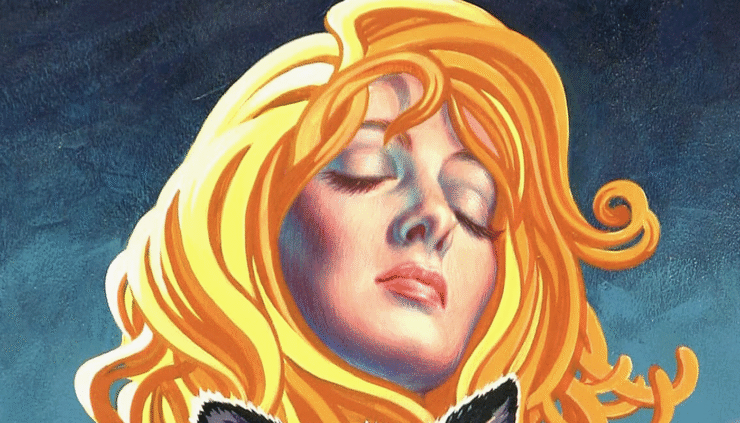
Sleepwalker’s World cover art by Frank Kelly Freas
Comment
0
Share New
Share
Sleepwalker’s World cover art by Frank Kelly Freas
Nothing builds appreciation for sleep quite like a life-long sleep disorder… or so I thought until my bed frame spontaneously reconfigured itself into what we up here in Canada like to call “a death trap”1. It turns out beds have a tremendous impact on the quality of sleep. Who knew?2
Science fiction and fantasy authors have long been aware of sleep’s potential where plots are concerned—not simply as a means of transporting people from one era to another, as useful as that is. Sleep can figure in so many ways, as these books demonstrate.
Sleepwalker’s World by Gordon R. Dickson (1971)
Core Taps combined with broadcast power solved the terrestrial energy crisis3. No person on Earth needs ever lack for energy again. True, broadcast power came with an unforeseen complication—most humans within range of it fall into a deep sleep—but it is a small price to pay for prosperity.
Rafe Harald, one of the few immune to the induced slumber, returns from the Moon to discover that his friend Ab Leesing is missing. Rafe sets out to find Ab. What he finds are secrets… and a monster.
Traditionally, every SF author is allowed one impossible assumption. In this case, it is that humans would be so desperate for energy that they would completely ignore their chosen energy generation system’s appalling externality. Obviously, a straightforward cost-benefit analysis would compel the adoption of alternative systems.
Lincoln’s Dreams by Connie Willis (1987)
Richard is convinced that his girlfriend Annie’s vivid Civil War dreams are a symptom to be cured. Annie wonders if the dreams have some deeper significance. As the dreams involve the American Civil War, Annie appeals to Richard’s old college roommate, who is researching that period, for help. Do her dreams reflect reality, or are they simply fantasies from her subconscious?
Jeff, the historical researcher, establishes that the dreams do indeed seem to originate from an American Civil War figure… although not Abraham Lincoln, but Robert E. Lee. However, unless Jeff can work out why Annie is being singled out for these dreams, Annie may well be doomed.
One of the many questions for which professional historical researcher Jeff appears to lack answers is how it was two stalwarts like Lincoln and Lee ended up on opposite sides of a seeming causeless conflict.
On an unrelated note, the following words do not appear in this American Civil War-centered novel: “slave,” “slavery,” “black” (save as a color of blisters, objects, and animals), African (save in reference to violets), “Negro,” or “abolition.”
Harriet the Invincible by Ursula Vernon (2015)
Princess Harriet receives delightful news on her tenth birthday. The wicked fairy Nightshade had cursed Harriet. When Harriet turns twelve, she will prick her finger and fall into a deep, magical sleep. So it is written. So shall it be.
Harriet reasons that she can only suffer her doom if she is still alive at twelve. Therefore, the curse will protect her until then… and therefore, Harriet is functionally indestructible. There is no reason why Harriet cannot spend the next two years vanquishing evil. When her curse does arrive? Well, by that time Harriet will be an experienced adventurer. Who knows what could happen?
There is a lot of ground between “must be alive, and retain sufficient cognitive ability that sleep and wake can be distinguished” and “invincible.” Horribly injured people can sleep. Badly brain-damaged people can sleep. Luckily for Harriet, this novel appeared under the author’s Ursula Vernon byline and not her T. Kingfisher horror-oriented persona, or Harriet’s fate might have been much darker.
Insomniacs After School by Makoto Ojiro (2019–2023)
Grumpy highschooler Ganta Nakami cannot sleep because pessimistic Ganta believes the future can hold only increasing disappointment. Cheerful highschooler Isaki Magari cannot sleep because her potentially fatal heart condition means she might never wake up. Insomnia seems inescapable.
Salvation comes in the form of their school’s abandoned astronomy club observatory. Both Ganta and Isaki have no problem sleeping there. However, access to the observatory is contingent on there being an astronomy club. It’s up to Ganta and Isaki to bring the club back from the dead.
This romance manga is far more upbeat than “two teens united by paralysing existential dread” would suggest4. It’s also almost entirely mundane, except for one detail. School legend has it that a heartbroken schoolgirl cursed the observatory. However, this is a barefaced lie put about by Isaki, who does not want other people to intrude into her refuge.
The Sleepless by Jen Williams (2025)
Artair is one of the Sleepless. Not in the sense that Artair cannot sleep. Rather, Artair needs to be careful when he sleeps. Artair shares his body with monstrous Lucian. Whenever Artair sleeps, Lucian is free to run riot. This is why the Brothers and Sisters of Perpetual Morning restrain Sleepless like Artair while he sleeps.
Mother Maura of the Bloody Claw blackmails Artair into running a little errand for her. Artair must kidnap a keltraxia cub from the Jih forest, and deliver it to Mother Maura. Why does Mother Maura not do this herself? In part, because the Jih forest has guardians. One such, Elver, wastes no time in confronting Artair… and teaming up with him.
Readers should be aware that this is part one of a duology, which is to say it introduces the setting, asks existential questions, increases the stakes and leaves matters such that you will want to buy the second book. Readers will also want to know that second book, The Dreamless, was published in May 2026.
Obviously, there are far more than five novels driven by sleep or its lack. There could six or seven, and I’ve even heard tell that numbers go up as high as eight. I may have overlooked, forgotten, or deliberately snubbed your favourites. If so, please mention them in the comments.[end-mark]
The frame has three lengthwise supports. The one in the middle is quite solid. It turns out Ikea in its wisdom provided long screws for the two side runners but positioned the rail screw hole such that only the last millimetre of screw engages. This means the two on either side will fail and when they do, the mattress will suddenly tilt to one side and roll the occupant out of bed. The frame could still be used as long as I, a bad sleeper who thrashes continually, remain perfectly still over the center rail. Nevertheless, I am getting a new frame… and not from Ikea. ︎Aside from judgemental legume-conscious princesses, I mean. ︎I ran the numbers for geothermal energy and I’m not sure it is quite as useful as Dickson needs it to be. ︎At least as of volume 10. If the final volume pulls an Anders Loves Maria, I will be so mad. ︎
The post Five SFF Works Based Around Sleep or Sleeplessness appeared first on Reactor.








 New Posts (Home)
 ChatBox
 Popular Posts
  Game Zone
 Top PodCasts