reactormag.com
Jo Walton’s Reading List: May and June 2026
Book Recommendations
Jo Walton Reads
Jo Walton’s Reading List: May and June 2026
Classic comfort reads and some excellent science fiction that you should all read immediately!
By Jo Walton
|
Published on July 16, 2026
Comment
0
Share New
Share
May began in Chicago, then I took the train home to Montreal, where I have been ever since. Being at home, I read a lot: a total of eighteen books, and some of them were great. But I read four books that were sent to me to blurb—excuse me, I read half of each of them and then stopped reading. And they were all awful and sapped my will to read and talk about books, because oh gosh yuck, I hate everything and want to put my head in a bucket. And then I read On the Calculation of Volume and I hated it so much, and they blurred the memory of the good books I did love and wanted to share, and that’s why this post is coming in late.
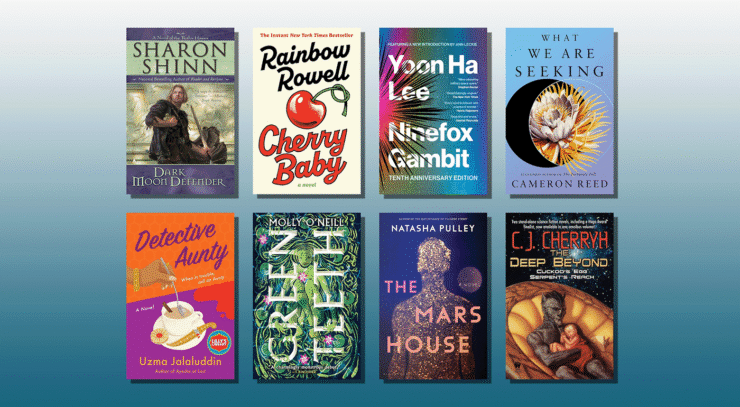
Cherry Baby — Rainbow Rowell (2026) This came out in April, and I saved it until I was home to read. I really think Rowell is getting better and better. This is a story of how people can meet at the wrong time in their lives, and meet again at a different time. It’s sort of like Landline in that respect, but also very different. It’s also about creativity and people’s expectations of each other. As always with Rowell, all the characters are great, all real and with real upsides and downsides. Terrific.
Five Windows — D.E. Stevenson (1953) Re-read. What a lovely book. It uses the literal framing device of five windows to tell the story of a young man’s life, and how he becomes a writer. It’s one of the most realistic depictions of someone becoming a writer and getting published I’ve ever read, and it’s also charming, with excellent characters. In some ways it’s a million miles and seventy-five years from Cherry Baby, but in others it’s very like it in the way it views the characters kindly but clearly and shows people having work and creativity in their lives. If you want to try Stevenson, this would be a good one to start.
Roman Tales: A Reader’s Guide to the Art of Microhistory — Thomas V. Cohen (2019) This is another of Cohen’s awesome books of microhistory, with some thoughts on what it is. What we have here is five stories of people and events around the beginning of the sixteenth century in Rome, discovered in court records and then looked for in other records, to make as coherent a story as we can out of events like a stolen dwarf, a monk who walled himself up without permission, a rowdy drinking party, a divination, and so on. All the cases are fascinating—and Cohen points out things like the way the father of the dwarf (being a court dwarf is a job) calls him “the dwarf” on the record, but his brother always calls him by name. If you’re interested in the oddities of people’s lives, this is a very readable book that’s definitely focused on the micro but all the better for it.
Success — Una Silberrad (1912) A completely unique book, about a man who is a scientist and inventor and his cousin who works with antique furniture. It contains some distressing anti-Semitism, which is a pity, because it’s otherwise a very interesting and unusual book. You seldom see characters like this. The story concerns an unfair dismissal and the invention of an aerial torpedo (what we might call an air-to-air missile) and as with other Silberrad and Nevil Shute and very little else, is a book that isn’t SF that’s concerned with technology and the way technology intersects with society. It’s also the story of a man having a breakdown when his work is taken away, and how he recovers and becomes a better person, but it sees very clearly the thing that capitalism can do to people. I really enjoyed reading this, on the whole.
Greenteeth — Molly O’Neill (2025) Fantasy about a Jenny Greenteeth, a lake-dwelling monster, and her adventures with a witch and a boggart peddler. This does involve some saving the world, or at least the village, and a lot of quests, and the Seelie Court, and it had reasonably thought-through worldbuilding. It was well written, and the first-person monster was great, but I somehow felt it went on a little too long.
The Memoirs of Philipe de Commines — Philipe de Commynes (1499) This is a primary source for the reigns of Louis XI and Charles VIII of France, and Charles VIII’s invasion of Italy. It is therefore very useful and relevant for me for the papal election. As always when I read this kind of primary source, I realise that other people have only read parts of it, if at all, and that I have read a lot of recent secondary histories that have definitely not read it, even though it is a (biased, French) eyewitness account of things that are writing about. Commines was sent to Florence right after the Pazzi Conspiracy! He was with the French invading force that swept down on Naples, and he was there when they fought their way back to France inch by inch. I cannot recommend this book. It is too long, and not only is it too long but it refers to everyone by title in a way that makes it extremely difficult to remember who they are if you don’t already know. But it is an invaluable primary source, there’s an English translation, it’s out of copyright, and I am making a good-parts version.
Detective Aunty — Uzma Jalaluddin (2025) Terrific book about an Indian mother whose daughter is being framed for murder, and how she solves the case—while meeting and interacting with a lot of people in Toronto’s Indian community. Great characters and sense of place and very well done, as always with Jalaluddin.
The Italian Village in the Hills — Victoria Springfield (2026) Romance novel set in Italy, which has three whole generations of romances and works beautifully. I also really liked that it began with a girl whose closest friend and connection is her grandfather, because that’s not something you often see. The big misunderstandings were to do with who was a fascist way back, and were therefore less annoying than such things often are. Springfield holds the balance between the POVs and stories pretty well.
Our Trip Around the World — Renate Belczyk (2020) This book ought to be better than it is. It’s a perfect example of how the protagonist of a travel book needs to be someone you want to spend time with, and not a perfectly ordinary, perfectly nice girl. Two German friends went around the world in the 1950s, stopping for quite a long time sometimes to work to get money for the next leg, sometimes milking the publicity and once even getting free motorcycles out of it. Then one of them wrote about it decades later. They go to Mexico, Canada, Japan, India, and… I was going to say “have very conventional experiences,” but it’s not that, their experiences are sometimes quite exciting, it’s the reactions to the experiences that are conventional. Everyone can’t be Bernard Ollivier or Alice Steinbach, I suppose, but this one was disappointing.
Dark Moon Defender — Sharon Shinn (2006) The next volume in the Twelve Houses series, which continues to be very good, and continues to be set in the “will to battle” space where a war may or may not be inevitable and things are happening. Contains a love story—it’s clear now that each member of our core team will find love, one per volume. I like the magic system. I like the way Shinn writes. Start at the beginning of the series.
Death on the Nile — Agatha Christie (1937) Re-read. Interesting to consider what makes this book so much better than most of the Christies that are exactly the same. It may be that she knew what the plot was from the beginning, rather than going back to put in the clues, but whatever it is, this one works. Hercule Poirot, on a boat going up the Nile, and someone is murdered in a very clever way. What more could you possibly want?
Hauntings and Other Fantastic Tales — Vernon Lee (1890) A collection of ghost stories, many of them set in Italy and with the historical details worryingly correct. Well written, interesting, but sometimes a bit creepy for my liking, while not being exactly horror.
Backstage: Stories of a Writing Life — Donna Leon (2025) Essays about Leon’s life and work. As with her previous collection of essays, I felt as if she was holding herself back.
The Man of Her Dreams — Sarra Manning (2023) Manning is a UK author who doesn’t always get US releases, and I lose track of her. This book is fabulous, in ways that require spoilers to discuss why it’s so interesting and what it’s doing, and which would land differently to someone who is or isn’t used to the conventions of genre romance. It uses a convention of genre romance to get away with doing a clever thing. And yet, it fulfils the romance author-reader contract. Funny, thoughtful, clever.
A History of Storytelling — Arthur Ransome (1909) As it says, a history of telling stories, very much of its time, but entertaining. It’s interesting to read Ransome discussing non-fiction stories in the seventeenth-century with the techniques of having a made-up point-of-view character (like “Poor Richard,” to give a familiar example) in what is actually an essay. Also interesting to see what he puts in and leaves out, and what he thinks about things. He’s very well read. I wouldn’t have picked this up if not for liking the Swallows and Amazons books, but I liked it.
What’s So Funny? — Donald Westlake (2007) Re-read, bath book. Later Dortmunder book which I’d only read once before and didn’t remember the plot well. It concerns stealing a chess set, from which nobody benefits. Some lovely cameo bits, and some great examples of the things Westlake does so well, like the regulars having their weird conversations and the friend group being friends, but nothing that really stands out.
On the Calculation of Volume I — Solvej Balle (2020), translated from Danish by Barbara J. Haveland Gosh I hated this so much. I don’t know when I’ve loathed a book more and actually finished it. But I didn’t hate it so much before I finished it and saw where it was going, which was nowhere. If there had been any kind of resolution whatsoever I still wouldn’t have liked it, but bleah. So this very normal French woman bookseller is caught in a Groundhog Day event where it keeps on being November 18th, but she can move freely around the country, she wakes up where she went to bed, she can accumulate objects, and things she uses are depleted, injuries heal in the time they normally would—she isn’t being reset, but the world is. The book is written as a diary, with numbered days; she goes through a whole year of living in that one day. She was a very unpleasant person to spend a whole year with, a whole book with, because she’s very passive. The book has the pacing of an existentialist movie. I will never read the sequels or anything else by this author. There are so many great genre books written in other languages that I’d love to read, but what do I get? This thing where reading it felt like being smothered by a pillow. The algorithms and humans who recommended this book are all fired!
Movie Shoes — Noel Streatfeild (1949) Re-read to cheer myself up after the former book. Well, it turns out that the book I read (the original, British version) was called The Painted Garden and this re-read of the ebook was also a first read of the Americanized edition, in which dustbin man had been changed to “sanitation man” and so on. As this is a book about a British family going to California for a winter in 1949, I wonder what the young American readers, who need to be spoon-fed with language, made of the actual story? Anyway, not a long book, and as always the backstage theatrical stuff is a joy.
June was the month when I realised I wasn’t reading enough science fiction and deliberately set out to read more, and this turned out really well. I read sixteen books.
New Adventures in Space Opera — Jonathan Strahan (2024) This is what made me realise I’d been missing science fiction—the kind of science fiction I like, the kind with aliens and space stations. I always say this is what I like, but somehow I’d not been reading it. About half my fiction reading is genre, but I don’t distinguish between fantasy and SF, and there had been a lot of fantasy in the mix recently. This brilliant anthology, full of fun stories, many of them long, almost all of them terrific, was such a joy that it made me decide to actively reach out for more of this stuff. I highly recommend this anthology.
Red Roses: Blanche of Gaunt to Margaret Beaufort — Amy License (2016) This is sort of if you wrote a book about all the women in Shakespeare’s history plays from Richard II to Richard III, but some of them are invisible in the text of the plays. This book looks at all the women, from the wives of John of Gaunt forward through the next five generations, finding out as much as it can about their lives. There are about ten women in this book, and most of them are interesting, and the less interesting ones are because there just isn’t much to find. They’re wives and mothers, but also significant people. The only odd thing is that License spends so much time telling me Margaret Beaufort did not kill the princes in the tower that I actually started to consider it, which I never had before. There must be a rhetorical term for denying something that never would have crossed anyone’s mind had it not been raised in denial. Anyway, the most interesting woman in the book is Katherine Swynford, third wife of John of Gaunt, after having been his mistress for years in the lifetime of his second wife.
Ninefox Gambit — Yoon Ha Lee (2026) Space opera, milSF, whatever you want to call it. I read it because Lee’s short story in the Strahan anthology was delightful, and this book kept me glued to the page. I’d not read it before because everyone recommending it had said how mathematical it was, which was extremely off-putting, and turned out to be nonsense. These people are using handwave tech to make nanotech do things, it’s explained the way such things are explained in SF, and the fact that the protagonist is good enough at math to solve the handwave equations on the fly is mentioned. I didn’t read this book for ten years because the people who liked it, in their enthusiasm, made it sound as if I wouldn’t. I did. It was great. Closer to Cherryh than to anything. Have bought the sequels. The good thing about not reading it before is that there’s more to catch up on.
Pine Breeze at Hotel Toscana Mare — Hanna Holmgren (2026) Romance novel set in Italy, but with the unusual feature of having been translated from German by the author. So a German woman leaves her skeevy boyfriend and goes to Italy and then everything is all right. That’s the formula of a romance novel set in Italy, after all, and this isn’t any different. I liked the details of making the abandoned house into a hotel, and dealing with the locals; the love interest was not especially convincing but that’s fine. I was less enthused about the fact that nobody thinks about accessibility for a second: making a bike path to the sea—that’ll save the day; putting in outdoor terraces up a lot of steps—that’ll make people like it. Well, not me, but two seconds of attention to the idea of guests who are not young and fit would have gone a long way. Perfectly fine book.
Starlight 3 — Patrick Nielsen Hayden (2001) Re-read. Contains many great stories with standouts from Susanna Clarke, Ted Chiang and Susan Palwick. The whole set of Starlight anthologies were terrific, I wish there had been more.
The Cambridge Companion to Petrarch —Albert Russell Ascoli and Unn Falkeid (2015) Set of essays by different people about different aspects of Petrarch’s life and work. Some of them were better written than others, but in general this was a terrific book full of valuable information and observations. If you are interested in Petrarch, you should definitely read it.
Marcovaldo, or The Seasons in the City — Italo Calvino (1963) This is a book of linked short stories about the same protagonist, Marcovaldo, and his family, living in Milan in the Fifties. They are gently whimsical but mostly not out-and-out surreal. This is not as good as Calvino’s best work, but it’s very good, and readable in a normal way, and weirdly less sexist.
Powsels and Thrums — Alan Garner (2025) Short stories, poems, essays, and biographical musings from the strange and brilliant Alan Garner. Probably not where you want to start, but if you already like any of his work, grab this. There are some very interesting thoughts on class and creativity, a lot about place (as you’d expect), amazing thoughts about Carroll’s odd words in “Jabberwocky” and how they relate to Cheshire dialect, and some wonderful flashes of fiction. There really is nobody like him.
Cuckoo’s Egg — C.J. Cherryh (1985) Re-read, bath book. I was looking for space opera that I had on the shelf and could read in the bath. Not a very successful bath book because it’s too gripping and I kept wanting to keep reading it and so having extra-long and extra-frequent baths. This is the story of an alien bringing up a human baby to become something that is in between human and alien, and we the reader know more than the human in question, but of course not everything, not enough. Quintessential Cherryh in many ways, maybe a good place to start if you’ve never read her, because it completely stands alone, and has aliens and space stations and also woods and hills and a world.
I wonder if it was in some way a response to the question in Card’s Ender’s Game of what it is ethical to do to a child in order to deal with an alien menace—but this is a very different equation. I don’t think of Cherryh as a kind writer, but while there’s plenty of war in her books there’s very little genocide, and while there are lots of different and scary aliens, her focus is always on finding a way to have, or be, a bridge between them; communication, not extermination. No easy answers, and this is a very good book.
Magus: The Art of Magic from Faustus to Agrippa — Anthony Grafton (2023) Marvellous book about real-world magicians and people called magicians in sixteenth-century Italy and to a lesser extent the rest of Europe. Grafton is a very good writer, and the book is compelling and full of fun detail. I raced through this and really enjoyed it. I think most people who have a general interest in what people thought they were doing when they were trying to do magic, and what general period ideas about magic were like would enjoy this book, and it would be very useful for anyone trying to write non-standard fantasy.
An Italian Education — Tim Parks (1995) Parks, married to an Italian woman and having two children, writes about how children grow up in Italy and about family life in the 1990s. Mildly amusing, and well characterised, so a reasonably fun read.
The Deepening Stream — Dorothy Canfield Fisher (1930) This is a book about a girl growing up, starting from early childhood and going on well past when she is herself a mother. Indeed, about halfway through the book you get to the point where a conventional novel would stop, and instead the Great War starts. Absolutely harrowing, and utterly brilliant. There’s nobody like Dorothy Canfield Fisher, and I recommend it, but you have to be braced for this one.
What We Are Seeking — Cameron Reed (2026) Re-read, I read it last summer and I read it again now because it is out and I can talk to people about it. The first paragraph is one of the most beautiful things I’ve ever read. This is a very traditional SF story, told in a way that could only be written now. There are people who live on spaceships and lots of settled planets, and there are aliens, and linguists, and first contact, and new ways of living and having families, coming into conflict with traditional ones. Lovely, lovely cultures, interesting aliens and language, terrific characters, and not as harrowing as Reed’s earlier The Fortunate Fall. Read it, love it, discuss it with your friends, nominate it for awards, this is great. As often with me and really good books I liked it better on second reading when I knew what was going to happen, because there wasn’t anxiety about what actually would happen. I love re-reading a book for the first time and knowing it will be the first of many.
Father Material — Alexis Hall (2026) Third book in the London Calling sequence. The beginning took a while to get me engaged, because I kept feeling these characters should have grown up a bit by now, and then I realised that was the point. It gets very good about a third of the way in. Considered as a whole, these three books are very good.
Koestler: The Literary and Political Odyssey of a Twentieth-Century Skeptic — Michael Scammell (2009) Long, thorough, and very interesting biography of Arthur Koestler, a strange man who had a fascinating life. Scammell does not try to make Koestler appear nicer than he was; indeed, he’s very fair to him. Good if you’re interested in Koestler, or twentieth-century communism and disillusion from it. Warnings for sexual predation. Also interesting on living for a long time as a demi-famous person.
The Mars House — Natasha Pulley (2024) This book is so great. I loved it so much I didn’t want to have finished it. This is a well-worked-out and interesting future in which people are living on Mars in complex ways and Mars has a relationship with Earth that can be described as “it’s complicated.” And there’s a guy called January who’s a dancer in the Royal Ballet in London, until London sinks and he becomes a refugee on Mars. So that’s all you need—don’t read the back of the book, don’t find out any more about it, just trust me that you want to read it. You’ll enjoy it much more if you don’t have more spoilers than I’ve given you for the first chapter and just go into it for what it is. Even without knowing anything about it, I guessed several major plot things. But I loved it anyway. Loved it. I want more like this.[end-mark]
Buy the Book
Everybody’s Perfect
Jo Walton
Buy Book
Everybody's Perfect
Jo Walton
Buy this book from:
AmazonBarnes and NobleiBooksIndieBoundTarget
The post Jo Walton’s Reading List: May and June 2026 appeared first on Reactor.








 New Posts (Home)
 ChatBox
 Popular Posts
  Game Zone
 Top PodCasts