reactormag.com
Rushing Headlong Toward a Terrible Fate: House of the Dragon, Season 3 Episode 5
Movies & TV
House of the Dragon
Rushing Headlong Toward a Terrible Fate: House of the Dragon, Season 3 Episode 5
White Worms, deadly butterflies, and some significant departures from the source material…
By Tyler Dean
|
Published on July 20, 2026
Credit: Ollie Upton/HBO
Comment
0
Share New
Share
Credit: Ollie Upton/HBO
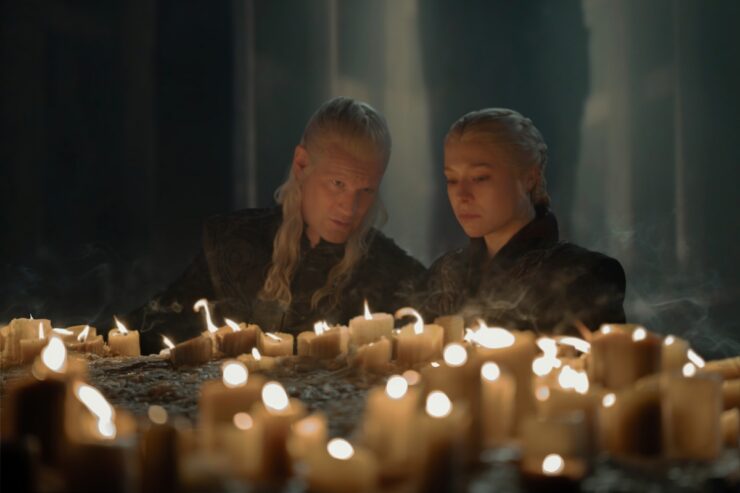
The back half of season 3 starts out strong with an entry that sends its characters hurtling towards the terrible fates they have wrought for themselves. Whether it’s Criston Cole telling his assembled men that the Stranger (the aspect of the Seven-Faced God that symbolizes death) offers them rest, or Daemon coming across the gruesome display of his Gold Cloaks, or Alicent and Helaena lost in the darkness beneath the Red Keep, the show is not pulling its punches.
There is a section below (clearly marked) that gets into some bigger-than-average spoilers for the source material (and potentially for future episodes of the show) as it discusses some of the major ways in which the series is now deviating from its source material, so be mindful of that as you read further if you’d like to remain completely unspoiled.
The Title
Tonight’s episode is entitled “Unbowed and Unbent.” It’s two thirds of House Martell’s motto—Unbowed, Unbent, Unbroken—cleverly hidden in Ormund’s history lesson about Meria Martell. The words of House Martell are overdetermined in their meaning. They refer to the favored Martell weapon, the spear—straight and whole despite adversity. They also refer to Dorne’s status as a kingdom unconquered by the Targaryens: during HotD’s era, Dorne remains an independent kingdom ruled by Prince Qoren Martell. They would not be brought into the Seven Kingdoms save by marriage 57 years from the current, in-world date, meaning they were arguably never conquered at all.
But, of course, the episode does not refer to the entirety of the house words. Notably, tonight’s episode leaves open the possibility that whomever is unbowed and unbent may well be broken. “Broken men” is the term Martin gives to soldiers who have been defeated in battle and either broken rank with their lords or been disbanded by them. They are one of the great dangers of Martin’s post-war eras as well as one of the great tragedies. Janos (Oliver Coopersmith), who meets his end tonight, is one of these broken men, only nominally loyal to Ser Criston Cole.
But it is Cole himself, the most broken, who vows to suicidally confront Lord Tully and the Winter Wolves head-on and remain, on some level “unbowed and unbent”: his days of servitude behind him and his last days lived out on his own terms. It should be noted that Cole is the only Dornishman of note in the series—the ultimate outsider, having been raised in the household of Marcher lords who had cause to hate him. The only one who might understand the words of House Martell in full.
In spite of what Ormund Hightower might grotesquely call the “taint in his blood,” Cole has risen to the second highest office in the Seven Kingdoms only to realize he will never be respected or loved by those he rules over. Cole is (rightly) detested for his bitterness, his misogyny, and his somewhat pathetic inability to bear rejection by both Rhaenyra and Alicent, but the show has given him a third path—neither failure nor redemption. Daeron asks Ormund if Meria was a hero or a villain. Ormund responds that her cunning mind makes her laudable regardless of what side she was on. And here we see Cole threading the same needle. His aim is not to be remembered as heroic, just to be remembered as unbent…and maybe that sort of immortality will be enough for Alicent to remember him—perhaps not fondly—in the same way.
Unraveling the Opening Credits
There is a new panel at the end that shows two men facing one another, one dressed in white and another dressed in brown. They are riding in a boat or maybe standing behind a hay bale… Very unclear as to what they might represent, but I have a feeling that there is a larger panel being drawn depicting Rhaenyra’s reign as a whole including the previous panels of her arriving with Syrax, the scene of Alicent and Helaena, and the panel showing someone whispering into Manderly’s ear (could the other figure be Sabitha Frey?). At any rate, the rent in the tapestry tears through this new panel.
It has also been pointed out at the self-animating, blood-soaked threads that rise up in the new opening shot are fourteen in number. This is conspicuous as it was the Fourteen Flames (the fourteen active volcanoes extending across the Valyrian peninsula) erupting all at once that brought about the Doom of Valyria. Here, fire and blood literally rise up from beneath the earth to weave history—that’s a neat touch.
The Joys of Motherhood
Credit: Ollie Upton/HBO
So much of the first season of House of the Dragon was a reflection on the ways in which patriarchy uses pregnancy as a form of violence against women—Queen Aemma’s death in childbirth, young Rhaenyra’s abhorrence at having children, Aegon II’s discarded bastards. This season is really bringing that theme back in this plot between Alicent and Helaena.
There is something particularly heartbreaking in Olivia Cooke’s performance of Alicent’s panic over her daughter’s refusal to take the abortifacient procured from Orwyle. Not just her fear for her daughter’s life and freedom, if a male child is born, but the recognition of Helaena’s continued subjugation as part of a patriarchal system that binds women’s fate to their children and refuses to recognize them as anything more. We never see young Alicent reckon with this. She dutifully agrees to marry Viserys at her father’s request and then, after a time jump, she is already a mother. The tragedy is in her recognizing that, if she could have avoided giving birth to her own children, she would now be free of the horrible men who have kept her subjugated, and also recognizing that she cannot, in good conscience, make that choice for her own daughter—the only one of her children she both raised and does not consider a failure.
This gets even more complicated and poignant when Mysaria discovers the pregnancy. After all, Mysaria is herself, infertile as a result of having had a miscarriage after being sexually assaulted by her father as a child. Alicent appeals to her on the basis of not being constrained by fealty to Rhaenyra (especially when Daemon will always be Mysaria’s favorite). But she is also striking a chord by reminding Mysaria that no woman is free from patriarchal violence and that, as horrific and unconscionable as the reasons for it were, Mysaria’s own infertility is part of the reason she has been able to raise herself up in the world, leaving her far freer from the indignities of men than either Alicent or Rhaenyra.
DragonWatch
This episode features only a single shot of Seasmoke and Moondancer as they wait patiently while Baela and Addam search for Vhagar. It’s always great to see them near one another for the size comparisons that, I assume, are meticulously orchestrated in every shot. I can go one episode without a bunch of dragon glamour shots so long as more are coming, especially since we’ve had such a glut this season.
Odds & Ends
Credit: Ollie Upton/HBO
RIP to lord Petyr Piper (Antonio Magro), one of the lords that Alys Rivers helped to deliver Daemon last season. In the book, he is already dead at this point, having had a heart attack during the battle at Acorn Hall (one of the three battles they combined into the opening scene of Daemon this season) upon seeing the mutilated body of his favorite grandson. After Criston Cole stabs him, we see the House Piper heraldry featuring a nude maiden with a swirl of white silk, invoking Pinkmaiden, the seat of House Piper.
Much of the episode revolves around Tully and Cole’s armies trying to make it to Stoney Sept. That crossing is at the very southern end of the Riverlands, and the river it fords is the headwaters of the Blackwater Rush which eventually empties into King’s Landing. We never see the town itself, but if they keep hewing closely to the novellas, a future season of A Knight of the Seven Kingdoms will be set there.
Alys Rivers summons a swarm of bats from the depths of Harrenhal. Bats have long been a part of Harrenhal’s ecology. In fact, the next two houses to inherit the castle (and the only two houses to occupy it between now and the events of Game of Thrones), House Lothston and House Whent, both take bats as their sigils.
The story Alys tells to the first band of would-be kingslayers references how King Harren Hoare, for whom Harrenhal is named, worked thousands of enslaved river men to death building it over the course of decades.
Gotta love the cats now populating the Red Keep. They’ll be there for the next 120 years.
Back in episode 2, Helaena remarked that it was the wrong season for a caterpillar in the godswood to be becoming a butterfly. This feels like it must be in reference to her unexpected pregnancy.
I did not spot it then, but the caterpillar she has been obsessing over this season also appears to be the larval form of what she refers to as the “Alicium of Naath.” This would be the same Naath that Danaerys’ servant, Missandei, is from—an island which is said to be populated by beautiful but disease-carrying butterflies. An open page in Helaena’s notebook details that “they are said to cause death to people around them while living but so far, I remain alive.” The prop work on this show is exquisite.
Sabitha Frey (Sarah Woodward) returns this episode, taking a seat on Rhaenyra’s small council. I will talk more about how this is a stark departure from her characterization and plot in the book in a section below, but I’m down for pairing her with the droll and catty Torrhen Manderly. His too-loud whispering of all the court gossip while they sit at the council table is fantastic.
Given that Alyn is the acting Hand, Manderly is the Master of Coin, Orwyle is Grand Maester, and Mysaria is the Mistress of Whispers, I presume that Daemon is Master of Ships and Lady Frey is the new Mistress of Laws. Those last two might be reversed, but it seems odd to appoint a Frey to a naval seat given that they live inland and at one far end of the Trident’s Green Fork.
Both Torrhen Manderly and Alicent use Mysaria’s sobriquet “The White Worm” this episode. The show has largely dropped Mysaria’s nicknames. I hope they get around to using the best of them—Lady Misery.
Wendish Town, where Vhagar was last sighted, is in the far West of the Riverlands, near the headwaters of the Blue Fork of the Trident. It would, indeed be preposterous for Aegon to try and get there from Rook’s Rest. He’d be crossing nearly the entire length of Westeros from East to West.
Mysaria asking if Alicent’s lover was “a lord or a commoner, or perhaps both” is proving that she is well aware it was Criston Cole who, for all his flaws, his dead-on in his assessment of how much contempt the nobility of Westeros has for him.
Yes, it’s primarily about the subjugation of women and the horrors of patriarchy, but the Alicent and Mysaria stuff in this episode is also delightful in showing us the two women who have feelings for Rhaenyra sizing each other up and recognizing that they can have some modicum of allyship as long as Daemon is in the picture.
The metal crow’s feet (or caltrops as they are sometimes called) that maim Criston and Gwayne’s horses recall the sigil of House Footly. Obviously, neither Sharis nor Glendon Footly have anything to do with the events this episode but it’s a neat little bit of resonance, especially since there will be a group of warriors called the Caltrops who show up later in the series.
The Hightower agent in King’s Landing with heterochromia was the second-in-command of Ser Freddryk, who we last saw ordering his men to not fire their scorpions at Syrax et al. when Rhaenyra arrived at King’s Landing.
Ormund gives Daeron a history lesson on Meria Martell, the Yellow Toad of Dorne. She was the elderly princess of Sunspear during Aegon’s conquest and one of the chief reasons that Dorne remained unconquered (and will remain independent until just a few decades before the era of A Knight of the Seven Kingdoms). She’s one of Martin’s best creations from that time period and, if HBO goes forward with their proposed film covering Aegon’s Conquest, she’ll absolutely be one its highlights.
Ormund and Daeron play a round of cyvasse—I believe for the first time on any A Song of Ice and Fire show. It’s the in-world version of chess, hailing from the free city of Volantis and popular with some Westerosi nobles including Doran Martell and Tyrion Lannister. Like chess, it consists of pieces with different abilities. We know that they include: rabble, spearman, crossbowman, light horse, heavy horse, trebuchet, catapult, elephant, dragon, and king. The dragon, with which Daeron wins, is the most powerful piece on the board but also precious—the equivalent to the queen in chess. I’m surprised that unlike sabacc, gwent, and triple triad, cyvasse doesn’t have real world-tournaments or at least one hit videogame you can play it online.
While threatening to assault Alys Rivers, one of the sellswords says he’ll make her his “saltwife.” That’s the Iron Islands term for lovers taken while raiding the mainland (as opposed to a rockwife—the one back at home). I think this is our first confirmed Ironborn of the series!
Tyland Lannister really hated those monkeys, apparently.
Daemon has gotten a lot of love from the internet over the last season or so, but this episode reminds us that he is, at his roots, a corrupt cop. He’s never more at home than when he’s with his Gold Cloaks causing injury or enforcing a brutal regime. Yes, he’s a wife guy and yes, he’s played by the unbelievably charming Matt Smith, but watching him torture that Hightower spy with glee was a real reminder that all City Watch are bastards.
Butterflies
Credit: Theo Whiteman/HBO
Beware of Potential Spoilers Below
Since we’ve passed the halfway point of the season, let’s take stock of all the changes the House of the Dragon is making to George Martin’s source material, Fire & Blood. Martin has been fairly vocal about his disagreements with Ryan Condal over changes to the plot of his novel, which the author believed were too numerous and momentous to square with the version of history presented in both his A Song of Ice and Fire books and the original Game of Thrones show. He’s called these changes “butterflies,” referring to the Butterfly Effect.
Personally, I feel like the show, while definitely making significant changes to his original vision, is still on track to have the plot reconcile more or less in line with the general history of Westeros. It’s not quite the deep integration with Gyldayn’s unreliable history that the first season was (where Fire & Blood would offer multiple possibilities for an event about which there were conflicting accounts and House of the Dragon would thread the needle and reveal the truth of it)—but we are not in a place where the show directly conflicts with the major beats of the endpoint of this chapter in Targaryen history.
I’ve saved this section for the end because it will contain some spoilers for Fire & Blood. I’m leaving out obvious and major ones as best I can, but if you want to go into the end of this season and season four with no idea about where it’s headed, I’d stop reading now. Here we go:
Luthor Largent — Largent, the latest beefy police chief to die horribly on House of the Dragon, does meet his end more or less around this time in the source material. But rather than being murdered and put on display by a Hightower agent in order to taunt Daemon, he is killed during a riot among the smallfolk of King’s Landing. It seems likely that such a riot is still coming but that it will be directly as a result of Hightower treachery rather than as a result of poor stewardship. This is in line with the show’s general departure from the novel; Gyldayn is a misogynist who thoroughly believes that Rhaenyra is a bad monarch, where the show wants to portray her as someone making mistakes while also trying her best to handle a bad situation.
Gwayne Hightower — Freddie Fox’s softer, gentler, take on Otto’s youngest son has been great this season, but he’s also already dead in the book. In fact, Gwayne serves as the second-in-command of the City Watch in the book; he was installed by his father to spy on Luther Largent in case the watch commander was still loyal to Daemon. In Fire & Blood he is killed by Largent when he tries to sound the alarm over Rhaenyra’s approach. Instead, the show has Alicent play on Luthor’s sympathies in order to get his Gold Cloaks to stand down. It’s unclear what the show will do with Gwayne now that he has apparently left Cole’s retinue.
Queen Helaena and Maelor — Helaena is also dead by this time in the book. It should be noted that the Helaena of Fire & Blood is basically a non-entity. Gyldayn mainly notes that she is not particularly attractive and that she loves riding her dragon, Dreamfyre (who we saw, only briefly, back in season one). In the book, she descends into madness after the murder of her son, Jaehaerys, and throws herself off the parapets of the Red Keep early in Rhaenyra’s rule. She is not pregnant with Aegon’s child in the book; rather, she has already given birth to her second son, Maelor. Maelor dies at the hands of a mob after being escorted secretly from Red Keep by Ser Rickard Thorne. I had originally assumed that Helaena would suffer the same fate as Maelor, but after this episode I’m not sure they are playing it that way. This is probably for the best as show-Helaena is fantastic and deserves something better.
Tyland Lannister — In the novel, Tyland never goes to the Triarchy personally; he merely brokers the deal that brings Sharako Lohar to the side of the Greens. He is in King’s Landing when Rhaenyra arrives, and is put in the Black Cells and tortured for information pertaining to the whereabouts of the missing treasury. While he has a role to play later on, placing Tyland with Aegon and Larys is a genuinely unexpected move that gives him a much more central and active role this season. Because book readers know where Aegon is headed but not how he’ll get there, this is all new territory for Tyland as well as his compatriots.
Grand Maester Orwyle, Torrhen Manderly, and Sabitha Frey — Placing Lady Sabitha on Rhaenyra’s small council is, like Ser Torrhen’s elevation to the council last season, an invention of the show, with no basis in the source material.Similarly, book-Orwyle is currently languishing in the Red Keep’s dungeons. In the case of the latter, I think they’ve kept Kurt Egyiawan front and center because he’s a great actor and using Orwyle instead of Gerardys (who, in the show, is still back on Dragonstone) is not a gigantic change. But with Manderly and Frey, both are important during events that will likely come to pass at the very end of the series. My guess is that they are bringing them in now to make sure that, by the end of the show (when we have far fewer friendly faces), the plot won’t seem to hinge entirely on newcomers. In the book at this point, Torrhen Manderly is journeying by boat alongside his brother Ser Medrick to serve Rhaenyra as good subjects of Lord Cregan Stark. Sabitha Frey, by contrast, is at Harrenhal and rumored to be Alys Rivers’ lover.
There are plenty of other minor changes that have been made but we’ve either discussed them in previous articles (you can read my account of the changes made to Rhaena in my coverage of “The Red Sowing” from back in 2024), or they mostly down to changes in characterization rather than plot.
In Conclusion…
Slower and less thematically tight than previous episodes this season, the episode, nevertheless, is another great entry in what has so far been the best season of House of the Dragon (and maybe the best season of any A Song of Ice and Fire show, period). Condal and his writing team have a very firm handle on both the overall world and their very specific takes on characters that were pretty broadly sketched in the original. But what do you think? Are you on board for the various butterflies and other departures from the book, or are you disappointed by them? If you haven’t read Fire & Blood, does this season feel exciting and novel to you? Or have you cooled as things have slowed down over the last few episodes? Let me know in the comments![end-mark]
The post Rushing Headlong Toward a Terrible Fate: <i>House of the Dragon</i>, Season 3 Episode 5 appeared first on Reactor.








 New Posts (Home)
 ChatBox
 Popular Posts
  Game Zone
 Top PodCasts