www.dailywire.com
Christopher Nolan Just Humiliated Both Sides
I wanted to hold my opinion on “The Odyssey” until I’d actually seen it. I know, weird.
So, here it is: It’s extraordinary. It’s a grand spectacle with a fascinating moral core. As a director, Nolan is unparalleled. He’s the best director working today without a doubt, and he just keeps creating iconic movie after iconic movie. Also, the actors shouldn’t have said “Dad,” and the casting of Elliot Page is like a chipped tooth — irritating, bothersome, and unnecessary.
On a scale of one to ten, where does this movie lie? Somewhere for me between an eight-and-a-half and a nine. It’s really, really, really good. But there are certain flaws in the movie that feel enormous to the viewer — like a chip in your tooth that feels like a canyon with your tongue, even though to everyone else there’s nothing wrong.
Now, it doesn’t hew entirely to Homer’s characterization of Odysseus in the original poem. If you’re reading Robert Fagles’ version, for example, the film takes liberties with some of the characterization. But when you’re talking about ancient literature, most of the characters aren’t especially well characterized — we don’t get much interior monologue. The thematic core of “The Odyssey” isn’t particularly clear, either. You get a handful of speeches that might insert a theme here or there, but there isn’t really any sort of overarching dramatic theme other than a man trying to get home.
Now, Nolan inserts an overarching theme that I quite liked, but whether you think that’s true to the theme of “The Odyssey” is another matter. But that’s okay. You’re allowed to take liberties when adapting ancient poems.
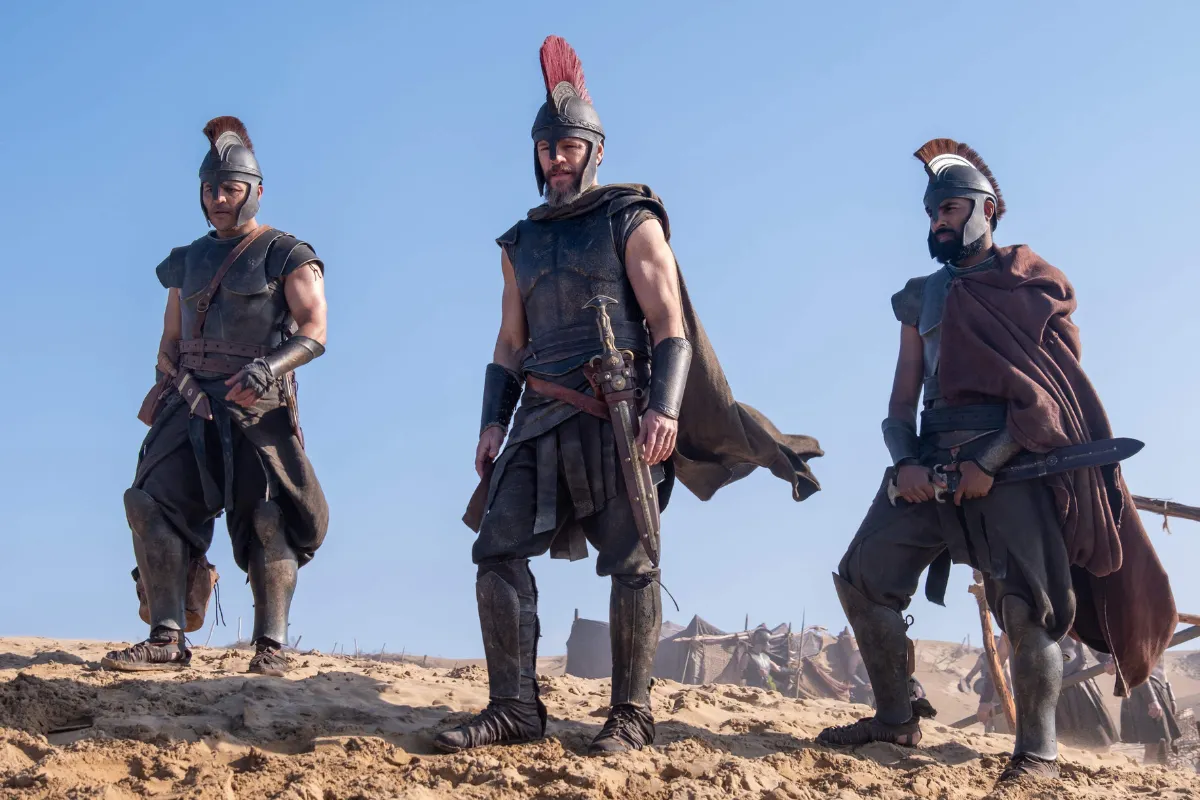
The cinematography is beautiful — it’s well shot, and the images are so iconic that some of them are hard to get out of your head after seeing the film. Everything with the Cyclops is amazing. The scene depicting the Trojan Horse is amazing.
I do have somewhat of a problem with Nolan’s sound mixing. He does this thing in a lot of his movies where the sound of the score sometimes overwhelms the dialogue, which is a problem when you’re trying to actually hear what the character is saying. Particularly, there’s a scene where Charlize Theron, who plays Calypso, is giving us her rationale for Odysseus’ departure, and it gets eaten up by the score. The score itself by Ludwig Göransson is good, but not great. I think the score of “Oppenheimer” is better.
The acting throughout is very good, with a few exceptions, which I’ll get to in a moment. I will admit I’m a big Matt Damon stan. I think he’s great in nearly everything, and he disappears into Odysseus in a way that he doesn’t in his other movies. Robert Pattinson as Antinous is an excellent antagonist. Tom Holland as Telemachus is excellent and well cast. Anne Hathaway does a great job as Penelope.
But first, on the theme of the movie: Nolan’s “The Odyssey” is an apologia for Christian morality poured into a Greek vase.
The entire movie is rooted in what Nolan terms “Zeus’ Law,” which they keep talking about over and over in the film. The law is essentially this: treat people as you would want to be treated. But it is presented as the notion that any person may turn out to be a god — a direct rip from the Biblical precept of man being made in the image of God.
Nolan uses Zeus’ Law as the film’s moral glue: the idea is that Odysseus, in utilizing the Trojan Horse, violated Zeus’ Law and led to full-scale slaughter. He is racked with regret over the loss of his men during the Trojan War, and his sin has led to the unleashing of broader globalized sin (the “sea peoples” who don’t respect Zeus’ Law and are invading surrounding areas).
This is a highly Biblical message: That sin is infectious, and that sin also affects the world at large, not just the sinner.
Odysseus must atone for that sin through self-imposed exile. But in the film, he is distraught over his crucial role in violating Zeus’ Law because he, as a character, is not someone who tends to fear the gods. He’s not someone who tends to think that fate is in the hands of the gods. He’s constantly rebelling against fate, as he’s informed by one of the other characters, Athena.
But it turns out that actually he’s not rebelling against fate as much as he’s rebelling against human nature. Odysseus must learn that human nature is venal, greedy, and bad, and that he’s not in control of everything.
Odysseus must also sacrifice his own aspirations to restore the possibility of a moral universe: Because he has unleashed catastrophic violence and violated Zeus’ Law — manifest in the suitors’ cynical use of Zeus’ Law to eat Penelope out of house and home — he must violate Zeus’ Law one last time and then accept the penalty, which is exile.
In other words, when Zeus’s Law is violated, it is very difficult to put everything back together.
In the original Odyssey, Odysseus just kills all the suitors, retakes the crown, and then he has to broker a peace with all of the remaining lords. But Nolan, in order to respect Zeus’ Law, has Telemachus become the king because he hasn’t actually violated the Law yet.
It’s a clever reimagining, and I kind of love it.
Now, for the film’s flaws: a lot of conservatives are missing the Biblical forest for the woke trees.
There are five flaws with the film that people on the Right have pointed to — four of which are casting criticisms.
Travis Scott as the bard or Lupita Nyong’o as Helen of Troy doesn’t change the story in any fundamental way. I’m not going to go crazy over those choices. Although Lupita Nyong’o is obviously a beautiful woman, Nolan goes out of his way to explain that the war wasn’t even launched over Helen’s beauty in the first place. He then underscores the point by making Helen and Clytemnestra twins — the idea being that Helen’s beauty is not unique.
Regarding Zendaya, Nolan does something super clever with her character that I loved: In a flashback near the end of the film where Odysseus is recalling the slaughter of Troy, Greek soldiers take Zendaya, who is a young woman living in Troy, and behead her in front of him. At the exact same time, Odysseus is watching a statue of Athena get beheaded. From then on, in Odysseus’ mind, the young woman beheaded in the siege is tied to Athena. Athena is Zeus’ Law in practice: any god can be a human being. Nolan cleverly weaves it into the script, and Zendaya does a fine job.
For those asking why everyone in the movie isn’t Greek: No one in the movie is Greek. Matt Damon is of Nordic extraction. He does not look Greek. Tom Holland does not look Greek. Anne Hathaway does not look Greek. If you want to make the case that everybody needs to be Greek to be authentic, I think you can make that case. But saying everybody has to be white is a lesser case because white people and Greeks are not quite the same thing.
What was actually bothersome was the use of language like “Dad” or “Mom.” It totally takes you out of it. They could have just said “father” and “mother,” and it would have worked, and as far as I’m concerned, anything that takes me out of the film is a thing that should not have happened.
Which brings us to Elliot Page.
This is an absolute puzzler of a decision by Christopher Nolan. Elliot Page’s character is a part of crucial plot points, but Elliot Page is a woman who has had surgeries to make her appear more manly, but still she is about 5-foot-2, 105 pounds soaking wet, and has the voice of a woman.
It doesn’t work.
Page’s character begins as a young, pudgy boy — which is weird — who ends up going to fight in the Trojan War in the place of Robert Pattinson’s character, Antinous. The character gets killed by the Trojans right away, and then reappears in a second crucial scene where Odysseus visits Hades and has a conversation with Page’s character about heroism in battle and how heroism isn’t really worth that much.
Coming out of the mouth of Elliot Page, the whole thing just doesn’t land. The shots are beautiful, the dialogue is good — but it’s coming out of the mouth of a woman. There’s just no other way to put it.
Now, does it kill the movie? No, of course not. But it could have been easily avoided. Elliot Page’s casting falls into the same category as the use of “Dad,” and “Mom,” because it’s an unforced error with no real rationale behind it.
Overall, I would group “The Odyssey” in the same tier as Nolan’s “Inception,” “Oppenheimer,” and “The Dark Knight Rises.” It’s not as good as the movies that are his very best, but “The Odyssey” is better than pretty much anything else anybody else is making today.
For those on the Right who were saying the movie would bomb: If conservatives want to be effective in the culture, reveling in being culturally black-pilled while a box-office hit dominates the cultural conversation is self-defeating.
This movie is going to make a fortune. It should make a fortune — it’s interesting, visually incredible, and the broader theme is very much in line with what many conservatives believe.
If you let Elliot Page kill that for you, I think you’re missing out on an incredible moviegoing experience.








 New Posts (Home)
 ChatBox
 Popular Posts
  Game Zone
 Top PodCasts