reactormag.com
The Eyes of Athena and the Disenchanted World of The Odyssey
Featured Essays
The Odyssey
The Eyes of Athena and the Disenchanted World of The Odyssey
Are you defying the gods, or betraying them?
By Leah Schnelbach
|
Published on July 22, 2026
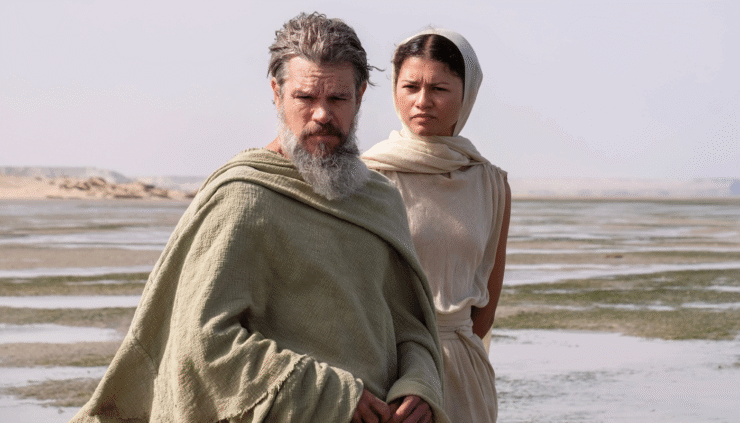
Photo: Melinda Sue Gordon © Universal Studios
Comment
0
Share New
Share
Photo: Melinda Sue Gordon © Universal Studios
I’m not a Nolan bro. I liked Prestige and Dark Knight, hated Dark Knight Rises, thought Interstellar had some great elements but also some howlingly bad ones. I just rewatched Tenet in glorious 70mm, and I still don’t think it’s the masterpiece certain bros insist it is. My favorite of his films is actually Dunkirk, where I think his obsession with time works beautifully. It was brilliant to tell the story through the soldiers’ subjective experience of time, and break it into how long it will take different vehicles to get them off that fucking beach.
And then there’s Oppenheimer, which in my mind is a wholly separate thing. It isn’t even a movie, it’s a thing I experience. The summer it came out, my life divided into “I am currently watching Oppenheimer, and I feel OK” and “I feel anxious because I’m not watching Oppenheimer right now”—I’ll admit that this was maybe a strange response. But it was also so obviously a culmination of Christopher Nolan’s Whole Thing that I was shocked to hear he was making another movie so soon after it, and even more shocked that it was an adaptation of The Odyssey.
I’ve been skeptical of this film for months. I really didn’t see how it was going to work. But now that I’ve seen it, I think it is a perfect follow-up to Oppenheimer, both in structure and in spirit, and I love it. I’ll talk a bit about why in non-spoiler ways, and then I’ll dig into the thematic stuff below, with the usual warning.
First let’s get he bad stuff out of the way.
Nolan has taken a timeless story and chosen to emphasize elements that make it extremely timely. Personally, this was my favorite thing about it, but I know people who feel like he sucked a lot of the life and nuance out of it, and I see their point.
One thing he did suck right out of it was color. I remain convinced that Nolan has an undiagnosed eye condition that only allows him to see steel grey and ice blue, and he genuinely doesn’t know that a lot of the rest of us see, like, purple, and forest green, and a whole plethora of pinks. In a movie like Tenet this is fine, but when you’re filming in the Mediterranean I want a wine dark sea and a goddamn rosy-fingered dawn, not roughly the same color scheme I can find in an industrial office park.
Everyone says “Zeus’ Law” wayyyy too often. I’m glad he made it the heart of the story, I thought it was a perfect choice, but by the end I was expecting Nolan to come out dressed as a bard and yell it into the camera like the ending of Killers of the Flower Moon or something.
…annnnd, that’s it. I’ve seen the film twice now, once on 70mm and once on 35mm (I haven’t managed to score an IMAX ticket yet) and I think it’s brilliant, it made me cry, it was even better the second time. Both times (one was a 10:30am screening, the other 8pm on a Sunday) the audience was absolutely silent and focused for the whole three hours. Both times a number of people stayed through the credits, both times people gathered in front of the theater to talk about what they’d just seen.
Which, about that: I think it’s safe to say that I’ve been in a state of despair for a while now. I try not to be, but the despair waits for me, under my conscious thought, my busy life, my stacks of books, and afternoons out at bars watching World Cup games. I would never go so far as to say that Christopher Nolan healed this—I can feel Charybdis below and Scylla above—but it is helpful to me to see people standing on a Brooklyn sidewalk at midnight, waving their arms around and interrupting each other to discuss a 3,000-year-old story with the same passion I imagine people had when they heard it sung during a feast, or read from the commentaries in the Library of Alexandria.
For anyone reading this who hasn’t seen it yet: GO SEE IT. As big as possible, IMAX if possible. Christopher Nolan has taken a very old story and used it to meditate on time, to look at what happens to a society that prizes war over peace, that refuses to welcome strangers, that distrusts anyone from outside its borders, that treats women and children as objects to be used. He does this with a cast designed in a lab to piss certain people off, and some extremely on-the-nose dialogue that may have been designed to piss certain other people off—but I think he’s made this movie for the generation of young people who are growing up in a toxic world, who need to be told that another world is possible, and he knows he needs to tell them that repeatedly, clearly, and in language that cannot be misunderstood.
So yeah, they say Zeus’ Law too many times, and I think it’s kind of stupid, but also this movie isn’t for me, not in that way.
The acting is uniformly excellent, though my favorite might be Elliot Page as Sinon. Sinon is kind of the best example of how Nolan has adapted the story; he takes a character who appears in Virgil’s Aeneid, not Homer’s Odyssey, and uses him to look at cowardice, honor, sacrifice, Odysseus’ willingness to lie and use his men like chess pieces, the terrible guilt he feels for doing that—and all of that comes through in Page and Damon’s scenes together. I’ve heard a few people ding Jon Benrthal for playing Menelaus like a small-time Outer Boroughs mob boss, but I actually enjoyed that. It was nice to see Tom Holland with a real character to chew on again. I would say that Nolan, maybe, brings too much of Penelope’s subtext to the surface, but also Anne Hathaway’s performance is amazing. John Leguizamo is perfect, Himesh Patel is perfect, Robert “plate-licker” Pattinson scoffed at mere perfection and created an all-time classic conniving villain. Samantha Morton is transcendent. And Matt Damon gives a nuanced portrait of grief and regret; Nolan’s Odysseus might not be enough of a trickster, and it would have been nice to see Damon play that as well, but he brings this version of Odysseus to life beautifully.
The effects are giant and over-the-top, though I do wish the monsters were weirder. (That said, it’s worth seeing the film in the theater for both the Cyclops and Circe sequences, and I add my voice to all the people asking for a Christopher Nolan horror movie.) Ludwig Goransson’s score has been in my head for four days now, and I am very, very happy about that. And really, it’s worth noting that this is a big movie, overstuffed with ideas, full of action and adventure and straight-up horror, with a giant cast, that’s actually about something. If you have even the slightest interest in the film, you should see it in a theater full of people.
But to get into thematic stuff I will need to spoil things from here on down, so board your ships and undertake a perilous voyage to the movie theater before reading on.
Leaving aside questions of objective reality, what are gods for? Are they meant to frighten us into obedience, promise reward, inspire us to acts of kindness and generosity? Are they a comforting lie? Are they load-bearing pillars in society, or a pretty facade of order that hides chaos beneath?
In Christopher Nolan’s version of The Odyssey, Odysseus uses Athena, and damns himself and his society in a way that transcends any dogma.
Aside from anything else that happens in the film, the question of whether the Athena that appears to him is real or a figment, if the girl slaughtered at the altar was a priestess who then haunts him, or if Odysseus imagined that murder as a statue was decapitated, or it was Athena, coming to earth to be sacrificed in front of him, to make a point—Nolan leaves all of that up to our interpretation. Only Odysseus sees Athena intermittently, over the ten-year voyage home. Usually she’s glaring at him, standing in judgement or pity. We know that he prays to her, both during the voyage and during his long time with Calypso. When he tells Telemachus not to look for gods in men, that could be a life lesson for a very young man, or it could be that his own experience of seeing his goddess murdered, whether it was literal or metaphorical, has hurt him in ways he doesn’t even understand yet.
But none of that matters.
What matters is that Odysseus, who believes in Athena, who wears his wife’s pin as a talisman both of home and of the goddess’s protection, uses other people’s reverence for her to enact terrible violence on the innocent. And the film encourages us to root for him to do this.
This is where the film becomes a true companion to Oppenheimer. In Oppenheimer, the Trinity Test is the center of the film. It’s the crux, and all the other action revolves around it. This is The Great Man, working on his Great Project, the Weapon That Will Win The War, the Miracle That Will Save Us From The Nazis. The Ark, the Grail, Captain America, The One Ring. When the Trinity Test happens, everything in the film, the action, the editing, the score, all tell us that we’re supposed to pull for this thing to work. The film uses all of the tricks and language of cinema to get us to to root for our own destruction.
Because the bomb wasn’t a miracle, it was our doom.
It was immediate death for thousands of people, slow torture for thousands of others, and probable extinction, eventually, for the rest of us.
The rest of the film teases all the threads apart to get us to question its creation, Oppenheimer’s morality, the United States’ choice to use the bomb at all, the subsequent proliferation of weapons that can end the world. And while the film only touches on it glancingly, I find it interesting that when Oppenheimer talks about it he invokes Vishnu in the Bhagavad Gita, and names the test itself after “Batter my heart, three-person’d God”, one of John Donne’s most God-besotted poems. (Which is saying something!) In dealing with this unspeakable thing, even the secular Jewish kinda sorta Marxist reaches toward religion and stories of gods to try to express the terror and awe of the bomb.
The Odyssey opens with the Bard (the fabulous Travis Scott) singing the song of the Trojan Horse. Even in this version, presumably embroidered over a decade of retellings, we hear that the horse is an offering for Athena specifically. The Trojans accept it and bring it into their city, in order to respect their foes and honor the goddess. Later the movie shows us the Horse from the inside, in Menelaus’ telling. Just as in Oppenheimer’s Trinity test, 135 years of movie magic conspire to make us want the gambit to work. We’re with the men inside the horse. We see some of them drown when the tides wash in, we’re with the men as they’re covered in each others’ shit and piss and trapped in a coffin with the rotting bodies of their companions. As Menelaus tells the story to Telemachus, as one of the men who risked everything to be part of this mission, we want them to succeed. We want the Trojans to bring the horse in. We want Odysseus and his men to get the gate open. The camera closes in on each torturous turn of the gears, each arrow that sails from the bows of the Trojan guards. When the gates open, and Agammemnon stands in his overpowering armor, and the Greeks around him scream in triumph, it feels like a victory. We cut back to Telemachus openly weeping at this story that he’s heard as a fable but now hears from the mouth of one of his father’s best friends, a man who was there and suffered with him.
But by the time we come back to the story of the horse at the end, we know that a moment that looked like victory was never so simple. Agammemnon murdered his child, was murdered in turn by his wife, who was murdered, in her turn, by her own son. We’ve heard Sinon’s account of his death, seen Odysseus pressed against the belly of the horse, listening to the young man’s last breaths just outside. We know that none of Odysseus’ men made it home. And worse: everywhere they went, they brought death with them, whether because of a god’s curse or their own actions, until, a decade on, they are whispered of as the People From The Sea and used as proof that civilization is collapsing.
And then to hear the story from Odysseus’ own mouth—it isn’t just the story of a trick that gets them inside the walls. Odysseus doesn’t even talk about the days inside the horse, he skips straight to the fight for the gate. And it isn’t his first-hand account of the horrors of war—we don’t see much of it, actually. We see fire, we hear screaming, but there is very little gore compared to most war stories.
The true horror is in his knowledge that he used the Trojans’ reverence for Athena against them, and destroyed a kind of trust between people that can never be restored. In this “time of apparent magic” it was Odysseus who took the magic out of the world, in a way—does it matter whether the gods are real, if any offering made to them could be a murderous trick? Do his prayers to Athena mean anything, after he used her like that?
The betrayal, the possible murder of a priestess, the definite desecration of a temple, we don’t see it until the last half hour of the movie, we just see the aftermath of those acts, spreading like radiation through every event in the film.
Much in the way Nolan uses silence in the Trinity test, rather than asking Ludwig Goransson to compose a song for the Sirens, he puts us in the point-of-view of Odysseus’ right hand, Eurylochus, who only sees the effect of the song as his friend screams and writhes against the mast—and Odysseus later tells him that the Sirens sang of the world he helped destroy. We hear talk of the Sea People constantly. We see how the generation after Odysseus exploits Zeus’ Law, we see how Telemachus, a good young man, desperately searches for Athena in the eyes of everyone he meets—and he nearly dies because evil men are only too willing to impersonate priests of Athena. Mentor dies because he trusts the drink the “priests” hand him, and the only reason Telemachus lives is that his father is there to protect him. But how is their trick any different than his—other than the fact that it would only have killed a few people, and doomed Penelope to a marriage she didn’t want? How does that treachery stand against what was done in Troy?
When Odysseus finally tells Penelope about the sack of Troy, he isn’t just telling her. He’s telling Athena, sitting in silence beside him. He reaches out to her and she hold his hand for a moment, but after we see the murder of the girl, and the beheading of the statue, when it cuts back all Odysseus holds in his hand is air. Maybe because she was never “real”? Maybe because, in betraying her, he has made himself unworthy of her presence?
What I love is that even after this, Odysseus fights to hold on to his values. It’s the fight with the suitors that allows us as an audience to lose ourselves in an action sequence, because this time Odysseus’ cause is entirely just. He murders the suitors, knowing it means his exile but also knowing that he didn’t intend to stay in Ithaca anyway. He protects his son’s honor, and avenges his wife. We see that throughout the fight, some of the suitors kneel and bow to Odysseus, showing that they’ve accepted him as the true master of the house and want the chaos to end. With Telemachus free of his unwanted guests’ blood, he’s free to rule Ithaca as a good-hearted young king who has behaved honorably at every turn. And finally Odysseus and Penelope go west to honor the fallen, just as he’s promised to do throughout the film. Society might be crumbling around them, but they refuse to give up on it, and every tiny action they take is one more step toward restoring the trust humanity needs to survive.
I may have mentioned this on this website before, but a number of years ago I attended a panel designed to help non-profits apply for grants. At one point the person leading the panel referred to the “Culture Wars” as a thing of the past, a thing he and the other panelists had apparently won. I remember the jolt I felt when he said that, I remember coughing so I didn’t laugh out loud.
I wish I had ever lived in the world he lived in. It must be so nice there.
A small (very small, very vanishingly small, but SO LOUD) army of people are now trying to say this movie isn’t successful. They’re making shit up online to convince their echo chamber that it flopped, that Nolan’s career is screwed, that going “woke” equals going broke. They spent months yelling about casting choices and their own stupid interpretations of Greek myth and culture, and now they’re in a panic spiral because, once again, most of us have taken the side of interesting art rather than bigotry and they can’t handle the idea that reality doesn’t match what they see on their screens.
They’re wrong. They’re always wrong, about everything. But it doesn’t matter, because some of them have power at the moment. We live in a time of magic and rumor, of wars across the sea and Sea People who try to escape those wars so their children have at least a (very small, very vanishingly small) chance at life—and are hated and condemned for it. A time when the story a few rich people tells each other shapes the reality the rest of us have to live in.
Christopher Nolan took a story of war and magic and monsters and homecoming, and he turned it into a story where civilization collapses when people fail to welcome the stranger. He took a story where people honor strangers lest they entertain the gods in disguise, and gently suggests that perhaps every person is worthy of welcome and guest-friendship. He took a story where the gods manipulate everything people do, and gently suggests that people should take some fucking responsibility for their own actions, and along the way shows us what happens when someone betrays the god he claims to worship. He did it with practical effects, human actors, human musicians using ancient instruments, human hands teaching actors how to fight, how to row, how to sail.
I am still not a Nolan bro, but if he ever comes to my door I’ll throw him a fucking feast, no questions asked. [end-mark]
The post The Eyes of Athena and the Disenchanted World of <em>The Odyssey</em> appeared first on Reactor.








 New Posts (Home)
 ChatBox
 Popular Posts
  Game Zone
 Top PodCasts