reactormag.com
The Summer of Jimothy
Column
SFF Bestiary
The Summer of Jimothy
Let’s talk about the latest celebrity animal sensation
By Judith Tarr
|
Published on July 27, 2026
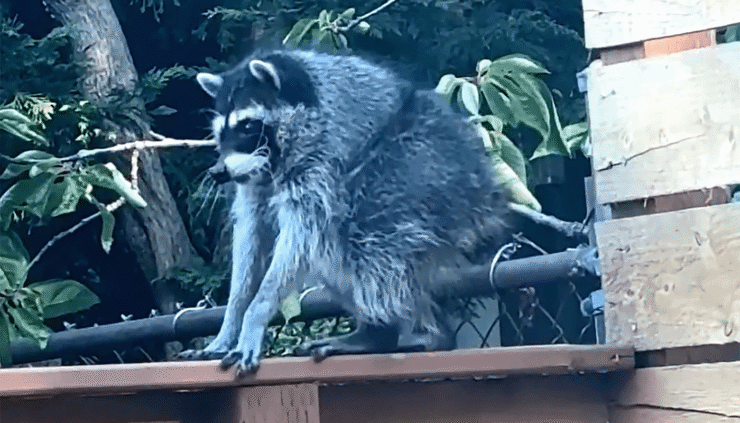
Photo: Dmitriy Ishimskiy via Storyful
Comment
0
Share New
Share
Photo: Dmitriy Ishimskiy via Storyful
And now for something completely different. By popular demand: JIMOTHY!
As incredible as it seems, the latest phenomenon that’s taken over the internet is barely two weeks old. Seattle-area Instagrammer Kiana Hall filmed a strange little creature on the night of July 13th and posted the video the next day. It immediately went viral.
At first she thought the fluffy grey animal—“an orb with legs” as she described it—might be a cat. Then it turned and she saw the face and realized it was a raccoon.
Experts leaped in to diagnose Jimothy, as Hall named them, with a congenital deformity called short spine syndrome. The spine is shortened, the vertebrae reduced in number or compressed. The body is very compact, almost square or spherical. There’s no tail and the animal may look as if it has no neck. That’s Jimothy.
The internet loves them. They have their own song. They’ve been immortalized in art, in games, as a bobblehead. They have an honorary degree from the University of Washington and a proclamation from the Seattle City Council, complete with festival and Jimothy-themed art contest.
If ever a crowd has gone wild, it’s done it for Jimothy. They press all the Cute buttons: little, round, fuzzy. They belong to a familiar species often regarded as a rampant nuisance, but they’re unique. They look like a cryptid but they’re incontestably real. And reeled: once Hall’s video hit the big time, others in the area started posting their own footage.
In June and July of 2025, Ben Trammell recorded what he called a “raccoon-colored koosh ball,” a tiny spherical baby clambering around his back yard. The little animal had a mom and two siblings, all of whom were normal raccoons. They were tiny, less than a third the size of their littermates, and yet there they were, doing raccoon things with their raccoon family.
The trees in which the raccoons lived were cut down and Trammell didn’t see them again that year, but this spring, the little round critter showed up again, solo now, weaned and on its own—and apparently thriving. Trammell saw them as a testimony to resilience. Animal experts agree. Jimothy looks healthy and seems quite able to look after themself.
Viral animal sensations are pretty common. Does everybody remember Fiona? There’s another and much less fuzzy and cute celebrity in Tasmania, the infamous Neil the Elephant Seal, whose size, strength, and capacity for destruction have been causing havoc.
Fortunately for Jimothy, they’re small as well as cute. The amount of damage they can do is relatively minimal, and because they’re Jimothy, they’re forgiven rather than called out as a raving nuisance. They’re a point of pride in Seattle—civic pride and, coincidentally, disability pride in a month dedicated to the concept.
It’s kind of a perfect storm. People love cute animals. They love cryptids, and Jimothy looks like a cryptid. What’s even more striking, Jimothy is doing it on their own. They’re not in a zoo or a sanctuary. Humans have not raised or cared for or protected them. They were born and raised in the wild and they’re making a go of it without human help.
That’s a grand thing and a great story, but humans being what they are, it comes with a warning. Public health officials in Seattle have called on the public to keep its distance. However famous and beloved Jimothy is, they are a wild animal. They are not tame; they’re not safe. Raccoons can carry diseases. People should not try to feed, interact with, or handle them.
This is not a remote possibility. Consider the fact that rangers in national parks have to constantly urge visitors not to get close to the animals. Do Not Pet The Fluffy Cows.
And then there’s the issue of late-stage capitalism. Within hours of Jimothy’s debut, enterprising humans were figuring out ways to make money off them. The Sarvey Wildlife Care Center posted a statement on its own and Jimothy’s behalf, thanking supporters for wanting to help them and Jimothy by selling Jimothy-branded merchandise (and presumably “rescuing” Jimothy and caring for them in the sanctuary), but pointing out that Jimothy is a wild animal, and should remain so. “Loving wildlife,” they want to remind us all, “means allowing it to remain wild.”
In film and story, when the unusual animal or the cute alien (ET, anyone?) shows up in human spaces, the biggest threat is Evil Government Scientists who want to study (i.e. dissect or weaponize) the subject. A few intrepid humans spend most of the film eluding the evil scientists and trying to save the animal—either to find a safe place for them to live or to return them to their home. Jimothy shows us how it is in real life.
The threat isn’t Evil Science; in fact scientists and wildlife experts are ringing the warning bells. The profit motive, which is another trope, is definitely there. But there’s also the problem of humans who want to be a part of the viral sensation. They want to track down the celebrity, see it for themselves, film it, interact with it. Evil Scientists and Steely-Jawed Military aren’t coming for Jimothy. Paparazzi, on the other hand…
I hope the people of Ballard take good care of their fuzzy superstar. Keep them safe. Stay out of their way. Let them live their life. Be glad they’re in the world, being their unique and beloved self.
I have a couple of sidebars to add to this story. It happens that I have a sort of connection to Jimothy’s anatomy: one of my cats is the daughter of a cat with a variation on the spinal defect. Her spine is normal in length but stops with the last vertebra. She has no tail, not even a stub. Two of her four kittens have the same trait.
It’s genetic, and there are appears to be no deficit of any kind. Jimothy diverges dramatically from normal raccoon conformation, but is agile and highly functional. Like Mama Willow, they’re doing just fine as they are.
The other thing I want to add is a rabbit hole I went down while researching Jimothy. Animal communicator Lori Cowen professes to have had a long conversation with them. I am skeptical about that part, but the message Cowen wants to convey is worth pondering, whether it comes from Jimothy or the communicator’s own mind and beliefs.
Jimothy, she says, does not consider themself disabled. This is the body they were born in. It’s normal for them. They know how it works, and they’re comfortable with it.
It doesn’t bother Jimothy that they don’t look like other raccoons. Worrying about looks, says Cowen, is a human thing. Animals are what they are. They take themselves as they come. It’s a good philosophy—for humans as well as animals.[end-mark]
The post The Summer of Jimothy appeared first on Reactor.








 New Posts (Home)
 ChatBox
 Popular Posts
  Game Zone
 Top PodCasts