reactormag.com
No Glory, No Songs, Only Butchery: House of the Dragon, Season 3 Episode 6
Movies & TV
House of the Dragon
No Glory, No Songs, Only Butchery: House of the Dragon, Season 3 Episode 6
Well… that ended badly. But on the bright side: mystery eggs!
By Tyler Dean
|
Published on July 27, 2026
Credit: Ollie Upton/HBO
Comment
0
Share New
Share
Credit: Ollie Upton/HBO
The antepenultimate episode of the season is an exploration of the ways in which everyone’s best-laid plans come to nothing when they collide with the vicissitudes of the real world. Criston, Alicent, Daemon, and Rhaenyra all discover the limits of what they can accomplish without terrible sacrifice. There are more branching paths from the novel, possible answers to enduring mysteries in the books, and at least some of the dark fate promised by last week’s episode. Let’s get into it below!
The Title
Episode six is entitled “Faceless Men.” It’s an interesting choice of title because it, very obviously, does not include any reference to or plot point involving the mysterious order of assassins known as the Faceless Men. Those were the priests of the Many-Faced God (an amalgam of all the different death gods of the world’s pantheons) whom Arya first encountered in the second season of Game of Thrones. According to legend, the Faceless Men were founded by slaves that toiled in the volcanic mines of the Valyrian Freehold who embraced murder as a gift given to other hapless members of the ancient civilization’s underclass.
In last night’s episode, the phrase most obviously applies to the plain-faced Baratheon assassins Rhaenyra sends to kill Daeron and Ormund. But it also refers to the waves of mercenaries coming to Harrenhal to kill Aemond. It refers to the many-headed hydra that is Ormund’s King’s Landing insurgency. It refers to the men Rhaenyra plans to send alongside Alicent to kill Aemond. It even refers to the men who die at Criston Cole’s side, falling namelessly in service to the lords, even as Criston Cole himself returns to the faceless state of a common man, little remembered by history.
The threat of the guild of Faceless Men is their ability (aided by magic) to look like anyone, taking on the faces of trusted friends and allies. But their origins in the slag pits of Old Valyria belie a less fanciful fear. The Faceless men are anyone and everyone—they are the rabble beneath the feet of great Lords, toiling away in the dark, bent but not yet broken. The Valyrians subjugated half the world from dragonback, but the sins of their imperialism and their slavery forged the greatest order of assassins the world has ever known. As Rhaenyra and Ormund and Daemon try to crush resistance beneath their boots and bring their enemies to heel, they are creating the conditions of possibility that make every face—known and unknown—into the one that will end their lives.
Unraveling the Opening Credits
I believe that the mysterious panel from last episode shows two men ripping a literal gold cloak asunder. A new panel after it shows a Gold Cloak/watchman being ripped limb from limb by two commoners. Clearly this is referring to the work of Ormund’s catspaw and the unrest simmering in Flea Bottom. The fact that the tear in the tapestry runs straight through the unfortunate Gold Cloak is an especially nice touch.
The Butcher’s Ball
Credit: Theo Whiteman/HBO
Book readers have been looking forward to the Butcher’s Ball, the name Archmaester Gyldayn gives to the final battle between Criston Cole’s men and the combined forces of the Rivermen and Winter Wolves. The show chose to play it out in an interesting way, taking an approach which has both pros and cons (and one particular omission which I think will disappoint some book readers).
In the book, Cole and his army march south from Harrenhal to intercept the Rivermen’s host. It is Cole’s men who are stalked and harried at every turn rather than the other way around. Gyldayn’s narrative depicts him as utterly hubristic in his final march, failing to recognize the Winter Wolves or the Rivermen as a major threat on his final march. While the final interactions between Cole and the Rivermen play out almost word for word as they do in the show, this episode cuts the final line delivered to Cole by the Riverman knight Ser Pate of Longleaf, after Cole proposes to fight the army’s leaders one against two (three in the book) and is struck down by archers: “I’ll have no songs about how brave you died, Kingmaker… there’s tens o’ thousands dead on your account.”
The last line is a pointed twisting of the proverbial knife—making sure that Ser Criston meets an ignominious rather than heroic end. But, of course, the line also lends a kind of mitigating gloss to the event. It tells us that Cole was denied a chance for valor, and if Gyldayn is repeating the story over a century later, that version of his final moments must have stuck. Here, the end is far quieter. Cole is not even given the dignity of an answer, cast aside and ignored by the lords of the realm in exactly the way he’d spent his life resenting, his greatest fear realized.
There is the matter of timing. Killing Cole off at the beginning of the episode, after giving him his somber final monologue in the last episode, lends the proceedings some of the off-kilter timing that Martin excels at. Part of the reason the Red Wedding of the novels hits so hard is because it comes two thirds of the way through A Storm of Swords, at a moment when we are not expecting there to be something so thoroughly climactic and awful. In some ways, by moving the Red Wedding to one Game of Thrones’ famously consequential ninth episodes, the writers built in certain expectations that something terrible would occur. Here, Cole’s death takes on the same sort of mistimed quality that makes it feel less like a narrative with a satisfying arc and more like the fickle whims of fate, which do not care if a character has finished speaking before claiming them.
Ser Criston Cole has always been a bad guy. He played the game of thrones ruthlessly and with a twisted misogyny that put the lie to his idea of chivalry. But here at the end of it, the blaze of glory he desperately tried to orchestrate for himself is abruptly unceremoniously snuffed out. In an episode all about the ways in which servants prove themselves useful to their lieges, we open in the fading light of a ravaged Tully camp, where the man who thought he could finally die on his own terms after living his life in the service of others is denied even that.
Audiences this season love to hate Ormund Hightower because he is a gleeful, cartoonish parody of an abuser. There is nothing worthy or redeeming in him. Criston Cole is a very different kind of character. Even as many will no doubt be overjoyed by Cole’s death, the show has ensured that it doesn’t leave us with pure catharsis. We may be better than Cole in a thousand ways—kinder, more self-aware, more selfless—but we are closer to him than we ever will be to the high lords of Westeros. Whatever unease you feel, it is a portent of what is coming, ignominiously, to everyone caught up in the conflict.
EggWatch
Credit: Theo Whiteman/HBO
We get an exciting bit of connective tissue between House of the Dragon and Game of Thrones in the form of Dreamfyre’s eggs at Harrenhal. Alys tells us that Rhaena Targaryen left them there. This is not Lady Rhaena, Daemon’s daughter (played by Phoebe Campbell), rather it is the woman for whom she is named. She’s one of the best characters in Fire & Blood and mentioning her here is prudent, in part because she did not live during a period of Westerosi history that’s conducive to adapting to television. This is likely the only way we’ll get Princess Rhaena Targaryen in this or any Game of Thrones show.
This Rhaena was Aegon the Conqueror’s granddaughter and the original rider of Dreamfyre, Helaena’s dragon. She was also famously uninterested in men. She lived a tragic life: her brother-husband was murdered by her uncle, Maegor the Cruel, who eventually forced her into marriage; her lover, Elissa Farman, eventually absconded with a clutch of Dreamfyre’s eggs and sailed into the mysterious western seas never to be heard from again. Rhaena’s her third husband, Androw Farman—Elissa’s brother—poisoned all of her closest companions out of jealousy; her daughter Aerea died horribly after flying on the back of Balerion the Black Dread to parts unknown (but probably the ruins of Valyria). After all of these tragedies she lived out the end of her days at Harrenhal, taking up residence in(and giving name to) the Widow’s Tower, where her ashes were eventually interred.
There is an enduring mystery as to Rhaena’s dragon eggs and where they ended up. This is because Martin has not accounted for where Daenerys Targaryen’s eggs (that eventually hatch into Drogon, Viserion, and Rhaegal) came from. One theory is that they were from Syrax and taken to Pentos alongside the young princes Viserys and Aegon (whom our era’s Rhaena failed to chaperone on their sea voyage). Another theory is that they were among the eggs that Elissa Farman stole and took across the Sunset Sea; when a young Corlys Velaryon visited Asshai during his nine voyages, he swore that he saw Elissa Farman’s ship, the Sun Chaser, docked in Asshai fifty years after it disappeared. But this episode proposes another possibility: Dany’s eggs are Dreamfyre’s, hidden away for nearly a century in the ruins of Harrenhal.
DragonWatch
The most prominent dragons in tonight’s episode are Vermithor and Silverwing, Hugh and Ulf’s dragons, respectively. We see them nuzzling one another on the hill outside Tumbleton. This is because they are a mated pair, having once been the dragons of King Jaehaerys and his sister-wife, Queen Alysanne. They are the second oldest dragons after Vhagar and we can see that Vermithor has begun to develop the same neck wattle that she has. Silverwing also has a distinctive cooing, bird-like trill as she calls out to Vermithor. I believe this is the first time we’ve heard her vocalize clearly. The series loves to show bonded dragons—Vermithor and Silverwing, Syrax and Caraxes, Syrax and Seasmoke. It’s a great detail that continues to keep them feeling real.
Odds & Ends
Credit: Ollie Upton/HBO
Gyldayn mentions that Criston Cole was most talented with a morningstar. While, for the purposes of being in the Kingsguard and his reputation as the Kingmaker, it makes sense for him to favor a sword, I’m glad the show featured the morningstar for his last brutal fight.
I stated this last season, but Oscar Tully, an invention of the show, is a combination of F&B’s Benjicot Blackwood and three Tully heirs (Oscar, Kermit, and Elmo—the show wisely went with the Muppet name least likely to distract viewers. Benjicot Blackwood is the eleven-year-old lord of House Blackwood whom Martin describes as bloodthirsty and preternaturally skilled in battle. The show seems to have split Benjicot with Oscar and last season’s Willem Blackwood (who had been a bloodthirsty kid first seen in season one). Essentially, they wanted a battle-hardened kid who could be the de facto leader of the Rivermen and Oscar is the result. In this episode he also seems to have merged with Ser Garibald Grey, a knight whose only real distinction in Gyldayn’s narrative is saying the line about building a sept of bones.
We don’t get a clear shot of them, but I assume that Cole’s killer is Alysanne Blackwood, given the coloring and hair.
I didn’t think they would include it, but the Baratheon delegation mentions that Lord Borros has left to fight one of the many Vulture Kings in Dorne rather than actively declare a side in the conflict. There are perpetual Vulture Kings throughout modern Westerosi history. The one Borros is fighting is the third to take on that mantle; 70-ish years from now, Dunk and Ser Arlan of Pennytree will fight against another Vulture King. Fighting one the Vulture King of the moment is a task that always demands some attention from Westeros, while clearly always being a lower priority in the grand scheme of things.
Hot pies mentioned!
Mysaria seems to be tying up loose ends to protect her own perfidy, having the handmaid who’d taken Alicent’s necklace in exchange for helping the queen escape killed.
Seeing as how the Tyland Lannister Triarchy plot was invented for the show, so too is Corlys Velaryon hearing rumors of his surviving. Not entirely sure where they are going with this, especially since Aegon seems to have chosen Larys’ option.
Lady Jeyne Arryn’s dry delivery of “never ceases to be fascinating” while watching a man fall out the Moon Door is fantastic.
Rhaena says she saw Moondancer and Seasmoke flying towards Iron Oaks. Iron Oaks is the seat of House Waynwood (Anya Waynwood was minor character in seasons 4 and 5 of Game of Thrones) and is due east from the Eyrie. Baela and Addam are really scouring the whole of the south for Vhagar.
Good that they’ve moved up Baela and Alyn’s romance to a bit earlier in the timeline. Making it a part of Baela’s post-Jace healing journey feels like a smart way to keep her in the narrative when she is at a bit of an ebb-tide in the book.
Last week, I was unsure what they were going to do with Ser Gwayne, seeing as he is long dead in the book and had left Ser Criston’s side. This seems like the best possible choice. Giving Darrin someone other than his cousin to play off of is a smart move and lets us see both how Gwayne has failed his nephew and how the two of them are victims of Ormund Hightower’s rages.
It did strike me as little bit odd to have Ormund imply Gwayne’s queerness with some small amount of contempt. While Gwayne being gay would explain why he is unmarried, it resonates just a bit oddly against Ormund’s own queer-codedness. Of course, we’ve had plenty of examples in the real world of closeted men at the nexus point of self-loathing and access to state power who have posed an especial danger to others like them. Maybe this is commenting on that.
So much of this season has been about forcing Alicent to reckon with how little she has listened to her daughter’s wishes or set up her up for success or happiness. I like the detail of her keeping Helaena from driving the embroidery needle into her finger—the tiniest intervention in the cycle of anxious self-harm that the Hightower women are prone to.
I have previously written about how HBO’s A Song of Ice and Fire shows fail to capture the horror and dread that are such a large part of Martin’s books. Helaena’s ghoulish embroidery—her brother Aemond, curled up like a fetus inside a bloody, vaginal mandorla, in the heart of a jet-black Harrenhal while Alys Rivers, red-eyed, casts her spells upon him—really gets back to that intersection of folk and cosmic horror that suffuses the novels. For all that it is a story of political intrigue and the horrors of patriarchy, I love that this show takes the time to indulge in the uncanny and unsettling when it suits them.
The Septa who petitions the Queen speaks of a “Motherhouse.” These are female monastic communities in the Faith of the Seven: single-entendre nunneries. The counterparts for male septons are called “septries.”
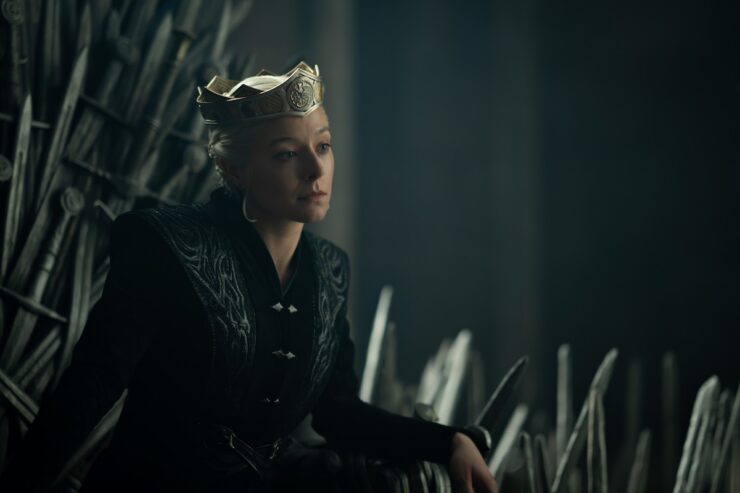
Cutting oneself on the Iron Throne is typically a sign of rejection by it. In the first season, Viserys was constantly cutting himself on the blades, worsening his leprosy. Rhaenyra looks to the statue of Viserys when it happens. As a fun detail, the statue of Viserys holds a version of his miniature Valyria as his royal totem.
The overhead shot of the Iron throne with the surrounding blade slag sure looks like a dragon’s wings.
Ormund’s King’s Landing catspaw (Richard Pepper) calls the newly minted monarch “Daeron the Daring.” In the novel, that is Prince Daeron’s sobriquet, earned by his valor in fighting the Blacks from dragonback en route to King’s Landing. I love the show making it Ormund’s propagandist invention.
When Rhaenyra learns about Helaena’s powers, she invokes Daenys the Dreamer whose foresight brought the Targaryen family to Dragonstone and away from Valyria. I wonder if part of the reason Helaena was able to communicate with Daemon last season and why she is so linked to Aemond is because her own dragon’s eggs are at Harrenhal.
We are well and truly off-book here with the kidnapping of Corlys Velaryon by Bold Jon Roxton at episode’s end. Part of this is likely about creating plot for central characters who have very little to do for long stretches (both Corlys and Alicent have very little going on during this time in the book—and Ser Criston could easily have been killed off by the second episode of the season without expanding on his doomed campaign). But what else it might portend, and who else it might involve are pretty opaque to me. Fascinating.
In Conclusion
Credit: Ollie Upton/HBO
I literally jumped for joy upon hearing Alys mention the historical Rhaena and Dreamfyre’s eggs. Aemond, who now has the dagger that will eventually end up slaying the Night King, is positioned in the center of a sinister web of prophecy. I’m a sucker for this show at its most weird and mystical, and it seems intent on delivering. But what did you think? Were you satisfied by the death of Ser Criston? Will you miss Fabien Frankel on the show? Are you excited to see what happens in the AemAlys shipper community? Let me know in the comments below![end-mark]
The post No Glory, No Songs, Only Butchery: <i>House of the Dragon</i>, Season 3 Episode 6 appeared first on Reactor.








 New Posts (Home)
 ChatBox
 Popular Posts
  Game Zone
 Top PodCasts