reclaimthenet.org
How NIH Silenced Its Critics Without Telling Them
If you're tired of censorship and dystopian threats against civil liberties, subscribe to Reclaim The Net.
Harry Harlow died in 1981. His maternal-deprivation experiments on rhesus macaques turn up in most undergraduate psychology courses, usually as the case study for why research ethics rules exist at all. Four decades after his death, his surname was one of the terms the National Institutes of Health typed into Facebook’s comment-filtering tool so that any comment containing it would vanish from public view.
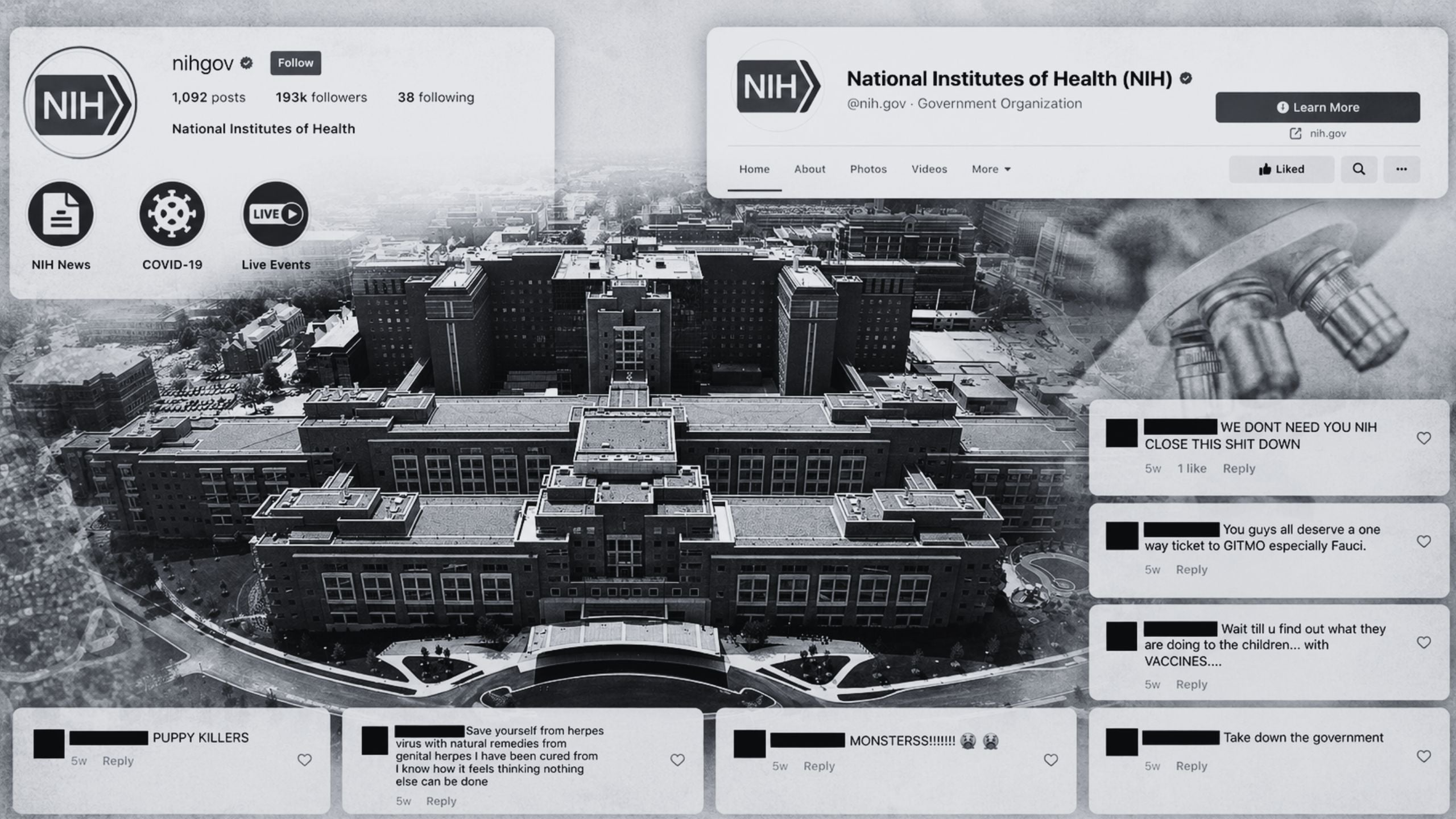
Next to Harlow on the Facebook list: Suomi, for Stephen Suomi, who runs a comparative ethology lab at NIH’s child health institute. Then monkey, monkies, marmoset, hamster, mouse, mice, primate, chimpanzee, cats, gatos, animales, animalitos, cruel, cruelty, revolting, torment, torture, two monkey emojis, and an emoji with an expletive face. Until December 2021, the list also held PETA and PETALatino.
The Instagram list ran shorter and odder: animal, chimpanzee, monkey, experiment, hurt, kill, test, torture, stop.
Much of this has been public since 2024, when the D.C. Circuit held the filters unconstitutional. What was missing was the agency’s own side of it: what NIH’s lawyers thought they were doing, and what they told the communications staff running the accounts.
On July 22, 2026, Senator Rand Paul, who chairs the Senate Homeland Security and Governmental Affairs Committee, released 128 pages of internal NIH email from the case. The messages run from November 2021 to January 2022, between NIH’s Office of the General Counsel, its Office of Communications and Public Liaison, and, relayed second-hand, the Justice Department attorneys defending the suit.
Paul’s interest was COVID, and the COVID material is in there. What the emails document, in greater detail, is how an agency behaves in the days after its own attorney tells it, in writing, that it is discriminating against a viewpoint.
How the hiding works
Facebook and Instagram give page administrators an optional keyword filter. You paste in a list of words. Any comment containing one of them, past or future, is hidden automatically. On Facebook there is also a built-in profanity filter with strength settings; NIH had it on “strong.” Instagram has its own default offensive-word filter, which NIH had enabled as well.
“Hidden” has a technical meaning on these platforms that differs from what most people assume. A hidden comment survives. It remains fully visible to the person who wrote it and to that person’s friends. Everyone else scrolling the page sees nothing. The joint stipulation in the case spells out the consequence in flat language: the user whose comment has been hidden typically receives no notice.
So the speaker’s screen looks normal. They wrote a sentence; they can see the sentence, the sentence is there tomorrow. The rest of the page sees nothing, and no error message ever told them so. The silencing leaves no trace, so there is nothing to appeal and no accurate way to complain. Madeline Krasno, one of the plaintiffs and a former University of Wisconsin animal-lab employee, eventually worked out that she was being filtered and started deliberately misspelling words to get through.
What the lawyers told NIH
On December 1, 2021, an NIH senior attorney in the Office of the General Counsel wrote to the communications team after a call with DOJ. The email is the heart of the release.
She opened with a direct instruction. NIH should stop blocking PETA and PETALatino on Facebook and PETA on Instagram, immediately. That is agency counsel identifying terms as viewpoint-based; you cannot block the name of an organization and claim you are policing subject matter. The words stayed up until December 3. Three Instagram hashtag filters, #stopanimaltesting, #stoptesting, and #stoptestingonanimals, were still running afterward. The attorney later had to check from her own personal Instagram account to establish that they were still live.
For those hashtags she laid out four options. The first, which NIH took, was to remove them and use a different neutral keyword hashtag “to achieve the same effect” against the volume of PETA comments; she suggested #testing or #animals. The second was to keep the anti-testing hashtags and add a pro-testing one to offset them, and she offered an example: #keepanimaltesting. The third was to drop the filters if they were not doing much. The fourth was to keep them, on which DOJ’s advice was that a court might find the terms not viewpoint-neutral, and that the worst that could happen would be an order to stop using them.
The first option is a piece of legal engineering. Counsel has identified a constitutional defect in the selection of words. The remedy chosen is a different selection of words, picked to produce the same suppression while surviving review. The volume of hidden speech stays exactly the same. The category of hidden speech barely changes. What changes is the paper trail.
The evidence DOJ kept asking for
DOJ wanted to argue that NIH had no policy of targeting animal-rights speech, and that a comment defending animal testing would be hidden on the same terms as one attacking it. To make that argument stick, they needed examples. They asked at least three times, across several emails, for two or three instances of the filters catching a pro-testing comment.
NIH came up empty. The answer that came back was that this was not a scenario that happens, since people were not really posting in favor of animal testing. The closest they could offer was that a pro-research reply posted under an already-hidden comment would disappear along with it.
That is a serious problem for the neutrality argument. A filter can be even-handed in its text and one-sided in its operation because only one side of a debate uses the vocabulary. “Torture” and “cruelty” are loaded words in a fight about animal research. They are the other side’s words. The substitute hashtags counsel proposed work the same way: #testing and #animals catch the people who came to complain, and say nothing about them.
Wuhan, ivermectin, and the “neutral” filter
Pressed for examples of off-topic hiding that had nothing to do with animals, NIH’s comms staff supplied one. On a post about the agency’s initiative to end structural racism, comments about the Wuhan Institute of Virology and ivermectin had been hidden as off-topic.
At its narrowest that is defensible. Ivermectin has no bearing on a post about racial equity in the biomedical workforce, and a moderator who removes it is doing an ordinary job badly rather than doing a sinister job well.
However, the agency’s stated purpose for its accounts, according to its own documents, is to be the voice of factual information in a time of “misinformation,” and its internal list of disruptive comment examples is characterized as mostly COVID misinformation.
And the December email contains a line that should worry anyone regardless of where they land on lab-leak or ivermectin: if the court found NIH’s pages to be designated public forums, the attorney wrote, NIH might lose the ability to use neutral filters to shut down discussion of a broad topic. Her two examples: animal testing generally, and COVID vaccinations generally.
A neutral filter is a tool for removing a subject, not off-topic noise, and the subjects an agency wants gone are the subjects on which it is under attack.
What it costs the rest of us
Keyword filtering falls hardest on people without lawyers. PETA had the Knight First Amendment Institute and the Animal Legal Defense Fund and four years of litigation budget. A parent asking whether a mouse-model result applies to their child, on a post about a mouse-model result, had none of that and never learned the question was invisible.
Any political movement with a recognizable vocabulary can be filtered by list. Animal advocacy happens to be the test case because its lexicon is unusually easy to enumerate. Immigration, abortion, Gaza, vaccine injury, policing: all have signature words, and all can be removed from a government comment section by an administrator with fifteen minutes and no oversight. What is documented is this one list on these two accounts. Whether the rest of the federal government and the fifty states run filters like it is unknown; almost nobody has asked.
Krasno asked. She filed a Freedom of Information Act request with NIH on April 24, 2021, for the keyword blocklist on its social accounts, and had the records five days later. A circuit opinion, four years of litigation, and 128 pages of internal email descend from that request. For the years before it, the only people who knew which words were on the list were the ones who typed them in.
If you're tired of censorship and dystopian threats against civil liberties, subscribe to Reclaim The Net.
The post How NIH Silenced Its Critics Without Telling Them appeared first on Reclaim The Net: Free Speech, Privacy, Digital Rights.








 New Posts (Home)
 ChatBox
 Popular Posts
  Game Zone
 Top PodCasts