reactormag.com
The Specific Bliss of Just Not Having an Opinion (Sometimes)
Column
Mark as Read
The Specific Bliss of Just Not Having an Opinion (Sometimes)
In a world of hot takes, it’s nice to take a break…
By Molly Templeton
|
Published on July 30, 2026
Image: Universal Pictures
Comment
1
Share New
Share
Image: Universal Pictures
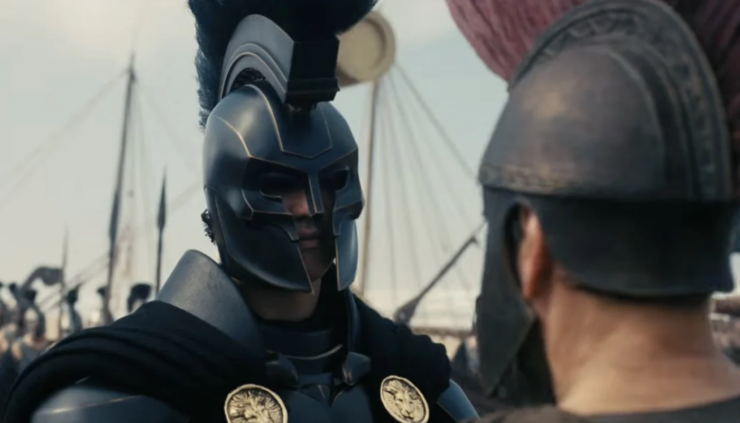
The Odyssey takes are everywhere. The takes are begetting takes; if they are not takes on Christopher Nolan’s film, they are takes on translator Emily Wilson’s take on Nolan’s film. These takes have in turn begotten takes on the takes on Wilson’s take. It is takeception (appropriately enough). Bluesky is a take ouroboros. The takes are eating their tails.
This is not an Odyssey take. This is a take on not having a take.
To be perhaps exceedingly clear, though, this is not about being too cool for school, or looking down one’s nose at the takes, or not letting people like things, or, for that matter, not letting people not like things. No: What I want to talk about is how sometimes it is bliss to cultivate no opinion whatsoever.
At present I have no opinion about The Odyssey, as I have not seen it, and no opinion about any of the takes on The Odyssey for the same reason. I do, alas, seem to have a take on some of the takes about Emily Wilson’s take—which is to say that I disagree with those people who think she should keep her mouth shut because the movie is making her money. That is capitalism brain talking. She owes no allegiance to a film she had nothing to do with. Let the woman opine! Let everyone opine.
But if you would like to take a break from opining, please, for this moment, come sit by me.
Most of the time, I have a lot of opinions. Professionally, I have opinions. Personally, I have opinions. We all have opinions. I have things I like and things I don’t like, things that make me grin in delight and things that make me slouch in dismal grumpiness. The internet has trained many of us into nigh-obsessive opinion-having (and if you are not one of those people thus trained, I salute you!). Between twenty years of writing about books and movies and more years than that of being online, I sometimes find that I am forming opinions without trying. This book looks great! That movie seems like a waste of time! Why is there another hot take about [insert hot take topic here]?
This is when I try very hard to stop. I do not need to have an opinion about everything I read about. I do not need to have an opinion about Taylor Swift or Dungeon Crawler Carl or House of the Dragon. In the best case scenario I can acknowledge these things and then simply let them pass out of my awareness.
But I must be honest: This requires work. It is a conscious choice to not have an opinion. To not care. To not be annoyed by the omnipresence of certain things at what feels like the expense of others. I was a pop culture obsessive from a young age, raised on Entertainment Weekly and Spin lists in the days before listicles were everywhere. It is hard to stop ranking and sorting and comparing. It is especially hard when there’s a deep temptation to focus on these things as a distraction, a diversion from all the horrors in the world. Having an opinion is easy. Pointing that attention somewhere else can be less so.
There’s another way to say all this, which is to say that it is important to cultivate an awareness of the instances in which things are not for you. I don’t mean “not for you” in a permission sort of way, but in the sense that we all have likes and dislikes, things we are more or less inclined to enjoy. Some things will not fit within your joy boundaries. Let them! Let them hang out over there, wherever there is. You don’t have to pay any attention to them. You may possibly be happier if you don’t pay attention to them.
This does not mean you can’t dislike things. Letting people not like things is important. Let haters hate; let lovers love; acknowledge that haters and lovers are often the same people, just pointed at different things. Sometimes I love Doctor Who and sometimes I hate Doctor Who, and when I hate it, it’s because I want to love it. Sometimes I hate a book I wanted to love, and sometimes the opposite happens. I feel very strongly that you have to let yourself be wrong about things as often as possible.
Cultivating a lack of unnecessary opinion is a good way to open yourself up to that joyful, expansive kind of being wrong. I don’t need to have opinions about horror or romance novels in general because those are not in my lane. I love the horror and romance communities; I love that these once-dismissed categories are dominating. I love underdog stories. But as a super-baby who is also rarely invested in a happily ever after, those genres are rarely for me. That isn’t a judgment, but an awareness: I don’t read them a lot, so when I do make an exception and pick a horror or romance novel up, I have to be aware of my ignorance. I have to try, really try, to not form any opinions ahead of time. To be a blank slate of curiosity.
Which is to say, in a roundabout way, that a lack of opinion is frequently a temporary state. I’m not going to be opinion-free about a book I’ve read, though I may try very hard to be opinion-free about an author’s later books if I have not enjoyed an early one. People change! Writers change! Readers change! What we’re looking for in the books we love might change week to week, or year to year. Or never. I have been wrong about books I thought I would like and wrong about books I thought I would hate. The space where expectations and opinions overlap is large and sometimes difficult to navigate, but I just keep saying to myself, Maybe I’m wrong about that.
I’ll have an opinion about The Odyssey eventually. I am neither a Nolan hater nor a Nolan lover, though I may be something of a Nolan skeptic after Tenet. (My favorite is The Prestige.) I will wait until I no longer feel like I’m swimming in a (wine-dark) sea of other people’s opinions, and I’ll go form my own.
But to be honest, I kind of like not having one at all.[end-mark]
The post The Specific Bliss of Just Not Having an Opinion (Sometimes) appeared first on Reactor.








 New Posts (Home)
 ChatBox
 Popular Posts
  Game Zone
 Top PodCasts