reactormag.com
Spider-Man: Brand New Day Is a Reminder We Could All Use Right Now
Movies & TV
Marvel Cinematic Universe
Spider-Man: Brand New Day Is a Reminder We Could All Use Right Now
You ARE saving the Shire for you, doofus.
By Emmet Asher-Perrin
|
Published on July 31, 2026
Image: Marvel Studios
Comment
0
Share New
Share
Image: Marvel Studios
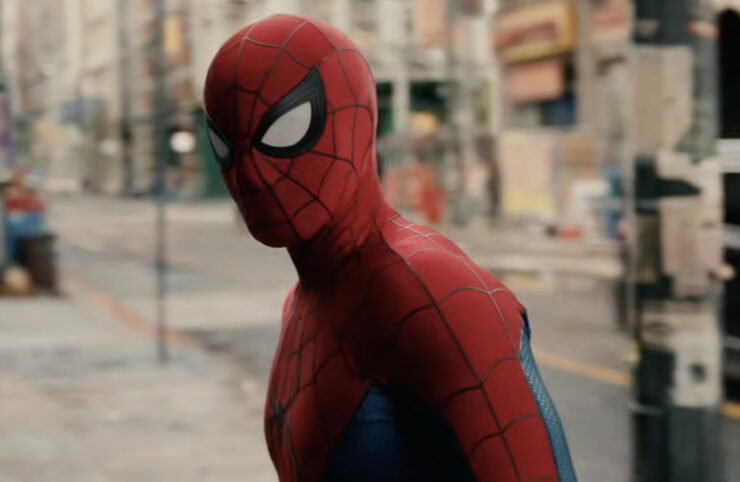
The MCU has now given us four Spider-Man films, and they’ve ranged, shall we say. Homecoming was beautifully done, Far From Home was… messy, No Way Home was enjoyable but also mostly an ode to all Spider-Man films simultaneously. Does it feel a little trite to say the Brand New Day really brings us back to why Homecoming worked so well? Yes. That doesn’t stop it from being true.
Is the movie still flooded with Marvel Studios setting up their next thing? Also yes. But it doesn’t detract nearly as much as I was expecting, and that’s because the movie never forgets to be about Peter Parker. And that’s good because where we left him at the end of No Way Home was quantifiably heartbreaking.
[This is a spoiler review, by the way, so watch out.]
So, it’s been four years. Ned (Jacob Batalon) and MJ (Zendaya) have already made it through college, and Peter Parker (Tom Holland) has been Spider-Man this whole time. Just Spider-Man. Only ever Spider-Man. He avoids developing relationships, moves further and further up in his apartment until he’s in a creepy roof space where he keeps his tech, his takeout, and his police scanner apps. He puts flowers on May’s grave and he works. He’s even made friends with Detective DeWolff (Liza Colón-Zayas)… and by friends, I mean that he calls her to ask about working. She’s worried about him and we can all see why.
There’s a note here that I’ve got to make about continuity because one admittedly annoying thing that Brand New Day does is make it clear that the films of the MCU are not even remotely interested in in figuring out how they align with any of the television we’ve seen. There’s even levels within the film hierarchy itself, if you take the meta commentary to its logical conclusion: Peter goes to get advice from Yelena (Florence Pugh, now the new obligatory “RDJ cameo” of these films, clearly having the time of her life just popping in and out to display all of the character’s idiosyncrasies) and she tells him bluntly that the work he does is “small potatoes.” She and the New Avengers work on the “big potatoes.”
It sounds innocuous on its face, but the opening of the film is a gleeful run-through of Peter’s day-to-day that feels an awful lot like a Spider-Man comic come to life. In it, we’re told that Spidey has spent the last four years rounding up basically every(!) crime boss in the city; he even manages to stop and capture the Hand all by himself.
You know, the Hand? The greatest threat in the world that Daredevil could barely knock back an inch? Oh, and apparently Kingpin didn’t warrant a spot on evil folks Spidey needed to pull down a peg, even when the city he lived in was under martial law and there was a vigilante task force running amok and throwing costumed heroes into an underground cage prison. Brand New Day is making it very unsubtly clear: Marvel Studios does not care if these things line up. They’re not meant to play nice together, even if they’re all stacked into the same timeline. It’s more than a little irritating, even if their breezy intro is adorable.
Image: Marvel Studios
Marvel is aware that fans have their quibbles, both major and minor. When we encounter Bruce Banner (Mark Ruffalo) for the first time in the film, he’s teaching at a university. One of his students wants to know why Thanos didn’t just Snap more resources into the universe if he was so worried about abundance. Bruce lets a Hulk fanboy student answer for him with a “Hulk smash!” It’s a cutesy way to have one of the biggest story houses on the planet (for the time being) collectively shrug emoji at its audience. And I’m not even getting into my bother over the fact that we never get to see any of Bruce Banner’s notable status quo changes. It seems like every time we see the guy, he and Hulk have a different dynamic (he’s currently suppressing him with a mechanical inhibitor). Too bad we never get to find out how or why any of these changes occur.
The plot of this film is nothing to write home about, as you’re liable to see most of the twists and turns coming a mile off. There’s also a lot of convenience built into the story where things just happen because they have to, and you roll your eyes and decide whether or not you’ll let it pass. The CGI is half well-rendered and half mushy mess, but the action sequences are thankfully mostly well-done and never over-long, which has been the standard of the MCU films for an age. Director Destin Daniel Cretton brings all of his experience from Shang-Chi to bear in making those sequences fresh and dynamic, resulting in the first appearance by the Hand in NYC that doesn’t make them feel like interchangeable (and therefore infinitely murderable) ninja stereotypes.
The mutant question looms large over the whole film, as the MCU is itching to bring in the X-Men, but knows that each micro step they take down that road will inform everything about how successful they can be going forward. To that tune, they do something that no film associated with the X-Men has ever done before: They do right by Jean Gray.
It was rumored from the start that Sadie Sink had been cast as one of the most prominent redheads in Marvel Comics, and the reveal comes fairly quickly: Someone is hopping minds to break into Damage Control facilities and keeps searching the classified files. Once we know it’s Jean, the question of who the film’s villain is gets muddied for Peter. (It’s probably never been muddy if you’re enough of a comics fan to know that Damage Control is bad news.) But it’s hard for Spider-Man to crack the case because Jean finds him first and goes straight for the heart: She threatens MJ’s safety, and also finds the note Peter meant to give her at the end of No Way Home, explaining how the world forgot him. Once she’s got him figured out, and busy trying to keep MJ out of harm’s way, her obstacles diminish.
Image: Marvel Studios
This is the place where the film shapes itself into a worthy piece of story, for two very notable reasons. One, the film begins to question how Peter has handled the last four years and unequivocally shows him to be wrong. And two, the film allows its two central female characters to be (respectively) angry and unsure. Jean, in particular, has never been allowed her rage in a manner that didn’t relate to the Dark Phoenix power and also didn’t elide the reasons for her anger and its justification. Brand New Day does both: Jean Gray hasn’t been touched by the Phoenix, but she’s furious and hurting and she has every reason to be. The movie doesn’t fear her anger or any potential instability that might come from it; she has as much right to it as any male character that Marvel has gotten the audience to side with over and over in the past two decades.
MJ is the one who is allowed to be unsure. She eventually gets that letter (though Peter doesn’t give it to her), and realizes that she’s forgotten someone important to her life. But love can’t save anything when there are literally no memories attached to anchor it. She doesn’t tell Spider-Man to hit the curb, but she’s clear about the fact that she doesn’t love him, and that he made a mistake in not delivering the letter immediately. She still asks him if he wants to come up and say hi to her roommate Ned, the guy responsible for a Spider-Man tracking app, who is admittedly desperate to figure out who the masked man is.
Ned Leeds is the key connection that Peter starts and finishes the film with, and this was the part of the film that wrung tears from me. Because love is great and Spider-Man movies can’t help but focus on who Peter Parker is besotted with on any given day. But good Spider-Man movies are about what it means to be a hero within your own community. I’ve written about this before, in fact, about how all the best Spider-Man films showcase that Peter Parker must lean on his community just as much as they lean on him. That’s the pact and precisely what makes Spider-Man a singular in the superhero pantheon. He’s your friendly neighbor; he just also happens to have super strength. But in all the lessons that he’s absorbed over the years, Peter failed to recognize that serving a community you’re not taking the time to be a part of is missing the entire point.
MJ invites Peter up and Spider-Man sits in their living room with Ned Leeds while they built Star Wars legos and quote Lord of the Rings at each other. And you realize that Peter must think he’s Frodo in all of this: He’s saving the Shire, but not for himself. It doesn’t have to work that way for him, but it absolutely will if he doesn’t return to the people he needs most.
That’s people plural.
Image: Marvel Studios
The uncertainty that MJ feels evaporates on watching Spider-Man hang out with Ned. It makes all the sense in the world because love—yes, even romantic love—doesn’t exist in a vacuum. She and Peter were never a duo alone and apart; they were part of a trio. The love MJ felt for him can’t possibly resurface in absence of who they all were together. She lost the man she loved, but her roommate lost his childhood best friend. The hole that Peter left in MJ’s life is paltry by comparison. We never even touch on how Ned has attempted to fill in the gaps left by the person he spent nearly every day of his life with, and that’s probably for the best because that’s more tragedy than my soft heart can take.
Peter Parker is someone wracked by loss at every turn. He somehow thought he could voluntarily continue that loss indefinitely. But he still creates bonds even when he doesn’t mean to—with Detective DeWolff, with Bruce Banner, with the freaking Punisher. That’s where we get to my second favorite part of the film, which is acknowledging that giving Frank Castle (Jon Bernthal) the opportunity to parent any relatively young person he comes across can only improve your story. Bernthal and Holland have worked together quite a bit. They even helped each other film their MCU auditions. Those years of rapport make all the interactions between Frank and Peter sing with an ease and comfort these characters are meant to have with each other.
All I can say is that I really hope they keep Frank’s new digs for television because his waterside hideaway is leaps and bounds above his Daredevil sadness basement and his One Last Kill empty Queens apartment.
Frank does seem to be doing a little better, despite his usual well of sadness and pain. The man instantly knows that Spider-Man is not alright because he won’t even take his mask off to drink a cup of coffee (the Punisher’s love language is caffeinating people and occasionally feeding them too), but he offers to look after MJ all the same. It’s an equally good idea to have Castle in this story because he moves things along by being who he is; the choices might be terrible, but he’ll never not make one with his whole growling chest. He runs as a very sharp contrast to Jean Gray at the same time—a pointed commentary on how the fury of men gets treated differently without really having to say anything at all.
Image: Marvel Studios
There’s a thematic undercurrent in the film about refusing to accept who you really are. Peter’s spider DNA is evolving; Jean is coming into her power; Bruce is stuffing the Hulk into a lockbox. That’s the surface of the theme, true, but the underlying subtext is far more affecting: What Brand New Day ultimately tells its audience is that change doesn’t need fighting at every turn. You will not be the same person tomorrow that you were yesterday, and fearing those changes as they emerge is likely to cause far more damage than the alternative. Let yourself mutate a little and maybe you’ll like what you find.
Another thing that Brand New Day gets exactly right? Fans are accustomed to Spider-Man’s central lesson: With great power there must also come great responsibility. And it’s a good one, but it ignores the fact that most people don’t really have a ton of power. It also ignores that Peter Parker needs more than a single all-encompassing lesson to be a full human being. May Parker (Marisa Tomei) was a wonderful parent to Peter, and her wisdom could never been so conveniently summed up. So we find that there are other gems in Peter’s memory, truths that May offered up that he wasn’t quite ready to assimilate. Peter Parker never stops learning to do better and neither should we.
Peter also knows when to gift those gems to others who need them. And he knows how to be a true friend to people—even the ones he barely knows. With this in mind, Brand New Day manages to be a Spider-Man film that continues the arc of Homecoming, acknowledging that the community and who you fill it with were always the point… but also that you cannot exist cordoned off from it, high above. Because you’re not saving the Shire for who comes after you.
You’re saving it in order to be a part of it.[end-mark]
The post <i>Spider-Man: Brand New Day</i> Is a Reminder We Could All Use Right Now appeared first on Reactor.








 New Posts (Home)
 ChatBox
 Popular Posts
  Game Zone
 Top PodCasts