New Posts (Home)
 ChatBox
 Popular Posts
  Game Zone
 Top PodCasts



In Florida, Senator Alexis Calatayud has introduced a proposal that could quietly reshape how millions of Americans experience the digital world.
The App Store Accountability Act (SB 1722), presented as a safeguard for children, would require every app marketplace to identify users by age category, verify that data through “commercially available methods,” and secure recurring parental consent whenever an app’s policies change.
The legislation is ambitious. If enacted, it would take effect in July 2027, with enforcement beginning the following year.
Each violation could carry penalties of up to $7,500, along with injunctions and attorney fees.
On its surface, this is a regulatory measure aimed at strengthening parental oversight and protecting minors from online harms. Yet it hits up against a larger philosophical and rights struggle.
For much of modern political thought, the relationship between authority and liberty has revolved around who decides what constitutes protection. Florida’s proposal situates that question in the hands of private corporations. The bill effectively deputizes Big Tech app store operators, such as Apple and Google, as arbiters of digital identity, compelling them to verify user ages and manage parental permissions across every platform.
Millions of Floridians could be required to submit identifying details or official documents simply to access or update apps. This process, while justified as a measure of security, reintroduces the age-old tension between the protective role of the state and the autonomy of the citizen.
By making identity verification the gateway to digital access, the law risks creating an infrastructure in which surveillance becomes a condition of participation. It is a move from voluntary oversight to systemic authentication, merging the roles of government and corporation in a single mechanism of control.
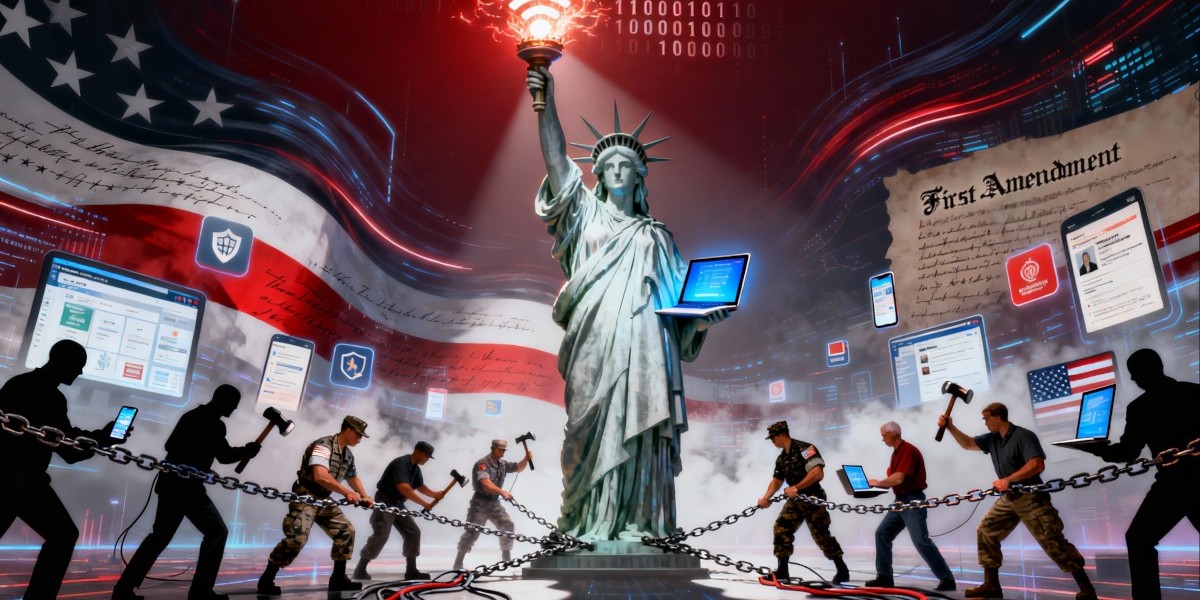
The proposal may collide with long-established constitutional principles. One of the objections lies in the concept of prior restraint. By conditioning minors’ ability to download or continue using apps on verified Big Tech platforms, the bill requires permission before access, effectively placing all expressive content behind a regulatory gate.
Apps today are not mere entertainment; they are conduits of news, art, religion, and political discourse. Restricting that access risks transforming a parental safeguard into a systemic filter for speech.
The burden falls most heavily on minors, whose First Amendment protections are often ignored in public debate.
Even developers face new forms of coercion. They must label their content, supply age ratings, and maintain disclosure protocols. These requirements constitute a form of compelled expression, obliging creators to describe their own work within state-defined categories.
The risk is a chilling effect, as smaller or independent developers avoid sensitive topics to evade potential penalties.
The broader concern lies in the erosion of anonymity. The obligation for app stores to collect age verification data introduces a structural obstacle to private or pseudonymous participation online, especially in areas concerning health or political dissent.
The loss of anonymity, long regarded as a cornerstone of free expression, narrows the space in which individuals can think and speak without fear of reprisal.
The bill’s structure reflects a growing trend in American governance: delegating the enforcement of public norms to private intermediaries. Under SB 1722, app stores become both enforcers and adjudicators, responsible for restricting access, revoking permissions, and coordinating compliance among developers.
Such delegation muddies the waters between market participation and state authority. It places speech regulation in the hands of commercial entities without traditional checks or transparency requirements. This could mean that access to lawful content might depend on the opaque policies of private corporations acting under the shadow of state mandate.
Beyond questions of speech, SB 1722 reflects a deeper issue about data power. As governments increasingly enlist private firms to enforce public policy, citizens find themselves surrendering personal information not to the state directly, but to corporations operating under legal obligation.
This dynamic is not unique to Florida. Across the United States and Europe, digital identity verification is emerging as the preferred tool for reconciling safety with access.
Yet the accumulation of sensitive data by large platforms magnifies existing concerns about surveillance and misuse. In the name of protecting minors, the law could inadvertently expand the very data-collection practices it seeks to regulate.
The state seeks to guide, parents to safeguard, and corporations to comply. But as the mechanisms of verification multiply, so too do the constraints on individual autonomy.