www.wearethemighty.com
Curtis LeMay: World War II bomber, cold warrior, and judo champion
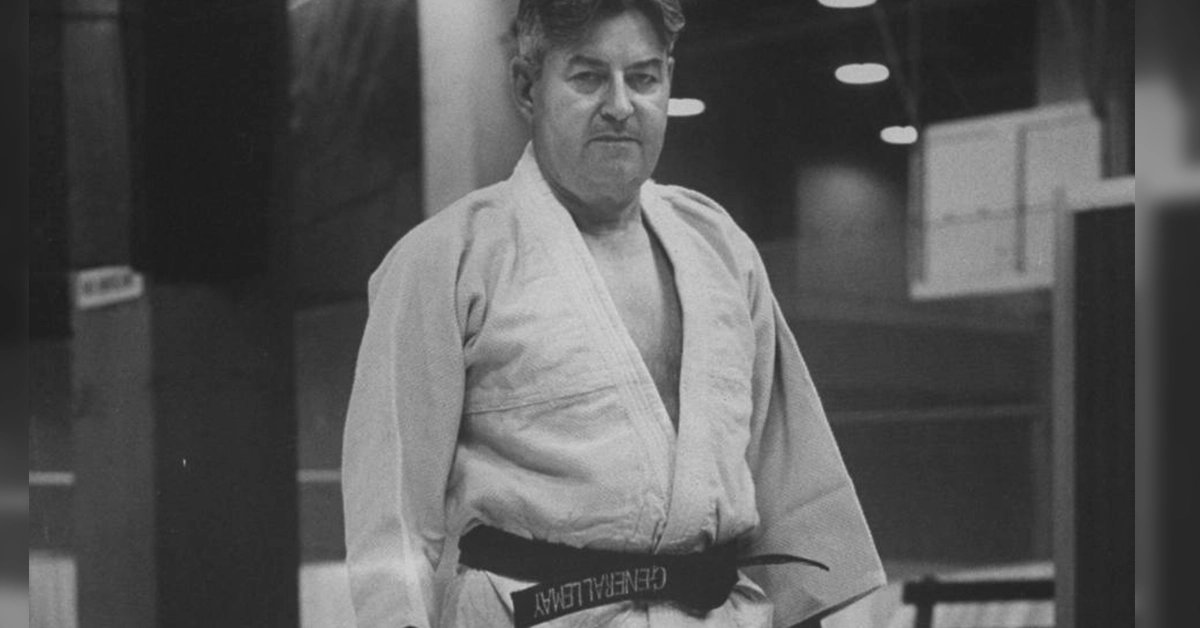
Okay, Curtis LeMay wasn’t a judo champion in the sense that he was winning awards for tossing people around. He did, however, popularize the martial art for the postwar world, bringing it into the U.S. Air Force, and through the military, to the rest of America.Time has not been kind to LeMay. He’s remembered for firebombing cities across Japan, especially Tokyo, an attack that killed 100,000 Japanese civilians in a single night. He also built the Strategic Air Command into a nuclear powerhouse with the belief that he would one day nuke the Soviet Union “back into the Stone Age.”Also Read: 7 awesome airpower quotes from General Curtis LeMayFor all his bluster, LeMay was an innovative thinker, a problem solver, and the first to make the changes he wanted to implement. When “Old Iron Pants” decided the Air Force was out of shape, he found a way to fix it. He even put on his own judogi.
Presumably after smoking a cigar. (National Archives)
A Fitness Problem
When LeMay took command of Strategic Air Command in 1948, he inherited a mess. SAC was supposed to be the nation’s nuclear deterrent, but its planes were unreliable, and—some veterans might be shocked to hear—the Air Force was out of shape.More importantly, the Air Force had new B-36 Peacemaker bombers that could keep crews airborne for 30 hours at a stretch, and physically unfit airmen could make mistakes during those long flights. Mistakes can cause accidents, especially at 40,000 feet.LeMay despised any kind of inefficiency.He needed something that would do more than just get airmen running laps. He needed a program that built endurance, coordination, and mental toughness. If it could also keep a downed aircrew alive and evasive behind enemy lines, that would be even better.Judo was the answer.
From the Kodokan to Omaha
In 1950, LeMay ordered Lt. Gen. Thomas Power to stand up an experimental physical conditioning unit at Offutt Air Force Base in Nebraska. The program combined preflight conditioning with post-flight recovery. Flight surgeons recommended steam baths and massages for recovery. For conditioning, they chose judo.There were a lot of good reasons to choose judo. It taught airmen how to fall and roll, a great skill for anyone who might have to bail out of an aircraft. It built functional strength and situational awareness. And it gave crew members a fighting chance if they were shot down and unarmed in enemy.To run the program, LeMay hired Emilio “Mel” Bruno, a former national wrestling champion and sixth-degree black belt in judo. It was Bruno’s job to build SAC’s judo program from the ground up. The Air Force officially dubbed it “Combative Measures,” a perfectly bureaucratic name for throwing around your fellow airmen.
(U.S. Air Force)
Training With Judo Masters
LeMay’s biggest challenge was instructors. There simply weren’t enough qualified judo teachers in the Air Force. His solution was characteristically bold. He decided to send airmen directly to the Kodokan Judo Institute in Tokyo, the birthplace of judo. There, they received advanced training under the world’s foremost experts.It was a “train the trainer” kind of program. The first class of 13 instructors shipped out in 1952. They trained in judo, jujitsu, karate, and other martial arts, then returned to teach at SAC bases across the country.In 1953, LeMay also brought 10 of Japan’s highest-ranking judo, karate, and aikido masters to the United States for a 60-day tour of SAC installations. The group included legends like eighth-degree black belt Sumiyuki Kotani and future Japan Karate Association head Masatoshi Nakayama.Japanese instructors were struck by how American airmen approached training. Unlike students in Japan who followed instructions without question, the Americans demanded to understand the why behind every technique. Nakayama later said that the experience pushed him into an intense study of kinetics, physiology, and anatomy under his own master’s guidance.It was a mutually beneficial cultural exchange. American judo players like Staff Sgt. George Harris proved that big, athletic Western fighters could compete at the highest levels, and by the late 1950s, even Olympic-caliber Japanese judoka started adding weight training to their routines.
American heavyweight judoist George Harris (left) and heavyweight boxer Joe Frazier compare their “weapons” as they meet in the Olympic Village in 1964. (Bettman)
America Becomes a Judo Powerhouse
LeMay, as usual, was unorthodox but turned out to be right. Within a decade, SAC produced more than 160 black belt judo instructors. Between 1959 and 1962, a judo instructor course at Stead Air Force Base in Nevada graduated nearly 10,000 instructors through a five-week curriculum that covered judo, aikido, karate, air police techniques, aircrew self-defense, and tournament procedures.Moreover, SAC’s competitive judo team became a national force. In 1957, Harris (who had only studied judo for only five years) won the Grand Championship at the National AAU Judo Championships in Hawaii. The Air Force team captured the National Five-Man Team Championship that same year, then successfully defended it the following year.Harris went on to represent the United States at the second World Judo Tournament in Tokyo in 1958, where his performance earned him a promotion to fourth-degree black belt. He was the first Armed Forces judoka to receive that honor.The SAC Judo Society became a chartered black belt organization under the Kodokan in 1956, the first and only U.S. Armed Forces judo association to receive that recognition.
Continuing a grand Air Force tradition, Senior Master Sgt. Dustin Clocherty prepares to throw an opponent. (U.S. Air Force/Staff Sgt. James Crow)
The Air Force Changed American Martial Arts Forever
LeMay’s judo program eventually wound down during the Vietnam era. Downed B-52 crews over Southeast Asia had little practical use for hand-to-hand combat techniques, and by the mid-1980s, Air Force physical conditioning had shifted almost entirely toward cardiovascular fitness and weight management.The Strategic Air Command Judo Association evolved through several name changes. First came the Air Force Judo Association, then the Armed Forces Judo Association, and finally, in 1969, the United States Judo Association (USJA). By the 1990s, the USJA had 10,000 members.More importantly, discharged Air Force judo instructors carried the art into civilian life. They opened schools in garages and YMCAs across Middle America, places where Asian martial arts may never have existed before.A four-star Air Force general’s quest to keep bomber crews alive during the Cold War planted martial arts in the American heartland, almost by accident.It’s understandable why history either loves Curtis LeMay or hates him. He remains a deeply complicated historical figure. His World War II bombing campaigns are still controversial, and his hawkish Cold War politics made him a lightning rod for criticism.Running for vice president alongside George Wallace, the pro-segregation governor of Alabama, doesn’t help his legacy.
President Lyndon B. Johnson once remarked to an aide, “LeMay scares the hell out of me.” (National Archives)
His foundational role in the story of American martial arts, however, is undeniable.He solved a practical problem of unfit aircrews flying long, dangerous missions with a program that rippled far beyond anything he likely imagined. The judo instructors he sent to the Kodokan became the seed stock for organized martial arts in America. The competitive teams he funded proved that American fighters could stand with the best in the world. The judo schools that dot strip malls across America can trace their roots back, in part, to a cigar-chomping Air Force general who wanted his airmen to know how to fight with their bare hands.
Don’t Miss the Best of We Are The Mighty
• The ‘Chopper Popper’ scored the A-10’s first air-to-air kill against an Iraqi helicopter• 5 Seldom-told tales about Air Force legends• The A-10 training guide from the 1970s was a hilarious coloring book
Air Force
Cold War
Curtis LeMay: World War II bomber, cold warrior, and judo champion
By Blake Stilwell
Resources
Everything you need to know about military ranks and what they mean
By Jessica Evans
Sports
The US service members competing in the 2026 Winter Olympics
By Stephen Ruiz
Aviation
4 things that made the F-16 Fighting Falcon years ahead of its time
By Ward Carroll
Cold War
The 1952 UFO Washington sighting that upended decades of denial
By Daniel Tobias Flint
The post Curtis LeMay: World War II bomber, cold warrior, and judo champion appeared first on We Are The Mighty.
 New Posts (Home)
 ChatBox
 Popular Posts
  Game Zone
 Top PodCasts