www.militarytimes.com
Push to identify remains of POWS who endured Bataan Death March, hell ships
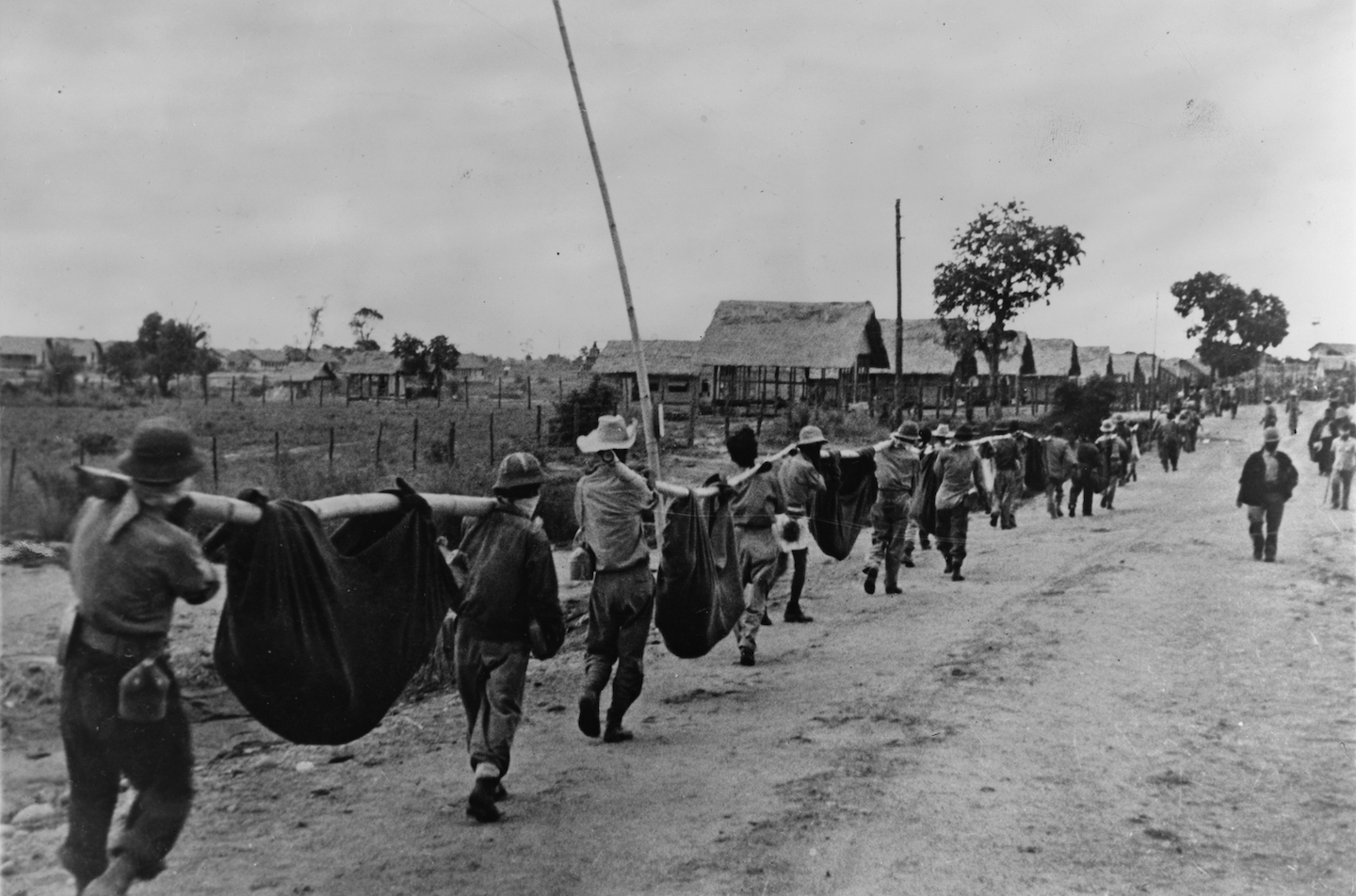
More than 80 years later, the remains of U.S. POWs buried as “unknowns,” or entombed in the holds of Japanese “hell ships” sunk by U.S. warplanes and submarines, have started coming home to families who kept their memories alive.In an extraordinary and ongoing effort, specialists from the Defense POW/MIA Accounting Agency, using new techniques including “next generation” DNA sequencing, have resumed the effort to recover and identify remains from the prison camps and ships used to transport POWs that the U.S. gave up on in 1951.One of the most recent identifications was that of Army Air Forces Pvt. Bennett H. Waters, who was serving on the Bataan peninsula with the 17th Bombardment Squadron, 27th Bombardment Group, when the forces of Imperial Japan invaded the Philippines on Dec. 8, 1941, the day after the Pearl Harbor attacks.He was among a group of at least 20 American POWs from the Pacific whose remains have been identified and returned to their families from the first of the year through April 21.Waters had survived the Bataan Death March; he survived more than three years of prison camp cruelty; and he would survive the sinking by U.S. aircraft on Dec. 14, 1944, of the unmarked Japanese transport Oryoku Maru, which had been taking him and more than 1,600 other POWs to Japan’s home islands to work as slave labor.Waters, then 26 years old, would not survive a second attack by U.S. aircraft on a second Japanese “hell ship,” the Enoura Maru, on Jan. 9, 1945, in the port of Takao, Formosa (now Taiwan). Waters and more than 300 other U.S. POWs killed in the attack on the Enoura Maru were later buried in a mass grave in Takao, according to DPAA.In both sinkings, the aircraft came from the same U.S. carrier, the Hornet (CV12), the namesake of the carrier Hornet (CV8) which launched the April 8, 1942, raid on Tokyo led by then-Lt. Col. James H. “Jimmy” Doolittle and was later sunk on Oct. 27, 1942, in the battle of the Santa Cruz Islands.Following the identification, the remains of Waters were brought back to his southeast Georgia hometown of Blackshear with a military escort from his great-great nephew, Army Sgt. Andrew Walsh of the 10th Mountain Division, for interment on April 4 with full military honors.Walsh told First Coast News that bringing home “Uncle Hubert,” as he was known, was “an important moment for me but not only me, but for my whole family.”“We come from a long line of service in the Waters bloodline dating back to the Civil War,” Walsh said. “As a family member of Pvt. Waters, it means a lot that he was able to be found and finally be placed next to his mother” who had a plot at the Blackshear City Cemetery waiting for himYears ago, Waters’ mother, Minnie Bennett Waters Kelly, bought a tombstone to mark the grave of the son that she believed would eventually return to his southeast Georgia hometown, the Blackshear Times reported.The April 4 services for Waters at the First Baptist Church of Blackshear marked one extended family’s tribute to the service of a relative who went off to war in another century and whose memory could not be erased by the passage of time and generations.As the Blackshear Times put it, “Over eight decades of pain, heartache and unanswered questions finally came to an end” when Waters was laid to rest.Attending the services were several of Waters’ nieces and “numerous” great-nieces and great-nephews; great-great nieces and nephews; and great-great-great nieces and nephews, the Blackshear Times reported.On his return to Fort Drum in upstate New York, Sgt. Walsh went to the Fallen Warrior Monument on the base to reflect on his unexpected mission to escort the remains of a great-great uncle he had only learned of through family lore.“My reaction was happy, for one, because he is coming home after so many years of being a POW/MIA,” Walsh said in an article by the Fort Drum Garrison public affairs office. “And then I was excited that I could honor my family in such an important way. As a soldier, it makes me happy to have a fellow soldier coming home, and honoring his memory, and being able to pay respect to him for the sacrifices that he made for this great nation.”Identifications continueAnother POW whose remains were recently identified was Army Air Forces Pfc. Weber S. Underwood, 25, a member of 28th Materiel Squadron, 20th Air Base Group.He survived the Bataan Death March but was believed to have died while assigned to the infamous Tayabas Road work detail, according to prison camp and other historical records, DPAA said in a release.The work at Tayabas Road was such that the POWs built a small cemetery where the remains of 35 POWs were recovered after the war, according to DPAA.The work detail was a brutal forced labor project in which the Japanese Imperial Army used roughly 300 POWs to construct and repair a strategic jungle road in Tayabas Province, DPAA said.Underwood died on June 3, 1942, according to the DPAA, and by then Japanese Prime Minister Hideki Tojo was getting ready to order the transfer of thousands of POWs aboard unmarked transports from the Philippines and other sites in the Pacific to Japan’s home islands to be used as slave labor.Tojo, who was hanged after the war, ordered prisoners to be shipped to Japan on all available vessels, and “The Japanese military subsequently transferred large numbers of POWs to industrial sites throughout their empire— Formosa (Taiwan), Korea, Manchuria, China, Burma (Myanmar), and Siam (Thailand),” DPAA said in a release.Thousands of prisoners had already died in captivity that began in 1942 when roughly 12,000 U.S. troops and more than 60,000 Filipinos surrendered on the Bataan peninsula in what was arguably the worst defeat ever suffered by the U.S. military.Then began what has come to be known as the “Bataan Death March,” a 65-mile trek to a railhead in tropical heat with little food or water amid the unremitting cruelty of the Japanese guards who stood ready to kill anyone who fell out of line.“We had no idea what was ahead” as the march began, Army Air Forces Cpl. James Bollich, who survived the war, said in a 2012 article published by Air Force Global Strike Command Public Affairs.As the march continued, “All we were doing was burying the dead,” Bollich recalled. “I remember looking around and deciding that the way people were dying that within a few weeks we would all be dead. The big killer was dysentery. Once you caught dysentery you were gone.”Bollich was later transferred in what the prisoners came to call “hell ships” to labor camps in Mukden, in what is now China, where he was eventually liberated by Russian troops.Hell on land and seaIn all, the floating dungeons that were the hell ships made a total 156 voyages to transfer POWs, and an estimated 25 of them were sunk by U.S. aircraft or submarines, according to a report by the U.S. Naval History and Heritage Command.The lingering question about the hell ships has been whether U.S. intelligence or theater commanders knew that American prisoners were aboard and still allowed the attacks to proceed.In the case of the Oryoku Maru, the sinking “was the result of intercepted Japanese radio transmissions that would have revealed some information about POWs on board,” according to a November 2019 article by the NHHC.“Whether that information made its way down to the theater commanders is unclear. At any rate, there is no evidence to suggest that commanders at sea had any knowledge of the presence of POWs on Japanese ships,” NHHC said.According to figures compiled for the Department of Veterans Affairs Advisory Committee on Former Prisoners of War in 1981, the Japanese held a total of 27,465 American POWs during the war and of that total, 11,107 died in captivity.The oral histories of survivors at the Veterans History Project of the Library of Congress attest to how they died: some were worked to death; some fell to disease and starvation; some died from the bayonet or the bullet of a prison camp guard.Following the war, the American Graves Registration Service sought to recover and identify remains, including at the main Cabanatuan prison camp in the Philippines, but discontinued the effort in 1951, citing the poor condition of and the commingling of the remains that prevented identification.More than 3,000 sets of remains were reburied as unknowns at the Manila American Cemetery where they have been cared for by the American Battle Monuments Commission. Others have been reburied as unknowns at the National Memorial Cemetery of the Pacific in Honolulu, known as the “Punchbowl.”In 2014, the Defense Department gave DPAA the mission of renewing the effort to identify, recover and repatriate the remains of POWs who died in the prison camps or aboard the hell ships.In an e-mail to Military Times, Heath Kennedy, the DPAA Indo-Pacific Disinterment Manager, said that 761 unknowns have thus far been disinterred from the Manila American Cemetery, with most of those occurring since 2017 when DPAA sped up operations.The 761 unknowns include 464 unknowns associated with common graves from the Cabanatuan POW camp, Kennedy said. “Of the 464 Cabanatuan POW Camp unknowns already disinterred, at least 142 have been identified,” he said.As for the hell ships, DPAA has disinterred 430 unknowns associated with the hell ships in Fiscal 2023 “and both the Manila and Punchbowl cemeteries and the DPAA Lab are still working to identify as many as possible,” Kennedy said.DPAA forensics specialists use dental and anthropological analysis, as well as circumstantial evidence, to make identifications. They are assisted by scientists from the Armed Forces Medical Examiner System who use mitochondrial DNA analysis to confirm identities, DPAA said in a release.The most recent identifications were also aided by next generation DNA sequencing, which can identify remains using DNA samples from relatives who are several generations removed from the deceased individual.At an April 1 briefing in Thailand, DPAA Director Kelly McKeague also announced that DPAA had begun its “largest, most complex underwater mission ever in the history” to recover and possibly identify the remains of POWs who were killed when U.S. Navy aircraft mistakenly bombed and sank the Oryoku Maru in December 1944.“When the ship was sunk, it limped back into Subic Bay and it sank there. And we began this effort three years ago to underwater investigate the site and the wreckage from the standpoint of trying to understand what it was, what the ship looked like,” McKeague said.“We estimate there might be over 250 missing Americans in the hold of the ship. We think they might be limited to one of two holds, and that’s where the divers are currently operating,” McKeague said.
 New Posts (Home)
 ChatBox
 Popular Posts
  Game Zone
 Top PodCasts