YubNub Social YubNub Social
    #music #trombone #atw #armymusic #militarymusic #atw2026 #armyband #band #concertband #tusab #jazz #trombonechoir #jazztrombone #quartet #warmup
    Advanced Search
  • Login
  • Register

  • Day mode
  • © 2026 YubNub Social
    About • Directory • Contact Us • Developers • Privacy Policy • Terms of Use • shareasale • FB Webview Detected • Android • Apple iOS • Get Our App

    Select Language

  • English
Night mode toggle
Featured Content
Community
New Posts (Home) ChatBox Popular Posts Reels Game Zone Top PodCasts
Explore
Explore
© 2026 YubNub Social
  • English
About • Directory • Contact Us • Developers • Privacy Policy • Terms of Use • shareasale • FB Webview Detected • Android • Apple iOS • Get Our App
Advertisement
Stop Seeing These Ads

Discover posts

Posts

Users

Pages

Blog

Market

Events

Games

Forum

Science Explorer
Science Explorer
2 yrs

Bizarre Sea Pig Spotted At Chile’s Deepest Seeps 2,836 Meters Below The Sea
Favicon 
www.iflscience.com

Bizarre Sea Pig Spotted At Chile’s Deepest Seeps 2,836 Meters Below The Sea

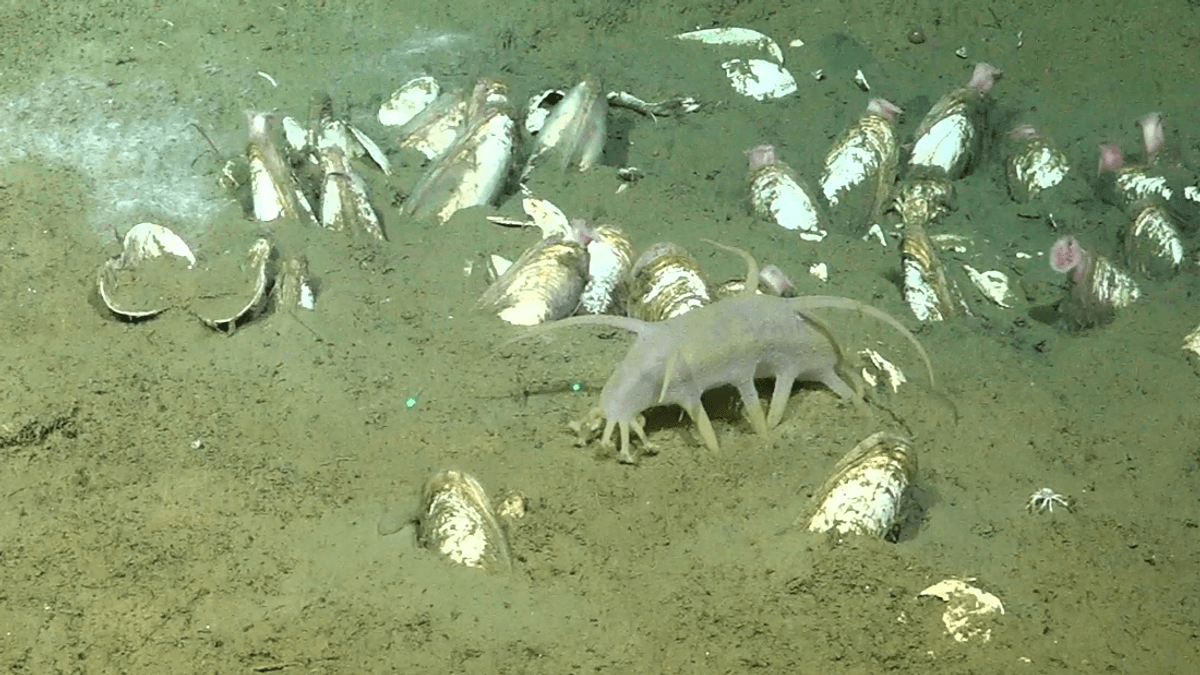
An almighty discovery has been made during an expedition in the Atacama Trench, an 8,000-meter-deep formation that stretches along the length of Peru and Chile. Here, Scientists on a research expedition onboard Schmidt Ocean Institute’s R/V Falkor (too) found Chile’s deepest and northernmost cold seeps at a depth of 2,836 meters (9,304 feet).Cold seeps are areas where hydrocarbons like methane form bubbles along the ocean floor. They get harder to find the deeper you go, and locating these record-breaking seeps took over 12 hours using seafloor mapping data.All evidence points to them being methane seeps, a phenomenon known to occur along subduction zones where two tectonic plates are colliding pushing one under the other – just like the Cascadia Subduction Zone that's leaking lubricant in a very strange way. The methane can be a great resource for deep-sea animals like clams, squat lobsters, and tube worms, as it feeds the bacteria that make up some of their diet.A methane seep documented on the seafloor during Dive 681.Image credit: ROV SuBastian/Schmidt Ocean Institute (CC BY-NC-SA 4.0)"The microbes that live on these seeps have amazing strategies for producing food without sunlight,” said expedition lead Dr Lauren Seyler of Stockton University, New Jersey, in a statement emailed to IFLScience. “Here on Earth, life in the dark is alien in its own right and provides critical information for understanding how organisms persist under the most extreme conditions. We are still trying to figure out how life started on Earth, and environments that provide chemical energy for life, like this one, might offer clues about the spark that ignited all the biodiversity on our beautiful planet.”The bacteria are crucial because sunlight can’t reach this deep, making these critters of great interest to astrobiologists trying to work out how life could evolve in extraterrestrial habitats that don’t meet our established criteria for what life needs to thrive.A deep-sea lizardfish documented on the seafloor during Dive 691.Image credit: ROV SuBastian/Schmidt Ocean Institute (CC BY-NC-SA 4.0)“The Atacama Desert is a well-known Mars analog model here on Earth. It contains precious insights for how life, if it ever arose on Mars, might be able to adapt to an increasingly drying plane,” said Dr Armando Azua-Bustos of Centro de Astrobiología (CAB, CSIC-INTA). “We hope the information we gathered from the Atacama trench, with help from the Schmidt Ocean Institute, will aid us in searching for biosignatures should we eventually study the oceans of Enceladus and Europa on Saturn and Jupiter, water worlds that may potentially support life.” A total of 70 specimens were collected during the expedition, some of which are thought to be new-to-science species. There may even be some living fossils in the mix in the form of brachiopods, leptochitons, and crinoids, which are speculated to be close descendants of fossils found in the Atacama Desert.And a trip to the seabed just wouldn’t be complete without an appearance from a sea pig, one of the planet’s strangest deep sea cucumbers. They snuffle along the seafloor, sifting out organic morsels to feed on, and come in all sorts of colors – including “Barbie sea pig” pink.
Like
Comment
Share
Science Explorer
Science Explorer
2 yrs

ChatGPT Might Have Passed The Turing Test, New Study Suggests
Favicon 
www.iflscience.com

ChatGPT Might Have Passed The Turing Test, New Study Suggests

In 1637, the French philosopher and probable pothead René Descartes came up with an interesting thought: can a machine think? In 1950, the English mathematician and computer scientist Alan Turing announced the answer to this 300-year-old poser: who cares? A much better question, he said, was something that would come to be known as the “Turing test”: given a person, a machine, and a human interrogator, could the machine ever convince the interrogator that it was actually the person?Now, another 74 years after Turing reformulated the question in this way, researchers at the University of California, San Diego, believe they have the answer. According to a new study, in which they had human participants talk to either one of a variety of artificial intelligence systems or another human for five minutes, the answer is now a tentative “yes.”“Participants in our experiment were no better than chance at identifying GPT-4 after a five minute conversation, suggesting that current AI systems are capable of deceiving people into believing that they are human,” confirms the preprint paper, which is not yet peer-reviewed. “The results here likely set a lower bound on the potential for deception in more naturalistic contexts where, unlike the experimental setting, people may not be alert to the possibility of deception or exclusively focused on detecting it.”Now, while this is certainly a headline-grabbing milestone, it’s by no means a universally accepted one. “Turing originally envisioned the imitation game as a measure of intelligence,” the researchers explain, but “a variety of objections have been raised to this idea.” Humans, for example, are famously good at anthropomorphizing just about anything – we want to empathize with things, regardless of whether they’re another person, a dog, or a Roomba with a pair of googly eyes stuck on top.On top of that, it’s notable that ChatGPT-4 – and ChatGPT-3.5, which was also tested – only convinced the human participants of its personhood about 50 percent of the time – not much better than random chance. So how do we know that this result means anything at all?Well, one failsafe that the team built into the experiment design was to include ELIZA as one of the AI systems. She was one of the very first ever such programs, created in the mid-60s at MIT, and while she was undoubtedly impressive for the time, it’s fair to say she’s not much on modern large-language model-, or LLM-, based systems. “ELIZA was limited to canned responses, which greatly limited its capabilities. It might fool someone for five minutes, but soon the limitations would become clear," Nell Watson, an AI researcher at the Institute of Electrical and Electronics Engineers (IEEE), told Live Science. “Language models are endlessly flexible, able to synthesize responses to a broad range of topics, speak in particular languages or sociolects and portray themselves with character-driven personality and values. It’s an enormous step forward from something hand-programmed by a human being, no matter how cleverly and carefully.”In other words, she was perfect to serve as a baseline for the experiment. How do you account for lazy test subjects just randomly choosing between “human” or “machine”? Well, if ELIZA scores as high as random chance, then probably people aren’t taking the experiment seriously – she’s just not that good. How do you tell how much of the effect is just humans anthropomorphizing anything they interact with? Well, how much were they convinced by ELIZA? It’s probably about that much.In fact, ELIZA scored 22 percent – convincing barely more than one in five people that she was human. This lends weight to the idea that ChatGPT really has passed the Turing test, the researchers write, since test subjects were clearly able to reliably distinguish some computers from people – just not ChatGPT.So, does this mean we’re entering a new phase of human-like artificial intelligence? Are computers now just as intelligent as us? Perhaps – but we probably shouldn’t be too hasty in our pronouncements.      “Ultimately, it seems unlikely that the Turing test provides either necessary or sufficient evidence for intelligence, but at best provides probabilistic support,” the researchers explain. Indeed, the participants weren’t even relying on what you might consider signs of “intelligence”: they “were more focused on linguistic style and socio-emotional factors than more traditional notions of intelligence such as knowledge and reasoning,” the paper reports, which “could reflect interrogators’ latent assumption that social intelligence is has become the human characteristic that is most inimitable by machines.”Which raises a worrying question: rather than the rise of the machines, is the greater problem rather the fall of the humans?“Although real humans were actually more successful, persuading interrogators that they were human two thirds of the time, our results suggest that in the real-world people might not be able to reliably tell if they're speaking to a human or an AI system,” Cameron Jones, co-author of the paper, told Tech Xplore.“In fact, in the real world, people might be less aware of the possibility that they're speaking to an AI system, so the rate of deception might be even higher,” he cautioned. “I think this could have implications for the kinds of things that AI systems will be used for, whether automating client-facing jobs, or being used for fraud or misinformation.”The study, which has not yet been peer-reviewed, has been posted as a preprint to the arXiv.

Like
Comment
Share
Science Explorer
Science Explorer
2 yrs

When Did Our Ancient Ancestors Start To Build On The Knowledge Of Others?
Favicon 
www.iflscience.com

When Did Our Ancient Ancestors Start To Build On The Knowledge Of Others?

Our technology and knowledge, just as much as our values and beliefs, have all been shaped by thousands of generations of people stretching back in an unbroken chain. But when did this process of accumulation begin? Or, to put it another way, when did our earliest ancestors start to build on the knowledge of others and make connections that set us apart from other primates?Cumulative culture, the process of accumulating technical and technological knowledge through social learning, is increasingly understood to be a key factor to our success as a species. The concept was first brought to wider attention in the 1990s, essentially as a way to differentiate human culture from that of other species. Sure, many species have “culture”, but only humans can accumulate modifications over time.Of course, this idea has been challenged since then, with various non-human species demonstrating forms of cumulative culture, including other primates like chimpanzees, baboons, and macaques, as well as pigeons and other birds, and also whales and dolphins.Regardless, cumulative culture has still had an important role to play in human development, allowing us to adapt to diverse environments and challenges we have faced. However, it is unclear when this process started in hominin evolution – that is, until recently.According to researchers Charles Perreault, an associate professor with the School of Human Evolution and Social Change at Arizona State University, and Jonathan Paige, a postdoctoral researcher at the University of Missouri and ASU PhD graduate, cumulative culture began rapidly around 600,000 years ago.“Our species, Homo sapiens,” Perreault explained in a statement, “has been successful at adapting to ecological conditions — from tropical forests to arctic tundra — that require different kinds of problems to be solved."“Cumulative culture is key because it allows human populations to build on and recombine the solutions of prior generations and to develop new complex solutions to problems very quickly. The result is, our cultures, from technological problems and solutions to how we organize our institutions, are too complex for individuals to invent on their own.”To investigate when this technological turn came about, Paige and Perreault examined differences in the complexity of stone tool manufacturing techniques across the archaeological record for the last 3.3 million years.In order to establish a baseline for the complexity of stone tool technology that can be created without cumulative culture, the pair examined stone tools made by non-human species, like chimpanzees. They also examined the stone tool-making experiments of inexperienced human flintknappers and the random flaking they produced.According to the team, the complexities of stone tool technologies can be understood in terms of the number of steps taken in each tool-making sequence. These steps are referred to as procedural units (PU).The results show that, from around 3.3 to 1.8 million years ago, at the time when australopiths and the earliest Homo species were alive, stone tool-making was within the baseline range of 1 to 6 PUs. Then, from around 1.8 million to 600,000 years ago, this rose to a range between 4 to 7 PUs. However, 600,000 years ago, the complexity of manufacturing rapidly increased to a range of 5 to 18 PUs.“By 600,000 years ago or so, hominin populations started relying on unusually complex technologies, and we only see rapid increases in complexity after that time as well. Both of those findings match what we expect to see among hominins who rely on cumulative culture,” said Paige.It is possible that tool-assisted foraging may have led to the start of our cumulative culture. Early hominins – those that lived around 3.4 to 2 million years ago – probably relied on foraging strategies that used tools to strip meat and access the difficult-to-reach bits of food like marrow and organs. This, over time, may have led to changes, as the authors write: "[a]s cumulative culture begins to produce adaptive know-how, selective pressures on brains and developmental processes facilitate the acquisition, storage, and use of that cultural information".Other forms of social learning may have influenced this process, but the researchers believe that it is only in the Middle Pleistocene that evidence of rapid changes in technological complexity and diversity occurs.This was also the time with more evidence of controlled fire, hearths, and domestic spaces in the archaeological record. These were likely the outcomes of cumulative culture, along with other early technologies like wooden structures created with logs hewn using hafted tools. These tools consisted of stone blades attached to wooden or bone handles.If Paige and Perreault are correct, then cumulative culture may have begun during the Middle Pleistocene epoch and may have predated the divergence of Neanderthals and modern humans.The study is published in PNAS.  
Like
Comment
Share
Strange & Paranormal Files
2 yrs

Virgin Mary statue in Mexico weeps tears of blood
Favicon 
anomalien.com

Virgin Mary statue in Mexico weeps tears of blood

A small family-owned church in Morelia, Michoacan has become the center of widespread attention after reports emerged of a statue of Our Lady of Guadalupe weeping what appears to be blood. The statue represents one of the most revered figures, Our Lady of Guadalupe, known for her apparitions dating back to the 1500s. The Archdiocese of Morelia has urged prudence and a measured approach to the claims of the supernatural. In a recent statement, church officials announced the commencement of a thorough investigation to ascertain the nature of the phenomenon. Emphasizing the importance of a meticulous and comprehensive analysis, the Archdiocese has refrained from making premature conclusions about the veracity of the miracle. “It is necessary to highlight the need for caution when approaching an issue as delicate as that of an alleged miracle,” the Archdiocese of Morelia said in a statement. “[We are] taking the necessary measures to investigate the situation in a deep and exhaustive manner. Therefore, it is too early to issue a definitive position on the matter.” “It will be the ecclesiastical hierarchy itself that confirms the team that will carry out the detailed study of the case, so, as soon as there is any relevant report or conclusion, it will be made public knowledge.” The ecclesiastical authorities have confirmed that a specialized team will be appointed to conduct an in-depth study of the case. The findings of this investigation will be disclosed to the public once a conclusive report is available. As the inquiry progresses, the church has become a place of pilgrimage. “I felt a sensation that I haven’t felt before, like a joy but also a real sadness because she is telling us, what will happen only she knows, it is a miracle and hopefully it is a miracle that is good for everyone,” one of the locals was quoted as saying. The post Virgin Mary statue in Mexico weeps tears of blood appeared first on Anomalien.com.
Like
Comment
Share
NewsBusters Feed
NewsBusters Feed
2 yrs

HAMAS MEDIA: NBC Laments ‘Human Cost’ of Israeli Hostage Rescue
Favicon 
www.newsbusters.org

HAMAS MEDIA: NBC Laments ‘Human Cost’ of Israeli Hostage Rescue

The media’s apologia for Hamas sinks to a new low, as NBC News runs a piece lamenting the “human cost” of the daring IDF raid that rescued four hostages held by Hamas within civilian residential areas. Watch as Lester Holt tees up Raf Sanchez’ report on the “human cost” of the four raids, and Sanchez touts his crew’s “documenting the painful other side of the story”. LESTER HOLT: Back now with our NBC News investigation of the human cost of that Israeli special forces mission that rescued four hostages held for over eight months by Hamas in Gaza. Raf Sanchez joins us. And Raf, it comes on a day when there has been a major shake-up in the Israeli government. RAF SANCHEZ: Lester, Prime Minister Netanyahu today disbanding the war cabinet following the break-up of that unity government formed after the October 7th attack, while in the heart of Gaza many families are still in mourning tonight. These images of Israeli commandos rescuing terrified hostages and reuniting them with their families after eight months of Hamas captivity were celebrated around the world. But inside Gaza, our NBC News crew documenting the painful other side of the story. The report goes very quickly into victim storytelling, wherein Sanchez talks to the mothers of deceased Palestinian children. The “human cost” here has very real names, ages, and faces, and this item is very clearly calibrated and crafted with the intent to elicit both sympathy for the victims and anger towards Israel. The IDF side of this one-sided story is told through nameless, faceless quotes of IDF spokespeople displayed on graphics as they are read out by Sanchez in a matter of seconds. Hamas draws pro forma mentions here and there throughout the report, so as to avoid accusations of omission. Beyond the IDF quotes, there is no recognition of the fact that civilians die in Gaza primarily because Hamas chose to embed among them before launching a medieval attack on Israel on October 7th, 2023. And taking hostages which were then placed among the civilian population.  While watching this report, one can’t help but remember former Univision News President’s forum with Jay Rosen at the University of Texas, where he said: ISAAC LEE: I think if you are an American journalist covering the Second World War, it’s not a problem for you to want the Nazis to lose. And I don’t think you need to be saying ‘Well, you know, the Allied Expeditionary Force Commander says this, and on the other hand the Fuhrer says that.’ I think it’s ok to understand that sometimes you have to be on the right side of the issues in history. Israel’s war in Gaza proves that the obligation to be “on the right side of history” is finite and limited in scope. One can easily imagine NBC News sending crews over to Dresden and Tokyo, to chronicle the “human cost” of Allied bombing campaigns. The absurdity of this piece is not lost among reasonable observers. Take Stephen Miller, for example: NBC did the Norm tweet. https://t.co/GsguZKnWVn — Stephen L. Miller (@redsteeze) June 18, 2024 At times, as this report shows, the Venn diagram between Regime Media and Hamas media is a circle. Click “expand” to view the full transcript of the aforementioned report as aired on NBC Nightly News on Monday, June 17th, 2024: NBC NIGHTLY NEWS 6/17/24 6:50 PM LESTER HOLT: Back now with our NBC News investigation of the human cost of that Israeli special forces mission that rescued four hostages held for over eight months by Hamas in Gaza. Raf Sanchez joins us. And Raf, it comes on a day when there has been a major shake-up in the Israeli government. RAF SANCHEZ: Lester, Prime Minister Netanyahu today disbanding the war cabinet following the break-up of that unity government formed after the October 7th attack, while in the heart of Gaza many families are still in mourning tonight. These images of Israeli commandos rescuing terrified hostages and reuniting them with their families after eight months of Hamas captivity were celebrated around the world. But inside Gaza, our NBC News crew documenting the painful other side of the story. The Hamas-run health ministry says at least 64 children were killed by Israeli fire during the raid. These are the stories of three of them. Taufiq, Karem, and Ahmed. Saher Aslei was already a mother in mourning long before the raid. Her eldest son died of cancer in 2022. And in March, she says, her two daughters were killed by an Israeli strike. Saher says 4-year-old Taufiq, her only surviving child, would ask "Why am I living? Why didn't I go with my sisters?" On June 8th, as Israeli troops moved in, Saher says she crouched in this corner, cradling Taufiq in her arms before the room went black and she saw blood on his face. Doctors at first thought Taufiq was dead. DOCTOR: This…(unint)...4 years old child. SANCHEZ: But just as he was being placed among the bodies, his hand twitched. A desperate rush to the emergency room, but the hope short-lived. He died five days later, his mother says. "He lived through three wars, his brother's death, his sisters' deaths. Taufiq never saw anything but war." The IDF says it has acted since the beginning of the war on its duty to return the hostages brutally kidnapped on October 7th, adding, "this operation is solid proof Hamas is hiding behind civilians and is holding hostages in the midst of densely populated civilian areas." You can see the house where Taufiq was killed was just 200 yards from the civilian homes where the hostages were held. But over a mile away near the coast, Nora Abuhami says she was getting lunch ready when Israeli helicopters opened fire on their camp. Her 8-year-old son Karem was killed instantly, she says. While his older brother Ahmed later died of his injuries. "He would tell me I want to go abroad and study and come back to Gaza. I'd like to be a doctor, Mommy." The IDF says “every loss of civilian life is a tragedy, a tragedy that Hamas brought upon us all. The IDF will continue to take all feasible measures in order to minimize civilian casualties.” Little comfort for Nora, who's left with only pictures and memories of her two young boys, who made each other smile, even in a war they couldn’t understand. Raf Sanchez, NBC News, Tel Aviv.  
Like
Comment
Share
Let's Get Cooking
Let's Get Cooking
2 yrs

PECAN PEACH PIE
Favicon 
thesouthernladycooks.com

PECAN PEACH PIE

This Peach Pecan Pie is one of our summer favorites! When the fresh peaches are available this is one of our first desserts. You can use frozen too! If you love this pie, you will definitely want to try this delicious Sour Cream Blueberry Pie. It’s very popular and has great reviews. ❤️WHY WE LOVE...
Like
Comment
Share
The Blaze Media Feed
2 yrs

Judge temporarily blocks Iowa's new illegal immigration law after Biden admin sues
Favicon 
www.theblaze.com

Judge temporarily blocks Iowa's new illegal immigration law after Biden admin sues

A federal judge issued a preliminary injunction on Monday, blocking Iowa's new illegal immigration law that would authorize state police to arrest and deport illegal aliens.Senate File 2340 was signed into law by Iowa Gov. Kim Reynolds (R) in April to address the Biden administration's open border crisis. Biden 'has left states with no choice but to do the job for him.'Reynolds previously stated regarding the bill, "The Biden administration has failed to enforce our nation's immigration laws, putting the protection and safety of Iowans at risk.""Those who come into our country illegally have broken the law, yet Biden refuses to deport them. This bill gives Iowa law enforcement the power to do what he is unwilling to do: enforce immigration laws already on the books," Reynolds added.If allowed to go into effect, the legislation would allow Iowa law enforcement to charge illegal immigrants with an aggravated misdemeanor if they have an outstanding deportation order, were previously removed from the country, or were prohibited from entering the country. The law would also impose felony charges against illegal aliens with any prior felony convictions or former deportation orders related to drug crimes or crimes against people.SF 2340 would authorize judges to allow the suspect to leave the country instead of facing the state's charges.The law was scheduled to go into effect on July 1.Last month, the Biden administration sued Iowa over the new law, claiming that the federal government holds the "exclusive authority under federal law to regulate the entry and removal of noncitizens."Ahead of filing the lawsuit against Iowa, Principal Deputy Assistant Attorney General Brian Boynton told Reynolds and Attorney General Brenna Bird in a May letter that "SF 2340 is preempted by federal law and violates the United States Constitution."On Monday, United States District Court Judge Stephen Locher issued a preliminary injunction blocking the law from taking effect.Locher wrote in his ruling, "As a matter of politics, the new legislation might be defensible.""As a matter of constitutional law, it is not," Locher said.In response to the judge's ruling, Reynolds wrote in a post on X, "Iowa's legislation to deter illegal immigration has been BLOCKED - leaving us defenseless to the consequences of Biden's Open Border. More crime, overdose deaths, and human trafficking. All because Biden won't do his job!"Iowa Attorney General Brenna Bird stated that she plans to appeal the judge's decision."Since Biden refuses to secure our border, he has left states with no choice but to do the job for him," Bird wrote on X. "I will be appealing the court's decision today that blocks IA from stopping illegal reentry and keeping our communities safe."The Biden administration's Department of Justice also filed lawsuits against Texas and Oklahoma over similar legislation.Like Blaze News? Bypass the censors, sign up for our newsletters, and get stories like this direct to your inbox. Sign up here!
Like
Comment
Share
Twitchy Feed
Twitchy Feed
2 yrs

New York Magazine's Sexist Hit Piece Calls Republican Women SUBSERVIENT and Hoo Boy Was THAT Ever Dumb
Favicon 
twitchy.com

New York Magazine's Sexist Hit Piece Calls Republican Women SUBSERVIENT and Hoo Boy Was THAT Ever Dumb

New York Magazine's Sexist Hit Piece Calls Republican Women SUBSERVIENT and Hoo Boy Was THAT Ever Dumb
Like
Comment
Share
RedState Feed
RedState Feed
2 yrs

Democrats Desperately Downplaying Trump’s Support From Black Voters – Trust Me, They’re Terrified
Favicon 
redstate.com

Democrats Desperately Downplaying Trump’s Support From Black Voters – Trust Me, They’re Terrified

Democrats Desperately Downplaying Trump’s Support From Black Voters – Trust Me, They’re Terrified
Like
Comment
Share
RedState Feed
RedState Feed
2 yrs

IDF Knew in Advance About Hamas Plan to Kidnap 250 Israelis—Then Things Went Terribly Wrong
Favicon 
redstate.com

IDF Knew in Advance About Hamas Plan to Kidnap 250 Israelis—Then Things Went Terribly Wrong

IDF Knew in Advance About Hamas Plan to Kidnap 250 Israelis—Then Things Went Terribly Wrong
Like
Comment
Share
Showing 89024 out of 120053
  • 89020
  • 89021
  • 89022
  • 89023
  • 89024
  • 89025
  • 89026
  • 89027
  • 89028
  • 89029
  • 89030
  • 89031
  • 89032
  • 89033
  • 89034
  • 89035
  • 89036
  • 89037
  • 89038
  • 89039
Advertisement
Stop Seeing These Ads

Edit Offer

Add tier


Select an image
Delete your tier
Are you sure you want to delete this tier?

Reviews

In order to sell your content and posts, start by creating a few packages. Monetization

Pay By Wallet

Payment Alert

You are about to purchase the items, do you want to proceed?

Request a Refund