YubNub Social YubNub Social
    #music #tew #tuba #euphonium #militarymusic #tew2026 #armymusic #armyband #uk #jazz #quartet #history #warmup #bigband #armyblues
    Advanced Search
  • Login
  • Register

  • Night mode
  • © 2026 YubNub Social
    About • Directory • Contact Us • Developers • Privacy Policy • Terms of Use • shareasale • FB Webview Detected • Android • Apple iOS • Get Our App

    Select Language

  • English
Night mode toggle
Featured Content
Community
New Posts (Home) ChatBox Popular Posts Reels Game Zone Top PodCasts
Explore
Explore
© 2026 YubNub Social
  • English
About • Directory • Contact Us • Developers • Privacy Policy • Terms of Use • shareasale • FB Webview Detected • Android • Apple iOS • Get Our App
Advertisement
Stop Seeing These Ads

Discover posts

Posts

Users

Pages

Blog

Market

Events

Games

Forum

History Traveler
History Traveler
2 yrs

At Auschwitz‚ Jews Composed Music in Secret. Now Their Works Are Being Performed in London.
Favicon 
www.historynet.com

At Auschwitz‚ Jews Composed Music in Secret. Now Their Works Are Being Performed in London.

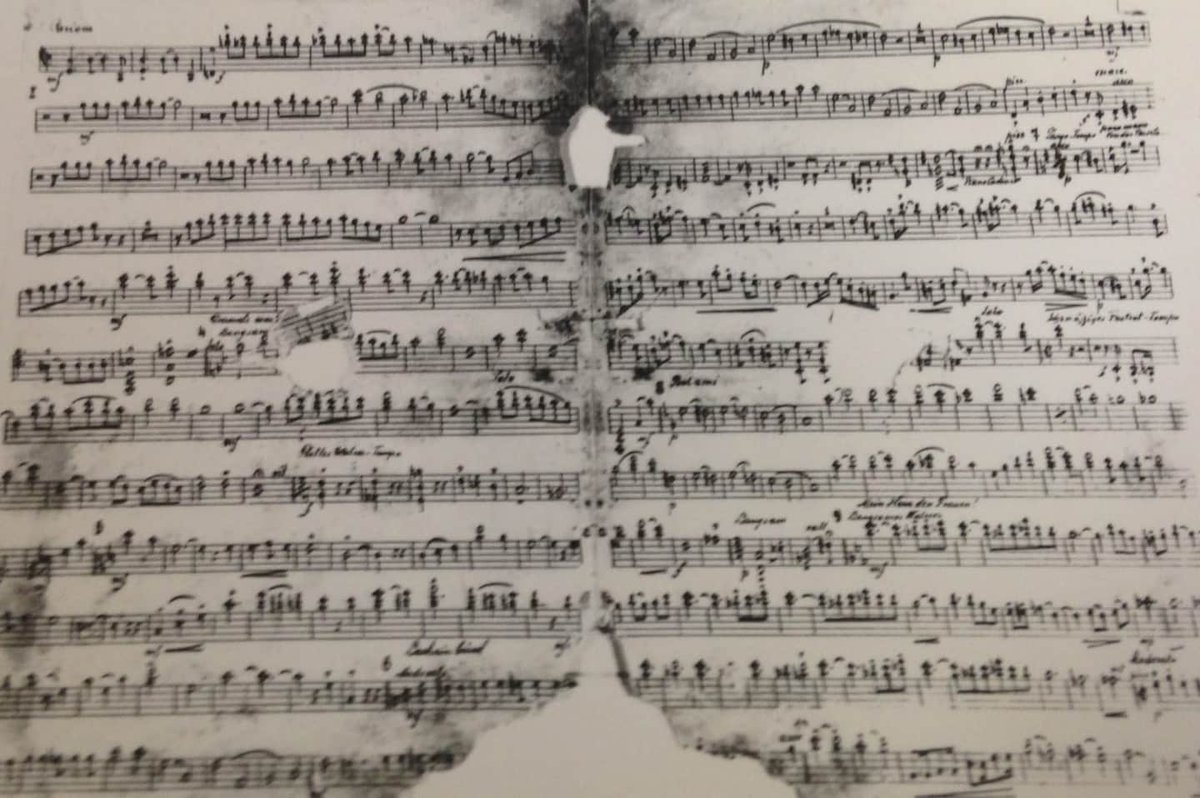
After more than 80 years and many different lives away‚ the reverberations of the heartbreaking melody‚ “Futile Regrets” was heard inside a concert hall in London. The song‚ reports the Washington Post‚ is part of a collection of more than 210 pieces of music found in the archives at Auschwitz‚ never played‚ until now. In 2015‚ British composer and conductor Leo Geyer stumbled upon the historic ephemera while on a trip to the Nazi death camp after he was commissioned to create a piece honoring historian and Holocaust expert Martin Gilbert. “I had a conversation with one of the archivists‚ and he said in a somewhat offhand way that there were some [musical] manuscripts in the archive‚” Geyer explained to the Washington Post. “I nearly fell over at the time when he mentioned it because I couldn’t believe that such a thing could exist and that it had been overlooked all this time.” From its opening in 1940 to the camp’s liberation in 1945‚ over 1.1 million men‚ women and children were systematically murdered at Auschwitz. More than 11 million were killed in the Holocaust — six million of whom were Jews. During these five years music provided comfort — but also became a beat to its seemingly never ending horrors. The Nazis used the arts “as part of the murder machine‚” Norman Lebrecht‚ a British music journalist‚ told the German media outlet DW. “Our task consisted of playing every morning and every evening at the gate of the camp so that the outgoing and incoming work commandos would march neatly in step to the marches we played‚” Anita Lasker-Wallfisch‚ an Auschwitz survivor who played the cello at the camp‚ relayed to CNN. “We also had to be available at all times to play to individual SS staff who would come into our block and wanted to hear some music after sending thousands of people to their death‚” she continued. Despite being intertwined with such hell‚ music was also a way for Jewish prisoners to express their pain and terror. It was “a chink of daylight in the darkness‚” Geyer stated to the Washington Post. “Jews being held in concentration camps were unable to document what was happening to them by conventional means. Writing down or photographing this would have been impossible‚ so they turned to a long cultural tradition of telling their stories through songs and music‚” historian Shirli Gilbert said in a news release. “ … Away from the eye of the SS officers‚ Jews secretly created their own music as a means to cope‚ survive and document.” However‚ the task of bringing the camp music back to life was a tall order for Geyer. Many of the sheets of music were partially destroyed‚ burned along the edges or tragically‚ never completed. Further complicating matters‚ writes the Post‚ was the fact that the orchestras often used a “hodgepodge of random instruments that were available‚” Geyer said‚ including some that are not traditionally used in orchestras like accordions‚ saxophones and mandolins. Geyer took it on as his mission to stitch together a proper coda to honor the victims of Auschwitz — a feat that would take more than seven years‚ extensive research‚ interviews with survivors and six visits to Auschwitz.   On Monday‚ Geyer’s work came to fruition as violin strings played the sorrowful sounds of a now completed “Futile Regrets” and three other pieces found at Auschwitz. “I’m not Jewish‚ Romani‚ Polish‚ Russian or disabled‚ or descended from any person from Auschwitz‚” Geyer told the Post. “But I do stand by those who are persecuted for no reason other than who they are. And I hope to live in a world where no evil could rise again.”
Like
Comment
Share
Hot Air Feed
Hot Air Feed
2 yrs

No More Mr. Nice Guy: Dem Senators are Done Asking Nicely for Reduction of Civilian Casualties in Gaza
Favicon 
hotair.com

No More Mr. Nice Guy: Dem Senators are Done Asking Nicely for Reduction of Civilian Casualties in Gaza

No More Mr. Nice Guy: Dem Senators are Done Asking Nicely for Reduction of Civilian Casualties in Gaza
Like
Comment
Share
Hot Air Feed
Hot Air Feed
2 yrs

Should Israel Flood the Hamas Terror Tunnels?
Favicon 
hotair.com

Should Israel Flood the Hamas Terror Tunnels?

Should Israel Flood the Hamas Terror Tunnels?
Like
Comment
Share
Hot Air Feed
Hot Air Feed
2 yrs

Lady Ballers: An Honest Review
Favicon 
hotair.com

Lady Ballers: An Honest Review

Lady Ballers: An Honest Review
Like
Comment
Share
Science Explorer
Science Explorer
2 yrs

Magnetic Blob Might Be Orbiting The Closest Supermassive Black Hole To Earth
Favicon 
www.iflscience.com

Magnetic Blob Might Be Orbiting The Closest Supermassive Black Hole To Earth

At the center of our galaxy‚ the Milky Way‚ there is a supermassive black hole. We call it Sagittarius A* and it weighs 4.3 million Sun. It is orbited by a bunch of stars with a period of years or longer. New evidence suggests that there is something else around‚ orbiting it much faster. A magnetized blob of material moving at incredible speed.The latest evidence comes from a yet-to-be-peer-reviewed analysis of gamma-ray emission. The data is publicly available and it was used by researchers at the National Autonomous University of Mexico to create a timeline of emission from June 2022 to December 2022. The data is from NASA's Fermi Gamma-ray Space Telescope. The team found a repeating emission‚ appearing every 76.32 minutes.The light curve shows the repeating pattern clearly and the period is consistent with observations from last year in a completely different wavelength. Radio observations also suggested that there is something going around Sagittarius A*‚ about every 74 minutes with an uncertainty of 6 minutes higher or lower.Sagittarius A*’s radius is 12 million kilometers (7.4 miles) and this object is expected to be fairly close to it‚ five times the black hole radius. To cover the orbital distance in just over an hour‚ the blob needs to travel at 30 percent of the speed of light‚ truly an impressive velocity.But the radio and gamma-ray emission is not the only emission recorded. There is also x-ray emission from around the black holes but that repeats every 149 minutes‚ about twice as long as the gamma and radio emission. The researchers believe that the two are connected."The coincidence of the multiwavelength periodicity in X-ray and gamma-ray points towards a single physical mechanism that produces it‚" the team wrote in the paper.The blob is believed to be magnetized providing insights into the magnetic field around the supermassive black hole. And while Sagittarius A* is not actively feeding like other supermassive black holes‚ it still has a disk of material around it. And the blob's emission tells us that it goes around it clockwise.Studying future flares across the range of wavelengths beyond the visible spectrum will allow a better understanding of the environment around our friendly neighborhood supermassive black hole.The paper is available to be read in the online paper repository ArXiv.
Like
Comment
Share
Science Explorer
Science Explorer
2 yrs

Magnetic Blob Might Be Orbiting The Closest Supermassive Black Hole To Earth
Favicon 
www.iflscience.com

Magnetic Blob Might Be Orbiting The Closest Supermassive Black Hole To Earth

At the center of our galaxy‚ the Milky Way‚ there is a supermassive black hole. We call it Sagittarius A* and it weighs 4.3 million Sun. It is orbited by a bunch of stars with a period of years or longer. New evidence suggests that there is something else around‚ orbiting it much faster. A magnetized blob of material moving at incredible speed.The latest evidence comes from a yet-to-be-peer-reviewed analysis of gamma-ray emission. The data is publicly available and it was used by researchers at the National Autonomous University of Mexico to create a timeline of emission from June 2022 to December 2022. The data is from NASA's Fermi Gamma-ray Space Telescope. The team found a repeating emission‚ appearing every 76.32 minutes.The light curve shows the repeating pattern clearly and the period is consistent with observations from last year in a completely different wavelength. Radio observations also suggested that there is something going around Sagittarius A*‚ about every 74 minutes with an uncertainty of 6 minutes higher or lower.Sagittarius A*’s radius is 12 million kilometers (7.4 miles) and this object is expected to be fairly close to it‚ five times the black hole radius. To cover the orbital distance in just over an hour‚ the blob needs to travel at 30 percent of the speed of light‚ truly an impressive velocity.But the radio and gamma-ray emission is not the only emission recorded. There is also x-ray emission from around the black holes but that repeats every 149 minutes‚ about twice as long as the gamma and radio emission. The researchers believe that the two are connected."The coincidence of the multiwavelength periodicity in X-ray and gamma-ray points towards a single physical mechanism that produces it‚" the team wrote in the paper.The blob is believed to be magnetized providing insights into the magnetic field around the supermassive black hole. And while Sagittarius A* is not actively feeding like other supermassive black holes‚ it still has a disk of material around it. And the blob's emission tells us that it goes around it clockwise.Studying future flares across the range of wavelengths beyond the visible spectrum will allow a better understanding of the environment around our friendly neighborhood supermassive black hole.The paper is available to be read in the online paper repository ArXiv.
Like
Comment
Share
Science Explorer
Science Explorer
2 yrs

Pioneering Brain Implant Restores Patients' Cognitive Function Years After Traumatic Brain Injury
Favicon 
www.iflscience.com

Pioneering Brain Implant Restores Patients' Cognitive Function Years After Traumatic Brain Injury

A brain implant that could help restore cognitive function after a traumatic brain injury (TBI) has been shown to be safe in a small clinical trial. The treatment delivers stimulation to key circuits deep within the brain‚ and produced promising results for the five participants in the trial without any serious side-effects.According to the most recent data from the Centers for Disease Control and Surveillance (CDC)‚ there were around 214‚110 hospital admissions related to TBI during 2020‚ and 69‚473 deaths – and this doesn’t include people who were only treated in the emergency department or did not receive treatment. For those who survive the initial injury‚ there’s a risk of long-term health issues.TBI occurs after a head injury‚ and the symptoms and risks change depending on how severe the injury is. Mild TBI‚ such as from a concussion‚ may resolve in a few days – although research is now showing how repeated impacts can lead to issues further down the road. Moderate and severe TBI‚ on the other hand‚ can lead to survivors having lifelong disabilities. In the US‚ the most common causes of moderate and severe TBI are falls and firearm-related incidents‚ but another is motor vehicle crashes. That’s what happened to Gina Arata‚ one of the five patients who completed the recent clinical trial. Her injury back in 2001 completely upended her life plans.“I couldn’t remember anything‚” said Arata in a statement. “My left foot dropped‚ so I’d trip over things all the time. I was always in car accidents. And I had no filter – I’d get pissed off really easily.”In 2018‚ Arata underwent a surgical procedure to have a device implanted deep inside her brain. After she had recovered from the surgery and the device was switched on‚ the effect was almost instantaneous. When asked to list items found in the produce section of the grocery store‚ Arata named numerous fruits and vegetables; when the device was switched off‚ she couldn’t remember any.How does the implant work?The implantable device targets a region of the thalamus called the central lateral nucleus. It’s a hub that connects to other brain areas and is involved in many aspects of consciousness. In patients with TBI‚ most of these pathways and connections are still there‚ but aren’t firing as strongly as before.“It’s as if the lights had been dimmed and there just wasn’t enough electricity to turn them back up‚” explained co-senior author of the study Dr Jaimie Henderson.For Arata and the other trial participants‚ who were aged between 22 and 60 and had sustained their injuries three to 18 years prior‚ the team had to precisely pinpoint where the device would sit in the brain. As everyone had different injury histories – and everyone’s brain is slightly different to begin with – this was a challenge that required the use of sophisticated modeling tools.“It’s important to target the area precisely‚” Henderson said. “If you’re even a few millimeters off target‚ you’re outside the effective zone.”The study period was 90 days long‚ and the devices were switched on for 12 hours per day. At the end of this period‚ the participants took a test assessing their ability to focus‚ concentrate‚ and plan under timed conditions.“The only surprising thing is it worked the way we predicted it would‚ which is not always a given‚” said Henderson. In fact‚ it worked better than expected: the average improvement on the test was 32 percent‚ far over the 10 percent the team hoped for. It was so good that they had a hard time convincing any of the participants to agree to have their device switched off for a later part of the study.For the patients‚ like Arata‚ the treatment meant they could go back to doing activities that had not been possible since their injuries.“Since the implant I haven’t had any speeding tickets‚” she said. “I don’t trip anymore. I can remember how much money is in my bank account. I wasn’t able to read‚ but after the implant I bought a book‚ Where the Crawdads Sing‚ and loved it and remembered it. And I don’t have that quick temper.”“In general‚ there’s very little in the way of treatment for these patients‚” said Henderson. But it’s hoped that if this treatment is validated in a larger clinical trial‚ that rather bleak outlook may be about to change. The study is published in the journal Nature Medicine.  
Like
Comment
Share
Science Explorer
Science Explorer
2 yrs

Face Of Pre-Columbian Person With Rare Skull Deformity Recreated
Favicon 
www.iflscience.com

Face Of Pre-Columbian Person With Rare Skull Deformity Recreated

Researchers have reconstructed the face of an unknown pre-Hispanic individual from Bolivia who had a rare congenital defect known as craniosynostosis. Affecting the formation and fusion of cranial bones‚ the condition causes the skull to become misshapen and often leads to cognitive deficits‚ impaired vision‚ and other debilitating symptoms.The ancient Andean face was recreated by forensic expert and 3D designer Cícero Moraes‚ who generated a digital model of the skull. Housed at Bolivia’s National Museum of Archaeology‚ the cranium has not been dated but is believed to have belonged to a member of the pre-Columbian Tiwanaku or Inca cultures.Located close to the shore of Lake Titicaca‚ Tiwanaku was a powerful Andean city state that was founded in the second century CE before disappearing about a millennium ago. At its peak‚ the settlement was home to around 20‚000 residents and exerted control over a large stretch of the southern Andes.The more famous Inca civilization‚ meanwhile‚ rose in the 13th century with its capital in what is now the Peruvian city of Cuzco. One of the most iconic ancient empires‚ the Incan realm was later overthrown by the Spanish conquistadors during the conquest of the Americas.In a statement emailed to IFLScience‚ the researchers explain that the skull’s morphology “differs significantly from the average.” With this in mind‚ the team consulted six different facial deformation surgeons in order to confirm a broad diagnosis of craniosynostosis. An umbrella term that covers numerous related syndromes‚ craniosynostosis includes conditions such as Crouzon syndrome‚ which occurs when the seams of the skull fuse in an abnormal manner and affects one in every 25‚000 to 60‚000 people. Apert syndrome‚ meanwhile‚ occurs in roughly one in every 80‚000 to 160‚000 births‚ and results in deformities in the skull‚ hands and feet.Yet another variation‚ known as Pfeiffer syndrome‚ affects around one in 100‚000 people and can cause increased pressure around the brain. However‚ in the absence of any limbs or other bones‚ the researchers are unable to confirm which specific syndrome this particular individual had.The person’s sex was also impossible to ascertain from the cranium alone‚ although the development of the teeth suggests that the skull’s owner was between the ages of 17 and 21 when they died. The researchers therefore decided to generate a “neutral face”‚ using “statistical studies based on computed tomography scans” to approximate their subject’s fleshed-out appearance.However‚ while Moraes has previously used this method to reconstruct the faces of ancient hominids and other historical figures‚ this particular project posed a series of unique challenges thanks to the skull’s abnormal morphology. For example‚ “the structure of the skull meant that the eyes were significantly protruded [a condition known as exophthalmos or proptosis]‚ due to the little space available for storing the eyeball in the orthotic region.”“The shape of the endocranium region‚ where the brain is housed‚ was also significantly different from models within the normal range‚ resulting in a face with noticeable expansion at the height of the eyes‚” say the researchers.Accounting for all these irregularities‚ Moraes was eventually able to reveal several of the pre-Columbian individual’s features‚ including “the small thickness of the oval window of the ear‚ indicating that the individual could have hearing problems.” The skull’s peculiar‚ pointed shape may also have restricted the size of the person’s brain‚ possibly leading to neural deficits.Fascinatingly‚ the skull also shows signs of having undergone some sort of surgical procedure‚ which the patient appears to have “survived for a short time.” More details about this potential operation‚ as well as the cranium’s other notable features‚ are due to be revealed in a forthcoming study.
Like
Comment
Share
Science Explorer
Science Explorer
2 yrs

Naturally Occurring Magnetic Monopoles Measured For The First Time
Favicon 
www.iflscience.com

Naturally Occurring Magnetic Monopoles Measured For The First Time

Regular magnets have two poles‚ a north and a south‚ and their behavior is defined in classical terms by the Maxwell equations. From contemporaries of Maxwell through to modern researchers‚ there have been hypotheses of the existence of magnetic monopoles‚ fundamental particles that are just north or just south. Researchers have not found them yet‚ but they have measured the next best thing.Using hematite‚ the rock equivalent of rust‚ the researchers discovered that on its surface‚ peculiar magnetic configurations can emerge. They measured quasiparticles – an interaction of sorts that behaves like a particle for a time – that had a single magnetic pole‚ two magnetic poles‚ and even four magnetic poles. The quasiparticles were swirling on the surface of the hematite.“Monopoles had been predicted theoretically‚ but this is the first time we’ve actually seen a two-dimensional monopole in a naturally occurring magnet‚” co-author Professor Paolo Radaelli‚ from the University of Oxford‚ said in a statement.“These monopoles are a collective state of many spins that twirl around a singularity rather than a single fixed particle‚ so they emerge through many-body interactions. The result is a tiny‚ localised stable particle with diverging magnetic field coming out of it‚” said co-first author Dr Hariom Jani‚ also from the University of Oxford.The formation of these magnetic monopoles is connected to a property known as emergence‚ where the combination of many physical entities produces something new with properties that are either more or different from the sum of its parts. In this case‚ they ended up with something very different; the monopole and the quadrupole are from entities that have the standard magnet configuration.“The magnets we use every day have two poles: north and south‚” said Professor Mete Atatüre‚ who led the research. “In the 19th century‚ it was hypothesised that monopoles could exist. But in one of his foundational equations for the study of electromagnetism‚ James Clerk Maxwell disagreed.”“If monopoles did exist‚ and we were able to isolate them‚ it would be like finding a missing puzzle piece that was assumed to be lost‚” added Atatüre‚ who is the Head of Cambridge’s Cavendish Laboratory‚ a position once held by Maxwell himself.The measurements were conducted using a diamond needle where the spin of a single electron – its intrinsic angular momentum – was used to precisely measure the magnetic field of the material. Discovering how to manipulate these peculiar quasiparticles might mean better computer technology‚ with fast and energy-efficient memory logic.The study is published in Nature Materials.  
Like
Comment
Share
Science Explorer
Science Explorer
2 yrs

Blood Carbon: The Darker Side Of Solving Climate Change
Favicon 
www.iflscience.com

Blood Carbon: The Darker Side Of Solving Climate Change

With COP28 underway‚ campaigners have a message for wide-eyed observers: beware of “Blood Carbon”. The warning relates to carbon credits‚ which they believe are muddying the issue rather than seriously addressing the real causes of the deepening climate crisis.World leaders‚ big business‚ and the media have flocked to Dubai this week for the COP28 United Nations climate conference and many are expecting it will bring a big expansion in the market for carbon credits.Carbon credits are like tradable permission slips that companies‚ individuals‚ or countries can buy to offset their carbon emissions. Let’s say your organization produces X amount of carbon emissions‚ then you can buy X amount of greenhouse gas reduction projects‚ such as planting forests or funding renewable energy‚ to balance the impact. This will allow the organization to say it is carbon-neutral or low emission (despite it still pumping the atmosphere with more carbon).While its advocates believe carbon credits offer a practical and realistic way to address climate change‚ it’s a complex field that’s rife with criticism. One of the main criticisms is that they act as a greenwashing scam‚ allowing organizations to seem greener than they really are. Another major criticism is that they put a price on nature‚ treating Indigenous and local communities’ lands as a carbon stock that can be bought and sold to allow polluters to keep polluting. In other words‚ carbon credits are often licenses for land grabs.“Anyone concerned about seriously addressing the climate crisis should oppose carbon credits‚” Indigenous rights organization Survival International said in a statement this week.Earlier this year‚ Survival published a report that looked at a flagship carbon credits scheme called Northern Kenya Grassland Carbon Project‚ which looked to improve grassland health and sequester carbon in the soils in a part of Kenya inhabited by more than 100‚000 Indigenous Samburu‚ Borana‚ and Rendille people. Some of the customers who bought into the scheme included Meta and Netflix.The NGO concluded that the project was breaking the Indigenous people’s long-standing traditional grazing systems and replacing them with a centrally controlled system more akin to commercial ranching. They also argued that the local people weren't given free‚ prior‚ and informed consent before the scheme took their land. Furthermore‚ it wasn’t even clear whether the scheme would actually increase the storage of carbon in the region’s soils.“The ‘verification process’ for carbon credits is broken beyond repair. For example‚ Survival’s exposé of the flagship carbon credits project run by the Northern Rangelands Trust in Kenya revealed major deficiencies in a project used by Meta and Netflix to offset their carbon emissions. Not only does the project not have the Free‚ Prior and Informed Consent of the Indigenous inhabitants of the land‚ it doesn’t even store any additional carbon‚” Survival continued in their recent statement.Survival International has even gone further to suggest that carbon credit schemes could increase human rights abuses‚ hence the name “Blood Carbon”. Land restoration schemes done in the name of carbon credits could ultimately result in more Indigenous and local communities’ lands being turned into Protected Areas‚ which could see people cut off from their ancestral lands using violence.“COP28 could be the 'Blood Carbon COP'‚ when governments‚ big business and conservation NGOs work together to boost the carbon credits market‚ rather than seriously address the real causes of the climate crisis‚” the organization added.“This could be disastrous for Indigenous peoples. Carbon credits represent a major new way for governments‚ corporations and conservation NGOs to profit from the theft of Indigenous lands‚ and they’re already doing so.”
Like
Comment
Share
Showing 106839 out of 114151
  • 106835
  • 106836
  • 106837
  • 106838
  • 106839
  • 106840
  • 106841
  • 106842
  • 106843
  • 106844
  • 106845
  • 106846
  • 106847
  • 106848
  • 106849
  • 106850
  • 106851
  • 106852
  • 106853
  • 106854
Advertisement
Stop Seeing These Ads

Edit Offer

Add tier


Select an image
Delete your tier
Are you sure you want to delete this tier?

Reviews

In order to sell your content and posts, start by creating a few packages. Monetization

Pay By Wallet

Payment Alert

You are about to purchase the items, do you want to proceed?

Request a Refund