reactormag.com
Australia’s Ancestral Cryptid: The Bunyip
Column
SFF Bestiary
Australia’s Ancestral Cryptid: The Bunyip
The Bunyip is everything from a cryptid to a children’s story to a tourist attraction. But the story is very old…
By Judith Tarr
|
Published on February 3, 2025
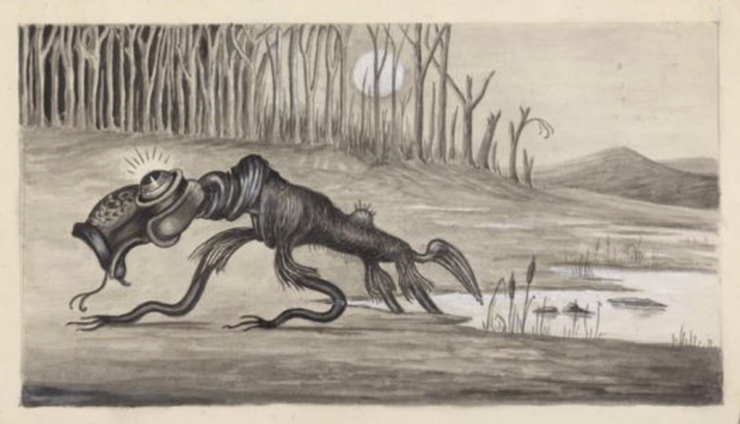
Illustration by Gerald Markham Lewis (1935)
Comment
0
Share New
Share
Illustration by Gerald Markham Lewis (1935)
Through much of the chapter on Cryptids, I’ve been viewing them through the lens of modern Western science. Do these creatures exist? Is there empirical evidence for them? Is that evidence credible? Does it point to an actual, verifiable animal, or can it be explained as a misidentification of another, known animal?
New animals are discovered all the time, either new to science or new variations on known animals. Occasionally a species thought to be extinct is found to still exist. This is especially exciting when it’s a species known only through fossils, though there’s something both heartwarming and hopeful about the discovery of hitherto unknown populations of animals thought to have been rendered extinct within human memory.
These “Lazarus species” are a hope and dream of cryptozoologists. So are species hitherto unknown to science, but known through legend and folklore and eyewitness accounts. To find just one of these, to produce physical evidence, will make a career, and prove that all the hunting and hoping and searching was worth it.
But there are other ways to look at the concept. I touched on it in an article on the monster of Lake Okanagan in Canada. Eli Watson and Jason Hewlett’s recent documentary devotes fair amount of air time to interviews with Coralee Miller. Miller is First Nations, and she has a quite different take on the monster than we see in more Western-focused analyses.
It’s not about proving the existence of an animal, she says. The creature that’s been turned into a tourist attraction and given a name from a silly song, Ogopogo, has a much older and deeper history. The original inhabitants of the area call it N-ha’a-itk, which translates to “Sacred Spirit of the Lake.”
She goes on to explain what this means both culturally and spiritually. In her culture, it’s not about proving the animal’s existence. It’s about understanding its place in that part of the world and its significance to the people who have been living in it for hundreds and thousands of years.
Western culture is very, very young in the grand scheme of human existence. It goes back reliably about five thousand years, and the dominant culture is only a handful of centuries old. Contrast this with indigenous traditions that go back ten thousand years or more—sometimes very much more.
That brings us (finally!) to Australia. Australian Aboriginal culture is, to the Western mind, unimaginably ancient. Estimates of its age vary widely, from 30,000 years all the way back to 100,000. Humans have lived on the Austrialian continent literally for time out of mind.
And they remember. The stories go back and back, but they’re not static. They’re alive. They’re being told now, by living people, passing on from generation to generation.
One of these stories has been appropriated by modern Australian colonist culture. The Bunyip is everything from a cryptid, complete with cryptozoologists and monster hunters, to a children’s story and—of course—a tourist attraction. But the story is very old and not at all simple or silly or cute.
Cryptozoologist Oliver Bennett has posted a thorough examination of the lore and legend of the Bunyip. He looks at it both as a scientist and as a cultural scholar, both as a possible real animal and as an expression of themes important to the tellers of the stories.
The name originates in Victoria, Southeastern Australia, in the Wemba-Wemba or Wergaia language. Its contemporary meaning is, more or less, “devil” or “evil spirit,” but that’s an oversimplification and probably a misinterpretation through the lens of modern Western culture. This version of the creature describes it as a monster that haunts the wetlands, the rivers and streams, and preys on women and children.
As such, it’s a cautionary tale. It’s a warning to stay away from the water. You can drown, or something in the water can rise up and eat you. Could be a fish, could be a predator—an elephant seal, maybe, or a leopard seal, wandering up the river from the sea.
That would explain the common description of the creature as horse- or hippo-sized, hairy, dark or brown, with a doglike or horselike head, a heavy, rounded body, and flippers. Or it could be a bird of some sort, emu-like with shaggy feathers and a long, supple neck. Or, possibly, it’s an ancient memory of extinct megafauna, which died out (Bennett notes) around 40,000 years ago.
But that’s not all it is. As with the spirit of Lake Okanagan, it’s something more. It’s an integral part of the world. It’s a guardian or protector of the land and particularly the waters—and maybe humans, too, in that it’s a warning against dangerous places and things.
It’s complex and layered and not easily explainable in Western cultural terms: in that way, emblematic of the problem of cultural appropriation. Its name and some of its characteristics have been taken over without understanding. It’s been turned into a mascot of sorts, but with a scary side, because we like our monster stories.
One thing it’s done to my Western mind with its deeply ingrained Western sense of time and space, is make me think of how we define very, very old. I can remember studying ancient history as a child and being in awe of stories and places that go back five thousand years. We were taught then that the dawn of time, the “first civilization,” was Sumeria and Ur of the Chaldees. And then Egypt, and then various histories and cultures till we got to the Greeks and the Romans. And that was ancient history.
Eventually I learned how narrow that view is, and how tightly it’s focused on the lands around the Mediterranean Sea. Even there, we now know, there are cultures we’ve long forgotten. Gobekli Tepe is mind-blowingly old to past me (and present me is pretty impressed, too) at close to 12,000 years.
It’s interesting to me how some of the icons of genre fantasy (and science fiction—for example, Tamsyn Muir’s Locked Tomb series) gravitate toward roughly that span. Tolkien’s Ages from the time before time to the end of the Third Age total just about 12,000 years. Beings who were alive and awake and considered to be unimaginably ancient were, in the time of Frodo and Aragorn, about 10,000 years old.
George R.R. Martin in building Westeros did a similar thing. His culture is around 12,000 years old, and there’s a whole history behind the events of A Song of Ice and Fire. But the parts we see, especially in the television series, are a very Western span of time, just a couple of hundred years, with references to events one or two thousand years in the past. As a viewer of the series and reader of the first few volumes, I never got the sense of the long stretch of time, or of the culture as being particularly ancient. It’s narrowly focused on one particular period, with a point of view that distinctly resembles the history of Western Europe. It’s medieval-ish but with a background memory of, essentially, Gobekli Tepe.
No wonder we have trouble comprehending the sense of time in First Nations stories. The culture they’re born in is tens of thousands of years older than ours. Their world goes beyond our perception of the deeps of time. The beings that inhabit it, both physical and otherwise, can’t be reduced to a linear or empirical concept of either history or story.
That’s where the Bunyip lives. In the wetlands, the rivers and lakes and the billabongs, but in the mind and the spirit as well. Like the place/time/concept labeled, in English, the Dreamtime, it’s a whole world of meaning beyond the empirical or the concrete.[end-mark]
The post Australia’s Ancestral Cryptid: The Bunyip appeared first on Reactor.








 New Posts (Home)
 ChatBox
 Popular Posts
  Game Zone
 Top PodCasts