www.theblaze.com
How Venezuela's communist government is using tech surveillance to cling to power
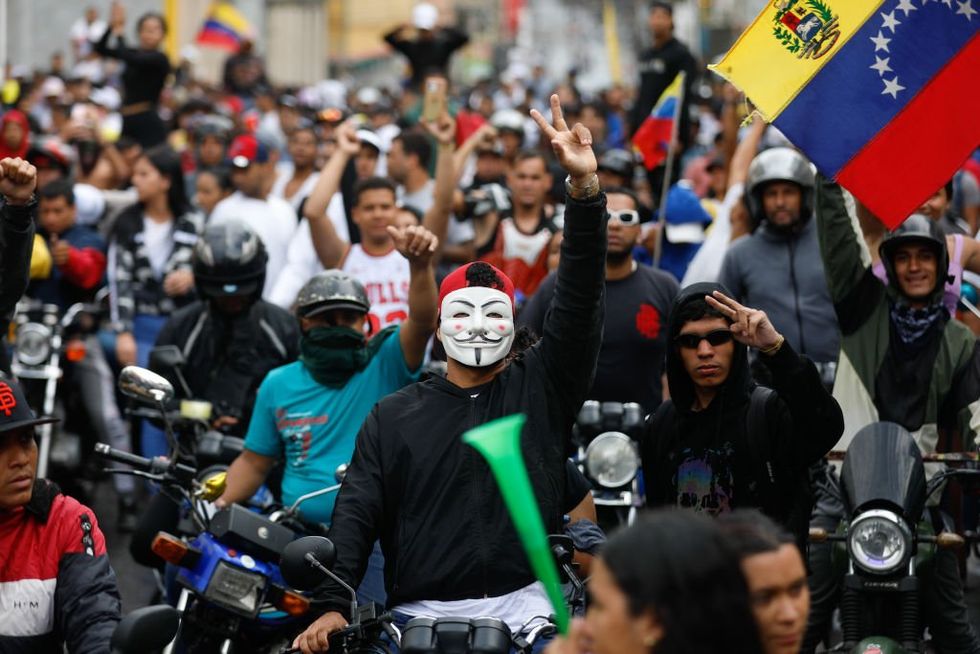
Protests and upheaval have roiled Venezuela following a contested election on July 28. Incumbent leader Nicolas Maduro claims victory by a margin of 51% to 44%, while his opponent leader, Edmundo Gonzalez, says his coalition garnered 66% of the vote. It’s worth noting that Gonzalez was 25 points up in polls through most of July.
The United States has officially recognized Gonzalez as the victor, joining a chorus of international criticism of the election’s lack of transparency.
Reports detail at least 15 protesters killed so far by Venezuelan authorities, including a teenager who stopped to watch the protests on the way back from a party. There have been at least 39 injuries reported, and over 1,000 protesters have been arrested.
The internet has led to significant democratization in many ways simultaneously, as it has allowed the rise of technocracy and autocratic governments to clamp down even farther on popular discontent they dislike.
Prior to the election, Maduro emphasized there would be a “bloodbath” if he didn’t win this time around. He has the wherewithal to make good on his threat, given that he’s in charge of the nation’s army, cops, courts, and most of its lethal paramilitary gangs. Even leftist-led Brazil and Colombia have expressed concerns over the situation and the transparency of Venezuela's July 28 election, urging Maduro to reveal the vote tallies that prove his claims publicly.
It’s worth keeping in mind that the U.S. Department of State is still offering up to $15 million for information or help in arresting Maduro for allegedly drug trafficking and engaging in narco-terrorism. He’s also under investigation at the ICC for violently cracking down on protests in 2014 and 2017.
In the past ten years, almost 8 million Venezuelans have left the country due to the economic and political crisis, which has been worsened by devastating sanctions from the U.S. and its allies. Maduro doesn’t have many options and certainly doesn’t appear to believe he’d receive much leniency if he negotiates with the West, steps down, or redoes an election to placate his critics. So he’s all in.
One key to Maduro’s power is control and leverage over information that reaches citizens, as well as their ability to spread viral messages and activism in a timely fashion. An analysis by the International Consortium of Investigative Journalists reportedly “uncovered a flood of GenAI dupes, disinformation campaigns, and blocks on more than 100 websites” before the election.
Despotic regimes from North Korea and Iran to Cuba and Syria are well known for limiting and censoring internet access to quell unrest, mitigate the citizenry’s ability to access information and mobilize resistance. This year, countries including Kenya and Comoros have also resorted to shutting down and limiting large areas of the internet to quell unrest.
Various independent outlets have been suspended in Venezuela since the election, including El Estímulo and Analítica, and that number has now climbed to 11, with Maduro authorities shutting down numerous outlets that were focused on exposing government-fueled disinformation and “fake news.”
“They wish to dismantle the sources of news that still spark communities in this country,” says Tinedo Guía, leader of Venezuela's National Journalists' Association.
A blueprint for totalitarian control
Venezuela's government adopts a four-pronged approach to achieve its aims of quashing widespread anti-government unity or mobilization.
Seizing power over what is shown and broadcast to Venezuelans by closing down independent media chains.
“For example, in April 2019, multiple media outlets were shut down after opposition leader Juan Guaidó used Twitter to announce an opposition plan to encourage the military to leave Maduro,” note Moises Rendon and Arianna Kohan.
“The internet was restored 20 minutes before a live-streamed speech given by Maduro in which he denounced the opposition.”
Limiting the ability and ease of citizens to use data, VPNs, and alternate browsers like TOR (the Onion Router).
Using the state-held internet and phone provider CANTV to spy on and track what citizens communicate about. Government agency Conatel also operates under the guise of technical compliance to yank licenses from those who displease Maduro.
Meanwhile, Chinese telecom company ZTE helps track citizens’ trends, habits, and behavior through a “fatherland card” that is required to access any state-subsidized services and social programs including emergency food assistance.
Weaponizing the court system and governmental bodies to prosecute and harass those whose activism, journalism, or online activity irks the regime. This includes the 2013 creation of the Center for Strategic Security and Protection (Centro Estratégico de Seguridad y Protección) to track and stop those who may be spreading information or communicating in ways that allegedly harm political stability.
Then there’s just plain intimidation and chasing down those who cause a headache for the regime. NGO Public Space (Espacio Público) reports 1,317 incidents of attacks on journalists, including arrests and murders, since 2002 in Venezuela. Many are embroiled in court cases and under charges that remain unresolved. In the past two decades under Maduro and former leader Hugo Chavez, Public Space lists 400 media companies that have bitten the dust, from TV channels and websites to radio stations and newspapers.
Most ordinary Venezuelans are focused on having enough to eat for the day and getting the fuel necessary for their daily work and needs. Twitter and other social networks help spread information and the locations of medicine and other services.
But for those who can’t afford internet access or aren’t in an area where they can use VPNs, text messaging on basic flip phones is used to stay in touch about what’s happening. However, the Maduro regime easily taps this, and smartphone ownership has been declining by around 7% per year due to costs. Mesh networks that let people talk offline are also used, although they are illegal and still trackable by the regime. In addition to state-run internet service providers, the Maduro regime has increasingly leaned on private ISPs to report user activity, including Spain’s Movistar, the nation’s only international ISP.
“What I can’t understand is how a company with corporate governance and an ethics code that operates under the European Union principles of free expression is doing what it’s doing in Venezuela,” says César Batiz, editor of the Venezuelan independent news website El Pitazo.
Surveillance politics
Jesus Vargas/Getty Images
Even apart from government control, censorship, and tracking and prosecution of user activity, Venezuela’s physical internet infrastructure has been on a dramatic downward slide for over a decade now, with lagging bandwidth, inefficient DNS servers, and sluggish performance due to lack of submarine cables connecting them to the rest of the world. The country’s millions of poor and various criminal gangs also routinely steal cables and antennae that are needed to keep the internet running smoothly. Only about 40% of those polled in Venezuela’s seven biggest cities report having any internet access.
At the same time as it throttles the internet for citizens, Venezuela’s government has become more skilled at utilizing the internet that does exist to its advantage. This information control has echoes with the past.
The internet and social media played a crucial role in the 2010 Arab Spring, rousing protesters against their governments, and numerous other democratic movements, uprisings, coups, and color revolutions from Nigeria to Ukraine. However, the groundswell of momentum and viral effect facilitated by social media and the internet was also quickly turned into a tool of increased state control. As Marwa Fatafta notes: “Dictators and despots — old and new — quickly learned how to weaponize the same online spaces and tools against their own citizens in order to quash any form of political dissent or mobilization, both online and offline.”
While the internet can be democratizing, it can also be a sand trap, full of mirror sites, tracking, and disinformation. As Venezuela has adapted to a patchy internet infrastructure, it’s also adapted to the reality of ground-level organizing and learning not to rely on digital messaging as the primary conduit of resistance.
The end result is a country in crisis but without much digital unification on the ground for anti-government citizens. The energy is in the streets more than the tweets. Political momentum is hard-won rather than easily disseminated widely or via top-down messaging. In addition to difficulty rallying a broad-based anti-government movement, digital weakness extends to trouble interesting foreigners in the country’s crisis. Tales of breakups and heartbreak ahead of the election are one approach used to try to rouse more engagement around the world in seeing the human side of the crisis.
The internet is both a malleable record-keeping environment and a receptacle of the collective instincts of the citizenry. It can be shaped and guided in many ways, from the bottom up and the top down. It has led to significant democratization in many ways simultaneously, as it has allowed the rise of technocracy and autocratic governments to clamp down even farther on popular discontent they dislike. Venezuela’s difficulty in shaking off Maduro and communications breakdown may seem distant and far more dramatic than anything going on in America, but if anything, it serves as a warning for how slippery the slope becomes when only one version of the political truth is permitted to be broadcasted and believed.








 New Posts (Home)
 ChatBox
 Popular Posts
  Game Zone
 Top PodCasts