YubNub Social YubNub Social
    #jesuschrist #liberals #christ #jesus #americafirst #socialists #easter #resurrection #resurrectionsunday #heisrisen #christisrisen #happyeaster #recruitment #rebirth #nokings
    Advanced Search
  • Login
  • Register

  • Night mode
  • © 2026 YubNub Social
    About • Directory • Contact Us • Developers • Privacy Policy • Terms of Use • shareasale • FB Webview Detected • Android • Apple iOS • Get Our App

    Select Language

  • English
Night mode toggle
Featured Content
Community
New Posts (Home) ChatBox Popular Posts Reels Game Zone Top PodCasts
Explore
Explore
© 2026 YubNub Social
  • English
About • Directory • Contact Us • Developers • Privacy Policy • Terms of Use • shareasale • FB Webview Detected • Android • Apple iOS • Get Our App
Advertisement
Stop Seeing These Ads

Discover posts

Posts

Users

Pages

Blog

Market

Events

Games

Forum

Daily Caller Feed
Daily Caller Feed
2 yrs

Discriminatory ‘Diversity’ Programs Are Taking A Beating Amid Legal Onslaught
Favicon 
dailycaller.com

Discriminatory ‘Diversity’ Programs Are Taking A Beating Amid Legal Onslaught

Over the past few years, the federal government, universities and other institutions across the country have ended or rolled back programs and policies that prioritize certain races following a series of lawsuits. Fueled by the landmark decision in Students for Fair Admissions v. Harvard in 2023, in which the Supreme Court ruled race-based college admissions […]
Like
Comment
Share
Daily Caller Feed
Daily Caller Feed
2 yrs

Martha MacCallum Spars With Dem State Senator Accusing Her Of Using ‘Bumper Sticker’ Immigration Rhetoric
Favicon 
dailycaller.com

Martha MacCallum Spars With Dem State Senator Accusing Her Of Using ‘Bumper Sticker’ Immigration Rhetoric

'I don't know what you're talking about'
Like
Comment
Share
Fun Facts And Interesting Bits
2 yrs

Remember That Show? Ep. 16: Good Morning, Miss Bliss
Favicon 
theretronetwork.com

Remember That Show? Ep. 16: Good Morning, Miss Bliss

Saved By The Summer starts here! We’re exploring four Saved By The Bell related series, starting with Good Morning, Miss Bliss starring Haley Mills and the core cast of Bayside regulars who would go on CONTINUE READING... The post Remember That Show? Ep. 16: Good Morning, Miss Bliss appeared first on The Retro Network.
Like
Comment
Share
Daily Signal Feed
Daily Signal Feed
2 yrs

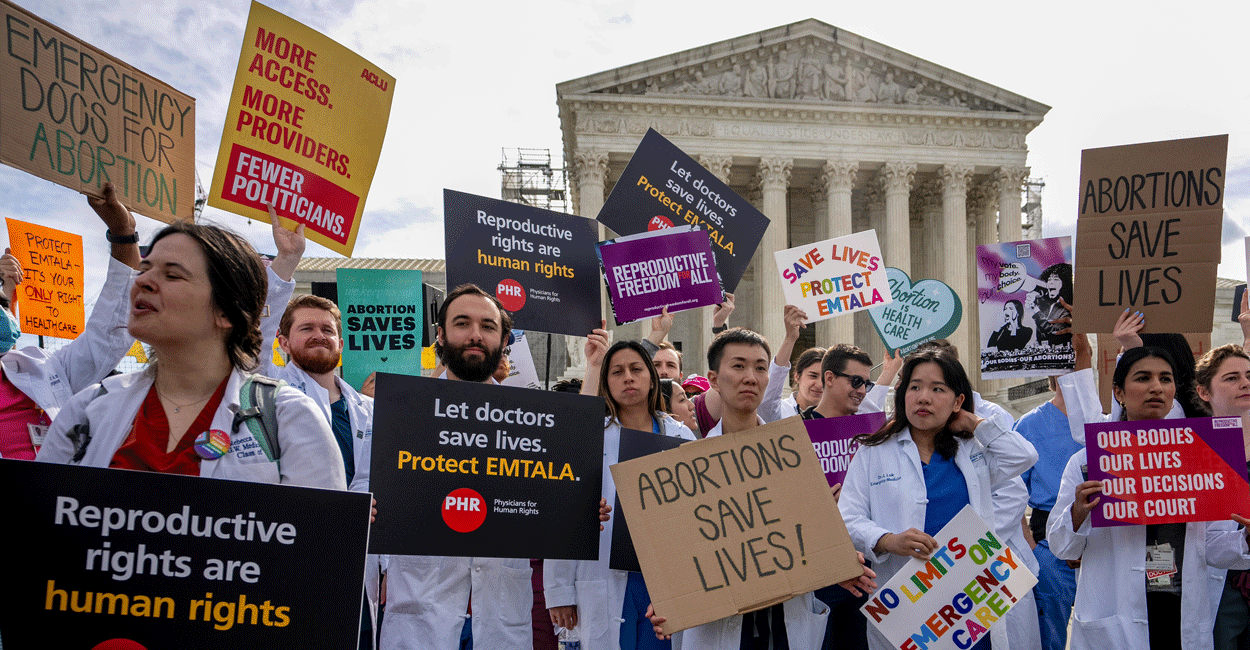
Supreme Court Dismisses Abortion Case Without Answering Key Question
Favicon 
www.dailysignal.com

Supreme Court Dismisses Abortion Case Without Answering Key Question

In an outcome that shocked court watchers everywhere, the Supreme Court today dismissed a pair of consolidated cases challenging the Biden administration over whether the government could require all federally funded hospital emergency rooms to perform abortions, regardless of any state law to the contrary. But by punting on the case with a “dismissed as improvidently granted” order, the court left that question—at least for now—unanswered.   In Moyle v. United States and Idaho v. United States, the justices were asked if the Biden administration’s interpretation of the Emergency Medical Treatment and Labor Act, or EMTALA, requiring abortions in emergency rooms was legal. Congress passed EMTALA in 1986 to address the problem of hospitals refusing to treat indigent patients in emergency rooms. The law requires hospital emergency departments that accept Medicaid funds either to provide available treatment required to “stabilize” a patient’s emergency medical condition or to transfer that patient to another medical facility. Notably, it also requires hospitals to provide stabilizing care to pregnant patients with emergency medical conditions that could harm the health of the mother or her unborn child.  Idaho’s Defense of Life Act, which was passed in 2022, prohibits abortions except when a physician determines “in his good faith medical judgment … that the abortion was necessary to prevent the death of the pregnant woman.” The justices were tasked with determining whether Idaho’s law conflicted with EMTALA. The Constitution’s supremacy clause requires that in the event of a clear conflict between federal law and a state law, the state law is preempted by the federal law. The Biden administration had argued EMTALA conflicted with the Idaho law because EMTALA allowed doctors to perform emergency abortions to address risks to a woman’s health (versus addressing something that could kill her), something the Idaho law doesn’t allow. Hence, the government argued that EMTALA preempted Idaho’s pro-life law. Idaho argued that its law and the federal law are in sync because EMTALA doesn’t mandate a particular treatment for particular medical conditions. The federal law leaves that to doctors, who must exercise their best medical judgment in the context of laws and regulations of the states in which they practice—something already accounted for in the Idaho law. But after extensive briefing and oral argument—and over the objections of four of the justices— the court issued a per curiam (that is, unsigned) one-sentence order dismissing the case. The order was “inadvertently and briefly uploaded … to the Court’s website” a day before its formal issuance, according to Patricia McCabe, the Supreme Court’s public information officer. The breach of protocol occurred on Wednesday, and the formal opinion was issued the next day. The Supreme Court occasionally issues a “dismissed as improvidently granted” order for a variety of reasons, whether procedural (such as when a litigant waives one or more of the key issues for which review was granted) or substantive (such as when the court identifies a policy better left to the political branches, rather than the courts, to decide). And while the order in Moyle v. United States and Idaho v. United States was issued without explanation, the justices’ separate concurring and dissenting opinions provide some insight into their thinking in issuing it. Justice Amy Coney Barrett wrote a concurring opinion that was joined by Chief Justice John Roberts and Justice Brett Kavanaugh, stating that the “shape of these cases has substantially shifted” since the court first decided to hear them. She noted that in their briefings and during oral argument, the two sides appeared to have made significant concessions. The government, she stated, appeared to concede that an abortion would not be an appropriate stabilizing treatment for mental health conditions and that EMTALA would not override conscience protections for hospitals and health care providers who refuse to provide abortions based on their sincerely held religious beliefs. That concession, she wrote, indicated that Idaho’s Defense of Life Act “remains almost entirely intact” and EMTALA would rarely override the state’s law. And, she noted, the state seemed to concede that physicians could administer emergency abortions to stabilize expectant mothers experiencing certain serious medical conditions even if there was no imminent threat to the woman’s life.  Barrett also stated that issuing the order was appropriate here because of an argument the state had raised for the first time at the Supreme Court: that EMTALA, a statute enacted pursuant to Congress’ spending power that operates solely against private parties, could not preempt state law since the state had never consented to the government’s conditional payment scheme. So, could Congress, in reliance on its authority under the spending clause, obligate recipients of federal funds to violate state criminal law? That was a “difficult and consequential argument.” “The District Court did not address this issue below—nor did the Ninth Circuit, which we bypassed. We should not jump ahead of the lower courts, particularly on an issue of such importance,” Barrett wrote. It is unclear how the chief justice and Barrett and Kavanaugh would rule if the issue makes its way back to the high court.  Justice Elena Kagan wrote a separate concurring opinion that was joined in full by Justice Sonia Sotomayor and in part by Justice Ketanji Brown Jackson. In the portion of the opinion that Jackson did not join, Kagan argued that the dismissal was appropriate, that the court’s order “follows” from the “premise” that EMTALA preempts Idaho’s law when they conflict, and that Idaho’s arguments about EMTALA did not justify its request for emergency relief. Jackson did, however, join the portion of Kagan’s opinion in which she took direct aim at Justice Samuel Alito’s dissent, writing that regardless of EMTALA’s language concerning the protection of a woman’s “unborn child,” nothing “alters EMTALA’s command when a pregnancy threatens the woman’s life or health.” Jackson wrote a separate opinion largely to disagree with dismissal of the case. She would have granted relief in favor of the United States because “Idaho law prohibits what federal law requires … under the Supremacy Clause, Idaho’s law is pre-empted.” It is quite clear that Kagan, Sotomayor, and Jackson would rule in favor of the Biden administration if the case returns to the Supreme Court. In a scorching dissent, Alito, joined by Justices Clarence Thomas and Neil Gorsuch, disagreed with the order and said he would rule in Idaho’s favor now. He argued that the preemption theory advanced by the United States was “plainly unsound,” and that “far from requiring hospitals to perform abortions, EMTALA’s text unambiguously demands that Medicare-funded hospitals protect the health of both a pregnant woman and her ‘unborn child.’” Even if EMTALA’s text was ambiguous, Alito wrote, Idaho would still prevail as “EMTALA was enacted under the [Constitution’s] Spending Clause, and … conditions attached to the receipt of federal funds must be unambiguous.” He called the court’s “about-face” in the case “baffling” and accused his colleagues of having “simply lost the will to decide the easy but emotional and highly politicized question that the case presents.” In reaching the Supreme Court, the state of Idaho had leapfrogged over the U.S. Court of Appeals for the Ninth Circuit to seek immediate relief. After the Supreme Court’s dismissal, the case now returns to that appellate court for continued litigation. In the end, the consolidated cases of Moyle v. United States and Idaho v. United States may live to see another day at the high court. After today, two things remain certain: States will always continue to protect the unborn, and the Biden administration will always work to protect its pet agenda items—like abortion—no matter how ridiculous its underlying arguments and application of the law appear to be. The post Supreme Court Dismisses Abortion Case Without Answering Key Question appeared first on The Daily Signal.
Like
Comment
Share
Daily Signal Feed
Daily Signal Feed
2 yrs

Supreme Court Deals Major Blow to the Administrative State
Favicon 
www.dailysignal.com

Supreme Court Deals Major Blow to the Administrative State

The Constitution separates power, the administrative state fuses it. The Constitution gives Congress the power to make law, the president the power to enforce law, and the courts the power to apply law to specific cases. The administrative state takes all three for itself. Today, however, the Supreme Court delivered an important blow against that administrative fusion of powers by standing up for the right to have your case heard by a jury. It held that if the Securities and Exchange Commission prosecutes you for fraud, you’re entitled to have your case heard by a jury of your peers.  An administrative agency like the SEC can make a law, charge you for violating it, and prosecute you before its own in-house tribunals—where the judges whose salaries it pays rule in its favor 90% of the time. That’s what happened to George Jarkesy, who was prosecuted by the SEC in one of its in-house tribunals for allegedly committing securities fraud. Jarkesy filed suit in federal court to defend his Seventh Amendment right to a jury trial, and 10 years later, the Supreme Court heard his case. The Seventh Amendment guarantees a jury trial right in all “suits at common law.” One such suit is fraud, and Jarkesy argued that because securities fraud is a type of fraud, he should get a jury. The government responded that the Seventh Amendment does not apply when the government enforces a “public right,” that is, a right created by Congress through law and entrusted to the administrative state for protection. Jarkesy replied that the text of the Seventh Amendment makes no such distinctions, and what’s more, the results of the government’s argument would be absurd. Under the government’s theory, victims of reckless drivers could be forced into administrative law courts if Congress decided that the injured motorist’s recovery of damages mattered less than the public’s interest in highway safety. Same thing for medical malpractice suits—the government has an interest in safe medicine, so it can drag defendants to a Washington back office where a bureaucrat will inevitably side with the agency that pays his wages.   Fortunately, the Supreme Court put the kibosh on those scenarios. In an opinion by Chief Justice John Roberts, the court agreed with Jarkesy. The jury is an indispensable bulwark of liberty. As is making sure that your prosecutor isn’t the one paying the judge. The question before the court was what, exactly, is included in “suits at common law.” We know some traditional common-law suits, like fraud, nuisance, and monopolization, for example. But we now live under millions of bureaucratic rules and regulations. Do they count, or does the government get to try you without a jury every time it invents a new one? The court held that whether the government’s case counts as a “suit at common law” depends on whether it resembles any of the traditional suits we know and, more importantly, whether the remedy the government wants is the sort of remedy that courts of law typically give. In Jarkesy’s case, for example, securities fraud is a subspecies of fraud, so the first factor is satisfied. And the government wanted money damages, which is a classic legal remedy, so the second factor is satisfied, too. That’s not quite the end of the analysis, however, because over the years, the court has invented an exception to the Seventh Amendment for “public rights.” Under that exception, if the government’s suit is trying to vindicate a right that the government invented, then no jury is required. The public rights exception has “no textual basis in the Constitution,” to quote the court, but it is long established in the court’s cases. The question is whether securities fraud involves a public right. The government, and Justices Sonia Sotomayor, Elena Kagan, and Ketanji Brown Jackson said in a dissenting opinion that a case involves a public right any time the “Government has acted in its sovereign capacity to enforce a new statutory obligation.” Roberts and the five remaining justices balked at that expansive rule. Not only is it unsupported by the court’s old public-rights cases, worse, it could “swallow” the Seventh Amendment whole. The majority concluded that public rights include only specific issues identified in those old cases, like collecting revenue, immigration law, and granting public benefits. But fraud, of any sort, is plainly far afield of those, and therefore, you get a jury in fraud cases. Justice Neil Gorsuch, joined by Justice Clarence Thomas, wrote a concurring opinion to recount the historical origins of American juries and how important they are to protecting liberty. They also reminded Americans that we should not undermine important safeguards any time someone unpopular—and Jarkesy may very well have committed securities fraud—finds himself under the government’s thumb. After all, “while incursions on old rights may begin in cases against the unpopular, they rarely end there,” they wrote. The dissenters took a broad interpretation of the court’s prior public-rights cases and then attacked the majority for disagreeing with their interpretation, saying that it “significantly undermines” the rule of law and “prescribes artificial constraints on what modern-day adaptable governance must look like.” But, as Gorsuch points out, that charge is hypocritical. First, the dissenters’ view almost erases the Seventh Amendment in federal cases, which is one of the most important rule-of-law safeguards we have. Second, the dissenters’ broad interpretation is, itself, out-of-step with the old cases. And third, the public-rights exception has no constitutional foundation. How bold to accuse someone of undermining the rule of law while ignoring the law yourself. Although the ruling forces the SEC to respect a core constitutional right, the decision hardly prevents the SEC from fulfilling its mission. Until the passage of the Dodd-Frank Wall Street Reform Act in 2010, the SEC always brought its cases in courts rather than in-house tribunals, and it can still do so now. All that has changed is that the people it targets once again benefit from the assurance that the judge isn’t being paid by the prosecutor. It’s only a basic bulwark of liberty, but it’s often good to go back to the basics. The post Supreme Court Deals Major Blow to the Administrative State appeared first on The Daily Signal.
Like
Comment
Share
Hot Air Feed
Hot Air Feed
2 yrs

Things Just Keep Getting Worse for Mayor Thao in Oakland
Favicon 
hotair.com

Things Just Keep Getting Worse for Mayor Thao in Oakland

Things Just Keep Getting Worse for Mayor Thao in Oakland
Like
Comment
Share
Hot Air Feed
Hot Air Feed
2 yrs

About that Hit Piece Letter Against Trump Signed by '16 Nobel Prize-Winning Economists'
Favicon 
hotair.com

About that Hit Piece Letter Against Trump Signed by '16 Nobel Prize-Winning Economists'

About that Hit Piece Letter Against Trump Signed by '16 Nobel Prize-Winning Economists'
Like
Comment
Share
Pet Life
Pet Life
2 yrs

Robot vacuum pushes startled cat underneath the couch
Favicon 
animalchannel.co

Robot vacuum pushes startled cat underneath the couch

It was an ordinary day for Indy, the cat, who was enjoying a serene nap on the living room floor. Little did Indy know, a surprising turn of events was about to make him an internet sensation. This unexpected incident not only startled the laid-back feline but also captivated the attention of nearly 400,000 viewers... The post Robot vacuum pushes startled cat underneath the couch appeared first on Animal Channel.
Like
Comment
Share
NewsBusters Feed
NewsBusters Feed
2 yrs

CNN's Acosta Silences Pro-Life Advocate By Cutting Her Mic
Favicon 
www.newsbusters.org

CNN's Acosta Silences Pro-Life Advocate By Cutting Her Mic

In the past few days, CNN has demonstrated just how blatant their prejudice has become. From Kasie Hunt’s outrage over the network’s bias being called out to Thursday morning's display of censorship, President of Students for Life of America Kristan Hawkins being silenced on CNN Newsroom by host Jim Acosta. Following the breaking news of the Supreme Court case Moyle v. United States, which kicked the case back down to the lower court, but allowed for “emergency” abortions to take place during the litigation process, Acosta welcomed Director of the NAACP Center for Health Equity, Dr. Chris Pernell, and asked her, “Your reaction to this abortion decision in Idaho, is this a kick the can kind of moment for the Court?” Pernell mourned that the Court did not go further:  So what that means is that women's health continues to be imperiled. It means that the federal law is in peril. And as long as that is true, the stats that we know that one in four Native American babies are born under these types of conditions where there is a lack of appropriate care. One in six black babies are born under these conditions where there is a lack of appropriate care. The Supreme Court missed an opportunity. I agree with Justice Jackson. This was a moment for the Supreme Court to decide clearly and compellingly in the favor of the universal rights of all people, especially women. And that didn't happen.     Acosta let Pernell speak uninterrupted, a noted contrast to how he treated Hawkins as the decorum surrounding CNN’s normally boasted beliefs of free press and expression was thrown to the wayside.  Hawkins claimed, “We also see a silver lining in this decision today. If Idaho, while this is tragic, saying Idaho must allow for abortions to prevent infertility, future infertility, the FDA must now change its policy too, to do the same, given their no test online distribution scheme of chemical abortion pills, which we know harm women's future fertility as 15 percent of women of our population are Rh negative and there is no testing now because of the Biden Administration and their FDA, on these dangerous chemical abortion pills, she's having these pill abortions—“ Acosta then cut her off, leading to the following exchange: ACOSTA: Is it mifepristone? HAWKINS: She’s not being tested for Rh negativity— ACOSTA: Haven’t the experts said that mifepristone is safe for women to use— HAWKINS: — and she’ll no longer be able to carry to term. ACOSTA: But, haven’t the experts said— HAWKINS: Ask any woman who's Rh negative, ask any woman, excuse me, as someone who's been pregnant, sir, when you're pregnant, one of the first things they do is, they test for Rh negative status because if you have a miscarriage, if you give birth, if you get an accident, if you get an abortion— ACOSTA: No, Miss Hawkins— HAWKINS: — You have to be treated immediately. ACOSTA: I have to, I’m sorry, mifepristone has been proven to be safe. It's been that way for years, but thank you for coming on. We appreciate it. HAWKINS: It actually hasn’t. We know [microphone cut] Hawkins was speaking about an earlier SCOTUS case, FDA v. Alliance for Hippocratic Medicine, one which the left claimed as another victory. It was this criticism that prompted Acosta to literally silence this opposing opinion as Hawkins had her mic cut as Acosta ended the segment. The transcript is below, click “expand” to read: CNN Newsroom with Jim Acosta 6/26/2024 10:41 AM ET JIM ACOSTA: I do want to take a quick moment to go out to Dr. Chris Pernell, director of the NAACP Center for Health Equity. Dr. Pernell, your reaction to this abortion decision in Idaho, is this a kick the can kind of moment for the Court? CHRIS PERNELL: It most certainly is a kick the can, kind of, moment while a technical win. This is not a victory for reproductive justice. And it's not a victory for health equity. Why? Because it does not change, it doesn't change the fact that there are maternity care deserts in Idaho and 36 percent of counties across the United States. So what that means is that women's health continues to be imperiled. It means that the federal law is in peril. And as long as that is true, the stats that we know that one in four Native American babies are born under these types of conditions where there is a lack of appropriate care. One in six black babies are born under these conditions where there is a lack of appropriate care. The Supreme Court missed an opportunity. I agree with Justice Jackson. This was a moment for the Supreme Court to decide clearly and compellingly in the favor of the universal rights of all people, especially women. And that didn't happen. ACOSTA: All right, Dr. Pernell, I also want to bring in Kristan Hawkins. She is the president of Students for Life of America. What's your reaction to this decision? KRISTAN HAWKINS: Sure well, I think President Trump and the GOP needs to take notes, the Biden Administration continues to make the case to weaponize federal agencies, to make abortion a federal issue. But we also see a silver lining in this decision today. If Idaho, while this is tragic, saying Idaho must allow for abortions to prevent infertility, future infertility, the FDA must now change its policy too, to do the same, given their no test online distribution scheme of chemical abortion pills, which we know harm women's future fertility as 15 percent of women of our population are Rh negative and there is no testing now because of the Biden Administration and their FDA, on these dangerous chemical abortion pills, she's having these pill abortions— ACOSTA: Is it mifepristone? HAWKINS: She’s not being tested for Rh negativity— ACOSTA: Haven’t the experts said that mifepristone is safe for women to use— HAWKINS: — and she’ll no longer be able to carry to term. ACOSTA: But, haven’t the experts said— HAWKINS: Ask any woman who's Rh negative, ask any woman, excuse me, as someone who's been pregnant, sir, when you're pregnant, one of the first things they do is, they test for Rh negative status because if you have a miscarriage, if you give birth, if you get an accident, if you get an abortion— ACOSTA: No, Miss Hawkins— HAWKINS: — You have to be treated immediately. ACOSTA: I have to, I’m sorry, mifepristone has been proven to be safe. It's been that way for years, but thank you for coming on. We appreciate it. HAWKINS: It actually hasn’t. We know [microphone cut]
Like
Comment
Share
NewsBusters Feed
NewsBusters Feed
2 yrs

Biology Denier: CNN Tool Wonders What Idaho Abortion Case Means for a ‘Pregnant Person’
Favicon 
www.newsbusters.org

Biology Denier: CNN Tool Wonders What Idaho Abortion Case Means for a ‘Pregnant Person’

New-ish CNN medical correspondent Meg Tirrell showed Thursday morning she’s so far to the left she doesn’t even believe basic biology as, in reacting to the released Supreme Court opinion on Idaho’s abortion law, Tirrell implicitly proclaimed men can get pregnant as she repeatedly told viewers the Court’s punt on the merits of the deal dealt with federal law protects “a pregnant person’s health” and “person who’s pregnant”. Tirrell first told Fake News Jim Acosta that the Court’s decision allows “medically necessary care” in the Potato State (i.e. kill your unborn child) “in the situations of abortion where that is the medically necessary care to stabilize a pregnant person’s health.”     Without a blink, CNN’s new top medical reporter made herself wholly qualified in the liberal media and advocacy scene, but unqualified in the real world. Tirrell immediately doubled down and went further with the “strict” qualifier: “So, Idaho has a very strict abortion ban that bans all abortions except to save the life of the pregnant person and in rare, other circumstances.” Moments later, she reiterated her stance that men can grow babies in their wombs: “I’ve talked with law professors who looked at the decision — the sort of decision that came out yesterday and said this allows confusion to rein in other states with abortion bans, even in states that have exceptions for the health of the pregnant person.” She returned in the next hour with even more quackery. First, she told host Wolf Blitzer that “reactions” to the Court’s decision were pouring in “from people who are pro-abortion access and anti-abortion access and neither one is particularly satisfied by this Supreme Court decision in the Idaho abortion case.” Then proceeded to label the Guttmacher Institute as “a pro-reproductive rights group” while slapping the Charlotte Lozier Institute with the description as one of the “groups that are against abortion access, including the Charlotte Lozier Institute”.  Tirrell twice made sure Blitzer was told women aren’t the only ones who have give birth: “ So, essentially what the court did here is say that actually we shouldn’t have taken this case and we’re going to send it back down to the lower courts in Idaho, but while we do that, we are going to keep in place federal protections for providing abortions in emergency room settings or emergencies settings at hospitals to preserve the health of the person who’s pregnant. Idaho’s abortion law right now contains an exception just to save the life of the person who’s pregnant and rare other exceptions. After fretting the lack of an answer on the validity of Idaho’s (pro-life) law will create “a lot of confusion in other states,” Tirrell slipped up and said “women”: “So, right now, nobody seems to be particularly happy with the Supreme Court’s holding here that essentially they sort of kick the can down the road, but in Idaho at least, there we’ll be those protections for women who need abortions and these emergency settings, Wolf.” Blitzer closed by asking Tirrell to “elaborate a little bit more Meg, if you don’t mind, on the practical effect of this decision on women in Idaho”, which allowed her a shot at redemption for her transgender overlords [W]e’ve been to Idaho. We’ve talked with doctors there who are practicing family medicine. We’ve talked with patients who are pregnant and Idaho and what they told us is that they’re afraid to be pregnant in the state because they’re worried about not having these protections and they’ve had to travel out of state themselves in some cases to access this kind of care. To see the relevant transcript from June 27, click “expand.” CNN Newsroom with Jim Acosta June 27, 2024 10:28 a.m. Eastern JIM ACOSTA: I want to go out to Meg Tirrell and Meg, a little weird in terms of how this ruling came out yesterday. But it sounds like it’s pretty much in line with what we saw yesterday. What do you think? What does this — gonna mean for women’s health? MEG TIRRELL: Yeah, Jim, reading through this, it does look the same as what we saw in an advertently posted yesterday and what it means for women’s health is that, in Idaho, this does put back into effect the protections of this federal law EMTALA, on hospitals providing emergency care in the situations of abortion where that is the medically necessary care to stabilize a pregnant person’s health. So, Idaho has a very strict abortion ban that bans all abortions except to save the life of the pregnant person and in rare, other circumstances. So, the Biden administration had argued that that federal law called EMTALA conflicted with Idaho’s strict abortion ban. And right now, what the Supreme Court is essentially saying is we shouldn’t have taken up this case. This should go back down to the lower courts in Idaho, but while that happens hospitals can provide this emergency care. But as we were hearing from Elie, you know, Justice Ketanji Brown Jackson points out, this is essentially a delay in deciding the issues of this case. And I’ve talked with law professors who looked at the decision — the sort of decision that came out yesterday and said this allows confusion to rein in other states with abortion bans, even in states that have exceptions for the health of the pregnant person. Because in many instances I was talking with Elizabeth Sepper at the University of Texas at Austin School of Law, and she was saying a lot of those states that have health exceptions, those exceptions are narrower than what the EMTALA federal law would state. And so, there’s still going to be a lot of confusion in other states, particularly in Texas where the Biden administration has asked the Supreme Court to look at their abortion ban. And so, we are potentially going to see this come back. But what a lot of folks have been pointing out today is that on both of the abortion cases before the court, this term, mifepristone, the abortion pill, they dismissed that based on standing. They didn’t consider the merits of that case. Now, with this emergency abortion case, sending it back down to the lower courts. So, there is a thought that this pushes this off until after the election, potentially when depending on who wins, this could come back in myriad ways, either through the courts or through other — other methods. And so, this doesn’t really settle any of these cases about abortion through the courts. This just sort of says that the courts aren’t going to really issue decisions on the merits, right now, guys. ACOSTA: Very interesting, Meg. All right. Thank you very much. (.....) CNN Newsroom with Wolf Blitzer June 27, 2024 11:09 a.m. Eastern WOLF BLITZER: Joining us now for more on this, CNN medical correspondent Meg Tirrell. Meg, is this huge victory for those who support abortion rights for women? TIRRELL: Well, Wolf, it does — not sounding that way. We’re getting the reactions really pouring in this morning after we saw this inadvertent posting yesterday, there were sort of reactions to that, but now that we know it’s official, we are seeing both reactions from people who are pro-abortion access and anti-abortion access and neither one is particularly satisfied by this Supreme Court decision in the Idaho abortion case. We’re hearing from the Guttmacher Institute, which is a pro-reproductive rights group, that says, “the Supreme Court is preserving the federal protections for emergency abortion care in Idaho for the time being”. They say, “the decision is the bare minimum and the court should have been clear and affirming that the Emergency Medical Treatment and Labor Act (EMTALA) protects abortion in emergency situations in all states.” Now, we also have been hearing from groups that are against abortion access, including the Charlotte Lozier institute, who’s saying that they’re disappointed that the Supreme Court has not rejected the Biden administration’s what they call blatant attempt to hijack a law that protects mothers and babies. So, essentially what the court did here is say that actually we shouldn’t have taken this case and we’re going to send it back down to the lower courts in Idaho, but while we do that, we are going to keep in place federal protections for providing abortions in emergency room settings or emergencies settings at hospitals to preserve the health of the person who’s pregnant. Idaho’s abortion law right now contains an exception just to save the life of the person who’s pregnant and rare other exceptions. And so there’s this argument that these two things are in conflict that has not been resolved by the Supreme Court. Legal experts also point out that this leaves a lot of confusion in other states. Legal experts also point out that this leaves a lot of confusion in other states with abortion bans. There are an additional seven states that have gestational limit bans between six and 18 weeks. And I was talking with legal scholar Elizabeth Sepper the University of Texas at Austin — she says, even in states that have health exceptions in their abortion bans, they are — still might be a lot of confusion here and we’re thinking about Texas in particular because the Biden administration has already asked the court to look at their abortion law as it pertains to these federal protections for emergency abortions. So, right now, nobody seems to be particularly happy with the Supreme Court’s holding here that essentially they sort of kick the can down the road, but in Idaho at least, there we’ll be those protections for women who need abortions and these emergency settings, Wolf. BLITZER: So, elaborate a little bit more Meg, if you don’t mind, on the practical effect of this decision on women in Idaho? TIRRELL: Yeah. Well, what we heard is that while this protection wasn’t in place, St. Luke’s Health Care system — which is one of the largest healthcare systems in Idaho — said that they had to airlift six patients out of Idaho to receive this kind of care. That compared with just one in the previous year when this kind of protection had been in place. And so, we’ve been to Idaho. We’ve talked with doctors there who are practicing family medicine. We’ve talked with patients who are pregnant and Idaho and what they told us is that they’re afraid to be pregnant in the state because they’re worried about not having these protections and they’ve had to travel out of state themselves in some cases to access this kind of care. BLITZER: Meg Tirrell reporting for us. Meg, thank you very much.

Like
Comment
Share
Showing 85405 out of 117596
  • 85401
  • 85402
  • 85403
  • 85404
  • 85405
  • 85406
  • 85407
  • 85408
  • 85409
  • 85410
  • 85411
  • 85412
  • 85413
  • 85414
  • 85415
  • 85416
  • 85417
  • 85418
  • 85419
  • 85420
Advertisement
Stop Seeing These Ads

Edit Offer

Add tier


Select an image
Delete your tier
Are you sure you want to delete this tier?

Reviews

In order to sell your content and posts, start by creating a few packages. Monetization

Pay By Wallet

Payment Alert

You are about to purchase the items, do you want to proceed?

Request a Refund