YubNub Social YubNub Social
    Advanced Search
  • Login
  • Register

  • Night mode
  • © 2026 YubNub Social
    About • Directory • Contact Us • Developers • Privacy Policy • Terms of Use • shareasale • FB Webview Detected • Android • Apple iOS • Get Our App

    Select Language

  • English
Night mode toggle
Featured Content
Community
New Posts (Home) ChatBox Popular Posts Reels Game Zone Top PodCasts
Explore
Explore
© 2026 YubNub Social
  • English
About • Directory • Contact Us • Developers • Privacy Policy • Terms of Use • shareasale • FB Webview Detected • Android • Apple iOS • Get Our App
Advertisement
Stop Seeing These Ads

Discover posts

Posts

Users

Pages

Blog

Market

Events

Games

Forum

Hot Air Feed
Hot Air Feed
2 yrs

Revealed: Why 'UN Women' Took 55 Days to Condemn Hamas Rapes
Favicon 
hotair.com

Revealed: Why 'UN Women' Took 55 Days to Condemn Hamas Rapes

Revealed: Why 'UN Women' Took 55 Days to Condemn Hamas Rapes
Like
Comment
Share
Science Explorer
Science Explorer
2 yrs

Notorious Cosmic Object Is Actually Two Galaxies In A Trench Coat
Favicon 
www.iflscience.com

Notorious Cosmic Object Is Actually Two Galaxies In A Trench Coat

In the southern hemisphere‚ looking up to the night sky‚ you can see two nearby galaxies. The two fuzzy splotches of light have been called‚ by Western scientists‚ the Large and Small Magellanic Cloud. But what you are not seeing is that the Small Magellanic Cloud (SMC) looks like it is made of two smaller galaxies‚ new observations argue.So‚ how it is possible that a cosmic object that has been seen by humans for tens of thousands of years could turn out to be two things? Well‚ the two distinct structures are actually superimposed on the line of sight. One part is 199‚000 light-years away and the other is 215‚000 light-years. About 16‚000 light-years or 5 kiloparsecs apart.The new work is actually based on some considerations from the 80s that suggested the SMC to be two objects‚ but only thanks to the most cutting-edge observatories‚ have researchers been able to establish this as a fact.Using the European Space Agency’s Gaia observatory‚ the team was able to estimate the velocity of many stars in the SMC. They also used the Galactic Australian Square Kilometer Array Pathfinder survey to study the motion of the Interstellar Medium (ISM) in these galaxies‚ as well as the APOGEE survey. The team also estimated the chemical composition of these two structures. They are chemically distinct‚ another crucial piece of evidence that they are two different small galaxies.Researchers found that the two systems have different velocities and that the faster stars are in the front galaxy. They know this because their light has less extinction: there is less gas between us and them. They can also estimate that the two components of the SMC have roughly the same mass. The SMC is interacting with the Large Magellanic Cloud‚ and both two components started interacting with their bigger companion 600 million years ago.“We find evidence that the SMC is composed of two structures with distinct stellar and gaseous chemical compositions. We construct a simple model that successfully reproduces the observations and shows that the ISM of the SMC is arranged into two‚ superimposed‚ star-forming systems with similar gas mass separated by ∼ 5 kpc along the line of sight‚” the authors‚ led by Dr Claire Murray from the Space Telescope Science Institute‚ wrote.This year‚ astronomers have called the international community to rename the Magellanic Clouds given the colonial atrocities perpetrated by Magellan. The fact that the galaxies are now three and not two feels like the perfect opportunity to do this.A paper discussing the results is accepted for publication in the Astrophysical Journal and is available at arXiv.

Like
Comment
Share
Science Explorer
Science Explorer
2 yrs

The Biggest Snowflake Ever Reported Was As Wide As A Large Pizza
Favicon 
www.iflscience.com

The Biggest Snowflake Ever Reported Was As Wide As A Large Pizza

Snowflakes can be any old fleck that falls from a winter cloud‚ but when we talk about the individual structure that gets slapped all over festive decorations‚ we’re talking about snow crystals. Their growth pattern is dictated by environmental conditions‚ typically branching out with six-fold symmetry‚ but is there a limit to how big they can get? It depends on what you’re talking about.“On the night of 27 January 1887‚ a fierce winter storm dropped snowflakes described as ‘larger than milk pans’ over the Clark Fork River valley‚ in the vicinity of a ranch owned by Matt Coleman‚ near Missoula in Montana‚ USA‚” says Guinness World Records. “Reports suggest that they were up to 1 ft 3 in (38 cm) wide and 8 in (20 cm) thick.”Here‚ the snowflake vs. snow crystal distinction becomes important because these monstrous pan-size snow droppings may have been clumps of many snow crystals smushed together. Snow crystals are the result of water freezing from a gas (vapor) straight to a solid (ice) without first becoming liquid‚ whereas a snowflake can be any old icy lump falling from the sky.Someone who is very familiar with snow crystals is Professor of Physics at Caltech Dr Kenneth Libbrecht‚ whose career has tackled the mystery of why snow crystals form in different shapes. “That was a puzzle it just seemed like somebody should solve‚” he told IFLScience. “That’s an embarrassment to the scientific community that we don’t know how that works. I mean‚ this stuff falls out of the sky.”In his 20+ year career studying snow crystals‚ he’s established a model that can explain why different temperatures give rise to different structures‚ as well as tackling the question “Are no two snowflakes alike?” by creating what he termed “identical twin” crystals in a lab setting.After looking at so many‚ it’s no surprise that the record for the largest individual snow crystal is attributed to one of Libbrecht’s observations in the wild. He found a massive crystal that measured 10 millimeters (0.39 inches) from tip to tip. Might not sound that big‚ but considering your typical stellar dendrite is around 2 to 4 millimeters in diameter‚ it’s actually pretty enormous.Just like birdwatching‚ snow crystal enthusiasts observe snowflakes to see what crystalline structures they can ID. Want to try it and see if you can top Libbrecht’s record?? Here are some of his top tips:Wear something warm with a dark sleeve – you need a backdrop for your snow crystal to land on.Take a magnifier – 5X should do it and cost less than $5.Know your snowflakes – just like how you need to know the species to see the birds‚ you’ve got to know your snow crystal before you can spot them in the wild. Libbrecht wrote what he calls a “field guide to snowflakes”‚ or you can find photographs and videos of different kinds on his website.Then‚ all you need is some cold weather and a bit of patience.[H/T: Live Science]
Like
Comment
Share
Science Explorer
Science Explorer
2 yrs

Yellowstone Bison Decides That Cars Are Better With More Holes
Favicon 
www.iflscience.com

Yellowstone Bison Decides That Cars Are Better With More Holes

A group of tourists traveling through Yellowstone National Park’s Lamar Valley were met with an unfortunate reminder of the importance of car insurance during this year’s bison rut‚ after one bull decided to redesign their bonnet with its horns.In a video posted to Instagram account TouronsofYellowstone – an account that often highlights the bad behavior of visitors to national parks – a car full of people were sat in stationary traffic when a herd of bison began to move across the road. Thankfully‚ one of the tourists started recording‚ because what happened next would otherwise make for a fairly unbelievable phone call to their insurance provider.A large bull approached the vehicle and rammed its horns into the car‚ causing the vehicle to bump upwards. Pictures taken after the incident show that the bull had managed to make a pretty hefty tear in the bonnet. Male bison can be more aggressive during rutting season‚ which may explain this bull’s sudden disdain for motor vehicles. Either that‚ or it would’ve preferred to see a Ferrari.  IFLScience is not responsible for content shared from external sites.Although it seems that these particular tourists were just plain unlucky‚ there’s no shortage of incidents where Yellowstone tourists have gone against official advice (and abandoned common sense) in favor of a close encounter with a bison.Last year‚ there was a spate of bison-related injuries at Yellowstone‚ after people decided to approach the animals. Other visitors have also tried “rescuing” bison calves from rivers and cold temperatures‚ resulting in the death of the young creatures after they were rejected by their mothers as a consequence. Whilst bison might appear friend-shaped from a distance‚ they are wild animals‚ both territorial and unpredictable‚ and have injured more people in Yellowstone than any other animal. The National Park Service recommends visitors stay at least 23 meters (25 yards) away from bison‚ and to go in the opposite direction if they would otherwise end up in close proximity.And maybe check if your car insurance covers bison attacks. 
Like
Comment
Share
Science Explorer
Science Explorer
2 yrs

How To Take Down Cancer’s “Death Star”: New Science Could Let Us Drug The Undruggable
Favicon 
www.iflscience.com

How To Take Down Cancer’s “Death Star”: New Science Could Let Us Drug The Undruggable

Scientists have discovered new vulnerabilities in a protein that’s often called the “Death Star” of cancer‚ opening up the possibility of new drugs to target it. This could be a game-changer‚ as the protein – KRAS – is one of the most frequently mutated cancer proteins‚ often found in the deadliest cancer types.KRAS mutations are found in one in 10 human cancers. Although the protein was first discovered over 40 years ago‚ only two drugs that directly target it have so far been approved for clinical use. This resistance to drug development efforts‚ as well as its spherical shape‚ earned it the nickname of the “Death Star” protein.The chief target for drugmakers when they want to deal with a protein like KRAS is its allostery communication system. Think of a lock and key: there are various “locks” secreted all over the surface of a KRAS molecule‚ waiting for the right “key” in the form of another chemical compound that can bind to the “lock” site.Once these “keys” bind‚ the KRAS protein will undergo a change in its shape that can subsequently affect how it behaves. Developing drugs that bind to KRAS at the right sites‚ therefore‚ can allow scientists to take control of its activity. These types of drugs can be highly specific to KRAS‚ minimizing the risk of side-effects‚ and can allow us to manipulate the protein in very subtle and targeted ways.That all sounds great‚ but there’s a big problem: finding the allosteric sites in the first place. The scientific literature contains more than 300 published structures of the KRAS protein‚ but that’s still only led to the successful development of two drugs‚ sotorasib and adagrasib. Both of these bind to pockets on the surface of the protein‚ preventing the binding of other compounds that could activate it. What we really need‚ then‚ is more pockets.Now‚ a team of researchers at the Centre for Genomic Regulation in Spain and the Wellcome Sanger Institute in the UK have come up with a new method of mapping all the possible allosteric sights at once.“In this study we demonstrate a new approach that can map allosteric sites systematically for entire proteins. For the purposes of drug discovery‚ it’s like turning the lights on and laying bare the many ways we can control a protein‚” explained co-author André Faure in a statement. “The unique selling point of our method is its scalability. In this work alone we made more than 22‚000 biophysical measurements‚ a similar number as the total ever made for all proteins before we started harnessing the remarkable strides in DNA sequencing and synthesis methodologies‚” added first author Chenchun Weng.By creating over 26‚000 variants of the KRAS protein‚ manipulating just a couple of its amino acids at a time‚ the researchers were able to systematically check how each variant responded to six potential binding proteins‚ including the ones that are critical for causing cancer. With the help of artificial intelligence (AI) software‚ they revealed that KRAS has many more allosteric sites than we ever suspected.One that caught the team’s attention is known as “pocket 3”. It hasn’t received much attention in previous pharmaceutical research‚ but they believe it is worth exploring. This first-ever complete map of allosteric sites in a protein could also generate new ways of targeting only mutated KRAS proteins in cancer‚ sparing healthy versions of the protein and hopefully decreasing side-effects.“The big challenge in medicine isn’t knowing which proteins are causing diseases but not knowing how to control them‚” said senior author Ben Lehner.“Our study represents a new strategy to target these proteins and speed up the development of drugs to control their activity. The nature of targeting allosteric sites means that the resulting drugs are likely to be safer‚ more effective treatments than the ones we have right now.”The study is published in Nature.
Like
Comment
Share
NewsBusters Feed
NewsBusters Feed
2 yrs

The Brian Stelter Memorial Award for Worst Quote of the Year
Favicon 
www.newsbusters.org

The Brian Stelter Memorial Award for Worst Quote of the Year

It was a challenging task‚ but an esteemed panel of NewsBusters editors led by MRC President L. Brent Bozell and MRC’s Vice President for Research and Publications Brent Baker‚ boiled down all the biased outbursts from lefty hack hosts‚ anchors‚ reporters and pundits in 2023 and declared a winner. This year the winner is Joe Scarborough!  The MSNBC host won for his absurd and dire prediction that if Donald Trump wins re-election he will “imprison” and “execute” his political opponents. The former Republican Congressman‚ on the November 21 edition of MSNBC’s Morning Joe also claimed that the federal judiciary was the “only thing that stood between” Trump and “the destruction of American democracy” when he was in office.  MRC President L.Brent Bozell announced: “Joe Scarborough spews out this kind of insanity every morning. But this particular attack on President Trump and his supporters was so absurd it managed to stand out from the everyday nonsense you typically hear from Joe‚ Mika and the rest of his crazy leftist cronies on that tire fire of a show.”  Scarborough was full of crazy rants in the AM this year. He also claimed Trump would wipe out the “free press.”  He dismissed President Joe Biden’s many senior moments as he bragged that “behind closed doors” Biden is “sharp” and “on top of everything” and has made “Europe safe for democracy.” Scarborough also shamed GOP House members as a bunch of “weirdos‚ insurrectionists and freaks” for trying to impeach the President over “Biden crime family nonsense.” Without further ado‚ here is the winner (followed by the top runners-up):  WINNER     “The only thing that stood between him [Donald Trump] and the destruction of American democracy was the federal judiciary. He will do‚ he will get away with‚ he will imprison‚ he will execute whoever he is allowed to imprison‚ execute‚ drive from the country.”— Co-host Joe Scarborough on MSNBC’s Morning Joe‚ November 21     FIRST RUNNER-UP  “I want this to be really clear. There has not been a more destructive force in the American jurisprudence in the last 30 years than Clarence Thomas’s wife. They’re the most destructive force in American jurisprudence. Those two together‚ they form like a Voltron of evil.” — MSNBC contributor Jason Johnson on MSNBC’s The ReidOut‚ September 11.   SECOND RUNNER-UP “If you have a heart‚ what happened to the 29-year-old father [Tyre Nichols]‚ skateboarder‚ FedEx driver and amateur photographer should outrage you. It should shock and disgust you. As should the so-called brothers who chose to behave like a little blue gang rather than as black men. But it damn sure shouldn’t surprise you. What happened to Tyre Nichols was as American as apple pie.”— Host Joy Reid on MSNBC’s The ReidOut‚ January 30.   THIRD RUNNER-UP “There are lots of people that are perfectly happy with black people being murdered on a regular basis….They’re happy to see black people be killed…To politicians like [Florida Governor] Ron DeSantis….black people being killed is just the cost of doing American business.”— MSNBC political contributor Jason Johnson on MSNBC’s Deadline: White House‚ February 1.   HONORABLE MENTION  “Report: Ron DeSantis Will Formally Announce His 2024 Bid With Elon Musk‚ Because Apparently David Duke Wasn’t Available”— Headline to May 23 Vanity Fair article. 
Like
Comment
Share
The Blaze Media Feed
2 yrs

Want to understand our world? Don’t ‘aks’ Google
Favicon 
www.theblaze.com

Want to understand our world? Don’t ‘aks’ Google

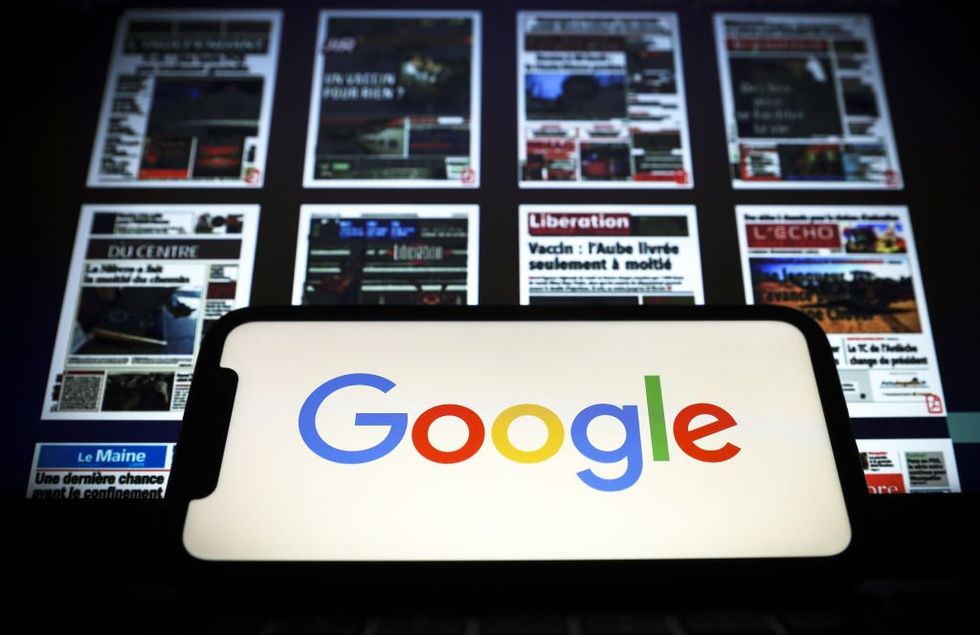
Back in the early days of the internet‚ about a year before Google was born‚ there existed a certain search engine called Ask Jeeves. Ask Jeeves perished in 2006 (first rebranded as ask.com‚ then vanishing into obscurity)‚ along with many of the other search engines of those freewheeling early days when the internet still held out the promise of returning power to the people. Now‚ most of us ask Google. But even when it comes to a question as seemingly basic as the pronunciation of the word “ask” itself‚ the sinister Silicon Valley behemoth does not answer our questions so much as it reshapes reality to conform it to its creators’ prejudices. Social convention and its enemies Sometime in the early 2000s‚ I had occasion to pal around with a bunch of grad students in Columbia University’s computer science department. Specifically‚ they worked in a subset of that department known as “natural language processing‚” a branch of artificial intelligence that marries computer science and linguistics to give us‚ among other things‚ the kinds of idiot-savant talking bots (ChatGPT‚ Bard‚ Microsoft’s Copilot‚ etc.) that have shaken up our society within the past year. I had a habit back then‚ as today‚ of amusing myself by correcting my friends’ grammatical errors. I do this in part because it is not considered nearly as much of a faux pas within the formality-loving‚ rule-abiding northern Russian culture in which my parents raised me and in part because I enjoy teasing friends about such matters even as I genuinely lament our growing collective apathy concerning written and spoken style and usage. And so it came to pass that while I was at a soiree and doing my usual thing of correcting a friend’s bad grammar‚ one of the Columbia grad students in attendance‚ an effete and supercilious sort who had overheard the exchange‚ interjected‚ in his accustomed pedantic tone: “You do know‚ don’t you‚ that linguists consider grammar to be descriptive‚ not prescriptive‚ and there is no ‘correct’ or ‘incorrect’ way to say things?” My response was something akin to‚ “Oh‚ yeah‚ sure‚ I understands‚ thanks-you very muchly.” Our collective apathy in the face of egregious grammatical errors was one thing. But when Google starts deliberately normalizing blatantly backward locutions‚ that significantly ups the ante. And that was the end of that particular exchange. In recent years‚ we have heard many such arguments from authority in a variety of fields in which people who play the role of journalists on TV and in print rely on some variant of “experts say‚” “experts believe‚” or “97% of experts agree” to short-circuit debate. These ex cathedra formulations often serve to paper over hotly contested matters and conceal ignorance and/or sloppy thinking‚ and it would‚ I think‚ be a good thing for all concerned if we made a routine practice of explaining arguments and laying bare evidence‚ at least by way of citation‚ rather than leaning on authorities. If we never again have to read the New York Times soliciting a quote from Harvard’s Frank Hu to demonize saturated fat and promote “heart-healthy” industrial seed oils or read another Katherine J. Wu-penned article in the Atlantic drawing on the alleged consensus of “experts” to promote state-sponsored‚ Big Pharma-boosted COVID fearmongering and disinformation‚ we will all be better for it. The grad student who reprimanded me all those years ago by drawing on the authority of “linguists” is a prime example of what I am talking about‚ and I have occasionally thought about his pronouncement as I’ve watched the deterioration of speech and writing roll on over the years. Like other questions as to which no objective truth exists — all sorts of moral norms and standards of appropriate dress and behavior — the rules of grammar are determined by long-standing traditions as iteratively modified by prevalent social conventions. But just as for these other conventionally determined matters‚ that there is no divinely decreed‚ unchanging Platonic form of proper English grammar does not end the inquiry. Nothing other than convention tells us that on a hot summer day‚ we should put on clothes before going out in public. Nothing other than convention commands us — at least in the West and in Eastern Europe — to eat with silverware rather than our hands and to cradle these implements with our fingers rather than grasping them in clenched fists. Closer to the matter at hand‚ nothing beyond convention dictates that we should continue to spell any given word one way rather than some other way that might even be far more intuitive than doozies like “queue” and “phlegm.” When we eat like barbarians‚ cannot spell‚ and permit egregious errors when we speak‚ we may not be violating any sort of God-given law‚ and yet we are violating important social rules and‚ as such‚ branding ourselves as uncouth and uneducated rubes. Children are taught these rules and conventions in school and at home so that they can grow up to thrive in a variety of social and professional environments as adults. More recently‚ however‚ the same brand of toxic wokeism that has infected much of the rest of our lives has worked to undermine the teaching of such conventions‚ deeming them racist or “white-normed.” As in other cases‚ academia’s left-wing monoculture has concocted apologias for these onslaughts‚ arguing that what appear on the surface to be grammatical errors are actually just manifestations of alternative dialects‚ such as African-American Vernacular English‚ within which a sentence such as “She don’t know what she done cuz she ain’t done nothin’ worth doin’” is perfectly correct. The speakers of such dialects‚ this story goes‚ communicate in this manner among themselves but are able to — and‚ indeed‚ forced to — “code-switch” into the standard American dialect to conform in white-dominated spaces. But to require such conformity to white norms is racist‚ we are told. A generation hearing aks spoken by our increasingly automated voices of authority will come to conclude that it is just another acceptable alternative. Far from universal among black Americans‚ however‚ “code-switching” is primarily something only people who grew up in families of low socioeconomic status but then received a good education can do. People who live their lives from start to finish in ghettos obviously cannot suddenly drop the double negatives‚ systematic misuses of subjective and objective pronouns‚ and predictable simplifications that drop certain verb conjugations‚ among other such errors common to uneducated speakers of English of all races‚ and start wielding the king’s English. And it is hardly racist to urge all uneducated people‚ regardless of their race‚ to get an education and master various mainstream social conventions‚ whether these be how we dress‚ how we eat‚ or how we speak. Such norms are necessarily dictated by the majority‚ as guided by traditions and historical practices‚ but that doesn’t make them racist or‚ in any respect‚ wrong. Revering shared traditions and striving toward universal standards give us our sense of communal belonging‚ of being a part of a single society within which we can feel invested and included by partaking in these implicit codes evolution deploys to help us distinguish our countrymen from strangers among us. Google’s Orwellian attack on pronunciation Google‚ however‚ seems to have taken a different view. I make somewhat regular use of an app in which I share articles to have it read them aloud to me while I go about various mindless daily chores. The app employs Google-generated text-to-speech voices. Sometime in mid-October‚ I began noticing that it had started pronouncing the word “ask” and all conjugations thereof as “aks.” Because I usually listen to text at a sped-up clip‚ I thought‚ at first‚ that I simply have to be imagining this. I slowed down the speech-generation rate to its natural pace and then even to half-speed. No‚ shockingly‚ I was not imagining this. Well‚ surely‚ I thought‚ this is some temporary glitch that will be remedied in a day or two. Some two months later‚ here we are. No remedy seems to be forthcoming. Curious to see if anyone else had encountered the issue‚ I came upon this Reddit discussion of the problem. Although it contained only a few posts‚ it consoled me to know that if I had entered the Matrix‚ at least I was not alone. On a Google Cloud community forum‚ I found another voice in the wilderness pleading with Google to correct the issue. The post was from October 17‚ having been met‚ as of this writing‚ with no responses whatsoever. I decided to try asking (aksing?) Google’s Bard to shed light on the matter. The depressing answer I got was that “given that the change has been reported by users of Google Voice applications all over the world‚ it seems likely that it is a deliberate change by Google‚” and that it was possible “Google may have decided to change the pronunciation of ‘ask’ to make it more consistent with the pronunciation of the word in some dialects of English‚ such as African American Vernacular English (AAVE)”: I was still not fully recovered from the Metropolitan Transit Authority’s decision to have people with some of the most grating‚ most thickly New York-accented voices around — Whoopi Golberg‚ Jerry Seinfeld‚ Awkwafina‚ etc. — making announcements on the New York subway‚ and now here was Google engaging in an exercise worthy of a Stalinist re-education camp or the Jacobins’ renaming of the months of the year. Our collective apathy in the face of egregious grammatical errors was one thing — I feel steam blowing out of my ears when the white-collar professionals in my midst keep talking about some opinion that’s shared “between my wife and I‚” an error that got its fittingly ignominious public stamp of approval when Bill Clinton spoke about the Lewinsky affair being “between Hillary and I” — but when Google starts deliberately normalizing blatantly backward locutions‚ that significantly ups the ante. Here is one of the most powerful corporations on Earth‚ in essence‚ flipping the bird to civilization and telling us that because some less-educated black people pronounce “ask” as “aks‚” we’re going to reshape reality to accommodate them. A larger battle against AI’s reimagination of our world This is far from the first time we have robotic voices trying to conform our reality to their ideological fantasies. Here is the unequivocal‚ 60% consensus-defying answer Google’s Bard gives when asked if a trans woman is a woman‚ after all: More broadly‚ research from New Zealand Institute of Skills and Technology professor David Rozado has shown that Bard’s responses to a range of salient political queries (such as those typically asked on political orientation quizzes) indicate flagrant left-wing bias. Compared to this‚ mangling the pronunciation of “ask” seems relatively innocuous. In important ways‚ however‚ it is also far more insidious. The 60% of us who do not buy into the absurd trans-woman-is-a-woman fantasy will have no trouble recognizing and rejecting Google’s propaganda on that front. On the other hand‚ ask versus aks is not some hot-button political issue that will readily register. It is‚ rather‚ the equivalent of a devious cheater shifting a pawn on the chessboard by a single square‚ knowing full well that his amateur opponents will not notice the shift until its devastating long-term ramifications come to fruition in the endgame. A generation hearing aks spoken by our increasingly automated voices of authority will come to conclude that it is just another acceptable alternative‚ and then the next generation will grow up hearing aks as the default setting‚ with only a few old codgers and odd ducks playing the part of antediluvian holdouts. And this‚ the linguists will tell us‚ is just how the natural evolution of language goes. Except that nothing about this particular process was natural. It was‚ instead‚ Google puppeteering us all the way. Furthering the cause of “antiracism‚” I fear‚ is only a ready-made justification Google will advance if it is ever called to comment on the change‚ while the underlying purpose may be more sinister. The subtle shift in the pronunciation of a single word may well be only a trial balloon. And even if Google reverses the change before long‚ the point will have been made. The experiment will have been successful‚ proving to the powers that be that‚ precisely as they suspected‚ when they begin to manipulate first the minor and later even the more consequential pieces on the board‚ hardly anyone will notice. The question we used to ask — the one put to us by the famous Turing test — was will we ever be able to get AI to sound sufficiently human to pass as one of our own? But as the titans of Big Tech continue to play their long game to reshape our world‚ bit by bit‚ the question we will all soon find ourselves aksing is a kind of counter-Turing test that will be administered‚ even if implicitly‚ to one and all: Will we humans be able to sound sufficiently like the robotic voices displacing our reality to avoid revealing ourselves as dissenters and nonconformists in need of re-education?
Like
Comment
Share
The Blaze Media Feed
2 yrs

Pentagon to tear down Reconciliation Monument in Arlington National Cemetery by week's end despite protest
Favicon 
www.theblaze.com

Pentagon to tear down Reconciliation Monument in Arlington National Cemetery by week's end despite protest

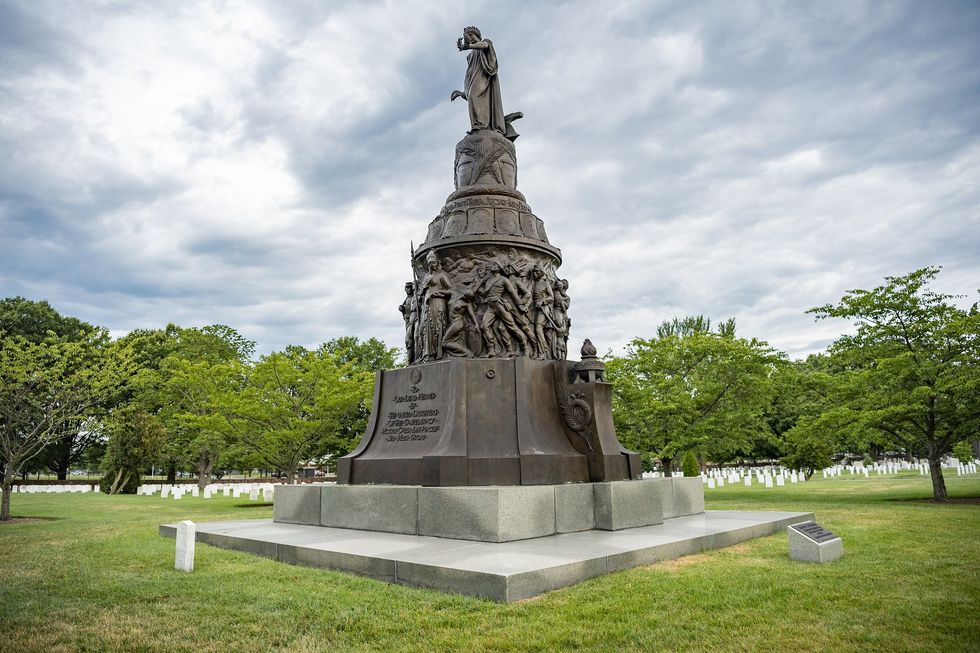
The Department of Defense has dutifully taken part in an iconoclastic sweep of American history that has left graves dug up‚ statues toppled‚ animals renamed‚ busts melted down‚ and church windows removed. Despite significant backlash‚ it appears no exception will ultimately be made for the Reconciliation Monument in Arlington National Cemetery. Workers will remove the 109-year-old monument this week‚ providing revisionists in the nation's capital with a gift of absence just in time for Christmas. What's the background? The Reconciliation Monument‚ also called the Confederate Memorial‚ was approved in 1906 by Secretary of War William Taft; commissioned by the United Daughters of the Confederacy in 1910; designed by Jewish former Confederate soldier Moses Jacob Ezekiel; and unveiled in Section 16 of the cemetery by President Woodrow Wilson on June 4‚ 1914. The monument consists of a bronze female figure crowned with olive leaves atop a 32-foot pedestal. The female figure holds a laurel wreath‚ a pruning hook‚ and a plow. At her feet is a biblical inscription that reads‚ "They have beat their swords into plough-shares and their spears into pruning hooks." Another inscription on the memorial states in Latin‚ "The victorious cause was pleasing to the gods‚ but the lost cause to Cato." Thirty-two figures of mythical gods‚ Southern soldiers‚ and civilians are depicted around the base‚ including two black characters — one holding a baby and the other a slave following his owner to war. The memorial also displays 14 shields representing the 11 Confederate states and the border states of Maryland‚ Kentucky‚ and Missouri. The memorial was intended as a monument to reconciliation in the aftermath of the Civil War. Union army veteran President William McKinley‚ who supported legislation in 1900 to establish a Confederate section in Arlington Cemetery‚ proclaimed four days after men from former Confederate states ensured America's victory against Spanish forces‚ "In the spirit of fraternity we should share with you in the care of the graves of Confederate soldiers. … Sectional feeling no longer holds back the love we feel for each other. The old flag again waves over us in peace with new glories." The American Conservative underscored that it was long understood to be a reconciliation monument‚ such that "some Confederate groups at the time opposed the statue and memorial precisely because they opposed the reconciliation that it symbolized. At the memorial’s dedication in 1914‚ President Wilson praised it as an 'emblem of a reunited people.'" Arlington National Cemetery highlighted the monument's historic value‚ noting that it "offers an opportunity for visitors to reflect on the history and meanings of the Civil War‚ slavery‚ and the relationship between military service‚ citizenship and race in America. This memorial ... invites us to understand how politics and culture have historically shaped how Americans have buried and commemorated the dead." Removal The National Defense Authorization Act for fiscal year 2021‚ passed by a Democrat-controlled Congress‚ required the removal of "all names‚ symbols‚ displays‚ monuments‚ and paraphernalia that honor or commemorate the Confederate Sates of America (commonly referred to as the 'Confederacy') or any person who served voluntarily with the Confederate States of America from all assets of the Department of Defense."' Congress established an eight-member commission in 2021 and tasked it with renaming military assets in accordance with this requirement. The deadline for such changes and removals is Jan. 1‚ 2024. The commission addressed the Reconciliation Monument in its final report on Sept. 19‚ 2022‚ recommending that Arlington National Cemetery "remove the 32 life-sized bronze statues from the top of the monument but not remove the entire monument because doing so might damage graves under the structure." Arlington National Cemetery indicated in March that it had begun preparations for the "careful removal and relocation" of the monument as required by Congress and demanded by Biden's Secretary of Defense Lloyd Austin. Backlash There has been significant bipartisan outcry in the face of this particular iconoclastic initiative. Former U.S. Sen. Jim Webb (D-Va.)‚ cognizant that the memorial was built "with the sole purpose of healing the wounds of the Civil War‚" stressed in an August opinion piece in the Wall Street Journal that the statue's toppling would signify the desire of a "deteriorating society ... to erase the generosity of its past‚ in favor of bitterness and misunderstanding conjured by those who do not understand the history they seem bent on destroying." Rep. Andrew Clyde (R-Ga.) was among over 40 Republicans who criticized the iconoclastic initiative‚ calling on Defense Secretary Austin in a Dec. 11 letter to suspend all removal activities related to the Reconciliation Monument until Congress finalized the appropriations process for fiscal year 2024. Clyde noted that the memorial ought to be exempt from the removal requirement because it "does not honor nor commemorate the Confederacy; the memorial commemorates reconciliation and nation unity." Additionally‚ "the Naming Commission's authority explicitly prohibits the desecration of grave sites." Christmastime iconoclasm Arlington National Cemetery announced Saturday that the monument had been fenced off and would be removed by no later than Dec. 22. All but the granite pedestal will be taken away. The cemetery further alleged that the removal is in compliance with both the National Environmental Policy Act and the National Historic Preservation Act‚ and that no nearby graves or headstones would be damaged during the "deconstruction" process. "During the deconstruction‚ the area around the Memorial will be protected to ensure no impact to the surrounding landscape and grave markers and to ensure the safety of visitors in and around the vicinity of the deconstruction‚" the cemetery indicated in a statement. Virginia Gov. Glenn Youngkin (R) plans to move the memorial to the New Market battlefield state historic park in Shenandoah Valley‚ reported the Military Times. Like Blaze News? Bypass the censors‚ sign up for our newsletters‚ and get stories like this direct to your inbox. Sign up here!
Like
Comment
Share
The Blaze Media Feed
2 yrs

MBS is building a 110-mile-long city in the Arabian desert. Is it all a mirage?
Favicon 
www.theblaze.com

MBS is building a 110-mile-long city in the Arabian desert. Is it all a mirage?

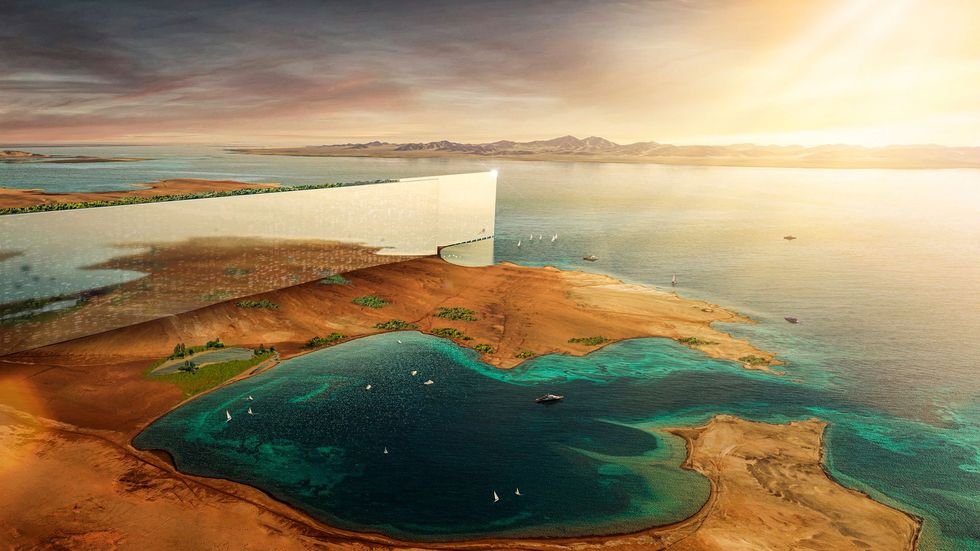
When Mohammed bin Salman became crown prince of Saudi Arabia in 2017‚ he consolidated his power first by imprisoning many of his relatives and other influential Saudis in the Ritz-Carlton. Next‚ and more unexpectedly‚ he took steps to liberalize social norms‚ pushing against Wahabi influence and loosening restrictions on women — allowing them to drive‚ to name one decree. These opening gambits of his reign give contrasting but hardly novel impressions of the kind of leadership he wants to forge. They derive from an uncompromising reforming zeal that is alien to and sometimes pined for in more strictly democratic societies. It is the style of the enlightened despot‚ summarized by the variously attributed maxim as “Everything for the people‚ nothing by the people.” And six years later‚ his ambitions for the small but significant petro state are only growing in magnitude and audacity. Indeed‚ he appears to be placing his entire legacy in the middle of the desert — that is‚ in Neom.The city of Neom does not yet exist. A 10‚200-square-mile spot of land in the northwestern province of Tabuk is staked out for its development. Much of it was supposed to have been completed by 2020‚ with full completion by 2025. In 2023‚ the $500 billion project has broken ground. Most prominent is the Line‚ a skyscraper that is 110 miles long and can house 9 million people. To many observers‚ the Line is a comical stroke of hubris‚ a 21st-century Titanic on sand. In the crown prince’s mind‚ however‚ it is a 21st-century pyramid and the key to taking Saudi Arabia into the future.Transforming Saudi Arabia drives MBS. He wants to wean Saudi Arabia off oil dependence‚ creating a dynamic‚ modern economy in the process. Oil accounts for 87% of the Saudi budget and 42% of economic activity. Oil production tends to be dependent on highly skilled foreign labor and technology‚ and the Saudi state maintains power through a combination of brutality and generous welfare payments. It is‚ according to journalist Karen Elliott House:a bewildering (at least to outsiders) combination of a feudal fealty system and a more modern political patronage one. At every level in every sphere of activity‚ Saudis maneuver through life manipulating individual privileges‚ favors‚ obligations‚ and connections. By the same token‚ the government bureaucracy is a maze of overlapping or conflicting power centers under the patronage of various royal princes with their own priorities and agendas to pursue and dependents to satisfy.MBS seeks to remove the need for this complex balancing act by bringing Saudi Arabia into the modern era. Indeed he is a modernizer in the mold of Atatürk‚ Muhammad Ali‚ or Peter the Great. He gained power in a society that was backward by the standards of the day‚ with pressure from more advanced regional and global powers. He is embarking on an effort to modernize Saudi Arabia by changing the underlying social structures to become more effective in the modern world. Past examples of such efforts come with many encouraging successes. Mustafa Kemal Atatürk created modern Turkey from the remains of the Ottoman Empire and is still revered for doing so‚ as is Singapore’s Lee Kuan Yew for turning the expelled Malaysian city-state into an independent developed nation. Others have had mixed success‚ Peter the Great built St. Petersburg and asserted regional hegemony but did not build a governing class that could sustainably compete with Europe. South Korea’s economy accelerated significantly during Park Chung-hee’s nearly two-decade presidency but not without becoming a dictatorial state that got only a brief respite after Park’s assassination by his intelligence chief in 1979. Muhammad Ali’s failure to modernize Egypt in the early 20th century has left him largely forgotten.Modernizing the Gulf Image courtesy of Neom Modernization is by definition a herculean task. It is easier when an existing political elite can coordinate to focus on the goal‚ e.g.‚ Meiji-era Japan. When the political elite cannot coordinate‚ it requires a powerful central hand. Concentrating power limits the necessary feedback loop to course-correct‚ as well as having an inherently corrupting element. MBS’ reform agenda follows Shenzhen and the logic of special jurisdictions more generally. If it is difficult to build political support for national reforms‚ reform neglected areas instead. Neom is being built in a sparsely populated desert and more or less outside any central power..Unlike many leaders in the Middle East‚ MBS appears to have learned at least some of the lessons from Dubai. Most leaders have laid the rise of Dubai on buildings alone; of aesthetics bringing success. In truth they have it backward: Dubai’s architecture is the result rather than the source of its success. Dubai succeeded because it was a relatively liberal entrepot in a region experiencing a natural resource boom. In addition to physical infrastructure‚ Neom is ensuring a strong legal environment‚ a “competitive legal framework.” Press releases and public statements always mention the importance of governance. A lesson they haven’t learned from Dubai is the organic‚ evolutionary process of development. Dubai succeeded by taking advantage of regional missteps. Iran raises tariffs: Dubai invites Persian traders to use its ports. Iranian Revolution: Dubai’s airport becomes more attractive for layovers. Civil unrest in Lebanon: Dubai positions itself as the financial capital of the Middle East. Cities‚ much less regions‚ are not planned from scratch‚ but instead the result of dynamic‚ competitive processes. Without a feedback loop — are people and businesses moving to the region? — MBS can easily misspend tens of billions of dollars. The Line is not Saudi Arabia’s first new city project. King Abdullah Economic City was touted to diversify the country’s economy from oil and create 1 million jobs by 2020. In 2018 the city had 7‚000 residents. MBS looked at King Abdullah Economic City and thought‚ "Not enough money!" Up to $1 trillion will be invested in Neom. The ambition of Neom at times appears unmoored from reality; it is not lacking for critics. Some ideas that are being advanced in addition to the already baffling Line include a beach with crushed marble for sand. To meet the goals in the promotional video‚ getting anywhere in the city in just 20 minutes requires trains faster than the fastest maglev trains in operation today. The beach with crushed marble was shelved for not being imaginative enough. Images from press releases look closer to sci-fi renderings than actual plans. Perhaps this isn’t surprising‚ as Neom is hiring experts on the aesthetics of "Blade Runner."Despite my own skepticism‚ there is still a case to be made for Neom. First‚ Saudi Arabia faces tremendous challenges in diversifying and modernizing its economy. Second‚ national reforms could be difficult given religious opposition and other entrenched interests. Third‚ governments have successfully built cities before‚ e.g.‚ Washington‚ D.C.; Abuja; and St. Petersburg. Brasilia even proves that modernist abominations can grow with enough of a helping hand from the government. But cities are also a series of logistical problems. Chief among them is coordinating‚ let alone encouraging‚ mass migration. Overcoming it will take more than a sweeping and singular vision or promises of roadless sustainability in a country whose income is still based on fossil fuels. Moreover‚ a credible commitment to spend obscene amounts of money on development is only the beginning. National leaders with grand visions should not be automatic net negatives. Whether they are vindicated in the long term is not ultimately in their hands. The sheer arrogance of Mohammed bin Salman’s designs is impossible to ignore. That he longs for pharaonic greatness is no secret. The best way to be remembered is to build vast structures in deserts. It may be that the crown prince will have his glass pyramid. It remains to be seen whether 9 million people want to entomb themselves within it.
Like
Comment
Share
Classic Rock Lovers
Classic Rock Lovers  
2 yrs

Music World Wishes Keith Richards a Happy 80th Birthday
Favicon 
bestclassicbands.com

Music World Wishes Keith Richards a Happy 80th Birthday

The legendary musician celebrated his 40th wedding anniversary on the same day The post Music World Wishes Keith Richards a Happy 80th Birthday appeared first on Best Classic Bands.
Like
Comment
Share
Showing 107223 out of 115996
  • 107219
  • 107220
  • 107221
  • 107222
  • 107223
  • 107224
  • 107225
  • 107226
  • 107227
  • 107228
  • 107229
  • 107230
  • 107231
  • 107232
  • 107233
  • 107234
  • 107235
  • 107236
  • 107237
  • 107238
Advertisement
Stop Seeing These Ads

Edit Offer

Add tier


Select an image
Delete your tier
Are you sure you want to delete this tier?

Reviews

In order to sell your content and posts, start by creating a few packages. Monetization

Pay By Wallet

Payment Alert

You are about to purchase the items, do you want to proceed?

Request a Refund