www.historyisnowmagazine.com
Roman Trade with Modern-Day Sri Lanka
When Roman sailors and merchants in the first centuries of the Common Era looked southward from the mouth of the Red Sea, the island they called Taprobane, now almost universally identified with Sri Lanka, appeared in their geographies as a rich and mysterious partner in an expanding Indian Ocean trade network. Classical geographers and travel writers treated Taprobane both as a place of fabulous commodities and as a real staple of long-distance exchange: it appears in the Periplus of the Erythraean Sea, in Pliny the Elder's Natural History, and on Ptolemy's maps, and these accounts, read together with archaeological finds around Sri Lanka's ancient ports, make a persuasive case that Greco-Roman traders reached the island's shores, if sometimes indirectly, from the mid-first century CE onward.Terry Bailey explains.
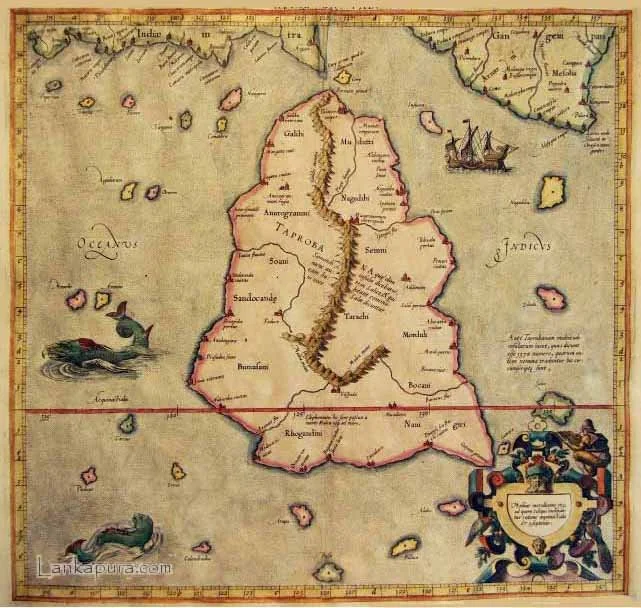
A map of Taprobane from Ptolemy's Geography.
The short but vivid Periplus of the Erythraean Sea, a Greek seaman's handbook usually dated to the mid-first century CE, is the most direct contemporary Roman-period testimony to long-distance navigation in the Indian Ocean. Its anonymous author describes routes, seasons and goods, and although Taprobane receives briefer treatment than the western Indian ports, the Periplus places the island within the author's pragmatic commercial map: it is a known source of gems, ivory and other sought-after products and a waypoint for ships that ranged along the eastern Indian seaboard and beyond. The Periplus also reflects the adoption of the monsoon crossing, knowledge of seasonal wind patterns credited to figures such as Hippalus, which made regular oceanic linkages between the Red Sea and South Asia feasible and economically attractive for Roman subjects based in Egypt.Pliny the Elder and Ptolemy amplify the picture of Taprobane as an object of classical curiosity and commerce. Pliny compiled earlier reports and travelers’ tales into his encyclopedic Natural History and explicitly names Taprobane among the distant islands whose products reached Mediterranean markets; Ptolemy's Geographia, meanwhile, institutionalized Taprobane on maps, even if the island's scale and position were distorted in late antique cartography. These literary testimonies outline what the Roman-world readers believed they were buying from the Indian Ocean: not only luxury items such as pearls, gems, spices and exotic woods, but also useful commodities—elephants for war and ivory for luxury works—that made a voyage to Taprobane, or through agents who dealt with it, commercially worthwhile.Textual notice must be matched to material traces, and here archaeology supplies concrete, if sometimes contested, evidence. Excavations and survey work at Sri Lanka's ancient trading sites—most notably Mantai (the harbor complex at Mannar), Godavaya and certain finds around the southern ports and the Ruhuna region—have produced imported ceramics, Indo-Roman wares, and metal finds datable to the first few centuries CE. These finds indicate that goods and perhaps persons moved between the island and the wider Indian Ocean economy at the time classical authors wrote. Archaeologists have recovered Roman or Roman-style amphora sherds and Mediterranean imports mixed with local and South Indian ceramics in contexts that often line up with the mid-first through third centuries CE, supporting the textual evidence that Taprobane was part of long-distance trade networks rather than an isolated curiosity.Numismatics has contributed one of the most headline-grabbing types of evidence: Roman and Indo-Roman coins found on the island and in neighboring Indian ports. Scholars have catalogued a variety of coins—official Roman denominations, later Byzantine and Sasanian pieces, and locally struck imitations, that turn up in hoards and stray finds across Sri Lanka's archaeological record. The presence of Roman gold, silver and bronze specimens, and of imitations that adapt Roman portraiture and types, demonstrates multiple channels of contact: direct importation, trade mediated by South Indian merchants, and the island's participation in a wider monetary ecology that incorporated foreign coinage as bullion or prestige money. At the same time, numismatists caution that coin deposits are slippery evidence for regular commercial routes, coins travel, are hoarded, reused and sometimes arrive centuries after they were minted, so they illuminate connectivity without always proving direct, continuous Roman state involvement.Material culture beyond coins, such as fragments of Mediterranean amphorae, glassware and certain classically styled objects helps round out the picture. Amphora sherds linked by form and fabric to Mediterranean production argue that Mediterranean foodstuffs (wine, preserved fish or oil) or at least their containers were carried into the Indian Ocean system. Yet many of the "Roman" finds in South Asia were funneled through intermediary entrepôts on the Malabar coast and the Arabian littoral; the principal agents of exchange in this era were often Indian, Arabian and later Southeast Asian merchants who operated the coastal networks and transshipped cargoes to and from Sri Lankan anchors. Consequently, although Roman subjects and merchants surely appear among the actors of this commerce, especially in Egyptian port cities like Berenice and Myos Hormos—the day-to-day movement of goods to Taprobane seems to have been largely run by regional middlemen who connected Mediterranean markets to South Asian and island producers.Certain Sri Lankan exports made the island especially prized by Mediterranean consumers. Classical authors and later commentators repeatedly emphasize cinnamon (whose precise identification in ancient texts is debated), pearls from the island's offshore banks, high-quality gemstones and ivory. Archaeology confirms the island's role in pearl fishing and its access to precious stones and fine timber, while epigraphic and local traditions record long-standing maritime commerce. The intersection of demand in the Roman world for luxury consumables and Sri Lanka's capacity to supply them produced the economic logic for sustained contact, sometimes direct, sometimes indirect—across the Indian Ocean.Historians still debate the scale and intimacy of Roman contact with Taprobane. Older popular narratives sometimes implied a flood of Roman merchants and colonial outposts, but modern scholarship tends toward a more nuanced reconstruction: the Roman world was linked into the Indian Ocean by regular traffic and predictable monsoon crossings, yet most trade remained mercantile rather than imperial in character. Exchanges involved ships and traders from many polities, and Roman interest in the island was commercial and mediated through established regional networks. Recent syntheses emphasize networks rather than empires and stress local agency: Sri Lankan rulers and coastal cities actively engaged with incoming traders, negotiated the terms of exchange, and integrated foreign goods into local economies and status displays.To read the Roman footprint on Sri Lanka is therefore to read an intricate palimpsest: classical texts furnish names, commodities and routes; coins and imported pottery confirm episodes of contact; port archaeology (Mantai, Godavaya and elsewhere) gives archaeological contexts; and numismatic and ceramic studies provide the cautionary notes that turn sensational finds into careful historical argument. Together they show a world in which a Mediterranean empire's appetites met an Indian Ocean island's riches through the wind and skill of monsoon sailors, the networks of Indian and Arabian middlemen, and the receptive markets of the classical Mediterranean. The story of Roman contact with Taprobane is thus not simply one of exotic discovery but of interlocking economic systems whose consequences can still be traced across texts, maps and the soil of Sri Lanka's ancient harbors.If modern readers take away anything from these fragments of evidence, it should be the image of an ancient globality: long before industrial shipping lanes and steam power, mariners harnessed seasonal winds and a shared appetite for luxury to connect Rome and Taprobane. The contacts were episodic and mediated, yet real—and archaeology keeps revealing fresh details that transform classical blurbs into a living maritime history of exchange, negotiation and cultural contact centered on an island the ancients called Taprobane.Therefore in conclusion, the story of Roman contact with Taprobane, (modern Sri Lanka), reveals a world far more interconnected than traditional histories of empire and conquest often suggest. It illustrates how commerce, curiosity, and the mastery of the monsoon winds drew distant civilizations into dialogue across thousands of nautical miles. Taprobane stood at the crossroads of the Indian Ocean trade, a hub where the ambitions of Mediterranean merchants, the enterprise of South Asian and Arabian intermediaries, and the wealth of the island's own natural resources converged. Rather than a tale of colonization or conquest, it is one of exchange and adaptation, in which goods, ideas, and cultural influences circulated through the flexible networks of ancient trade.From the Roman amphora fragments unearthed at Mantai to the gold coins buried in Sri Lankan soil, every discovery underscores that global trade, even in antiquity, was a shared venture driven by mutual interest and the steady rhythm of the monsoon. Taprobane's presence in classical geography, literature, and cartography speaks not only to Roman fascination with distant lands but also to the island's active participation in shaping the maritime world of its time. In the final measure, the legacy of these contacts lies in their reminder that globalization is not a modern invention, it is a continuous human story that began when early sailors learned to follow the winds from the Red Sea to the shining shores of Taprobane. The site has been offering a wide variety of high-quality, free history content since 2012. If you’d like to say ‘thank you’ and help us with site running costs, please consider donating here. Notes:HippalusHippalus was a Greek navigator and mariner traditionally credited with one of the most important breakthroughs in ancient navigation, the discovery of the direct sea route across the Indian Ocean from the Red Sea to the west coast of India, aided by the predictable seasonal winds known today as the monsoon. His exploits, usually dated to the 1st century BCE, revolutionized maritime trade between the Greco-Roman world and India by allowing sailors to venture directly across the open ocean rather than hugging the dangerous and time-consuming coastlines of Arabia and Persia. Although few details of his life are known, Hippalus's name became synonymous with this vital navigational discovery, with both the southwest monsoon wind and the route itself often referred to in ancient texts as the Hippalus or Hippalus wind.Before Hippalus's innovation, Greek and Roman merchants relied largely on intermediary traders and coastal navigation routes that followed the Arabian Peninsula, using small vessels ill-suited for deep-sea travel. By observing the regular reversal of the monsoon winds, blowing from the southwest in summer and the northeast in winter, Hippalus realized that a direct crossing from the Red Sea to the Malabar Coast of India was possible. This not only shortened the voyage but also dramatically increased the volume and efficiency of trade. His discovery effectively opened the Indian Ocean to Greco-Roman seafarers and established a reliable maritime corridor that endured for centuries, connecting ports such as Berenice and Myos Hormos in Egypt to Muziris and Barygaza in India.The Periplus of the Erythraean Sea, a 1st-century CE Greek navigational text, preserves some of the earliest references to Hippalus's route. Although historians debate whether Hippalus himself made the voyage or merely identified the wind pattern, his legacy was profound. Roman merchants soon began to dominate the Indian Ocean trade, importing spices, silks, gemstones, and ivory in exchange for gold and silver. The new route not only enriched the Roman economy but also deepened cultural exchanges between the Mediterranean world and South Asia, influencing art, religion, and material culture on both sides. Thus, even though the man Hippalus remains elusive, his name endures as a symbol of early scientific observation and the spirit of exploration that bridged civilizations across the seas.








 New Posts (Home)
 ChatBox
 Popular Posts
  Game Zone
 Top PodCasts