YubNub Social YubNub Social
    #trump #democrats #loonylibs #americafirst #sotu #k #culture #fuckdiversity #streetingtrial #wesstreeting #saynottopubertyblockers
    Advanced Search
  • Login
  • Register

  • Night mode
  • © 2026 YubNub Social
    About • Directory • Contact Us • Developers • Privacy Policy • Terms of Use • shareasale • FB Webview Detected • Android • Apple iOS • Get Our App

    Select Language

  • English
Night mode toggle
Featured Content
Community
New Posts (Home) ChatBox Popular Posts Reels Game Zone Top PodCasts
Explore
Explore
© 2026 YubNub Social
  • English
About • Directory • Contact Us • Developers • Privacy Policy • Terms of Use • shareasale • FB Webview Detected • Android • Apple iOS • Get Our App
Advertisement
Stop Seeing These Ads

Discover posts

Posts

Users

Pages

Blog

Market

Events

Games

Forum

Intel Uncensored
Intel Uncensored
3 w ·Youtube News & Oppinion

YouTube
CNN Delivers Jaw-Dropping News to Trump-Hating Democrats: ‘It’s Going to Last’
Like
Comment
Share
DeepLinks from the EFF
3 w

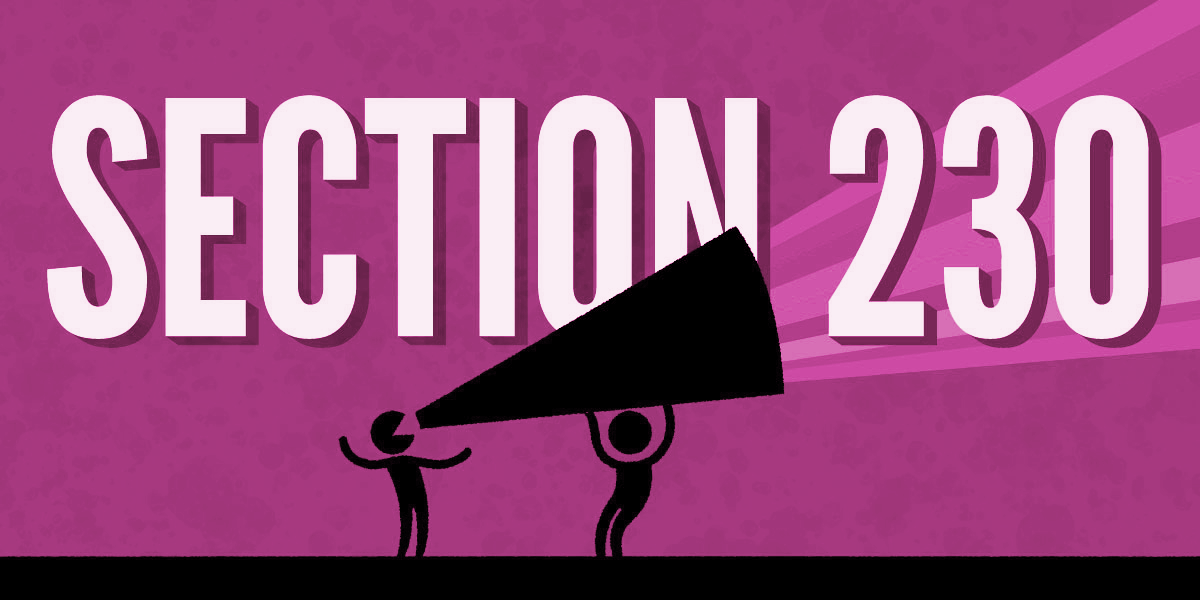
Op-ed: Weakening Section 230 Would Chill Online Speech
Favicon 
www.eff.org

Op-ed: Weakening Section 230 Would Chill Online Speech

(This appeared as an op-ed published Friday, Feb. 6 in the Daily Journal, a California legal newspaper.) Section 230, “the 26 words that created the internet,” was enacted 30 years ago this week. It was no rush-job—rather, it was the result of wise legislative deliberation and foresight, and it remains the best bulwark to protect free expression online. The internet lets people everywhere connect, share ideas and advocate for change without needing immense resources or technical expertise. Our unprecedented ability to communicate online—on blogs, social media platforms, and educational and cultural platforms like Wikipedia and the Internet Archive—is not an accident. In writing Section 230, Congress recognized that for free expression to thrive on the internet, it had to protect the services that power users’ speech. Section 230 does this by preventing most civil suits against online services that are based on what users say. The law also protects users who act like intermediaries when they, for example, forward an email, retweet another user or host a comment section on their blog. The merits of immunity, both for internet users who rely on intermediaries—from ISPs to email providers to social media platforms, and for internet users who are intermediaries—are readily apparent when compared with the alternatives. One alternative would be to provide no protection at all for intermediaries, leaving them liable for anything and everything anyone says using their service. This legal risk would essentially require every intermediary to review and legally assess every word, sound or image before it’s published—an impossibility at scale, and a death knell for real-time user-generated content. Another option: giving protection to intermediaries only if they exercise a specified duty of care, such as where an intermediary would be liable if they fail to act reasonably in publishing a user’s post. But negligence and other objective standards are almost always insufficient to protect freedom of expression because they introduce significant uncertainty into the process and create real chilling effects for intermediaries. That is, intermediaries will choose not to publish anything remotely provocative—even if it’s clearly protected speech—for fear of having to defend themselves in court, even if they are likely to ultimately prevail. Many Section 230 critics bemoan the fact that it prevented courts from developing a common law duty of care for online intermediaries. But the criticism rarely acknowledges the experience of common law courts around the world, few of which adopted an objective standard, and many of which adopted immunity or something very close to it. Congress’ purposeful choice of Section 230’s immunity is the best way to preserve the ability of millions of people in the U.S. to publish their thoughts, photos and jokes online, to blog and vlog, post, and send emails and messages. Another alternative is a knowledge-based system in which an intermediary is liable only after being notified of the presence of harmful content and failing to remove it within a certain amount of time. This notice-and-takedown system invites tremendous abuse, as seen under the Digital Millennium Copyright Act’s approach: It’s too easy for someone to notify an intermediary that content is illegal or tortious simply to get something they dislike depublished. Rather than spending the time and money required to adequately review such claims, intermediaries would simply take the content down. All these alternatives would lead to massive depublication in many, if not most, cases, not because the content deserves to be taken down, nor because the intermediaries want to do so, but because it’s not worth assessing the risk of liability or defending the user’s speech. No intermediary can be expected to champion someone else’s free speech at its own considerable expense.Nor is the United States the only government to eschew “upload filtering,” the requirement that someone must review content before publication. European Union rules avoid this also, recognizing how costly and burdensome it is. Free societies recognize that this kind of pre-publication review will lead risk-averse platforms to nix anything that anyone anywhere could deem controversial, leading us to the most vanilla, anodyne internet imaginable. The advent of artificial intelligence doesn’t change this. Perhaps there’s a tool that can detect a specific word or image, but no AI can make legal determinations or be prompted to identify all defamation or harassment. Human expression is simply too contextual for AI to vet; even if a mechanism could flag things for human review, the scale is so massive that such human review would still be overwhelmingly burdensome. Congress’ purposeful choice of Section 230’s immunity is the best way to preserve the ability of millions of people in the U.S. to publish their thoughts, photos and jokes online, to blog and vlog, post, and send emails and messages. Each of those acts requires numerous layers of online services, all of which face potential liability without immunity. This law isn’t a shield for “big tech.” Its ultimate beneficiaries are all of us who want to post things online without having to code it ourselves, and so that we can read and watch content that others create. If Congress eliminated Section 230 immunity, for example, we would be asking email providers and messaging platforms to read and legally assess everything a user writes before agreeing to send it.  For many critics of Section 230, the chilling effect is the point: They want a system that will discourage online services to publish protected speech that some find undesirable. They want platforms to publish less than what they would otherwise choose to publish, even when that speech is protected and nonactionable. When Section 230 was passed in 1996, about 40 million people used the internet worldwide; by 2025, estimates ranged from five billion to north of six billion. In 1996, there were fewer than 300,000 websites; by last year, estimates ranged up to 1.3 billion. There is no workforce and no technology that can police the enormity of everything that everyone says. Internet intermediaries—whether social media platforms, email providers or users themselves—are protected by Section 230 so that speech can flourish online.
Like
Comment
Share
Trending Tech
Trending Tech
3 w

Ex-Googlers are building infrastructure to help companies understand their video data
Favicon 
techcrunch.com

Ex-Googlers are building infrastructure to help companies understand their video data

Founded by former Google Japan leaders, InfiniMind is building enterprise AI to turn vast, unused video archives into searchable, actionable business intelligence.
Like
Comment
Share
Trending Tech
Trending Tech
3 w

Snapchat now lets you inform others when you have arrived at your destination
Favicon 
techcrunch.com

Snapchat now lets you inform others when you have arrived at your destination

With its new "Arrival Notifications," users can now set one-time or recurring alerts for locations beyond their home, providing an automatic way to share when they’ve arrived at their destination.
Like
Comment
Share
The Patriot Post Feed
3 w

Monday Executive News Summary
Favicon 
patriotpost.us

Monday Executive News Summary

Team Trump's Obama faux pas, Benghazi conspirator extradited, more WaPo upheaval, global warming stops global warming, and more.
Like
Comment
Share
The Patriot Post Feed
3 w

Don't Let Republicans Cheat!
Favicon 
patriotpost.us

Don't Let Republicans Cheat!

Don't Let Republicans Cheat!
Like
Comment
Share
Country Roundup
Country Roundup
3 w

Cross Canadian Ragweed To Headline Red Rocks For The First Time Ever This Summer
Favicon 
www.whiskeyriff.com

Cross Canadian Ragweed To Headline Red Rocks For The First Time Ever This Summer

The comeback continues. Cross Canadian Ragweed has remained a cornerstone band of the Red Dirt music movement. Forming in Stillwater, Oklahoma, in the mid-1990s, the band featured members such as Cody Canada, Grady Cross, Randy Ragsdale, and Jeremy Plato. Simply put, Ragweed caught fire early upon the release of their 1998 debut album, Carney. Throughout their career, the Oklahoman band released seven studio albums and three live albums, but sadly disbanded in 2010. Red Dirt fans were beyond heartbroken when the group broke up, and from a conversation with Cody Canada, it seemed there was no way in hell they would get back together, comparing their breakup to a divorce. 2025 proved to be nothing short of a miracle for the band. After making their long-awaited return to the stage in January at Mile 0 Fest in Key West, Florida, Ragweed dropped the bombshell and announced their grand reunion: “The Boys From Oklahoma” Concert series, a four-night experience in April, along with fellow Red Dirt legends, Turnpike Troubadours. This would later expand into a “Texas Encore” edition of the reunion, which included Shane Smith & The Saints, Wade Bowen and more in August. With so much momentum heading into 2026, Ragweed announced another two “Boys From Oklahoma” shows: one “Cornhuskers Edition” in the University of Nebraska’s Memorial Stadium in August and one additional show in Stillwater at Boone Pickens Stadium to commemorate the one-year anniversary of their reunion in April. Just when you thought Ragweed was done with their newest round of “Boys From Oklahoma” shows, they announced yet another one back on November 14th, this time in Athens, Georgia, at Akins Ford Arena on February 28th with Turnpike returning once again along with the severely underrated Texan singer/songwriter, Shelby Stone. Given the high demand, they would add a second date for February 27th with Turnpike and The Castellows shortly after. Today, however, they just announced their biggest and most notable show of 2026 so far: their first-ever headlining show at the iconic Red Rocks Amphitheater in Morrison, Colorado, on July 24th, with Waves in April and The Smokin’ Oaks as openers. View this post on Instagram Undoubtedly, headlining a venue as iconic as Red Rocks is nothing short of a bucket-list item for the band, as noted in Ragweed’s Instagram caption announcing the concert. However, for frontman Cody Canada, going back to the amphitheater carries a bit of extra weight to it. In an interview with Rolling Stone, Canada would recall the last time the band played the venue was back in 2008 on Dierks Bentley’s High Times and Hangovers Tour. Given that they were frequent openers for the “I Hold On” singer, they typically took the second slot right before Bentley went on stage. 18 years ago at Red Rocks, however, they were bumped down to the first set, in turn only getting 30 minutes to play, which has bothered the frontman for years. “The first time I went, we opened for Dierks Bentley, and it was supposed to be us and Dierks doing “High Times and Hangovers.” Then, they put a guy in the middle — we don’t have to say his name — because he had a song on the radio. We got bumped to the first set, which was about 30 minutes, and man, I was pretty sore about it. I don’t want to be a jerk, but it was kind of bullsh*t. I always kind of wanted to come back and do a full set just to redeem that moment.” Of course, Cody and Dierks are still great friends, Cody even named his son Dierks. But the Red Rocks show isn’t just about getting to redeem that moment of frustration all those years ago, but it’s also about finishing the goal they set when officially announcing Ragweed’s reunion last year. As Canada noted, it was the first thing he told his agent, Jon Folk, when discussing the reunion that they “had to play Red Rocks.” Canada would also express that the show carries an even heavier weight then their grand reunion last year in Stillwater, noting that it’s simply going to be a family affair with the openers, Waves in April and the Smokin’ Oaks. Waves In April is a band that features Canada’s sons, Dierks and Willy, and Grady Cross’ son and nephew play in Smokin’ Oaks. “It’s gonna be Grady’s boy and our boys, and I’m probably gonna cry more that night than I did the first night in Stillwater.” Tickets for their grand Red Rocks headlining debut go on sale this Friday, February 13th at 10 a.m. As of now, no pre-sale opportunities have been announced.The post Cross Canadian Ragweed To Headline Red Rocks For The First Time Ever This Summer first appeared on Whiskey Riff.

Like
Comment
Share
Conservative Voices
Conservative Voices
3 w

Lidia Curanaj: 'Hillary Clinton needs to be held accountable for Benghazi'
Favicon 
www.brighteon.com

Lidia Curanaj: 'Hillary Clinton needs to be held accountable for Benghazi'

Lidia Curanaj: 'Hillary Clinton needs to be held accountable for Benghazi'
Like
Comment
Share
Clips and Trailers
Clips and Trailers
3 w ·Youtube Cool & Interesting

YouTube
Woody Harrelson Takes the Stage (Full Scene) | The Cowboy Way
Like
Comment
Share
Fun Facts And Interesting Bits
3 w

Why Is the Winter Sport Called “Bobsledding”?
Favicon 
www.mentalfloss.com

Why Is the Winter Sport Called “Bobsledding”?

Breaking down the origins of the name you’ll hear during this year’s Winter Olympics.
Like
Comment
Share
Showing 2541 out of 111753
  • 2537
  • 2538
  • 2539
  • 2540
  • 2541
  • 2542
  • 2543
  • 2544
  • 2545
  • 2546
  • 2547
  • 2548
  • 2549
  • 2550
  • 2551
  • 2552
  • 2553
  • 2554
  • 2555
  • 2556
Advertisement
Stop Seeing These Ads

Edit Offer

Add tier


Select an image
Delete your tier
Are you sure you want to delete this tier?

Reviews

In order to sell your content and posts, start by creating a few packages. Monetization

Pay By Wallet

Payment Alert

You are about to purchase the items, do you want to proceed?

Request a Refund