www.dailywire.com
More Spending, More Suffering: The Failure Of America’s Homelessness Policy
In a recent ruling that defies both logic and compassion, a federal judge has blocked the Trump administration’s effort to reform the Department of Housing and Urban Development’s (HUD) Continuum of Care program — the federal government’s primary funding mechanism for homelessness assistance.
The lawsuit — filed by a coalition of 20 mostly Democratic-led states, local governments, and nonprofit organizations and spearheaded by groups such as Democracy Forward — warns of “funding gaps,” winter instability, and the potential displacement of people currently housed. These alarms are sounded even though HUD includes a nearly 12% increase over last year’s funding allocation.
At the core of the complaint is a revealing claim: that reform would “upend longstanding projects that have been thoughtfully developed to comport with evidence-based, best-practices services delivery.”
But HUD’s own data make clear that the evidence on which they have long relied is catastrophically wrong.
Despite a 300% increase in federal spending, homelessness has reached the highest level ever recorded in the nation’s history. Unsheltered homelessness — the most dangerous and lethal form — has surged.
Mortality among people struggling with homelessness has also peaked. If these outcomes qualify as “evidence-based best practices,” then the phrase has lost all meaning.
The real question is not whether reform is upending but upending to whom.
The organizations positioning themselves as defenders of the homeless are fully aware of the catastrophe that has unfolded on their watch. Yet they are using the courts to block reforms aimed at saving lives, restoring accountability, and reversing a crisis their preferred policies helped entrench.
For more than a decade, Housing First has dominated federal homelessness policy. It prioritizes lifelong subsidized housing — branded as “permanent housing” — while eliminating requirements for sobriety, treatment for mental illness or addiction, or participation in work. Its architects promised stability, lower costs, and an end to homelessness in a decade.
Instead, the model guarantees keys to a housing unit while making treatment optional and accountability negligible.
With nearly 80% of the homeless population struggling with mental illness and/or addiction, the result is predictable and deadly: people are placed alone in apartments, isolated from the community and clinical intervention these diseases require. Overdoses go unseen, and help arrives too late.
California — the only state to adopt federally-mandated Housing First with state funding in 2016 — provides a stark case study. Despite an unprecedented $24 billion investment from 2019 to 2023, homelessness surged 40%. Encampments have proliferated, public trust has eroded, and taxpayers have seen zero return on their investment.
Yet as desperately needed reform proposals emerge, self-described “homeless advocates” — including several based in California — reflexively resist.
San Francisco Homeless Outreach Team vehicle with city department logo parked on urban street, San Francisco, California, February 5, 2026. (Photo by Smith Collection/Gado/Getty Images)
Their concern is not instability for the homeless, but instability for themselves: the potential loss of 12-year guaranteed renewals, preferred status, and the comfort of championing a single, simple — demonstrably failed — approach.
HUD’s proposed reforms would rebalance funding toward transitional housing, mandatory treatment for addiction and mental illness, work and recovery expectations, and measurable outcomes — changes designed to promote self-sufficiency, public safety, and life-saving interventions.
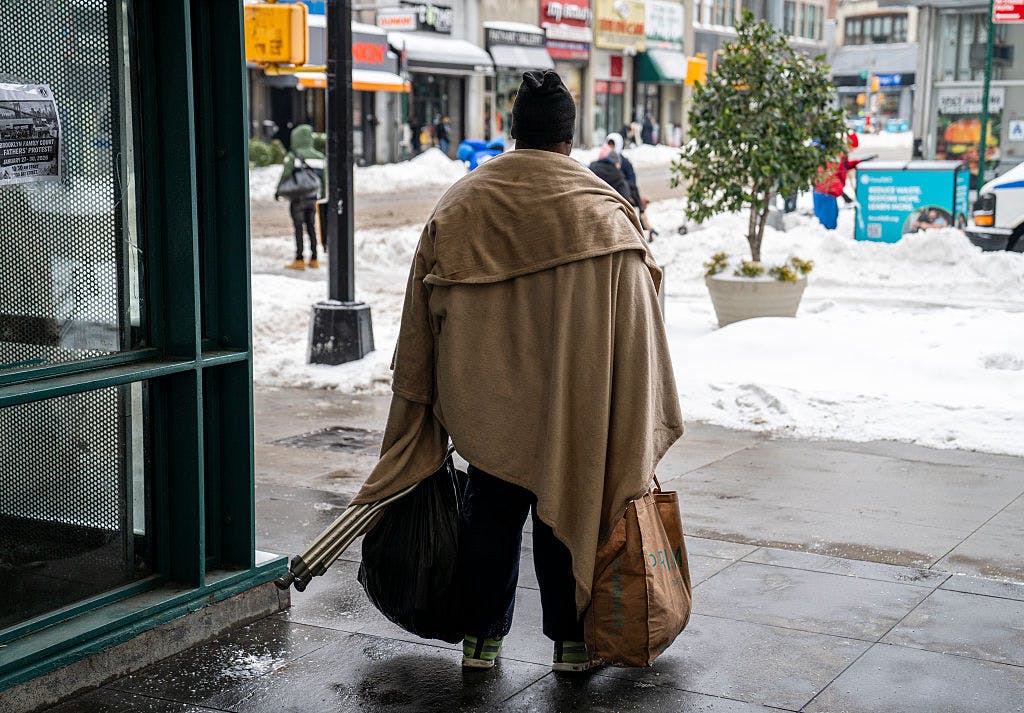
The plaintiffs warn of “chaos” if reform proceeds. But chaos is not hypothetical — it is the present reality. Record homelessness despite unprecedented public spending. Sidewalks surrendered to encampments. Tens of thousands dead from overdoses, exposure, and untreated psychosis, including 18 mothers, fathers, sisters, and brothers who died on the streets of New York City in just the past two weeks.
Robert Nickelsberg/Getty Images
This is not a system at risk of failure. It has already failed.
The threat these reforms pose is to institutional comfort. The Housing First industry knows it will lose guaranteed funding renewals, protected status, and a model optimized for compliance rather than outcomes, to which it has become accustomed over the last 12 years.
Where is the outrage for those left lining the streets year after year, promised housing that never materializes?
Where is the outrage for those who died waiting for a system to recognize their worth and deliver the help that could have saved their lives?
By collapsing expectations to the bare minimum, Housing First has reduced capable human beings to permanent dependents — managed rather than restored, housed rather than helped — rather than treating them as people worthy of recovery, accountability, and reintegration into society.
True advocacy requires accountable compassion. It demands intervention when people are too sick to choose safety for themselves, and the moral courage to admit when a policy has become lethal.
The court’s injunction jeopardizes urgently needed funding and reform, but it also exposes a grim truth: those fighting to preserve Housing First are defending a deadly status quo. Every day reform is delayed, more lives unravel, and more people die from fentanyl poisoning, methamphetamine addiction, and untreated mental illness.
Those struggling with homelessness deserve far more than containment. They deserve a real path off the streets. They deserve recovery. They deserve the opportunity to rediscover purpose.
Reform is not disruption. It is a rescue mission.
* * *
Michele Steeb is the founder of Free Up Foundation and author of “Answers Behind the RED DOOR: Battling the Homeless Epidemic,” based on her 13 years as CEO of Northern California’s largest program for homeless women and children. She is a Visiting Fellow with the Discovery Institute’s Fix Homelessness Initiative. Follow them on Twitter: @SteebMichele and @ DiscoveryCWP.
The views expressed in this piece are those of the author and do not necessarily represent those of The Daily Wire.








 New Posts (Home)
 ChatBox
 Popular Posts
  Game Zone
 Top PodCasts