www.thecollector.com
13 Street Art Masterpieces You Cannot Miss in Lisbon
Walking around Lisbon is the perfect opportunity to find the most striking murals and installations. You will find incredible art pieces at the most unexpected locations.
For many years, Lisbon saw its buildings covered with unwanted tags. Then, in 2009, the Lisbon City Council opened the Galeria de Arte Urbana (GAU — Urban Art Gallery), whose purpose was to encourage street art and stop people from vandalizing buildings. At the time, GAU invited several artists to create new pieces.
Today, you can find thousands of urban art pieces scattered around Lisbon. In this article, you will find some of the most famous murals and installations.
1. Desassossego by AkaCorleone
Desassossego, by AkaCorleone, Photo by R2hox, 2016. Source: Flickr
Desassossego is a stunning psychedelic mural designed by AkaCorleone. In his hometown, the artist paid tribute to Fernando Pessoa, one of the most intriguing Portuguese writers.
Pessoa was a prolific writer who developed several heteronyms and left hundreds of works unfinished or unpublished. One of them was Livro do Desassossego, a book written by Bernardo Soares, one of Pessoa’s heteronyms. This masterpiece is a remarkable autobiography of Bernardo Soares and was published 47 years after Pessoa’s death. It tries to answer Modernism’s fundamental questions, such as “Who am I?” or “How can I explain reality?”
AkaCorleone captured Pessoa’s delusional essence with this incredible piece. According to the artist’s own words, the mural is called Desassossego since it “represents in a very free way the character that most represents the city of Lisbon, Fernando Pessoa, in a psychedelic dream.”
The Underdog Gallery provided materials for the work and documented the process on video.
AkaCorleone’s real name is Pedro Campiche; he is a Portuguese artist of Swiss descent born in Lisbon in 1985. Graffiti marked his first steps in the art world. However, his repertoire developed to include brightly colored murals and sculptures, which include graphics and typography as part of his signature style.
2. Look Up by AkaCorleone
Look Up, by AkaCorleone, Photo by Bosc d’Anjou, 2024. Source: Flickr
Another mesmerizing piece by AkaCorleone was created in February 2020 amidst the global pandemic. It was designed for SEAT Art Cities, a project curated by Vhils.
In this piece, the artist was looking to explore the obsessive connection to social media that stops us from enjoying the world around us without realizing all that we are missing out on.
Yet, this piece also represents the profound irony we experienced during the lockdown. While we may be glued to screens and addicted to unstoppable scrolling, the thing that prevents us from enjoying the world becomes our escape from real life.
3. Sophia by Daniel Eime
Sophia, by Daniel Eime, Photo by Trux Photo, 2023. Source: Flickr
In the Graça neighborhood, in the heart of Lisbon, you can admire this beautiful stenciled portrait of Sophia de Mello Breyner Anderson (1919-2004) by Daniel Eime.
Sophia was one of the most influential Portuguese poets of the 20th century. During her lifetime, Sophia published several works, including children’s books, and translated a handful of literary masters such as Dante and Shakespeare.
Since Sophia had always been connected to this Lisbon neighborhood, this was the perfect location to pay tribute to her.
Daniel Eime, a Portuguese artist born in Caldas da Rainha in 1986, is the author of this incredible piece. He is considered a master of stencil art, a technique that uses stencils made of paper or cardboard to build an image. For Daniel, most of his stencil creations are inspired by human faces.
4. Tropical Fado in RGB Tones by OzeArv
Tropical Fado in RGB Tones, by OzeArv, Photo by Benedicte Panariello, 2021. Source: Flickr
This must be one of the most eye-catching murals in Lisbon. It was created in 2021 and is one of the 100 urban art pieces selected by the online community Street Art Cities.
Tropical Fado in RGB Tones is a striking urban art piece by OzeArv, a renowned Portuguese artist born in Lisbon in 1980. His murals often depict vivid and colorful representations of birds and other natural elements. Tropical Fado is no exception.
The mural was supported by Lisbon City Council and São Vicent Parish and curated by Galeria de Arte Urbana. Although the artist had the support of a crane and an operator, it took over a month to complete. OzeArv started by outlining the design on the building façade and then filling it in with bold colors.
It might seem that the artist followed a strict design, however, during the process he left some room for imagination. The result is an explosion of color filled with impressive details that combine natural and realistic elements with stylized drawings.
5. Peace Guard by Shepard Fairey
Peace Guard, by Shepard Fairey, Photo by Kai Friis, 2018. Source: Flickr
Inspired by the Carnation Revolution, Shepard Fairey created this powerful mural symbolizing peace and freedom.
On the 25th of April 1974, a peaceful and bloodless revolution led by the Portuguese military ended António Salazar’s 40-year dictatorship. At the time, soldiers on the streets placed red carnations in their rifles to celebrate the end of the regime.
As an activist who defends peace and freedom, this was something Shepard Fairey could easily relate to. So, in 2017, Fairey made a mural of a woman soldier with a red carnation on her rifle while looking up as if she was standing in formation. The original design, built in 2017, used red as the main color. Yet, in 2023, during a trip to Lisbon, Fairey decided to retouch his masterpiece by changing the red to blue.
Shepard Fairey is an American artist and activist famous for his Obama “Hope” poster design for the 2008 U.S. presidential election. Fairey is currently considered one of the most influential street artists, having his pieces displayed in Los Angeles, New York, London, and Lisbon.
6. Universal Personhood Lisbon by Shepard Fairey & Vhils
Universal Personhood Lisbon, by Shepard Fairey & Vhils, Photo by Trux Photo, 2023. Source: Flickr
Universal Personhood is a series of art pieces by Shepard Fairey, whose goal is to promote peace and equality. This was inspired by the systematic prejudice against Arabs and Muslims when it comes to discrimination against women.
During a trip to Lisbon in 2018, during the Printed Matters Lisbon Exhibition, Fairey partnered with Vhils to develop a new mural under the Universal Personhood Project.
Alexandre Farto, also known as Vhils, is a Portuguese visual artist born in Lisbon in 1987. He became famous worldwide for his unique bas-relief carving technique, where he removes a wall’s surface layers with unusual tools to create impressive portraits.
The mural depicts a young woman painted in bold and warm colors on the left and sculpted onto the building’s façade on the right. This striking masterpiece’s goal is to call for equal rights for women of all ethnicities and religions.
7. Amália by Vhils
Amália, by Vhils, Photo by Eyrie Man, 2015. Source: Flickr
In 2015, Vhils accepted a challenge by Portuguese filmmaker Ruben Alves to create a portrait of the late Fado singer Amália Rodrigues. At the time, Alves was preparing a Fado music record performed by contemporary Fado singers as a tribute to Amália. He figured Fado music was born in the streets, much like Vhils’ artwork.
Unlike other urban art pieces, Vhils created a one-of-a-kind portrait of Amália Rodrigues in Portuguese Cobblestone in the Alfama neighborhood, the birthplace of Fado. With this piece, Vhils draws attention to the craftsmanship of the “calceteiros,” the pavers who keep the Portuguese Cobblestone alive. Simultaneously, the artist also pays tribute to Fado, Amália Rodrigues, and Lisbon culture.
The result is a mesmerizing artwork resembling an ocean wave starting from the ground and moving up the wall. This way, when it rains, it looks like Amália is crying over the Portuguese Cobblestone, a literal representation of the Portuguese saying “Faz chorar as pedras da calçada”—something deeply saddening that makes anyone cry, things which Fado singers used to sing about while wandering Lisbon’s streets.
8. Saudade by Mário Belém
Saudade, by Mário Belém, Photo by Trux Photo, 2023. Source: Flickr
“Saudade” is a unique word in the Portuguese language that it is impossible to translate. Although there are several synonyms in other languages, none truly captures the saudade’s meaning. It translates to the feeling of nostalgia and longing for something or someone so intense and deeply saddening.
Mário Belém, a Portuguese artist born in 1977 in Lisbon, tried to capture the saudade feeling people experienced during the lockdowns in 2020 and 2021. His goal was to represent how we keep longing for the past and not giving ourselves the chance to enjoy the good parts of such difficult times. Once the second lockdown was in place, this mural gained a new meaning, representing a wish for a brighter future.
The mural represents a woman sitting at the edge of a colorful flower pot while gazing upon the word “saudade.” We can feel the woman’s nostalgic feeling of longing for the world to go back to what it once was and the sense of being isolated and lost in her own thoughts.
In the bottom right corner, you can read the words: “Antes perdida por aqui algures, do que a caminho de nenhures” which literally translates to “Better to be lost here somewhere than on my way to nowhere.”
9. Adapta by Add Fuel
Adapta, by Add Fuel, Photo by Jaime Silva, 2022. Source: Flickr
Add Fuel is the man behind this stunning mural from 2021. The artist was inspired by people’s resilience and ability to adapt (Adapta) and face the unknown times during the global pandemic.
The mural adapts to its surroundings by adjusting the new patterns and colors with the ones on the existing tiles. That is how Add Fuel found the perfect balance between the two buildings.
With this captivating mural, the artist reflects on how people adjust to a new reality, so they can live happily amidst adversity. At the same time, Add Fuel evokes traditional Portuguese tile making.
Add Fuel, born in 1980 under the name Diogo Machado, is a Portuguese visual artist renowned for his reinterpretation of the traditional Portuguese tile design. You can also find his artwork in France, Belgium, and the USA.
10. Poseidon by PichiAvo
Poseidon, by PichiAvo, Photo by Papfoo, 2019. Source: Flickr
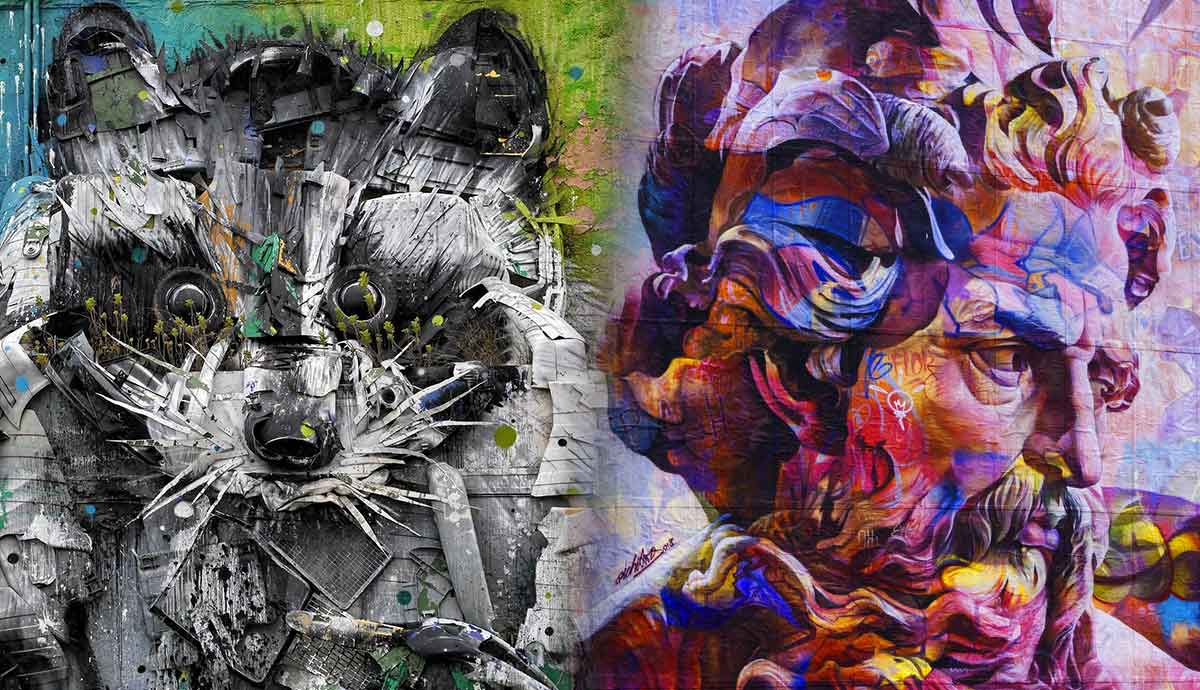
The Poseidon mural designed by the Spanish duo PichiAvo is a masterpiece of Lisbon’s street art scene. The Roman God of the Sea overlooks the Tagus River, where numerous sailors have passed over the years.
This striking mural is the perfect blend of classical art and graffiti. While looking at a distance you can clearly admire Poseidon, if you pay close attention, you will notice the graffiti details.
Pichi studied Fine Arts and Avo, Industrial Design. Then in 2007, they met in Valencia’s graffiti art world. Since then, PichiAvo has developed several projects together, seeking a defining trademark style.
Their artwork is scattered around the world. You can admire it in New York, Porto, Lisbon, Paris, Las Vegas, Montreal, Melbourne, and Valencia.
11. Iberian Lynx by Bordalo II
Iberian Lynx, by Bordalo II, Photo by Jaime Silva, 2022. Source: Flickr
The Iberian Lynx by Bordalo II is one of the most iconic urban art pieces in Lisbon.
You can admire this multicolored giant lynx at Parque das Nações; it is completely made of waste. The artist’s goal was to raise awareness of an endangered species in the Iberian Peninsula while leaving his own remarks on environmental pollution.
The Iberian Lynx sculpture is part of the Big Trash Animals series. All pieces are entirely made of waste materials that pollute the environment and threaten the animals Bordallo II represents.
Bordallo II is a visual artist born in Lisbon in 1987. He is the grandson of the famous Portuguese painter Artur Real Chaves Bordalo. So far, Bordalo II has used over 60 tons of trash to build these magnificent installations. You can admire his work in Portugal, Switzerland, Italy, the United States, and France.
12. Big Racoon by Bordalo II
Big Racoon, by Bordalo II, Photo by Pippigar, 2018. Source: Flickr
Big Racoon is another installation from the Big Trash Animals series by Bordalo II.
This stunning artwork is made of several types of waste, from car bumpers and tires to all sorts of plastic. It was clearly made to be seen from a distance. If you stand too close, you will lose sight of the bigger picture, but you can observe the materials it is made of. The colors light up the image, transforming a pile of trash into a cute raccoon.
Go and see it for yourself and take some time to admire this beautiful artwork.
13. Crono Project
Cono Project, by Os Gémeos, Photo by Carlos Pinheiro, 2015. Source: Flickr
The Crono Project began in 2010 and gathered several national and international artists to design a series of murals on abandoned buildings at Avenida Fontes Pereira de Melo in central Lisbon.
Pedro Soares Neves, Angelo Milano, and Vhils co-curated this project and brought unknown artists together to show their artwork. The goal was to create public art instead of tearing down the Art Nouveau buildings.
Thanks to the Crono Project, you can admire the works of BLU, Os Gémeos, or 2-D SAM3. Later that year, Ericailcane, Bastardilla, Lucy, Mar, and Ram also left their artwork on these buildings.
In 2011, Brad Downey and Momo, together with Vhils, painted two abandoned buildings in Alcântara and Avenida Almirante Reis.
 New Posts (Home)
 ChatBox
 Popular Posts
  Game Zone
 Top PodCasts