reactormag.com
Nine of the Worst On-Screen Draculas
Lists
Dracula
Nine of the Worst On-Screen Draculas
An actor can really sink their teeth into a role like the Count, but some performances just end up… sucking.
By Tyler Dean
|
Published on October 22, 2024
Comment
0
Share New
Share
With Halloween nearly upon us, many folks are going through annual rewatches of their favorite scary, or spooky, or (god forbid) spoopy movies. And, almost exactly as old as movies themselves is Dracula, Bram Stoker’s 1897 novel that revolutionized horror, catapulted vampire media into the mainstream, and gave dark-haired, brooding actors an excellent role to play for the next hundred years.
I got my PhD in Victorian Gothic literature and Dracula is among my very favorite novels. I’ve taught vampire literature classes for the last fifteen years and have something of an obsession with film and television adaptations of the infamous Count. So, this October, I’m attempting to rank the best and worst on-screen Draculas (Draculai?) so that you don’t have to sift through the mediocre middle and watch a bunch of vampire stuff that’s just ok.
The Criteria
First and foremost, this is a ranking of the best and worst on-screen Draculas—not the best and worst vampire movies. I adore Let the Right One In and A Girl Walks Home Alone at Night but those don’t feature Dracula in any way so they won’t show up here. I’m trying to stick to actual Dracula himself and not just “a Dracula type.” I loved Matthew Goode playing the Elder Vampire in Abigail and he is heavily implied to be Dracula, but it’s still a tenuous connection. Alternatively, while Max Schreck in Murnau’s 1922 Nosferatu is named Count Orlok, that was to avoid a copyright lawsuit and, for all intents and purposes, he is Dracula, so I do count that movie. Other than that, the plot doesn’t have to reflect the plot of Stoker’s novel. This ranking considers any film in which Count Dracula appears to be a Dracula film.
That said, Dracula has appeared in over 600 films. There’s simply no way for me to watch all of them. I’ve garnered a fairly extensive knowledge in my years as a Gothic literature professor but it still falls far short of the totality. So, this will certainly be an incomplete sampling. That said, I’ve tried to pull from a wide variety of time periods and genres to get a more even spread.
I’m judging the portrayal of Dracula himself. That is obviously going to be affected by both the film in which the Count appears and the choices of the actor portraying him. Sometimes a film’s script or production design uplifts a less compelling Dracula. Sometimes an awful movie highlights the quality of a good performance by making it feel out of place. The reverse is also true for both these scenarios. Also, as a general rule, I talk about the performance and the actor behind it in these rankings. Any performance of a role is shaped by a variety of factors—the talent of the actor, sure, but also the talent or confidence of the director, the quality of the material provided by the screenwriter, the way in which the performance meshes or fails to mesh with fellow actors and the rest of the film. Please don’t take my condemnation or praise in this list as vitriol or encomia leveled at the actor portraying Dracula alone.
I am also attempting to avoid performances that don’t stand out from one another. Rudolf Martin, who plays Dracula in the Buffy the Vampire Slayer episode “Buffy vs. Dracula” (S05E01) is basically doing a C+ impression of Gary Oldman. Adam Sandler in the Hotel Transylvania films is parodying Bela Lugosi (and maybe also Catskills Vaudeville comedians?). In fact, hundreds of Dracula performances are just conscious knockoffs of the Hungarian actor’s iconic portrayal. Going through all of those isn’t particularly compelling.
Covering the Basics
While I am not judging these performances by their plot accuracy, it’s probably important to give a brief summary of the novel and its adaptation history so that deviations from it don’t require endless, repetitive explanations later on. Spoilers for a 127-year-old novel follow!
Dracula is an epistolary novel, meaning it’s composed of letters, diary entries, newspaper clippings and other diegetic texts. Count Dracula is an ancient vampire who rules over a remote portion of Transylvania in what is modern day Romania. He is visited by real estate lawyer, Jonathan Harker who is finalizing a deal for the Count to buy a number of English properties, including a Gothic ruin called Carfax Abbey. Harker discovers that Dracula is a vampire and is trapped in the castle by the Count, where he assumes that he will die.
Back in the English town of Whitby, Harker’s fiancée, Mina Murray, and her childhood friend, Lucy Westenra, await Jonathan’s return. Lucy (far and away the novel’s best character) is caught between three men all vying for her hand: local aristocrat Arthur Holmwood, Dr. Jack Seward (the closest thing the novel has to a narrator), who works as a sort of proto-psychologist, studying the clinically insane, and Quincey Morris, a Texan adventurer who is drawn from a bunch of stereotypes about cowboys. Lucy eventually chooses Holmwood but the marriage is not to last.
Dracula stows away aboard the cargo ship Demeter, kills its crew, and begins stalking Lucy after the ship runs aground off the coast. Seward notices that one of his patients, Renfield, is obsessed with eating flies and spiders, promising lives to a mysterious master. As Lucy grows ever sicker, her husband and former suitors ask Dutch scientist Abraham van Helsing to come and examine the case. Her former suitors all contribute blood to an emergency transfusion but Lucy dies of anemia anyway. When Lucy rises from the dead as a vampire and begins to kidnap and murder local children, van Helsing and company drive a stake through her heart (this whole section is as weird and closeted and uncomfortable as it sounds).
Jonathan escapes Transylvania and marries Mina. Through her, van Helsing and Lucy’s former suitors learn about Dracula, Carfax Abbey, and some of the rules of vampirism. Renfield is killed by Dracula while the men go out to reconsecrate the properties defiled by the Count. They confront the Count, but he has already begun to seduce and turn Mina. Defeated temporarily, he flees back to Transylvania and the heroes use Mina’s half-transformed visions of the vampire to track him to his castle where Morris cuts off his head with a Bowie knife.
The Count Dracula of the novel is only seductive by inference. He is never described or portrayed as particularly handsome. In fact, most of his physical descriptions imply he is old, ugly, and somewhat bestial (he has hairy palms and pointed ears). He did not become explicitly seductive and handsome until the Hamilton Deane play of the same name (first performed in 1924, with a revised version by John L. Balderston in 1927). The revised version of the play simplifies the plot of the novel significantly, with Jonathan being affianced to Lucy Seward who is now the daughter of Dr. John. Mina and Lucy swap characterizations and plot significance with Mina being Dracula’s first victim. Additionally, the play takes place entirely in Whitby rather than moving between Whitby, Transylvania, and London. Also notable in this version, Dracula is known to all the protagonists as an eccentric but fundamentally charming Romanian aristocrat. Many film adaptations use the Deane and Balderston version, not only because it’s an easier plot to fit in a two-hour film, but also because it lets Dracula have much more screen time and non-violent interactions with the rest of the cast.
The book is a nasty narrative: deeply sex-negative, wildly misogynistic, anti-immigrant, and arguably anti-Semitic. It is invested in valorizing middle-class professionals and the aristocracy as intrinsically more worthy than the lower classes, and presents its women as the passive, fragile victims of “reverse colonization,” with even Stoker’s independent New Woman archetype, Mina, eventually being tamed by marriage and motherhood.
The book also has an uncertain relationship to the historical Voivode of Wallachia (a region of Romania that borders Transylvania), Vlad Țepeș, sometimes styled as Vlad III or Vlad the Impaler. Count Dracula shares his name with Vlad III’s sobriquet; Dracula or Dracuglia means “son of the Dragon” (his father, Vlad II, was known as Vlad Dracul—Vlad the Dragon). Other than the name (and the fact that van Helsing supposes he must be “that Voivode Dracula who won his name against the Turk”) Stoker’s Count has little in common with his historical counterpart. Stoker’s inspiration, aside from previous pieces of vampire literature like Le Fanu’s Carmilla and Polidori’s The Vampyre, is likely borrowed from slanderous legends about the Hungarian Countess Elizabeth Bathory mixed in with some liberal interpretations of Stoker’s documented research into Romanian ethnographies and political history. Prior to his name being used in Stoker’s novel, Vlad Țepeș was mostly known as a Romanian National Hero whose bloodthirsty reputation was often considered (at the time) to be no more than what the situation demanded in a never-ending fight against the Ottoman Empire.
The Worst On-Screen Draculas
This is, in some ways, the harder of the two lists. Because of both the volume of appearances and the eventual public domain status of the Count, I’m sure there are much worse Draculas than the ones I’ve listed here, but they are likely worse by dint of being boring. I’ve sifted for the spectacular failures and the controversial picks: These are the Draculas who either took huge swings and missed, or the ones who completely failed to meet the expectations an audience reasonably had for them.
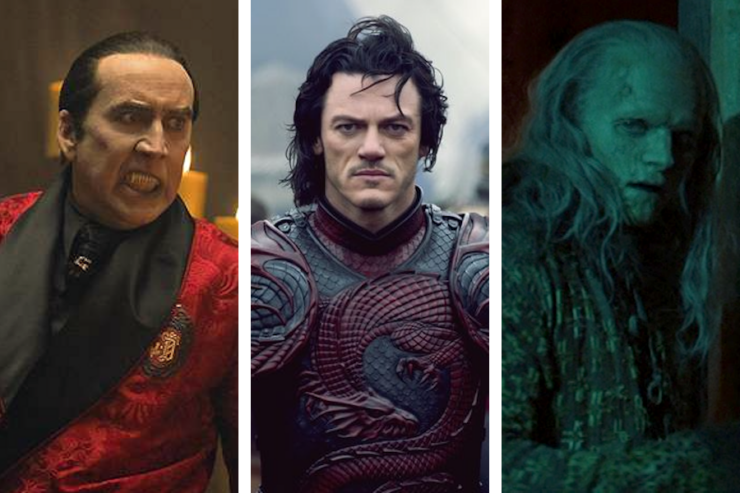
9. Luke Evans in Dracula Untold (2014)
Originally supposed to launch Universal’s “Dark Universe”—a sort of MCU for Universal monsters that crashed and burned with the Tom Cruise flop, The Mummy (2018), Dracula Untold has an interesting premise. It takes the biography of the real Vlad Țepeș and attempts to square it more thoroughly with the Dracula myth. Vlad III, whom history rightfully remembers as a brutal and sadistic ruler, was, after all, raised as a noble hostage in the court of the Ottoman sultan, Murad II. Dracula Untold asks its viewers to conceive of the Count as a traumatized former child soldier who takes on the curse of the Vampyr in order to save Transylvania from his foster brother, the sultan Mehmed II (played by Preacher and Mamma Mia!’s Dominic Cooper in uncomfortable brownface).
Not a bad premise! The film is meant to show us Vlad Dracula, played by The Hobbit’s Luke Evans, slowly losing his grip on his humanity as he fights for his people and attempts to spare his son (Game of Thrones’ Art Parkinson) from life as an Ottoman prisoner. Also, Evans spends a lot of the movie exploding into a swarm of bats, flying across the battlefield and reforming, long sword in hand, to decapitate a bunch of Turkish soldiers. Good dumb fun.
But Evans’ performance is one of dreary, mopey, sorrow. He spars with mournful monk Paul Kaye and ignores the warnings of Master Vampire Charles Dance (Game of Thrones alumni always travel in packs of three or more) but there’s not much depth to the script. Evans’ Vlad is stoic, kind-hearted, and boring, which is bad enough, but the film has the added problem of suggesting that, just maybe, we should give a little bit of a break to the guy who was known for impaling enemy combatants on spikes and nailing turbans to the heads of negotiators. It’s the same fundamental problem of movies like The Greatest Showman where any sympathy generated feels like it’s being used to whitewash a historical monster’s legacy. Combine that with the discomfort of some post-9/11 Islamophobia in the form of representing Mehmed’s sultanate as monolithically bad, and a failure to really explore the complexity of what could have made this retelling interesting and you get a Dracula that is too disappointing and banal to matter.
8. Klaus Kinski in Nosferatu the Vampyre (1979)
I know I’m going to get in trouble for this one, as the Werner Herzog remake of Nosferatu is generally thought of as one of the best Dracula adaptations and, certainly, generally superior to the Murnau original. I have no qualms with Herzog’s direction. It is as beautifully and unsettlingly shot as any of his best work. Returning to the novel’s names after the 1922 film changed them in an (unsuccessful) attempt to avoid a copyright lawsuit, but keeping the German setting, Herzog brings out the cold beauty of Wismar’s canals, dresses his sets in macabre bone and brass automata, and uses the unresolved strains of Wagner’s “Rheingold” to produce an arthouse horror film for the ages.
The problem is fully Klaus Kinski’s. Herzog’s fickle, occasionally violent muse is given every advantage by the auteur’s tenebristic lighting and Dutch angles but mostly just sits there. Sure. He’s weird. If nothing else, Kinski is always weird. But this performance is borderline soporific. Rumor has it that Herzog got Kinski to tone down his usual frenetic furor by filming takes after provoking Klaus into throwing a temper tantrum, so that he only got the most worn-out version of the troubled thespian’s talents but, far from seeming subtle or subdued, Kinski just seems tired.
Strip away Reiko Kruk’s ghastly makeup and Jörg Schmidt-Reitwein’s eerie cinematography and Kinski’s Dracula is just a very sleepy man aping the Max Schreck thousand-yard stares of the original film with about half the energy and 150% of the eyeball exposure. One wonders if the film would have been better with Bruno S, Herzog’s other outsider leading man.
7. Gerard Butler in Dracula 2000 (2000)
In one of his earliest starring roles, 300’s own Gerard Butler is credited here, incredibly, as “Gerry Butler.” He’s much more in the soft, sad-boy mode he adopted for 2004‘s Phantom of the Opera than the shredded, gleeful, tough-guy persona he’s known for today.
Set in (you guessed it) the year 2000, the story chronicles Dracula’s search for his lost love in New Orleans after his coffin is stolen by high-tech thieves (led by Omar Epps) from an Abraham van Helsing (Christopher Plummer!) that has been microdosing vampire blood to keep himself alive for the last century, the better to ensure that Dracula remains imprisoned. The film folds in the publication of Stoker’s book with the fictional van Helsing having been inspired by Plummer’s real-life vampire-hunting doctor—though it still manages to throw some shade his way by insisting that the Dracula myth is more than “the ravings of a mad Irish novelist.”
It’s got a great cast that includes Johnny Lee Miller, Nathan Fillion, Vitamin C, Jennifer Esposito, and Jeri Ryan, and hinges on the reveal that Dracula fears crosses and silver because he is, in fact, Judas Iscariot, who walks the earth as a vampire because God cursed him to never know his embrace in the afterlife. It takes itself slightly more seriously as a tentpole action horror than something like Blade 3, but is let down by Butler’s wide-eyed mugging and “who, me?” reaction takes, filtered through a heavy smear of attempted late ’90s cool. Dracula sports a long coat over a crew neck black tee that feels very close to, but legally distinct from, Keanu Reeves’ costume in The Matrix, performs acrobatic feats of coitus while hovering in midair, and executes the world’s dopiest, straight-armed Tom Cruise run through a hallway I’ve ever seen.
The film knows that Butler’s voice, not entirely free of his natural Scottish burr, combined with his permanently bewildered and slightly amused expression won’t really cut it, so they keep him off screen as much as they can and only have him speak in a whisper. His thick mane of black curls may look better than other vampires on this list, and he may inspire momentary thrills when he enters a room in a dense blow of music video fog, but there is still an ignominy to a Dracula who only looks good in promotional stills.
On top of all that, despite being set in New Orleans at Mardi Gras, way too much of the film is takes place at a Virgin Music Megastore, with its love interest wearing a branded “Virgin” t-shirt for half the film.
6. Nicolas Cage in Renfield (2023)
Billed as a gonzo comedy focused on a redemption arc for the titular character, played by Nicholas Hoult (of The Great and X-Men First Class), Renfield also gave the world Nic Cage’s spin on Dracula. Portrayed as something between a bad boss and abusive ex in the movie, Cage’s Dracula should have been as wildly unhinged and meme-able as that particular combination of actor and role implies. After all, he had already given one of the all-time great, unhinged, meme-able, Nic Cage performances as a vampire (or at least a man who believes he is one) in 1988’s Vampire’s Kiss.
The concept of a Renfield who learns to stand up for himself after joining an AA-style self-help group is fun. And they add a weird bit of seemingly Sam Raimi-inspired lore where eating bugs gives him superpowers rather than just being a weird thing Renfield likes to do. But neither Hoult’s charm nor Cage’s manic mugging has much of a chance in this forgettable comedy. Buried under gross-out makeup and saddled with an accent that can’t quite reconcile itself with his prosthetic teeth, Cage’s Count is an incoherent mess that feels more like an SNL sketch of what Cage-as-Dracula would be like rather than the genuine, batsh*t (pun intended) performance we were promised. It’s a watered-down version of the kind of wild performances Cage has given a hundred times before.
Worse still, the film, set in present-day Miami, has Dracula join forces with a drug kingpin played by the incomparable Shohreh Aghdashloo who projects far more cold menace and steely terror than the vampire in every scene they share. Obviously, Cage isn’t playing Dracula for menace, but it’s never a good sign when you start wondering, mid-scene, if his co-star might be a much better Dracula if she were to play the Count in a dramatic adaptation.
Also, over in the minor quibble corner, the film knows enough of Stoker’s gloss on history to call Dracula the Prince of Wallachia rather than Transylvania but Cage pronounces it “way-lay-shee-uh.” So close. Look, I’m as disappointed as the rest of you that the film wasn’t better. But we’ll always have Vampire’s Kiss. It may not Dracula, but it is peak Cage.
5. Marc Warren in Dracula (2006 TV Movie)
Like Dracula Untold, this is another production where a delightfully novel and interesting take on Stoker’s book is thoroughly let down by a rather ho-hum performance from its title character. The BBC TV movie chooses to center Arthur Holmwood (a young but still uncompromisingly weird Dan Stevens) as a syphilis sufferer who, along with his cabal of wealthy, British Illuminati types, arranges for Dracula to come to Britain in order to donate his vampiric blood to cure him.
It features Tom Burke, Rafe Spall, and the inimitable David Suchet as Seward, Harker, and van Helsing respectively and does a good job of assembling an almost entirely new plot out of the themes, scenes, and dialog of the original novel. They shore up some of Stoker’s plot holes, give Lucy and Mina something more interesting to do than be mere damsels in distress (it’s one of the few Dracula adaptations to pass the Bechdel test), and take some of the grotesque anti-immigrant sentiment out the tale by making its clear that it’s British greed and hubris that opens the way for Dracula’s invasion.
The problem is Marc Warren. Similarly miscast as the Thistledown Gentleman in the BBC One adaptation of Jonathan Strange & Mr. Norrell, Warren presents a gruff, laconic exterior punctuated by moments of rage and a sort of slimy entitlement in place of seductive verve. Dracula doesn’t have to be sexy. He isn’t in the original novel, but if you’re going to play into his potentially seductive qualities, get an actor who is disarmingly attractive or capable of looking at least halfway charming as he paws at the women in the cast or half-heartedly fumbles around with a fig a la Tom Jones.
And all of this is without mentioning the atrocious way Warren has been styled. I assume that they were attempting to go for a sort of rakish, Byronic look with a loose-fitting shirt, colorful vest, and shaggy black curls. But, between Warren’s deep-set eyes and prominent brow, his bafflingly bad wig, and the slightly unplaceable Continental accent he affects, this Dracula is far too close to Tommy Wiseau for comfort.
4. Dominic Purcell in Blade: Trinity (2004)
The third installment of the Blade franchise is probably most famous for being the first Marvel film Ryan Reynolds appeared in. It contains an unexpected vampire crossover with Interview with the Vampire’s Eric Bogosian playing a reporter, as well as some phoned-in turns from James Remar, John Michael Higgins, Natasha Lyonne, Patton Oswalt, and Parker Posey sporting a hairstyle that my friend described as “Funko Pop chic.”
In the first of these early Marvel successes, Blade fights a gonzo Stephen Dorff (delectably named Deacon Frost). The second is a gruesome, twisty Guillermo del Toro classic. This third film has him fighting Dracula, whose name is rendered, within the film, as “Drake,” played by Prison Break star Dominic Purcell.
Presented as the ancient Babylonian vampire progenitor, Purcell’s Dracula is a big, muscly beefcake who mostly dresses like a Miami Vice cocaine kingpin and speaks in a low growl (and some slightly archaic dialogue that the writers aren’t fully willing to commit to). By the end, he’s a fully CGI Predator knockoff with quadripartite jaws, wearing a single pauldron and fighting with a bone-handled machete. All of that could work (especially in the Nu Metal-tainted wastelands of 2004) but Blade: Trinity doesn’t seem invested in giving Purcell much of a specific character. They try a few times to make him to something more than stock, threatening monster, but halfhearted stabs at giving him a fish-out-of-water, archaic style of speech, or comparing him to the Nome King from L. Frank Baum’s Ozma of Oz all fall flat.
Or, perhaps he just gets lost in the shuffle. Blade: Trinity had a notoriously troubled production, spawning rumors that Wesley Snipes refused to break character while on set. The end result is a film that ping-pongs between long takes of Snipes’ stoney stares from behind his wrap-around shades and Reynolds taking some first stabs at the profane, motormouth swagger he would spend the next twenty years honing into a lucrative brand. Amidst all that, what room did Dracula—sorry, Drake—have to be anything more than a broad-chested heavy, cursed with period-appropriate CGI?
3. Udo Kier in Blood for Dracula (1974)
Obviously, Paul Morrissey’s campy, broad directorial style leaves a lot to be desired in terms of verisimilitude and subtlety. The Andy Warhol-produced Blood for Dracula (1973) is, like most of the Factory’s horror movies, an exercise in blurring the line between art film and exploitative giallo. Blood for Dracula adds an interesting layer of class revolt to its source material, with its servant anti-hero being a Bolshevik who despises the Count for his aristocratic roots. It’s probably unfair of me to even include Udo Kier’s performance as the titular Transylvanian. Great performances are definitely not the point of the film (as one can see, plainly, in every loving shot of Joe Dallessandro’s nude backside). But that said, there is such a disappointment in getting one of the great, arch-camp heartthrobs in the role and wasting his talents in a frivolous, seedy romp that he seems utterly disengaged from.
Kier manages to be, above all things, beautiful and sad. His best work is in the first three minutes when he looks mournfully into a mirror that does not reflect him, applying makeup and hair dye, silently and sadly. He spends the rest of the film writhing in quasi-comic pain—seizing ridiculously in the throes of starvation, bugging out his eyes as he sweats nervously, and twitching with hunger and arousal. Most bafflingly, he seems to trip over the German accent. This is doubly strange, given that Dracula is a role nearly always played with an accent of some kind and that Kier is using his real one.
Ultimately, it’s a shame. Udo Kier is a gorgeous man, never more so than in this film. They’ve styled him like Rudolph Valentino, and, even when he’s doing uninspired comedy-vomit takes into the bathtub, there is still something haunting and seductive in the abyssal depths of his green eyes. And one can do a great comic Dracula with the right actor and right direction. This just isn’t it.
2. Jonathan Rhys Meyers in Dracula (2013 TV Series)
The short-lived 2013 TV series was an NBC/Sky co-production that starred The Tudors and Bend it Like Beckham actor Jonathan Rhys Meyers as the Count. This version, like fellow 2013 Sky/NBC coproduction Hannibal, is a remix of the original novel, changing major plot points but touching on familiar relationships between familiar characters and angling towards the same prestige drama transcendence. Meyers’ version of Dracula is masquerading as an American industrialist, Alexander Grayson, obsessed with spreading Tesla-inspired alternating current to the people of England, and hunting down “the Order of the Dragon”—here conceived of as a Freemason-esque secret society that he ran afoul of during his mortal life. The cast is rounded out by some luminaries—the venerable Thomas Kretschmann as van Helsing, Haunting of Hill House/Bly Manor’s Oliver Jackson-Cohen as Jonathan Harker, Game of Thrones and Sweet Tooth’s Nonso Anozie as a sane and calculating Renfield, and Merlin and Supergirl’s Katie McGrath as an explicitly queer Lucy Westenra
By 2013, with the success of Twilight and True Blood, we were well into the era of vampires as dashing, romantic heroes. Count Dracula as a Byronic antihero certainly makes sense as a part of that. The problem is that Meyers, as he so often does, mistakes intensity and volume for substance and gravitas. He was always a sort of whiny Henry VIII on The Tudors, and that carries over to his performance as Dracula. Worse, in giving him a pouty little goatee and having him use an American accent, the show aims for the sexy feel of Secretary or Fifty Shades of Grey and winds up with a reedy, twerpy performance that feels like nothing so much as Count Dracula channeled through Ben Shapiro.
There are very few rules on who should or should not play Dracula in terms of physicality. Certainly, there is a space in the original novel for a Count who is not particularly imposing. But, above all things, Dracula needs to seem dangerous in one capacity or another. Jonathan Rhys Meyers just seems eternally petulant, and that is very hard to come back from.
1. Claes Bang, Dracula (2020, miniseries)
Gods below. Where do we start with Steven Moffat’s misbegotten Netflix miniseries? Let’s begin with a Moffat caveat: the man has an 80-90% hit rate for authoring amazing episodes of Doctor Who and put together precisely five good episodes of Sherlock. But his impulse to engineer clever twists combined with a misogyny that he tries to mask with a series of poorly written “strong female characters” makes so much of his voluminous output sour, cruel, and strangely sophomoric about trying to update its source material.
Despite having the objectively coolest billboard in the history of billboards, Moffat’s Dracula is a trainwreck whose gross conclusions about race, culture, and femininity are made all the worse by the promising set-ups it despoils. It wastes Dolly Wells as a distaff van Helsing and commits the cardinal sin of giving Galadriel herself, Morfydd Clark, absolutely nothing to do.
Enter Claes Bang, the Danish actor whose square jaw, aquiline nose, and dark eyebrows give him the look of a younger, arguably far handsomer Bela Lugosi. Bang is not a bad actor. He sneers and jests and insinuates with a rakish charm that feels like it wouldn’t be out of place in a performance as James Bond. It’s not that Bang isn’t a perfectly good actor. He’s not even bad in this, strictly speaking. The performance, under Moffat’s direction, just lends the Count an air of too-smart-to-take-any-of-this-seriously contempt.
Worse, somehow, than all of this, concerns the fact that Moffat’s script makes much of the queer subtext of the novel text. There is good evidence to suggest that, despite Bram Stoker’s late-in-life advocacy for the criminalization of all homosexuality, the man was deeply closeted. While it is usually inappropriate to use the biography of an author to read into the themes of a novel, it is notable that Stoker compared the sycophantic, unrequited relationship between Renfield and Dracula to his own relationship with the actor (and Lee Pace doppelgänger) Henry Irving. So much of Dracula is predicated on intimate, unclear friendships between men that reading queerness into the novel is a long literary and scholarly tradition.
In Moffat’s series, John Heffernan’s Jonathan Harker is closeted and in love with Dracula, making him a sort of midway point between Harker and Renfield. It should be a slam dunk, but Bang somehow manages to be the straightest Dracula ever put on film. Moffat has Bang flirt rapaciously with the series’ female characters but is only ever violent with its men. He’s a queer Dracula that the show is willing to name as such but who never kisses a man or so much as raises a suggestive eyebrow in a way that is anything but mocking. It’s an insult that could only come from nerd culture’s most infamous queer-baiter.
So there you have it. It is, perhaps, unfair to say that Claes Bang is the worst actor to ever portray Dracula. But his Dracula is the worst committed to celluloid—a version of the Count that seems to find its source material risible and leaves the viewer feeling like they were being rebuked for wanting to watch an adaptation of Dracula.
But what do you think? Do you want to speak up in defense of any of the performances I’ve mentioned here? Is there a truly bad Dracula that has escaped my notice? Let me know in the comments—and be sure to stay tuned for my picks for the Best On-Screen Draculas, coming soon![end-mark]
The post Nine of the Worst On-Screen Draculas appeared first on Reactor.








 New Posts (Home)
 ChatBox
 Popular Posts
  Game Zone
 Top PodCasts