www.dailywire.com
Here’s Who Could Replace JD Vance In The Senate
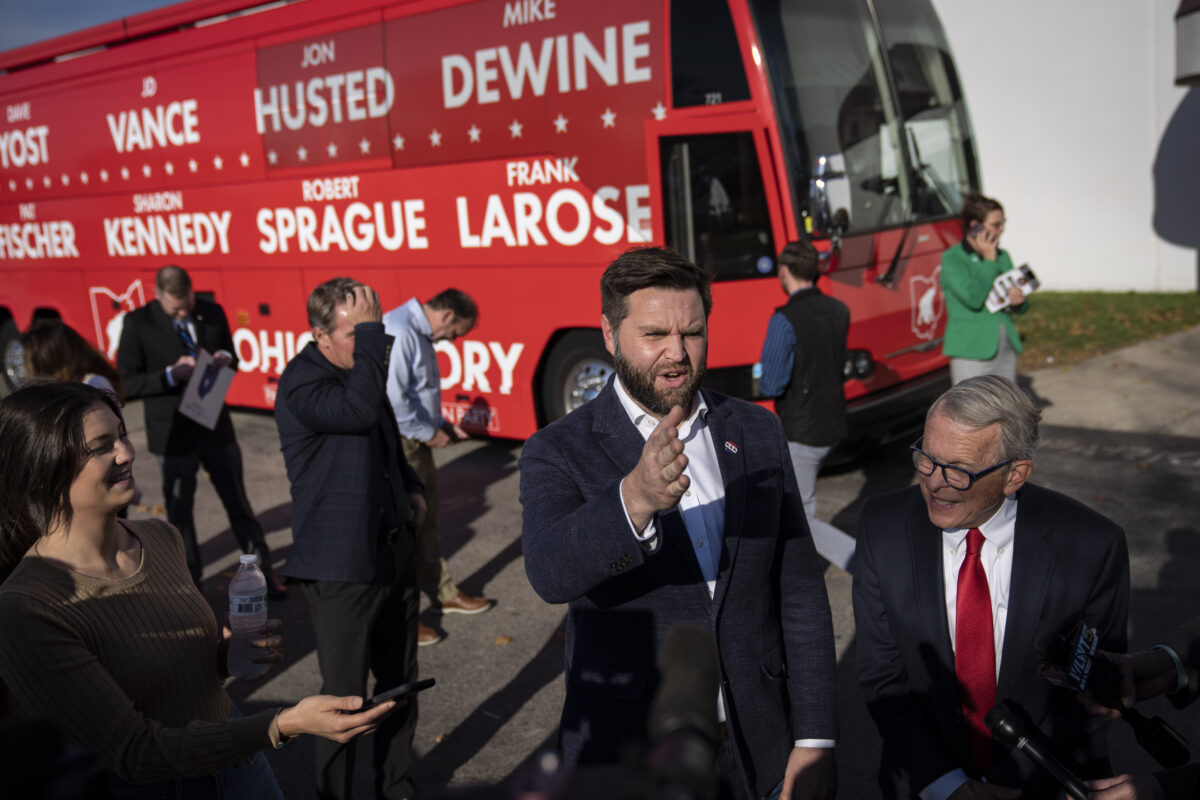
Ohio Republican Sen. JD Vance will leave his Senate seat when he becomes vice president on January 20, giving Republican Gov. Mike DeWine the responsibility to appoint a replacement until a special election is held in 2026.
Ohio went red in the 2024 election, giving Trump an 11-point win over Vice President Kamala Harris. Longtime Democratic Sen. Sherrod Brown also lost his re-election bid this year to Republican Bernie Moreno, giving the GOP both Senate seats in the state. Now, with Vance’s seat opening up, numerous Republicans are being floated as potential replacements.
Frank LaRose
Ohio Republican Secretary of State Frank LaRose is a favorite among the state’s Republicans to replace Vance. LaRose made headlines in the past year for leading an effort to clean up Ohio’s voter rolls ahead of the 2024 election, including purging hundreds of non-citizens from the rolls. LaRose has served as Ohio’s secretary of state since 2019. Before that, he was a member of the Ohio State Senate. LaRose ran for Senate in 2024 but lost to Moreno in the Republican primary.
Jon Husted
Ohio Lieutenant Gov. Jon Husted has served in that position since 2019. He has long been a major player in Ohio politics, serving as the Ohio secretary of state from 2011 to 2019, and the Speaker of the Ohio House of Representatives from 2005 to 2009.
Husted also pushed hard to secure Ohio’s elections, saying he wanted to make it a state where it is “both easy to vote and hard to cheat.” After taking office as secretary of state, Husted switched voting rules to make early voting hours uniform across the state instead of allowing county boards of elections to set their own hours.
Husted appears more likely to run for governor than for the Senate in 2026, and he has already received DeWine’s endorsement for the position. “Based on my six years working with him, he will be a great governor,” DeWine said earlier this month.
Jim Renacci
A Republican rival of DeWine, former Congressman Jim Renacci would be an unlikely appointment, but he could campaign for the 2026 special election. Renacci challenged DeWine in 2022, regularly criticizing the Ohio governor. He lost to DeWine in the Republican primary by 20 points. Renacci also mounted a U.S. Senate campaign in 2018, winning the Republican primary before losing to Democrat Sherrod Brown in the general election.
Before he was elected to Congress in 2010, Renacci was a successful businessman, owning multiple dealerships in the Columbus area. In Congress, he served on the House Ways and Means Committee and the House Budget Committee.
CHECK OUT THE DAILY WIRE HOLIDAY GIFT GUIDE
Matt Dolan
Ohio Republican state Senator Matt Dolan has thrown his hat into the ring for a U.S. Senate twice in the past three years, falling short in Republican primaries in 2022 and 2024. Dolan is the son of Larry Dolan who owns the Cleveland Guardians (formerly Cleveland Indians) of the MLB. Dolan was given a partial stake in the franchise in 2000.
Dolan is also a partner at the law firm of Thrasher, Dinsmore & Dolan and the vice president of 7th Avenue Properties, managing businesses and real estate properties. Dolan could have an edge over others in seeking DeWine’s appointment. In the 2024 Senate election, he was endorsed by DeWine while Republican Bernie Moreno, who went on to win the election, was endorsed by President-elect Donald Trump.
Dave Joyce
Republican Congressman Dave Joyce is currently serving his sixth term in the U.S. House after first being elected in 2012. Before Congress, Joyce worked as a public defender and was later appointed prosecutor of Geauga County, Ohio, to the east of Cleveland.
Earlier this year, Speaker Mike Johnson (R-LA) appointed Joyce to serve on the task force investigating the July 13 assassination attempt on Trump. Joyce said he would “work diligently to uncover the facts, demand accountability, and ensure these security failures are prevented from happening in the future.”
Warren Davidson
Warren Davidson, another Ohio Republican congressman, has been floated for the Senate seat. Davidson served as a U.S. Army infantryman, where he was stationed in Germany. He later earned an appointment to the United States Military Academy at West Point and graduated near the top of his class.
Davidson also owned and operated manufacturing companies in Ohio for 15 years before he was elected to the House in 2016.
Jane Timken
Attorney and former Ohio Republican Party Chair Jane Timken is at the top of the list of people DeWine is considering for the appointment to the Senate, according to ohio.news. Timken served as the head of the Ohio GOP from 2017 to 2021 and then ran for Senate in 2022. Despite boasting the endorsement of outgoing Sen. Rob Portman in 2022, Timken finished in fifth place in the Republican primary.
Mike Carey
Rep. Mike Carey (R-OH) has thrown his name in the mix for Vance’s seat, telling Fox News earlier this week that Trump “needs somebody in the Senate that will make sure that we get his agenda through.” Carey has been in Congress since 2021, where he has prioritized fighting for tax relief, housing affordability, and energy independence.
Before his time in Congress, Carey was an executive for a large privately owned energy company.
Mehek Cooke
Republican attorney Mehek Cooke is also being considered by DeWine, according to Fox News. Cooke was a political and legal surrogate for Trump in the 2024 election, appearing on Fox News to boost Trump’s campaign. Cooke served as assistant chief counsel in the Ohio governor’s office from 2012 to 2014. She also worked in the U.S. Attorney’s Office for the Southern District of Ohio, focusing on cases involving corruption, terrorism, drug trafficking, asset forfeiture, and money laundering.
According to a WPA Intelligence poll reported on by ohio.news, LaRose (17%) leads among candidates for the seat on favorability and potential to defeat the Democratic candidate in the special election. Husted is in second place at 10%, according to the poll. Ohio Attorney General Dave Yost is in third place, according to the poll, but Yost said earlier this month that he would decline an appointment to the Senate seat as he appears to be a top candidate for governor in 2026.
The WPA Intelligence poll rounds out with Renacci and Dolan at 5%, Joyce and Davidson at 3%, Timken and Carey at 2%, and Cooke at 1%. Whoever is appointed in the coming weeks will have to run in the 2026 special election to hold onto the seat, and the regular election for the Senate seat will take place two years later in 2028.








 New Posts (Home)
 ChatBox
 Popular Posts
  Game Zone
 Top PodCasts