YubNub Social YubNub Social
    Advanced Search
  • Login
  • Register

  • Day mode
  • © 2025 YubNub Social
    About • Directory • Contact Us • Developers • Privacy Policy • Terms of Use • shareasale • FB Webview Detected • Android • Apple iOS • Get Our App

    Select Language

  • English
Install our *FREE* WEB APP! (PWA)
Night mode toggle
Community
New Posts (Home) ChatBox Popular Posts Reels Game Zone Top PodCasts
Explore
Explore
© 2025 YubNub Social
  • English
About • Directory • Contact Us • Developers • Privacy Policy • Terms of Use • shareasale • FB Webview Detected • Android • Apple iOS • Get Our App
Advertisement
Stop Seeing These Ads

Discover posts

Posts

Users

Pages

Blog

Market

Events

Games

Forum

The Lighter Side
The Lighter Side
1 y

Psychologist shares 15-second trick to make kids of any age less rude and more cooperative
Favicon 
www.upworthy.com

Psychologist shares 15-second trick to make kids of any age less rude and more cooperative

Sometimes, it can feel like half of parenting is repeating yourself over and over again, asking your child to brush their teeth or take a dish from the living room to the sink. It’s exhausting and makes you feel like a nag. Don't you wish there was a simple way to make your kids listen the first time? Dr. Rebecca Kennedy, aka “Dr. Becky,” is a clinical psychologist and founder and CEO of Good Inside who says she has a quick way to make your kids more cooperative and less rude. Talk about killing two soul-crushing birds with one parenting stone. Dr. Beckly got into psychology after growing up with anorexia as a teenager. “Okay, no matter how old your kid is, you can use this 15-second tip to decrease rudeness and increase cooperation,” she says in a TikTok video with over 32,000 views. “Find your child today and ask them this question. 'Hey, I was just wondering, what could I do better as your parent?'”The psychologist says that even if the child has a random or impractical answer such as “Let me stay up ‘til midnight” or “I’d like to eat macaroni and cheese for breakfast, lunch and dinner,” just to listen. Simply by listening, you can change your child’s behavior.She says we should also ask more questions to further the conversation: “Tell me more. What would that be like?”Want to improve your relationship with your kid in less than 15 seconds? Watch this reel for a quick-win strategy.  @drbeckyatgoodinside Want to improve your relationship with your kid in less than 15 seconds? Watch this reel for a quick-win strategy. The best part: When we use strategies like this in calm moments, we reduce the frequency of difficult moments with our kids. Of course, I’m a realist… I know you need in-the-moment strategies too! Cue: My Conquering Problem Behaviors Workshop. You’ll get an entire toolbox of in-the-moment and outside-the-moment strategies for reducing outbursts and strengthening your bond with your kid. Learn more in the link in bio! “I mean, imagine your boss coming to you randomly and asking how they could be a better manager to you. Just by asking the question and listening,” she continued. Dr. Becky says that asking our kids how we’re doing as parents communicates three essential ideas: “I care about you. I respect you. I'm invested in this relationship.”This type of questioning builds a connection with a child that can spill over into other behaviors. “You're building connection. And with more connection always comes more cooperation,” she ends the video.The big takeaway from the video is that when we enhance our connection with our kids, they will be less likely to disobey or be rude because they feel heard and respected, so there’s no need to act out. They will also return that respect by listening to you when you have a request, such as taking out the trash or putting down their phone and coming to dinner.Some people in the comments got funny responses when they asked their kids what they could improve. “I asked my 5yr old. I got a mildly scathing look and she said ‘erm, maybe try and burn dinner less next time?’” Collette wrote. “My 5 yo told me to look better and get a haircut,” Mark Amend added.Dr. Becky’s quick question is a great way for parents to strengthen their relationships when things are going well instead of trying to forge connections during conflict. It’s a great reminder that even when parenting, an ounce of prevention is a pound of cure.Dr. Becky sums up the importance of prevention in her TikTok caption: “When we use strategies like this in calm moments, we reduce the frequency of difficult moments with our kids,” she wrote.This article originally appeared on 6.6.24
Like
Comment
Share
The Lighter Side
The Lighter Side
1 y

Pennsylvania home is the entrance to a cave that’s been closed for 70 years
Favicon 
www.upworthy.com

Pennsylvania home is the entrance to a cave that’s been closed for 70 years

Have you ever seen something in a movie or online and thought, "That's totally fake," only to find out it's absolutely a real thing? That's sort of how this house in Pennsylvania comes across. It just seems too fantastical to be real, and yet somehow it actually exists. The home sits between Greencastle and Mercersburg, Pennsylvania, and houses a pretty unique public secret. There's a cave in the basement. Not a man cave or a basement that makes you feel like you're in a cave, but an actual cave that you can't get to unless you go through the house. Turns out the cave was discovered in the 1830s on the land of John Coffey, according to Uncovering PA, but the story of how it was found is unclear. People would climb down into the cave to explore occasionally until the land was leased about 100 years later and a small structure was built over the cave opening. The idea was to make it accessible to visitors and use the cave as a tourist attraction, and the small structure was eventually built into a two-story house. But it was closed to the public in 1954 after the land was purchased for limestone mining and it remained closed for nearly 70 years. (In the words of Stephanie Tanner, "How rude.") Sometime during that 70-year closure, the home that contains the cave was purchased by Dara Black, and in 2021, it reopened to the public.Currently, the home is occupied by Black, but to gain access to the cave you can simply book a tour. The best part about booking a tour is that you only have to make a donation to enter. It's a pay-what-you-can sort of setup, but since someone actually lives in the home, you can't just pop in and ask for a tour. You have to go during the "open house" times available. According to the Black-Coffey Caverns Facebook page, they treat the tours truly as an open house, complete with snacks and drinks. There's a waiting room area where people can chat and eat their snacks while they wait for the tour to start. They also offer cave yoga once a month. According to Uncovering PA, the tour takes about 45 minutes to complete and there are about 3,000 feet worth of passageways. Imagine living on top of a cave and just taking strangers on a waltz under your floorboards essentially. It makes me wonder if the house is quiet at night or if you can hear echoes of the cave sounds while you're trying to sleep. From the Facebook page, it appears that the cave doesn't have any lights, but there were pictures with some Christmas lights mounted to the cave walls. Otherwise, you have to use flashlights. Hopefully, no mischievous children decide to play hide and seek or you just might have to call in a rescue crew. Literally. But what an unbelievable "pics or it didn't happen" kind of story to tell. It's not every day you run into someone that has a door that leads you to an underground cave. If you want to see what a cave tour looks like starting from the outside of the house, check out the video below:This article originally appeared on 1.30.23
Like
Comment
Share
The Lighter Side
The Lighter Side
1 y

Finally, someone explains why we all need subtitles when watching TV
Favicon 
www.upworthy.com

Finally, someone explains why we all need subtitles when watching TV

It seems everyone needs subtitles nowadays in order to "hear" the television. This is something that has become more common over the past decade and it's caused people to question if their hearing is going bad or if perhaps actors have gotten lazy with enunciation. So if you've been wondering if it's just you who needs subtitles in order to watch the latest marathon-worthy show, worry no more. Vox video producer Edward Vega interviewed dialogue editor Austin Olivia Kendrick to get to the bottom of why we can't seem to make out what the actors are saying anymore. It turns out it's technology's fault, and to get to how we got here, Vega and Kendrick took us back in time.They first explained that way back when movies were first moving from silent film to spoken dialogue, actors had to enunciate and project loudly while speaking directly into a large microphone. If they spoke and moved like actors do today, it would sound almost as if someone were giving a drive-by soliloquy while circling the block. You'd only hear every other sentence or two.But with today's technology, microphones are so small they can be strapped just about anywhere on an actor. This allows the actor to move about the set freely and speak at a normal volume without worrying that their words won't be picked up. So then why can't we hear them? Turns out it's super complicated…and also not."A lot of people will ask, 'Why don't you just turn the dialogue up?' Like, 'Just turn it up.' And...if only it were that simple," Kendrick said before explaining, "If you have your dialogue that's going to be at the same volume as an explosion that immediately follows it, the explosion is not going to feel as big. You need that contrast in volume in order to give your ear a sense of scale."Sure, you may be thinking, well that kinda explains it, but why do the music and other cinematic noises sound like they're beating on your eardrum while the dialogue sounds like the actors are whispering every line? That doesn't seem very balanced. There's more to it, and again, it falls back onto technology.In the video, they explain how our televisions are too thin to hold large speakers facing in the correct direction, and until this video, it didn't dawn on me that the speakers to my television are indeed in the back. No wonder we can't hear. The actors are quite literally talking to our walls. And there's more. Check out the full explanation in the video:This article originally appeared on 2.1.23
Like
Comment
Share
The Lighter Side
The Lighter Side
1 y

Why this grandmother's advice went viral and is so very needed right now
Favicon 
www.upworthy.com

Why this grandmother's advice went viral and is so very needed right now

There’s no shortage of advice for getting through difficult times. Unfortunately, most of that advice is either painfully unrealistic or reeks of toxic positivity. Solid advice that is both helpful and comforting is hard to come by, which is why this advice is going viral for all the right reasons.The advice comes from Elena Mikhalkova—or rather her Mikhalkova’s grandmother—and it goes like this:My grandmother once gave me a tip:In difficult times, you move forward in small steps.Do what you have to do, but little by little.Don't think about the future, or what may happen tomorrow.Wash the dishes.Remove the dust.Write a letter.Make a soup.You see?You are advancing step by step.Take a step and stop.Rest a little.Praise yourself.Take another step.Then another.You won't notice, but your steps will grow more and more.And the time will come when you can think about the future without crying.Can we all just pause for a minute to take a deep breath and maybe wipe the tears from our eyes? Because I don’t know about you, but this advice is just what I’ve needed to read almost every day lately. See on Instagram I suspect I’m not alone in this either because Mikhalkova’s advice is being shared all over the internet..With COVID-19 raging again and many of us (dare I say, all of us?) struggling with one thing or another, this quote hits. Unlike the clichéd “one foot in front of another” advice that can seem both demeaning and overwhelming, this advice offers concrete steps to take.Wash the dishes. Make soup. Rest, and praise yourself.These are things I can do. Well, maybe not soup, per se. But cookies. I can make cookies. And maybe you can make soup. Or knit a scarf. Or sweep the kitchen floor. This is enough.What this advice taps into that other tidbits lose sight of is that when we’re in the midst of a calamity, even the most simple and everyday tasks are more difficult. Making lunch can seem monumental and the mere thought of doing virtual school for another few weeks can make us take to our beds, sobbing in the fetal position. Advice to “look on the bright side” can be patronizing and counterproductive. This advice does none of those things but, instead, acknowledges that even a small step matters. It doesn’t dismiss the pain, but recognizes that even thinking about the future can be painful and that progress sometimes looks like making it through the day without cryingThis advice also goes beyond the “sun will come out tomorrow” reminders and acknowledges that things might not be better tomorrow or the day after that. It will take time for wounds to heal and difficult times to pass, but we need not passively wait for this time to come. We can make soup, rest and be kind to ourselves.In the early days of the pandemic, I remember feeling like there was so much more I should be doing with all this extra “at home” time. Yet I found even the most basic tasks to be more difficult. In turn, I felt guilty for not being more productive. But what I’ve learned—or rather am learning—is that allostatic load and decision fatigue are very real. Productivity looks different on different days, and sometimes being patient with ourselves is the most productive thing we can do.Mikhalkova’s advice taps into a mantra that I often recite when I’m struggling: Just do one good thing. Unload the dishwasher. Return an email. Fold the laundry. Hug my kids. Then do the next good thing. Eventually these things add up. Time passes and small steps turn into something bigger.What I love most about Mikhalkova’s advice—and what is easy to forget in difficult times—is the reminder to praise ourselves along the way. Because sometimes that pat on the back we need the most is our own.This article originally appeared on 02.07.22 Christine Organ is a writer who lives in the Chicago area with her husband, two sons, and rescue dog. You can find her on Facebook and Instagram.
Like
Comment
Share
The Lighter Side
The Lighter Side
1 y

German soccer fans turned on a racist heckler, punctuating his exit with an anti-Nazi chant
Favicon 
www.upworthy.com

German soccer fans turned on a racist heckler, punctuating his exit with an anti-Nazi chant

As a soccer match between German teams Preussen Munster and Würzburger Kickers went into its final minutes, a defender from the Kickers, 23-year-old Leroy Kwadwo, stopped to point out a problem in the stands.A Munster fan was making monkey noises at Kwadwo, a black player of Ghanaian descent. It was a clearly racist heckling—an issue that has publicly plagued the international sport in various venues, even as recently as last week. But this time, the response from the crowd far outshined the racist in the stands.First, the man was quickly identified by his fellow Munster fans and ejected from the game. While stewards escorted him from the stadium, the crowd chanted, "Nazis out! Nazis out!"Some fans also stood and applauded Kwadwo and the player received supportive pats on the back from opposing team members as well. \u201cChills.\n\nIn Germany, a fan hurled racist slurs towards Leroy Kwadwo, a Ghanian football player.\n\nWhen other fans saw it, they alerted security, who escorted the man out.\n\nThen, as opposing players came to hug Kwadwo, the entire stadium stood up and chanted "Nazis Out!"\u201d — Muhammad Lila (@Muhammad Lila) 1581795227 This is how it's done, folks.Kwadwo thanked fans via social media the next day for their "exemplary" reaction, the Associated Press reported:"I was racially abused by one single spectator. It just makes me sad. I indeed have a different skin color, but I was born here in this wonderful land that has given my family and I so much and made so much possible. I am one of you. I live here and can live my calling as a professional with the Würzburger Kickers.Something like yesterday just makes me sad and angry because everyone has to know, racism does not belong in OUR world. We all have the opportunity to oppose it and stop it if it happens."Munster said it would seek to ban the racist fan from all German stadiums for three years, which is the toughest sanction the sport itself can implement. However, the man also faces legal consequences and is being charged with incitement."As repulsive as the monkey noises against the player were, the subsequent response from the rest of the spectators were so impressive," the Preussen team said in a statement.According to CNN, Preussen Munster president Christoph Strasser said of the heckling: "It is not something that belongs on the soccer field and certainly not in our stadium. We don't want and need people like that here. We clearly distance ourselves from such statements and I apologized to the Würzburgers immediately after the game."If we have to live with nasty racists in our midst, it's at least encouraging to see a huge crowd reject it with such immediacy and fervor. Nazis out, indeed.This article originally appeared on 3.1.23
Like
Comment
Share
The Lighter Side
The Lighter Side
1 y

13 comics use 'science' to hilariously illustrate the frustrations of parenting.
Favicon 
www.upworthy.com

13 comics use 'science' to hilariously illustrate the frustrations of parenting.

Norine Dworkin-McDaniel's son came home from school one day talking about Newton's first law of motion.He had just learned it at school, her son explained as they sat around the dinner table one night. It was the idea that "an object at rest will remain at rest until acted on by an external force.""It struck me that it sounded an awful lot like him and his video games," she joked.A writer by trade and always quick to turn a phrase, Norine grabbed a pen and scribbled some words:"Newton's First Law of Parenting: A child at rest will remain at rest ... until you need your iPad back."And just like that, she started creating "The Science of Parenthood," a series that names and identifies hilarious, universal parenting struggles. She put in a quick call to her friend Jessica Ziegler, a visual and graphics expert, and together the two set out to bring the project to life.Here are some of their discoveries:1. Newton's first law of parenting2. The sleep geometry theorem3. The baby fluids effusion rule4. The carnival arc5. The Archimedes bath-time principle6. Schrödinger's backpack7. The naptime disruption theorem8. Calculation disintegration9. Chuck e-conomics10. Plate tectonics11. Silicaphobia12. Delusions of launder13. The Costco contradictionNorine and Jessica's work struck a nerve with parents everywhere.Norine said almost every parent who sees the cartoons has a similar reaction: a quiet moment of recognition, followed by a huge laugh as they recognize their own families in the illustrations.But is there more to it than just getting a few chuckles? You bet, Norine and Jessica said."Even, at the worst possible moments, you're standing there, your child has just vomited all over you, or you've opened up the diaper and your kid is sitting waist deep in liquid ****. Even at that moment, it's not really that bad," Norine said. "You will be able to laugh at this at some point.""It gets better. You're not alone in this parenting thing."This article originally appeared on 11.30.16
Like
Comment
Share
The Lighter Side
The Lighter Side
1 y

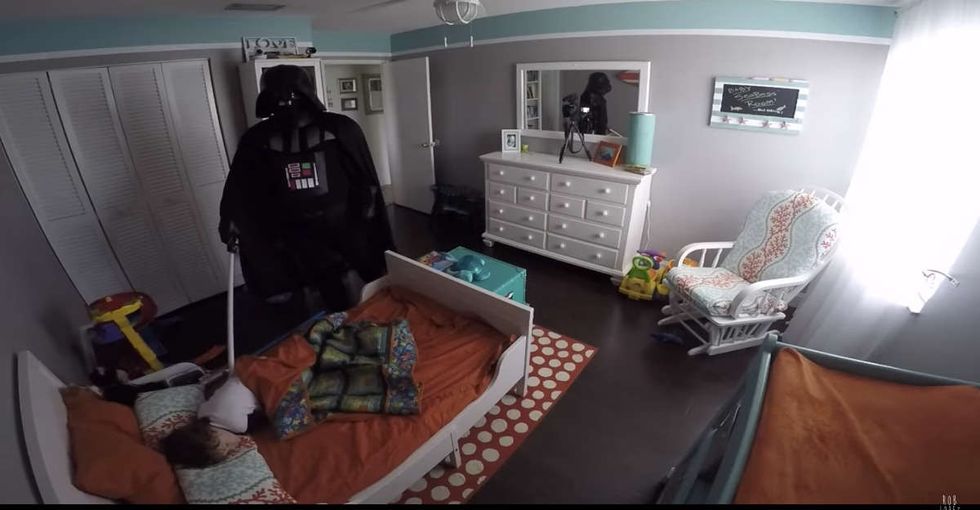
A dad dressed as Darth Vader to wake up his son. The kid's reaction is pure 'Star Wars.'
Favicon 
www.upworthy.com

A dad dressed as Darth Vader to wake up his son. The kid's reaction is pure 'Star Wars.'

Dads are ridiculous. But perhaps, in the world today, there is no dad quite so ridiculous as Rob Lopez: Photo via Rob Lopez/YouTube.On a morning not too long ago, Lopez apparently had the following thought: "I'm going to dress up as Darth Vader and wake up my 2-year-old." Photo via Rob Lopez/YouTube.Clearly, the correct follow-up thought is, "No. That's silly. Why would I ever wake up a 2-year-old. Like, on purpose."But not for Rob Lopez. Oh, no.After suiting up......and receiving the mission critical sign-off from his wife.He grabbed his lightsaber and gave it a go. The results ... pretty much speak for themselves (fast-forward to 1:05 for the main event).There are a couple of things about Lopez's son's reaction that we should talk about.(First, this child is objectively the hardest core human on the face of planet Earth right now.)He grabs the lightsaber he keeps next to his bed (just in case) and it's game on, Dark Lord of the Sith. Game. On.Think about how you would feel, as an adult person, in complete control of your faculties, with a firm grasp on the difference between fiction and reality, being aggressively prodded awake by a six-foot-tall man in a full-body Darth Vader mech-suit complete with voice modulator and terrifyingly heavy breathing.Think about how loud you would scream and the volume of pee you would pee into your pants.Meanwhile, this toddler — who is probably no more than three feet tall, groggy and vulnerable, with no cognitive ability to discern this is not the real Darth Vader — didn't even think twice about taking him on.Perhaps the most impressive part? At a mere 2 years of age, he's already learned, perhaps, the single greatest lesson of "Star Wars."You don't defeat the dark side with mad lightsaber skills (although they are fun to show off).You defeat it with compassion. ...which, in this kid's case, involves casually grabbing a book and asking Darth Vader to read him a story.Empathy for Siths — with an assist from curiosity and literacy: That's a lesson we could all use.This article originally appeared on 05.06.16
Like
Comment
Share
The Lighter Side
The Lighter Side
1 y

KoreanBilly explains the differences between American and British accents
Favicon 
www.upworthy.com

KoreanBilly explains the differences between American and British accents

There's an ongoing feud between people of the U.S. and Britain over who speaks correct English. Of course, the English invented the language which gives them an upper hand in the argument.But Americans have a point when they bristle see words like "Leicester" being pronounced "Lester" or "Schedule" pronounced "Shed-joole" by the British. (Although, of course that's what an American would say!) Then again, the English may be on to something when they describe New England accents as "grating."In the video below, a YouTuber known as KoreanBilly discusses the differences between American and British English pronunciation from the perspective of a Korean person. People learning English as a second language may not be aware of the differences in pronunciation between the dialects that native speakers pick up easily. Billy discusses the differences in how both types of speakers pronounce the T, H, R, O and A sounds. After a few minutes of listening to him, it's easy to see why your dialect sounds foreign to someone from across the pond.This article originally appeared on 09.26.17
Like
Comment
Share
The Lighter Side
The Lighter Side
1 y

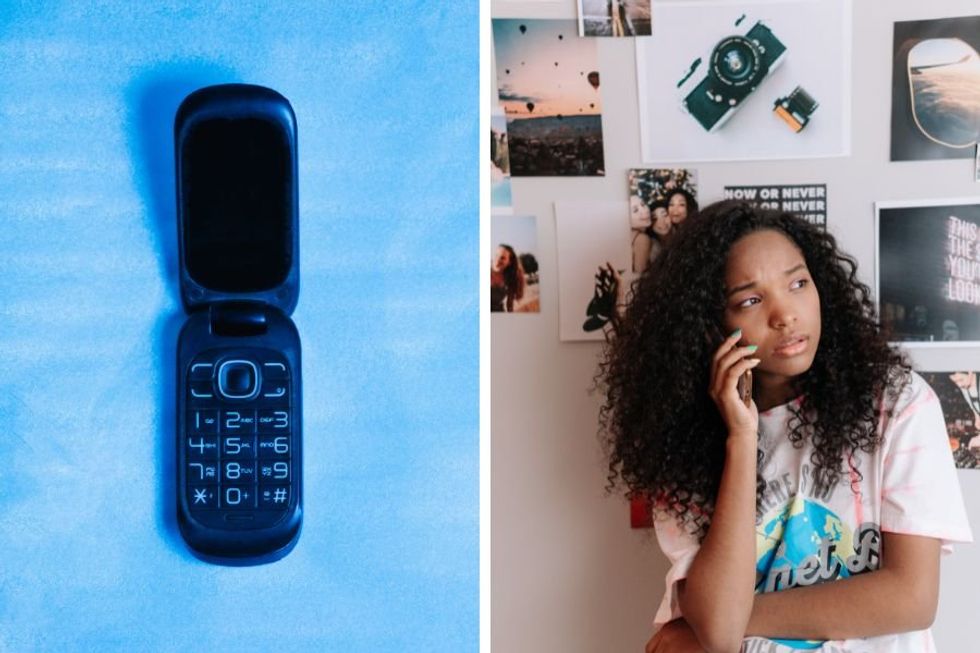
Nokia is bringing back the flip phone. Mom warns teens to be mindful to avoid a taste of 2002.
Favicon 
www.upworthy.com

Nokia is bringing back the flip phone. Mom warns teens to be mindful to avoid a taste of 2002.

Are you over the age of 35? Do you remember your first cell phone? Those things were life changing for Millennials who were just getting their first real taste of the freedom that comes with remaining reachable. Many of us memorized the feel of the buttons so we could sneak and text our friends under the desk during a boring lecture in class. Kids today will never know the skill it took to not only memorize where the keys were but to press the five button three times to get to the right letter. T9 texting should've been an Olympic sport. But texting and making calls was about all those phones were good for because the internet was still using dialup so the world was not at your fingertips–just your bestie. Gen Z has never had to experience technological advancement purgatory when it comes to electronic devices, but all that is about to change. Well, for some, if parents take the advice of Lydia Kyle. Recently the mom shared that Nokia is coming back out with their old flip phone, which could be a great tool for parents of teens according to her. "They're missing a huge, huge marketing area when it comes to parents of teenagers. If I was a teenager I would be shaking in my boots because the second you slip up on Snapchat, no more smartphone for you. Dumb choices. Dumb phone," Kyle tells the phone maker while encouraging parents to use the phone to solve some of today's problems caused by social media.The new Nokia phone is currently being marketed to Millennials looking to detox from social media according to Kyle, but parents in the comments like this mom's suggestions. View this post on Instagram A post shared by Lydia Kyle (@lydia_kyl)One parent points out the lack of security features as a positive for parents, "This makes absolute sense!!! Don’t have to worry about your kid cracking the passcode to their smartphone limits, this is a very good idea!!"Some parents are already on trend, "You are spot on! We got one for my son going into middle school. No apps nothing. He can call and text. The only draw back is that it doesn’t have find my. So we had to get Apple air tags. Otherwise it’s the perfect starter phone!!""My sister has several teens, and none of them have smart phones. They have to use like old school flip phones. Which I think is great. It allows them to communicate but not have to deal with the additional issues of smart phones and social media," another shares.The overall consensus is positive, "literally best idea for middle schoolers that have after school activities and you really need them to have a phone in case the activity bus decides not to run that day and they have to text you to come get them (been there many times) but you don’t want them having access to a smart phone!"This video may be made in jest but parents seem to be finding this as a viable solution to the over exposure of screens, online bullying, and exposure to social media too early. So maybe Nokia does need to branch out in their marketing a bit, old school tech is also really big for younger generations so some kids may not even fight parents on it.
Like
Comment
Share
The Lighter Side
The Lighter Side
1 y

'Sleep training' is a heated debate in the parenting world. It shouldn't be.
Favicon 
www.upworthy.com

'Sleep training' is a heated debate in the parenting world. It shouldn't be.

Welcoming a new baby to the world is a wonderful but daunting experience, and no matter how much you try to prepare, there will always be something you aren't fully prepared for. For many parents, that thing is lack of sleep.You can hear parents talk about exhaustion and sleep deprivation and still be wholly unprepared for what a baby who isn't a great sleeper does to to your psyche. It's no surprise that many parents turn to parenting books and "experts" to try to figure out how to get their babies to sleep, which is where the idea of "sleep training" comes in. Sleep training is a broad term for teaching or training a baby to go to sleep (or back to sleep) without needing to be soothed by a parent or other caregiver. There are many sleep training methods that range from fairly common sense to borderline abuse, which is one reason it seems to spark big debates between parents. Everyone's talking about a different method when they defend or vilify sleep training.Sleep training usually involves letting a baby fuss or cry for some length of time, which some see as problematic because of research on the importance of responding to babies' cries. Others say that a little crying is a small price to pay because it's healthier in the long run for baby and parents to get good sleep. Of course, there's a huge difference between "crying or fussing for a few minutes" and "wailing and screaming with no end in sight," and that's where the big disconnect comes in. For some parents, sleep training entails the former, and it works, so they swear by it. For others, it entails the latter, and it's a nightmare, so they think it's horrible. — (@) There's also a huge difference between "I'd love it if my baby would sleep all night without waking" and "I think I might die if I don't get a 4-hour stretch of uninterrupted sleep." Desperation makes many parents who might not love the idea of sleep training to give it a go. I have some personal experience with this. My first baby wasn't a great sleeper. I remember thinking, at six weeks postpartum, "There's no way a person can survive on this little sleep." I adored my baby, but the sleep deprivation from waking up several times a night for weeks on end felt like literal torture. She started sleeping through the night when she was a few months old, but that didn't last long. Teething happened. Then crawling happened. It seemed like just when she'd get into a nice sleep routine, some milestone would throw us right back to waking up and crying multiple times a night. She slept in our room next to our bed, so it was easy enough to nurse her back to sleep, but it was still night after night of disrupted sleep.I was desperate to try something, but I wasn't keen on the idea of sleep training. It's a natural instinct to respond to your baby's cries, so walking away didn't feel right. One book had suggested leaving the baby in their crib to cry by themselves and not pick them up no matter what. If they got so upset that they threw up, you were just to clean them up and do the same thing again. Um, no thank you.But I had heard other parents say they tried different sleep training methods that involved leaving them to cry for just a few minutes, going in to pat/comfort them, leaving them again for a little longer, and going back and forth until they eventually fall asleep. I read so many parents say something like, "It took like 15 minutes of fussing for them to fall asleep the first night, 5 minutes the second and after that they just went right to sleep and didn't wake up until morning!" If only all babies slept this peacefully.Photo by Yan Krukau/PexelsThat sounded reasonable. So I tried it, a couple of times. It went nothing like how those parents described. Not even close.First of all, my baby did not "fuss." It was full-on crying, wailing and screaming with snot and drool involved. Secondly, there was no patting her to calm her down—she would only calm down if I picked her up. Third, the wailing when I left the room didn't ever subside, it only got worse and worse. I felt like I was torturing my baby and it was breaking my mama heart, so we gave it up. I have no doubt that those parents were telling the truth about how sleep training worked with their child. It just absolutely did not work that way with mine. That baby is now 24 and has slept in her own bed all night for over two decades. My other two kids had their own sleep personalities as babies—one of them super easy and the other more like my first. I didn't do anything different to make them that way—it's just how they were. It was hard sometimes. We co-slept as needed. It all worked out in the end. There are a few things I know for sure after parenting three kids and talking with countless other parents: 1) Every baby, child and family is different and what works for one won't necessarily work for another. As long as no one is actually being abused or neglected, do what works for your kid and your family. 2) Anyone who offers definitive, one-size-fits-all advice on any part of parenting is flat-out wrong. One size most definitely does not fit all.3) Sleep is important, but unless you've slept a night in their bed, don't judge a parent for how they choose to handle sleep with their baby. What's right for you may not be right for them.

Like
Comment
Share
Showing 65441 out of 103634
  • 65437
  • 65438
  • 65439
  • 65440
  • 65441
  • 65442
  • 65443
  • 65444
  • 65445
  • 65446
  • 65447
  • 65448
  • 65449
  • 65450
  • 65451
  • 65452
  • 65453
  • 65454
  • 65455
  • 65456
Advertisement
Stop Seeing These Ads

Edit Offer

Add tier


Select an image
Delete your tier
Are you sure you want to delete this tier?

Reviews

In order to sell your content and posts, start by creating a few packages. Monetization

Pay By Wallet

Payment Alert

You are about to purchase the items, do you want to proceed?

Request a Refund