www.historyisnowmagazine.com
The History of Cornbread: The Importance of an American Staple Food
There is little doubt that the establishment of agriculture and the domestication of wheat production in Mesopotamia between 12,000 and 14,000 years ago represented one of the most significant shifts in human history. However, wheat’s American analog receives substantially less attention. Nearly 8000 years ago corn was domesticated in North America in Mexico. The Native Americans who domesticated corn established multiple different breeds and hybrids which spread throughout the entirety of North America and South America as a staple crop which provided substantial nutrition. Corn was ground into cornmeal with the simple tools of a mortar and pestle which provided the capability to create breads which were easier to store, preserve, and absorb nutrients. With the introduction of European and African food and cultural customs, cornbread as a food of North America experienced significant changes and adaptations. This article does not seek to provide an exhaustive history of the history of corn and its cultural significance. However, this article does seek to display the significant adaptations and changes cornbread has gone through as a dynamic and important centerpiece of life in North America. Through its origins as a staple of Native American diets to its introduction into Euro-American, and African American cuisine, the recipes for cornbread experienced significant changes due to the unique and dynamic nature of the Columbian Exchange. The Columbian Exchange refers to Alfred Crosby’s revolutionary thesis in arguing that the most consequential aspects of contact between the old world and new world were not social or cultural but biological in nature with the massive interchange of disease, plants, and animals primarily between the Americas, Europe, and Africa.[i]Additionally, cornbread experienced changes in recipes due to the collapse of home-based subsistence agriculture during the Great Depression and the end of the process of stone mills in the production of cornmeal for the rise of industrial cornmeal separation with steel roller mills. Food provides perhaps one of the most significant windows into the soul of a people. This article provides a longue durée approach to the history of cornbread as a food within North America through multiple narratives, recipes, and technological changes.Roy Williams explains.
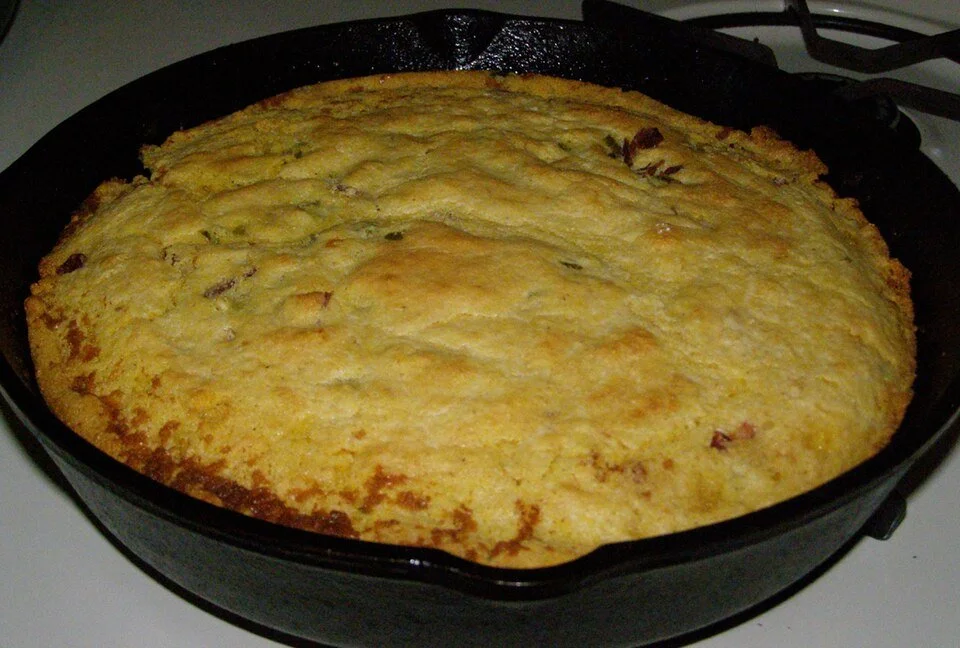
Skillet cornbread. Source: Creative Commons license 3.0, Zankopedia, available here.Part I: Prehistory to the American RevolutionCorn was domesticated in Mexico between 6000 and 9000 years ago from a grass plant called teosinte native to Mesoamerica. While teosinte’s seeds were too hard to eat, its husks could be used for crafting material. Over the next 4000 to 5000 years, teosinte was bred to become a staple food across the Americas, spreading outward from Mexico both to the North and the South.[i] By the time Europeans reached the Americas, corn had been domesticated across wide swathes of both the North American and South American continents. For multiple groups of Native Americans, corn had become a way of life and the concept of a deity the “Corn Mother” had spread across multiple different Native American cultures.[ii] Corn varied in breeds as well with different breeds being domesticated to grow and produce in their respective climates. From the desert to the rainforest and all the way up into modern day Canada, corn was bred to serve the people that depended upon it. When Europeans reached the Americas, they encountered corn early and did not want to consume it as a staple food in their new colonies. These Europeans attempted to grow wheat in the new world but ultimately failed and had to resort to changing their diets to accept corn as a new part of their lives. They learned to accept the agricultural practices of Native Americans and adapt for their own cuisine. Native Americans practiced companion planting to increase harvests and maintain soil health. One such example of companion planting is the Three Sisters method. The Three Sisters method included growing corn in mounds with squash and beans. The corn provided a structure for the beans to grow, and the squash provided shade for the beans to stop the potential of sun damage. In addition, the beans fixed the nitrogen in the soil which corn is known notoriously for consuming copious amounts of nitrogen.[iii] The Three Sisters method of companion planting represented perhaps one of the greatest feats of agricultural engineering among Native Americans of the New World. In addition to the planting of corn in mounds via the Three Sisters method, Native Americans also utilized the method of planting corn in rows in large fields. Corn is a unique plant in that it is a grass that requires wind pollination. Corn must be planted near other corn plants so that the pollen put forth by the male tassels can pollinate the female part of the plant: the silks and the ears. Without proximity of other corn plants, corn will not properly pollinate, and the ears of corn will either not develop properly, or they will develop inconsistently. One method to counter the issue of wind pollination is the process of hand pollination by removing the male tassels of the plant and spreading them evenly throughout the female silk and ears. This method however is too time consuming and only works in methods of intensely watched subsistence agriculture, the more effective method remains in planting corn in close proximity via mounds and rows to ensure that the wind can do the job of pollination without human intervention. In addition to corn’s ravenous appetite for fertile soil and nitrogen, corn requires substantial amounts of water. The soil must remain damp in the initial stages of germination which range from 7 to 14 days from planting. Without proper rainfall and irrigation corn has a high likelihood of drying out and being unable to produce fruit.[iv] The North American continent has multiple different planting zones ranging from zone 1 in the freezing upper reaches of Canada to the hottest regions in southern Mexico of Acapulco de Juarez with Zone 13b.[v] Astonishingly, corn can be grown in each of these regions at different starting points. In the southeast United States, which encompasses a range of zones 6 to 9, corn can be grown in two crops, one starting in early spring in March and April and another starting in late July or early August. In many regions of North America which are hotter or colder, corn can only be harvested once due to shorter growing seasons. Corn is a relatively fast producing crop with harvests estimated between 60 and 75 days from planting. As corn became a staple of the colonist’s diets, recipes changed from the introduction of ingredients such as milk, eggs, pepper, and other regional additions. This introduction and exchange of ingredients represented one of the most important and long-lasting aspects of the Columbian Exchange. Corn as crop also moved across the Atlantic back to Europe and Africa where some estimates place the introduction of corn to West Africa in the early 1500s by the Portuguese.[vi] If this is true, many West Africans would have been familiar with maize as a food staple long before their forced capture and journey to the Americas as enslaved workers. Michael Twitty, a culinary historian argues that an early cornbread dish was prepared in West Africa from the interaction between Portuguese and Africans, “This was a grainy type of corn dish, made either from meal or crumbled cornbread. In both cases, its origins lie in Senegambia and the Sahel, where Islamic West Africa was born. Kusha is the Hausa name for one of many dishes that reflected a dual transfer of cuisine and culture between North and West Africa. We are still unclear who got there first, but it was most likely West Africans—who once shared the green Sahara with their cousins to the North—that came up with the idea for couscous-type dishes. Kusha (or "kush" in the mouths of their descendants in the United States) was shorthand for "couscous," the steamed or boiled grains of millet or sorghum eaten as a staple in savanna areas of West Africa, where the influence of Islam was felt.”[vii] Nevertheless, corn moved in multiple dynamics as a newfound food staple for European colonists in the Americas as well as for Africans and Europeans in the old world. Early recipes differentiate cornmeal from flour, referring to it as “Indian meal” or “Indian flour” rather than referring to it as the contemporary term of cornmeal.At this point corn was still processed into meal via simple analog methods of mortar and pestle but European colonists also introduced the process of stone milling which used mills to grind and separate corn into meal. This meal would generally consist of a mix of dried corn ground into meal with an occasional leftover kernel which would give the cornmeal a mild sweet flavor. Early recipes were extremely simple compared with the massive varieties of cornbread present throughout north America in the modern era. Native American recipes generally followed two different trajectories, a mix of cornmeal and water either boiled or cooked over a fire. Sometimes this mixture of cornbread would include beans within the dough to increase protein content making the cornbread a wholly sustainable food but other times it would just include cornmeal and water. One such early instance of cornbread stood in the example of the Oneida people’s recipe for cornbread which was provided to Washington’s Continental Army at Valley Forge to prevent the army from succumbing to starvation.The harsh winter of 1777 to 1778 at Valley Forge proved to be a particularly challenging time for the Continental Army during the American Revolutionary War. Without supplies and food, many of Washington’s conscripts began starving to death as they waited out the winter. Fortunately, about 50 Oneida-Iroquois people including Polly Cooper travelled many miles bringing a large supply of white corn to feed the Continental Army. Many of the soldiers attempted to eat the corn immediately but the Oneida taught them that the white corn was not edible until it had been processed properly.[viii]Through a process known as nixtamalization, the white corn was processed in an alkaline solution of wood ash boiled until the hulls were removed from the corn and the nutrients were made easier to digest by the human body. After boiling, the corn became Massa which could be ground and processed into a dough which could be effectively used to cook bread. Once the nixtamalized corn was rinsed multiple times, the hulls could be ground into Massa by a simple method of mortar and pestle until it was fine and soft enough to be held together. George Washington wanted to pay Polly Cooper for her help in saving the Continental Army, but she refused, claiming that it was her moral duty to help her allies. Instead, Martha Washington took Polly Cooper shopping in Philadelphia after the ordeal where she bought a shawl that became a symbol of the cooperation between the United States government and the Oneida-Iroquois people.[ix] The cornmeal dough from the white corn was combined with beans into a large dough and boiled.[x] This combination of cornbread and beans provided all the essential amino acids and protein for survival and ultimately allowed the Continental Army to survive the brutal winter of 1777-1778. The cornmeal dough was shaped into disks and boiled in water for about 45 minutes until it was firm and cooked thoroughly. The cornbread was finally done when it began to float in the water which signified that it was fully cooked through and not doughy on the inside.The Oneida-Iroquois cornbread recipe represents perhaps one of the earliest and most purely Native American recipes for cornbread. Rather than being baked in an oven or over a fire, this recipe combined white corn, water, and beans to create an essential food item which saved the Continental Army from certain starvation. Over the next few centuries cornbread would continue to adapt and change with the addition of European and African ingredients and cultural elements to become a significant food item throughout the Americas with a particular emphasis upon the culture of the American Southeast. The significance of the Oneida people’s contribution to United States history cannot be understated, however. Without the addition of Native American recipes and the knowledge passed down from Polly Cooper to Washington’s troops, the army would have surely perished, and the experiment of the American Revolution would have collapsed. Therefore, although cornbread has experienced massive adaptations and changes over the years through the additions of European, American, and African culture, the significance of this food item in the genesis of the United States and the connection between the Native Americans who subsisted on it for years stands as a consequential unifier between multiple diverse cultures. Part II: The Columbian Exchange: Cornbread Recipes over Three CenturiesThe different incarnations that cornbread went through during the colonial era stands as one of the most significant and insightful windows into understanding the genesis of modern cornbread. Cornbread is consumed throughout North America in different forms but ultimately garners the most attention in the Southeast. Here the varieties of cornbread vary in whether they are sweet, spicy, or savory, and to what level flour is combined in the cornmeal. By examining early colonial recipes and following a longue durée approach to these recipes a greater understanding of the processes and changes that led to modern cornbread and the divergences in recipes can be determined. The earliest North American cookbook to include cornbread as a recipe is the 1796 recipe book American Cookery by Amelia Simmons. This cookbook includes many recipes that were both European and American as well as a few which were a synthesized mixture of European and Native American ingredients. Beginning on page 33 and 34, The American Cookery lists recipes for Hoe cakes, Indian Slapjacks, and Johnny Cakes using the ingredient referred to as Indian Meal. The Johnny Cake or Hoe cake Recipe from The American Cookery reads as follows, “Scald 1 pint of milk and put to 3 pints of Indian meal, and half pint of flour-bake before the fire. Or feald with milk two thirds with boiling water, add salt, molasses, and shortening, work up with cold water pretty stiff and bake as above.” The Indian Slapjack recipe reads as follows, “One Quart of milk, 1 pint of Indian meal, 4 eggs, 4 spoons of flour, little salt, beat together, baked on griddle, or fry in a dry pan which has been rubbed with lard or butter.”[xi]The 1798 recipes from the American Cookery by Amelia Simmons shows a significant divergence from the early recipes used in pre-colonial America. The additions of flour, salt, eggs, shortening, and milk change the recipe for cornbread show the massive changes that occurred due to the Columbian exchange between the old world and new world. Interestingly, the racialization of cornmeal as a food is present within this cookbook. The mentions of cornmeal as Indian meal provides an insight into the othering of corn and cornmeal in the new world from typical colonial and European palates. The fact that these recipes were included shows an adaptation and a reluctant acceptance of the abundance of corn as a food but also shows the relative ambivalence towards it as a staple food source. The addition of multiple European derived ingredients also shows an approach to diminishing cornmeal as a begrudging alternative to flour rather than one of the most appropriate carbohydrates available in the new world.The 1889 recipe book Aunt Babette’s Cookbook was the first Jewish American cookbook published in the United States. It quickly became a bestseller and contained multiple non-kosher recipes as a tendency of assimilation of Jewish people who had emigrated to the Americas. Aunt Babette’s Cookbook also includes multiple recipes for cornbread and cornbread derivatives corn muffins showing the importance of cornbread as an American food by this point. Aunt Babette’s Cookbook, however, still uses the racialized language of Indian meal rather than cornmeal which further others the vegetable of corn and the processed product of cornmeal over the more familiar European ingredient of wheat flour. Aunt Babette’s recipe for corn muffins on page 170 reads as follows, “One cup of Indian Meal, and a half cupful of flour, in which you have sifted two teaspoonfuls baking powder. Wet this with two cups of sweet milk, add one teaspoonful of butter, one teaspoonful of salt and one of sugar. Beat the yelks of two eggs light and add and last the stiff-beaten whites; bake in muffin rings. Eat cold.”[xii] Aunt Babette’s 1889 cookbook adds what many in the southeastern region of the United States would consider the most controversial ingredient considered in cornbread, sugar. While early recipes for cornbread in the pre-contact Native American period and early colonial period certainly did not include sugar as an ingredient, cornbread evolved to include a sweet taste among certain regional palates throughout the United States. The Aunt Babette’s Cookbook cornbread recipe is detailed as follows, “One pint of Indian meal, one pint of buttermilk, two eggs, whites and yelks beaten separately, whites to be put in the last thing; two tablespoonfuls of sugar; one tablespoonful of melted butter, a little salt and a teaspoonful of baking powder.”[xiii] This recipe in particular resembles many of the contemporary recipes throughout the modern south with varieties including the addition of pepper, green peppers, and the addition or subtraction of sugar in different varieties. Some Southwestern varieties of cornbread also include the introduction of cheese to cornbread as a regional derivative. Marion Cabell Tyree’s 1878 Housekeeping in Old Virginia mentions multiple recipes using cornmeal but begins the transition from the racialized language of Indian meal towards cornmeal as well as changing the larger naming conventions of cornbread recipes. This change represents the historical paradigm shift as corn and cornmeal became accepted as a regional food staple of the south away from its previous incarnation as a begrudgingly accepted food stuff of Native Americans that lived in the southeastern United States before Euro-American colonizers. By the 1870s the last vestiges of Native Americans on the east coast had been pushed westward after the Trail of Tears between the 1830s and 1850s and the only remaining Native Americans not subjected to state-controlled reservation governance had adopted sole reliance upon the bison of the Great Plains in the American West. Marion Cabell Tyree’s Housekeeping in Old Virginia represents the change from cornbread as a Native American food reluctantly accepted by Euro-American colonizers to a regional delicacy. The recipe for Old Virginia Batter Cakes, another variety of cornbread is as follows, “Beat two eggs very light in a bowl. Add one teacup of clabber, one of water, one of cornmeal, a teacup of flour, one-half teaspoonful of salt. Just before baking, sift in half a teaspoonful of soda and stir well. It is better to grease the griddle with fat bacon than with lard. The above proportions will make enough batter cakes for two or three persons.”[xiv] Another recipe for the same with cheaper ingredients is listed below as, “1 quart sweet milk, 1 heaping pint cornmeal, 4 eggs, 1 teaspoonful of salt, 1 half teaspoonful of soda,1 tablespoonful of warmed butter or fresh lard. Break the eggs, whites, and yolks together, beat slightly, then add the milk, stir in the meal, and beat until it looks light. Bake on a griddle.”[xv] A final recipe for hoe cakes is listed under the name cheap recipe for batter cakes, this recipe is listed as, “1 pint of sour milk, 1 teaspoonful of soda, 1 tablespoonful of flour, enough meal to make a good batter, bake on a hoe.” This recipe is particularly significant as little ingredients are used and the instructions remain relatively lacking in comparison with its predecessors. What would have been called Johhny cakes in preceding recipes for this particular concoction is simply referred to as the simplest and cheapest viable option for Virginia batter cakes. This lack of continuity with the original historical recipe as well as the relative lack of ingredients and instructions arguably shows a class divergence occurring in the initial stages of the transition between reconstruction era and gilded age America. By this point corn and cornmeal had certainly earned its place as a staple food of the southeastern United States however, the changes in regional culture and the stratification of class points to the beginning of stratification of class in food as well as racial barriers throughout food which can arguably be discerned through the study of cornbread. The turn of the century from the 1800s to the 1900s represented a renaissance for cornbread recipes once again asserting the southern identity and the values of cornbread as a regional staple. The Dishes and Beverages of the Old South Cookbook by Martha McCulloch-Williams stands as another beneficial example of evidence of this larger trend. Once again, the cornbread recipe in this book deals away with the previous racialized terminology of Indian meal and instead uses cornmeal but another innovation also occurs in specifically delineating the type of meal whether yellow or white in the cornmeal which is used for the recipe. This variation in ingredients represents perhaps the second most contentious disagreement amongst proponents of cornbread about which is the best or most suitable for the preparation of the recipe. Marth McCulloch-Williams’ recipe for plain cornbread is as follows, “Sift, sound fresh white cornmeal, wet with cold water to a fairly soft dough, shape it by tossing from hand to hand into small pones, and lay them as made into a hot pan well sprinkled with dry meal. The pan should be hot enough to brown the meal without burning it. Make the pones about an inch thick, four inches long, and two and a half broad. Bake quickly, taking care not to scorch, until there is a brown crust top and bottom. For hoecakes make the dough a trifle softer, lay it by handfuls upon a hot meal-sprinkled-griddle, taking care the handfuls do not touch. Flatten to half an inch, let brown underneath, then turn, press down, and brown the upper side. Do not let yourself be seduced into adding salt-the delight of plain cornbread is its affinity for fresh butter. It should be eaten drenched with butter of its own melting-the butter laid in the heart of it after splitting pone or hoe cake.”[xvi]Finally, the southern identity with regards to cornbread came to its modern format in the 1930s with the writing of the Southern Cookbook of Fine Old Recipes by Lillie S. Lustig, Sarah Rensel, S. Claire Sondheim. This book included many varieties of cornbread ranging from corn pudding, hoe cakes, spoon bread, and cornbread. Noticeably, all language of Indian meal has ceased indicating the acceptance of corn and cornmeal as a food staple in the southeastern United States. The recipe for Miss Lee’s cornbread is as follows, “1 cup white cornmeal, ¼ cup of wheat flour, 1 teaspoon baking powder, ½ teaspoon of salt, 1 beaten egg, ½ cup of milk, 1 tablespoon of melted butter. Sift together the dry ingredients; combine the milk with the egg and add to the dry ingredients. Add the melted butter and pour batter into a well-greased pan. Bake in a hot oven (425 degrees) about 25 minutes.”[xvii]The different incarnations of cornbread represent both a monumental change in the recipe of cornbread from its Native American roots consisting of cornmeal, water and beans to a much more complex food including salt, pepper, shortening, eggs, milk, and a mix of flour. However, one of the most significant developments of cornbread across the colonial period ranging into the 20th century rests in the dynamic and persistent agency of women. In both the 1700s and 1800s, women were largely excluded from the world of publishing and the production of the written word, however women left their mark on the realm of cornbread recipes in the Americas. These women ranging from Aunt Babette’s combination of Jewish American recipes to the 1930s Southern Cookbook of Fine Old Recipes displayed agency in changing the dynamics of the recipes of cornbread defining and establishing a unique southern culture delineated by its cuisine and direct dependence upon the food staples of corn and cornmeal. While it may be difficult to discern their wants, desires, and larger ideologies during these periods, these recipes provide a direct link to the agency of women in the Americas and specifically their agency in creating a regional culture and identity in the southeastern United States. Part III: Making A Southern Identity: Cornbread in Media“The North thinks it knows how to make corn bread, but this is mere superstition. Perhaps no bread in the world is quite so good as Southern corn bread, and perhaps no bread in the world is quite so bad as the Northern imitation of it.”-Mark Twain (Autobiography of Mark Twain, Volume 1)[xviii] Mark Twain’s disdain for northern versions of cornbread provides a window into the differences between regional variations of cornbread recipes throughout the United States. While much of the debates regarding whether cornbread should be sweet or savory or utilize white or yellow cornmeal had not reached the levels of mass contention apparent in the aftermath of the Great Depression, Mark Twain’s opinions give us a window into the creation of a uniquely southern identity associated with its culinary practices. Media representation of cornbread through figures such as Mark Twain, General Robert E. Lee, and general articles about the value of cornbread can be used to approach and uncover this southern identity. One early article which reaffirmed the southern identity and its association with cornbread is the 1864 Charleston Mercury story, General Lee’s Table. The article expands on a semi humorous tale of General Lee’s culinary habits during the war and his relative distaste for day old, boiled cabbage. The Charleston Mercury is quoted as follows, “In General Lee tent, meat is eaten but twice a week; the General not allowing it oftener, because he believes indulgence in meat to be criminal, in the present straightened condition of the country. His ordinary dinner consists of a head of cabbage boiled in salt water, and a pone of corn bread. In this connection, rather a comic story is told: Having invited a number of gentlemen to dine with him, General Lee, in a fit of extravagance, ordered a sumptuous repast of cabbage and middling. The dinner was served, and behold! a great pile of cabbage and a bit of middling about four inches long and two inches across. The guests, with commendable politeness, unanimously declined middling, and it remained in the dish untouched. Next day General Lee remembering the delicate tid-bit which had been so providently preserved, ordered the servant to bring middling. 'The man hesitated, scratched his head, and finally owned up. 'De fac is, Masse Robert, dat ar middlin'was horrid middlin'; we all didhab nar spec; and I done paid it back to de man whar I get it from.'Gen. Lee heaved a sigh of deepest disappointment and pitched into his cabbage.”[xix]This article associates civil war southern identity directly with cornbread out of necessity from the lowest socioeconomic rungs of southern society with slaves and poor whites all the way up to figures of the military aristocracy like General Lee. It also displays southern confederate war propaganda in showing the example of General Lee’s judicious eating habits in avoiding the overconsumption of meat amidst the turmoil of the civil war. This propaganda pushes cornbread as a meal of both southern identity and necessity in overcoming the challenges presented by the war. These high-profile instances of cornbread in the media provide a window into the creation of a uniquely southern identity associated with certain culinary habits. While corn and cornmeal in the south were originally begrudgingly accepted as a grain alternative to the wheat flour which European settlers were accustomed to in the old world, over time they became a staple and symbol of distinct identity. The process by which this identity was shaped came out of necessity but over time became ingrained in the southern way of life. These media representations are important in understanding the synthesis of identity regarding cornbread, however the technological and social changes of the turn of the century provide an additional window into understanding the inherited culinary traditions and debates of the present. Part IV: The Great Cornbread Debate and The Technological Transition of the 1930s from Stone Milling to Industrial MillingPrior to the late 1800s, corn around the United States was not uniform in nature. Each area had a different heirloom breed which had been cultivated specifically for the climate and soil conditions. However, this all changed as the field of agriculture became increasingly influenced by technocratic ideals of efficiency and standardization. Arguably the most consequential innovation in corn cultivation came from the work of corn cultivator, James L Reid. James L Reid was a farmer from Tazewell County Ohio who worked from the mid-1800s until the turn of the century to breed and standardize corn as a crop. Reid’s innovations would pay off when he was finally able to cultivate the hybrid blend of corn known as yellow dent which would ultimately dominate and standardize the market for corn throughout the United States.[xx] In 1891, Reid won the highest honor at the Illinois State Fair in Peoria for his work in producing exemplary specimens of corn. In 1893, however, Reid won the greatest honor at the 1893 World Columbian Exposition in Chicago. George H Iftner, a historian, memorialized this monumental accomplishment stating that, “In 1893, James L Reid made an exhibition of Reid’s Yellow Dent Corn at the World’s Columbian Exposition, winning the highest score a medal and a diploma…Mr. Reid established a retail mail order seed corn trade. The corn was sent to many growers in Illinois, and neighboring states. State colleges of agriculture carried on experiments covering several years.”[xxi] Reid’s Yellow Dent Corn spread throughout the nation and led to increased efficiency and standardization of corn harvests ultimately leading to greater corn production. The 20th century represents perhaps the most contentious point for cornbread as a recipe. Beginning around the 1930s and 1940s recipes began to change to reflect broader changes which occurred both in the manner of processing cornmeal and in maintaining its overall flavor. The cornbread debate in the southern United States falls on two sides of two different questions. Whether to use yellow cornmeal or white cornmeal and whether cornbread should be sweet or savory. Additionally, some recipes allow for the introduction of wheat flour which is another debate as to whether flour has a place alongside cornmeal in cornbread. This debate did not exist prior to the 20th century as the previous recipes we have discussed have shown. What happened that caused the introduction of sugar, wheat flour, and the debate between white and yellow cornmeal? The transition from subsistence agriculture to commercialized industrial agriculture is perhaps the greatest indicator of the larger changes in cornbread recipes. Prior to the 1940s, cornbread was a uniquely subsistence-based food created by individuals who farmed their own corn and then processed it into cornmeal. This processing ranged from individual based mortar and pestle to the application of local stone mills or toll mills. The stone mills provided an easier and more effective way to grind corn into cornmeal without the need for currency. Farmers would trade a few bags of corn for a few bags of cornmeal, additionally, the mill would profit from a percentage of the cornmeal which could be sold to other consumers. This all changed significantly when the practice of subsistence agriculture declined precipitously during the Great Depression and in the aftermath of World War II. Most consumers transitioned to purchasing cornmeal from local grocery stores rather than trading their homegrown corn for cornmeal as their predecessors had done for centuries. With this transition, the stone mills which once provided cornmeal for most southerners began to disappear as cornmeal was produced industrially rather than in stone mills. This technological change, however, changed the flavor of cornmeal in a substantial manner which led to changes in recipes for consumers in attempting to recreate the old flavor of the cornbread which was produced in stone mills. As Robert moss argues, “The mills were typically water-powered and used large millstones to grind the corn. Starting around 1900, however, new "roller mills" using cylindrical steel rollers began to be introduced in the South. Large milling companies set up roller operations in the towns and cities and began taking business away from the smaller toll mills out in the countryside.”[xxii] The new application of steel roller mills produced a greater level of heat which both made the cornmeal shelf stable but also drained it of much of its previous flavor. The previous stone mills which processed corn into cornmeal also would occasionally fail to completely grind the corn into cornmeal powder and leave bits of corn kernels which added a slightly sweet flavor to any recipes in which it was used. To remedy this change in flavor, recipes began to call for the addition of sugar and occasionally flour to make up for the loss of flavor caused by the heat in steel roller mills. The debate regarding white and yellow cornmeal also began to take shape as consumers attempted to preserve the robust flavor of corn in cornbread by using yellow cornmeal as an alternative to the white cornmeal which had in the past always been the basis of cornbread recipes. The technological change from stone mills to industrial steel roller mills exacerbated a massive change in the recipes for cornbread as well as the production of cornmeal. Prior to the agricultural innovations of the 20th century, wheat flour was a product most southerners did not have access to. The humid subtropical climate of the south caused wheat to whither in the heat and humidity while in the northern and midwestern regions of the United States it thrived. For all but the richest of southerners, cornmeal, and the cornbread it produced was the daily bread of the south. However, with the agricultural and economic innovations of the 20th century, wheat flour became more affordable, and consumers were able to buy wheat to make bread and occasionally use it in modifying recipes for cornbread.The change in recipes for cornbread over the course of the 20th century represents perhaps one of the greatest and consequential transitions in American history. Before the Great Depression, most citizens of the United States supplemented their diets by growing a certain percentage of their food in homebased subsistence garden, however after the Great Depression, people began to rely more on local grocery stores and larger farms which provided processed and ready products for their daily nutritional demands. This transition also resulted in the beginning of a commodification and commercialization of cornbread as a product rather than as a food of necessity. The Great Migration of African Americans northward over the course of the 20th century to industrial rust belt centers such as Detroit in search of jobs, opportunities, and an escape from the status quo white supremacist hierarchy of the south stands as another crucial component in understanding the debates and status of modern cornbread recipes.[xxiii]Crescent Dragonwagon argues in her book, The Cornbread Gospel, that Cornbread recipes in the south generally shied away from the introduction of wheat and flour relying instead on a mix of white cornmeal, eggs, buttermilk, salt, and occasionally pepper. Recipes in the northern United States allowed for the introduction of sugar, flour, and many times utilized yellow cornmeal rather than white cornmeal.[xxiv] As many African Americans moved northward, these recipes began to change and alter to reflect a synthesis of culinary traditions from both the south and the north. These recipes began to move geographically both northwards and return to the south when African Americans who had moved north in the Great Migration travelled back to the south to visit family and occasionally return to the south. As economic opportunities decreased over the course of the 20th century many African Americans returned to the south seeking jobs all the while bringing these culinary adaptations with them. Over the course of the 20th century, commercialism of cornbread became widespread with the introduction of ready-made cornmeal mixes such as Jiffy Mix which removed the homemade component of cornbread and repackaged the food into a commodified fast-food alternative. The Jiffy Mix company or Chelsea Milling Company as it was originally called, formed in the 1930s in Chelsea Michigan and took advantage of the influx of southerners both white and black who had moved to the north.[xxv] These customers were alienated from their previous way of life which relied upon subsistence agriculture in growing corn and then processing it at toll mills for raw processed white cornmeal. Jiffy Mix created a product which synthesized a mixture of northern and southern culinary sensibilities for mass production across the United States. With the massive decrease in subsistence farming conducted on an individual basis with the onset of the Great Depression, Americans both in the south and the north began to purchase their cornmeal from grocery stores and rely on easy premade mixture products such as Jiffy Mix to satiate their desire for cornbread. With Americans moving away from the days of subsistence agriculture and sharecropping, towards industrialization and urbanization, farms began to consolidate and shift from small family-based farms to large corporate farms further alienating the American public from homebased production of food. One element of the lineage of home-based food production remained, however. Cast iron skillets were passed down throughout families in both the north and the south and remained in use in some circumstances for hundreds of years. David Sutton and Michael Hernandez explores this connection between cooking tools and collective memory and identity, they argue that, “The skillet stands out because it has become a repository of family history, both a daily tool, and an externalized reminder to remember (and to pass on) the stories of important ancestors, stories that convey particular moral values that he believes in and for which his family stands.”[xxvi] The application of cast iron skillets remained consistent throughout the 20th century only declining in sales over the 1960s when coated nonstick pans were introduced to the market. Cast iron skillets endured as one of the few elements of bygone eras of subsistence agriculture and homebased cornmeal production with many antique skillets still being used presently providing a direct link between the past and present. ConclusionOver the course of American history, cornbread has endured, constantly adapting to the palates of Americans both in the south and the north. Above all however, cornbread is associated within the public consciousness as a southern comfort food built upon Native American traditions. Cornbread represents the culmination of thousands of years of agricultural engineering and domestication both by the Native peoples of Mexico who domesticated the grass Teosinte into maize as well as the 19th century farmers such as James L Reid who standardized and improved previous breeds of corn to create the prevalent hybrid Yellow Dent Corn which dominates the market today. The introductions of multiple different ingredients and adaptations of recipes through the machinations of the Columbian Exchange provide a window into a dynamic world of synthesis and syncretism which created the recipes we have today. The Columbian Exchange allowed for the introduction of ingredients such as milk, eggs, salt, leavening, and pepper which changed Native American cornbread recipes which relied upon the combination of cornmeal, water, and beans. The technological changes brought about by the collapse of subsistence farming for industrialization and urbanization and the transition from stone milling to steel roller mills altered the recipes of cornbread to show the changing taste of cornmeal produced in industrial manners as consumers attempted to recreate the flavor which was lost due to the change in processing techniques. The great debate regarding cornbread which continues to exist in kitchens and dinner tables throughout the United States in determining whether cornbread should be sweet or savory and in whether cornbread should be made from white or yellow cornmeal is irrelevant. There is no right or wrong answer in determining the culinary heritage of a food which has constantly adapted and changed to reflect the introduction of new variables. Cornbread is not a monolith but a window into the soul of the American people, from the Native Americans who domesticated and engineered it over thousands of years, to the dinner table of the present, cornbread provides a window into the ever changing and dynamic landscape of the Americas and the people who inhabit them. Did you enjoy the piece? Join us on X here to receive regular updates: @HistoryIsNowMag[i] Paul Weatherwax, “The History of Corn,” The Scientific Monthly 71, no. 1 (1950): 50–60. http://www.jstor.org/stable/20077.[ii] “Selu: Seeking the Corn Mother’s Wisdom,” Masks of the Goddess, https://www.masksofthegoddess.com/selu---corn-mother.html.[iii] “The Three Sisters,” National Park Service, Last Modified May 18, 2023, https://www.nps.gov/tont/learn/nature/the-three-sisters.htm.[iv] Catherine Boeckman, “How to Grow Sweet Corn: The Complete Guide,” Farmers Almanac, June 27, 2024, https://www.almanac.com/plant/corn.[v] “2023 USDA Plant Hardiness Zone Map,” USDA, https://planthardiness.ars.usda.gov/.[vi]Rebecca Sharpless, Dethroning the Deceitful Pork Chop: Rethinking African American Foodways from Slavery to Obama, Edited by Jennifer Jensen Wallach, University of Arkansas Press, 2015, https://doi.org/10.2307/j.ctt1ffjdh9.[vii] Michael Twitty, “A People’s History of Cornbread Stuffing,” Vice, November 20, 2015, https://www.vice.com/en/article/ezqaba/a-peoples-history-of-cornbread-stuffing.[viii] Joseph T., Glatthaar and James Kirby Martin, Forgotten Allies: The Oneida Indiansand The American Revolution. (New York: Hill and Wang, 2006).[ix] “Polly Cooper: Oneida Heroine.” Oneida Indian Nation, Accessed July 19, 2024, Accessed from http://www.oneidaindiannation.com.[x] “The Art of Cornbread,” Oneida Indian Nation, Accessed July 19, 2024, https://www.oneidaindiannation.com/the-art-of-cornbread/.[xi] Amelia Simmons, American Cookery (Harford, Ct: Hudson and Goodwin of Hartford, CT, 1796), 33-34.[xii] Aunt Babette, Aunt Babette’s Cookbook (Cincinnati, OH: Bloch Publishing and Printing Company, 1889), 170. [xiii] Aunt Babette, Aunt Babette’s Cookbook (Cincinnati, OH: Bloch Publishing and Printing Company, 1889), 171.[xiv] Marion Cabell Tyree, Housekeeping in Old Virginia, (Louisville, KY: J.P. Morton and Company, 1878), 55.[xv] Marion Cabell Tyree, Housekeeping in Old Virginia, (Louisville, KY: J.P. Morton and Company, 1878), 56.[xvi] Martha McCulloch-Williams, Dishes and Beverages of the Old South, (New York: McBride, Nast and Co, 1913), 34.[xvii] Lillie S. Lustig, Saran Rensel, S. Clair Sondheim, The Southern Cookbook of Fine Old Recipes, (Reading, Pennsylvania: Culinary Arts Press, 1939), 31.[xviii] Mark Twain, Autobiography of Mark Twain Volume 1,(Chicago: University of Chicago Press,2010).[xix] H.L. Pickney, General Lee’s Table (Charleston, SC: The Charleston Mercury, April 27, 1864), http://www.accessible.com.eu1.proxy.openathens.net/accessible/print.[xx] William Reid Curran, “Indian Corn.: Genesis of Reid’s Yellow Dent,” Journal of the Illinois State Historical Society (1908-1984) 11, no. 4 (1919): 576–85. http://www.jstor.org/stable/40194511.[xxi] George H. Iftner, “Memorial to James L. Reid: Pioneer Corn Breeder,” Journal of the Illinois State Historical Society (1908-1984) 48, no. 4 (1955): 427–30. http://www.jstor.org/stable/40189468.[xxii] Robert Moss, “The Real Reason Sugar Has No Place in Cornbread,” Serious Eats, June 5, 2019, https://www.seriouseats.com/why-southern-cornbread-shouldnt-have-sugar.[xxiii] Carole Marks, “Black Workers and the Great Migration North,” Phylon (1960-) 46, no. 2 (1985): 148–61. https://doi.org/10.2307/274413.[xxiv] Crescent Dragon Wagon, The Cornbread Gospel (New York: Workman Publishing, 2007).[xxv] Steve Pardo, “Happy 85th birthday, Jiffy mix," The Detroit News, April 30, 2015, https://www.detroitnews.com/story/life/food/2015/04/30/jiffy-mix-biscuits-recipe/26600727/.[xxvi] David Sutton and Michael Hernandez, “Voices in the Kitchen: Cooking Tools as Inalienable Possessions,” Oral History 35, no. 2 (2007): 67–76. http://www.jstor.org/stable/40179947.[i] Alfred Crosby, The Columbian Exchange, (Santa Barbara, CA: Greenwood Publishing Group, 1972).








 New Posts (Home)
 ChatBox
 Popular Posts
  Game Zone
 Top PodCasts