www.thecollector.com
How Medieval Siege Weapons Worked and Why They Were So Effective
From mighty trebuchets to cannons, medieval siege weapons were some of the most dramatic and powerful weapons that warfare has ever seen. Indeed, if you were inside a castle and a trebuchet pulled up outside, loaded with huge rocks, your time was just about up. But were medieval siege weapons so effective because of the psychological damage that they caused, or was it simply down to sheer power? And could they be attacked by defenders? Read on to find out.
Why Was the Trebuchet the Most Feared Siege Weapon?
A trebuchet in use from the Siege of Antioch (1097-98), c. 1280-91. Source: Portail Biblissima
Perhaps the most famous of all medieval siege weapons, the trebuchet was a formidable sight to behold rolling up to the walls of a castle.
Capable of firing huge lumps of rock, bricks, and even human beings—dead and alive—the trebuchet, essentially a mighty catapult, was arguably more psychologically damaging than any other medieval siege weapon.
A prime example of this was during the Black Death, when Mongol forces besieged the Port of Kaffa on the Black Sea in 1347. The Mongols used trebuchets to fire plague-ridden dead bodies over the castle walls, which is often cited as the reason that the Black Death spread into Europe, and an early example of medieval biological warfare.
The sight of it alone would have been enough for the majority of men to raise the white flag of surrender, but for those who stayed to defend the castle, they knew their time and their chances were limited.
However, this was not always the case. During the First Barons’ War (1215-17) in England, King John’s forces used a trebuchet to attempt to besiege the defenders in Dover Castle. This was actually the first recorded use of a trebuchet in English history, and the garrison successfully managed to resist the siege.
Diagram of a trebuchet, 1187. Source: Wikimedia Commons
The main problem with a trebuchet was that while it was psychologically damaging to see such a powerful weapon rolling up to the castle gates, it also tended to be a last resort for most sieges. This is because of the sheer amount of destruction that a trebuchet could cause. For example, castle walls were destroyed much more quickly than they could be rebuilt, especially when many medieval castles had outer walls that were anywhere from nine to twelve feet thick.
As such, unless it was in the besieger’s best interests to completely destroy the castle of the defenders, using a trebuchet to take huge chunks out of the castle was economically nonsensical, as many of the leading figures in sieges were knights or lords who would expect to be rewarded with castles as part of their land rewards after a successful battle or war.
As such, the trebuchet was a mighty medieval siege weapon, but was not as commonly used as previously thought during medieval warfare.
How Did a Battering Ram Break Down a Gate?
Replica battering ram. Source: Wikimedia Commons
One of the most famous battering rams that many people are familiar with is the huge dog’s head battering ram used by the orcs in The Lord of the Rings movie trilogy, and it is a fairly accurate representation of what the battering ram was used to do during a medieval siege.
Usually made from strong and large tree trunks, the battering ram relied on basic engineering, physics, and manpower to break down a siege. It was generally suspended on either ropes or chains to give more leverage when being used to break down an entryway.
Operated by anywhere from ten to over 50 men, the battering ram was an effective medieval siege weapon for a number of reasons.
Unlike the aforementioned trebuchet, the battering ram caused far less damage, and what damage it did cause was generally much less severe than that caused by a trebuchet.
Battering rams were primarily designed to break down huge wooden doors at the main gates or beyond the drawbridge. To enhance their abilities, the penetrating end of the battering ram was typically covered in metal for a more direct and effective hit. As such, these metal-tipped battering rams could often be used to cause damage to metal gates, as well as wooden doors.
Replica battering ram of the set of Robin Hood. Source: Wikimedia Commons
The purpose of a battering ram was to give the besiegers easy and direct access to the castle, such as through its main doors, where the rest of the infantry could pour through (these soldiers were known as the “storming party”). They could then take down the defenders with relative ease, particularly if they were unarmed or unprepared.
Many battering rams were also covered with a wooden frame in a pyramid shape to protect the men operating them. Earlier iterations of the battering ram did not have protection, so castle defenders could pour things like boiling water or boiling oil from holes above the castle gates or doors to maim, injure, or kill the attackers.
Battering rams were commonly used in the Crusades and became synonymous with the Crusades as a part of Crusading warfare. While they were commonly used to break down doors, gates, and other entryways, if they were large and powerful enough, they could also be used to break down outer and inner walls of castles, especially those in the Middle East, which were not fortified as thickly as European castles at the time.
The Ballista
A horsedrawn ballista, c. 1552. Source: Library of Congress
Another popular medieval siege weapon was the ballista. While its heyday had been in the ancient world, it was still used on occasion during the Medieval Period.
The ballista was essentially a huge crossbow. It used the natural tension of powerful strings to fire large stones or bolts at distant targets.
This was a popular choice for attackers who were besieging a well-defended castle, as they could fire the ballista over a large range and did not have to get too close. At the aforementioned Siege of Dover, a ballista was used alongside a trebuchet to intimidate the defenders, which, as we already know, was unsuccessful.
The ballista saw a decline in favor of alternative siege weaponry such as the trebuchet in the medieval world, but it was still a powerful weapon that could send a bolt through several people or cause significant damage to ramparts, towers, and castle turrets.
Siege Ladders
Town wall being attacked with siege ladders, c. 1250. Source: The Morgan Library and Museum
Siege Ladders were another popular weapon at the disposal of besiegers.
Siege ladders were often utilized first, once an attack commenced. Made of wood, these ladders could be up to 50 feet tall, as many medieval castle walls stood at around 30 feet.
These ladders typically had metal grapple hooks on the end so that the besiegers could hook them over the castle walls for a good grip and then climb them as quickly as possible to get onto the castle ramparts and begin hand-to-hand fighting with the defenders.
While the defenders would often have buckets of boiling water or oil to pour down the ladders on the attackers, the sheer number of attackers could generally overcome the defenders. It was also advantageous for the attackers because they would generally end up face-to-face with the defenders on the ramparts, who, rather than swordsmen, were often archers.
As such, slaying archers in hand-to-hand combat was much easier than fighting them from afar, and the only swords that many medieval archers were equipped with were generally something light or even something as small as a dagger to not weigh them down.
A notable example of siege ladders being used successfully was at the infamous Siege of Constantinople in 1453, where the Turks used approximately 2,000 siege ladders to gain access inside the walled city.
How Did Siege Towers Get Armies Over Castle Walls?
Siege of Jerusalem in 1099, c. 13th-14th century, note the covered siege tower (bottom left) and the siege tower on wheels (bottom center). Source: Wikimedia Commons
Built with the same purpose in mind as siege ladders—to give besiegers easy access to the castle or city walls that they were besieging—siege towers were a huge feat of engineering for the Middle Ages.
These towers could house tens or hundreds of men, and they were typically boarded with wood to offer the men inside protection from arrows and other missiles thrown from defenders while the huge tower was wheeled up to the castle walls.
One notable example of a siege tower being deployed was during the First Crusade at the Siege of Jerusalem in 1099. The attackers built huge siege towers to get men over the castle ramparts (known as an escalade) and into the castle itself—they were ultimately successful on this occasion, and went on to capture the Holy City for Christendom.
Another instance of the siege tower being deployed was during the Siege of Kenilworth in 1266, where a huge siege tower was constructed to mount archers and catapults, offering them an elevated platform from where to attack the castle from afar, an unconventional but ultimately successful method of deployment.
Siege towers were often pulled by huge groups of men operating machinery, or even by animals like cattle, horses, donkeys, and more, as they were built on wheels. Again, this method was demonstrated fairly accurately during The Lord of the Rings movie trilogy, where several siege towers (and siege ladders) are unleashed during the Battle of Helm’s Deep.
Final Thoughts
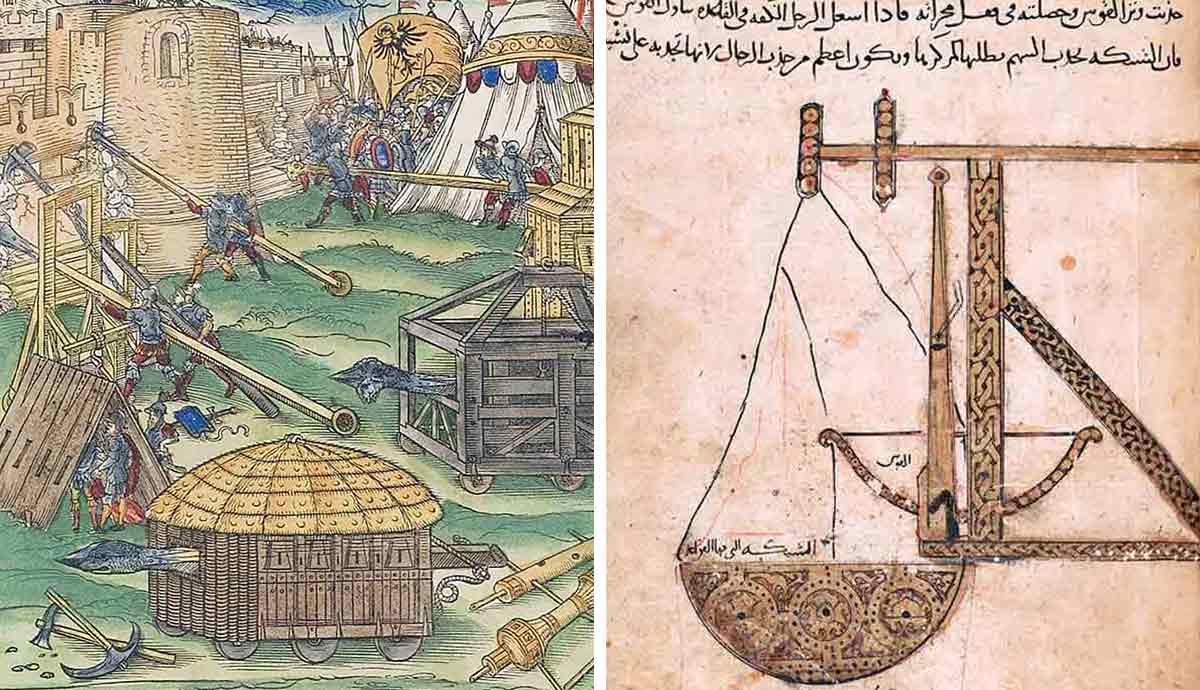
Depiction of various siege weapons, 16th century. Source: Wikimedia Commons
While many medieval siege weapons lasted for hundreds of years, the end of their use coincided with the movement towards gunpowder-based warfare, from the Early Modern Period onward.
Once cannons and guns were the norm in medieval warfare, sieges were few and far between, and especially sieges that lasted for months on end. A fraction of the number of men were required to operate a cannon compared to a trebuchet or a siege tower, for example, while from the defending side, guns were much easier to pick off besiegers than hand-to-hand combat or bows and arrows had been.
Siege weapons also saw a decline in use thanks to the move away from castle-based warfare, and as castles were no longer in use (many of them in ruins from medieval sieges).
However, their legacy as weapons of psychological warfare has captured the imaginations of filmmakers, writers, and other creatives over the years.
While they would seem clunky and redundant in today’s age of groundbreaking technology-focused warfare, few weapons were more formidable in the Middle Ages than siege weapons.










 New Posts (Home)
 ChatBox
 Popular Posts
  Game Zone
 Top PodCasts