www.theblaze.com
Did Jan. 6 threaten ‘our democracy’? Or prove the republic still works?
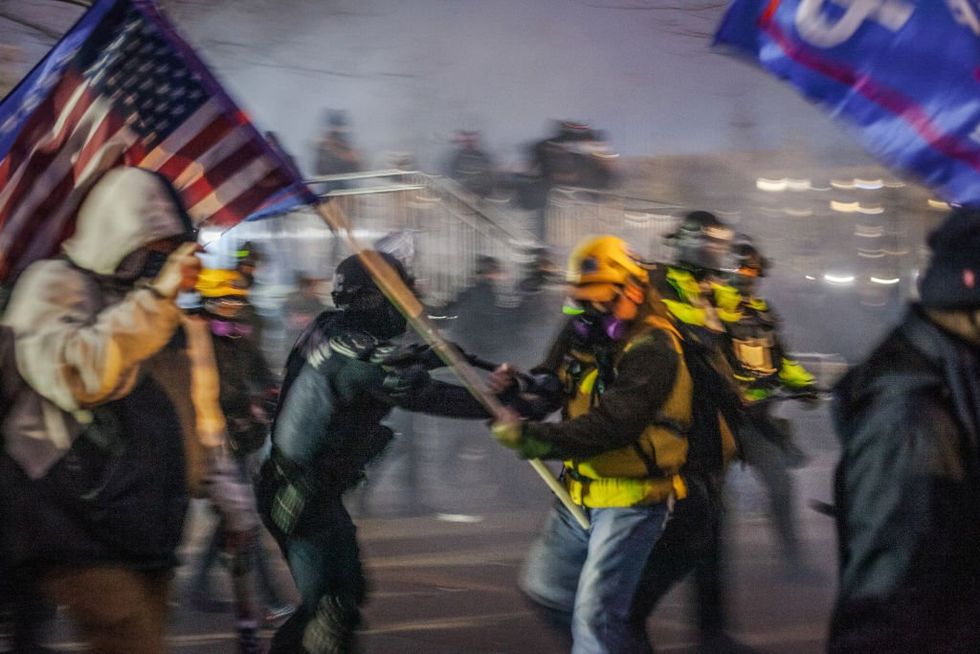
Like Dec. 7, 1941, Jan. 6, 2021, has taken on a mythic stature that surpasses the actual events of that day. Trump’s opponents view it as an “insurrection” — a deliberate attack on the Constitution, carried out by his supporters at his command to illegally overturn the 2020 election by threatening members of Congress. Many of his supporters, though, see it as a protest that spiraled into chaos, ensnaring citizens who never intended harm but wanted to express their belief that the election had been unfairly conducted.
I do not consider the events of that day an insurrection, nor do I believe that all those arrested received fair treatment. Still, Jan. 6 was a dark day for the republic — an act of lawlessness that stains Donald Trump’s legacy.
As Lincoln stated, no matter how desirable our goals may be, 'there is no grievance that is a fit object of redress by mob law …'
I do not believe he intended to overthrow the constitutional order. Instead, the events reflected the folly of taking politics to the streets, a tactic once favored by the left. More than anything, Jan. 6 exposed the dangers of unrestrained democracy — a threat America’s founders understood all too well.
The Great Seal of the United States proclaims that the American founding represents a novus ordo seclorum — a new order of the ages. The Constitution of 1787 was a remarkable achievement, establishing a commonwealth designed to protect the natural rights of all citizens. At the same time, understanding the founding requires looking to the past, particularly to the taxonomy of regime types identified by Greek philosophers such as Plato and Aristotle, the founders of political science.
What the Greeks knew
Greek political science differs from modern political science by focusing on fundamental questions. What is the best form of government? What system best ensures citizens’ excellence (areté) and happiness (eudaimonia)? What causes political communities to decline?
In contrast, today’s political science fixates on minutiae. Modern scholars, adopting a value-free perspective, struggle to explain why one form of government is superior to another beyond personal preference. As a result, they increasingly write more and more about less and less.
For the Greeks, political constitutions directly corresponded to the human soul (psyche). They divided the soul into three parts: nous, the intellective, reasoning part; thumos, the spirited part, concerned with honor and justice; and epithumeia, the appetitive part, which governs basic desires and is especially vulnerable to passions.
Each type of government, according to this framework, reflected a part of the soul. In this political taxonomy, the noetic part of the soul corresponded to rule by one; the thumetic part to rule by the few; and the appetitive part to rule by the many.
Each system had both good and bad versions. In a just system, rulers governed for the benefit of the entire polity. In a corrupt system, they ruled for their own benefit. The Greeks classified kingship as the good form of rule by one, while tyranny was its corrupted counterpart.
Aristocracy was the noble form of rule by the few, while oligarchy or plutocracy represented its decay. The good form of rule by the many was politeia, or a balanced constitution — a concept the Romans translated as res publica, best rendered in English as “commonwealth.” The corrupted version of rule by the many was democracy in its worst form: ochlocracy, or mob rule.
The founders feared unbridled passion and mob rule, which led them to reject democracy. They saw it as easily corrupted and unstable, prone to constant turmoil and disorder, and just as much a threat to citizens’ rights as tyranny or oligarchy. Democracies, they believed, were especially vulnerable to demagogues who could manipulate the masses.
To prevent this, the U.S. Constitution deliberately established a self-governing republic — the virtuous form of rule by the many.
Republic vs. democracy
No founder articulated the dangers of democracy — the perils of unchecked passions — better than Alexander Hamilton. Like most of his contemporaries, he viewed the American Revolution as an act of deliberate action, designed to secure the natural rights outlined in the Declaration of Independence: “life, liberty, and the pursuit of happiness.”
However, Hamilton also recognized that revolution is inherently lawless. Before establishing a government that safeguards rights and liberty, men must first “dissolve the [existing] political bands.” But revolutionary fervor, he warned, is ill suited for maintaining a stable political society — even one dedicated to protecting individual rights.
Hamilton understood that a passion for liberty was necessary if the cause of American independence was to succeed, but that ultimately it had to be tempered by the rule of law. As he said during the New York Ratifying Convention in 1788,
In the commencement of a revolution … nothing was more natural than that the public mind should be influenced by an extreme spirit of jealousy … and to nourish this spirit, was the great object of all our public and private institutions. Zeal for liberty became predominant and excessive. In forming our confederation, this passion alone seemed to actuate us, and we appear to have had no other view than to secure ourselves from despotism. The object certainly was a valuable one. But Sir, there is another object, equally important, and which our enthusiasm rendered us little capable of regarding. I mean the principle of strength and stability in the organizing of our government, and of vigor in its operation.
Passions unleashed in the fight for rights can ultimately destroy those very rights. Individual freedoms survive only when society maintains a strong sense of law and order.
Hamilton was alarmed by calls for “permanent revolution,” a theme that dominated Thomas Jefferson’s rhetoric. He saw Jefferson’s dismissive and intellectualized response to Shays’ Rebellion and the French Revolution — expressed in statements like “a little rebellion now and then is a good thing” and “the Tree of Liberty must be watered from time to time with the blood of tyrants” — as a dangerous philosophy. To Hamilton, this mindset invited chaos and guaranteed frequent upheaval rather than stable governance.
He believed that the solution was to instill respect for the Constitution, binding Americans to the rule of law. Though a creation of the people, the Constitution imposes necessary constraints that must be respected while it remains in force.
Hamilton argued that attaching people to the Constitution’s rule of law would preserve the new government as if it were an ancient institution. This stability would allow for the just administration of laws, without which the Revolution’s central aim — the protection of rights — could not be secured.
Through both words and actions, Hamilton worked to temper popular passions and connect citizens first to their state constitutions and then to the federal Constitution. He defended New York Loyalists after the Revolution, a position he reinforced through his "Phocion" letters. During the ratification debates in 1787 and 1788, he vigorously argued for the new Constitution, emphasizing its role in securing national stability.
As treasury secretary, he promoted fiscal responsibility, stressing the necessity of paying debts and honoring contracts. Within Washington’s administration, he sought to subordinate American gratitude to France and enthusiasm for the French Revolution to the dictates of international law.
Nothing better illustrates Hamilton’s commitment to moderating revolutionary fervor than a letter he wrote to John Jay around the same time he was crafting his own revolutionary pamphlets.
The same state of passions which fits the multitude … for opposition to tyranny and oppression, very naturally leads them to contempt and disregard of all authority. … When the minds of those are loosed from their attachments to ancient establishments and course, they seem to grow giddy and are apt more-or-less to turn into anarchy.
Lincoln: Passions vs. reason in politics
In his 1838 speech to the Young Men’s Lyceum of Springfield, “On the Perpetuation of Our Political Institutions,” Abraham Lincoln warned against the dangers of mob violence in pursuit of political goals. He saw it as a sign that unchecked passions were overtaking reason.
Lincoln identified the greatest threat to American freedom and prosperity not as a foreign enemy but as an internal danger. “If destruction be our lot, we must ourselves be its author and finisher,” he declared. “As a nation of freemen, we must live through all time, or die by suicide.”
I hope I am over wary; but if I am not, there is, even now, something of ill-omen, amongst us. I mean the increasing disregard for law which pervades the country; the growing disposition to substitute the wild and furious passions, in lieu of the sober judgment of Courts; and the worse than savage mobs, for the executive ministers of justice. This disposition is awfully fearful in any community; and that it now exists in ours, though grating to our feelings to admit, it would be a violation of truth, and an insult to our intelligence, to deny. Accounts of outrages committed by mobs, form the every-day news of the times. They have pervaded the country …
Thus, then, by the operation of this mobocratic spirit, which all must admit, is now abroad in the land, the strongest bulwark of any Government, and particularly of those constituted like ours, may effectually be broken down and destroyed — I mean the attachment of the People …
… Passion has helped us; but can do so no more. It will in future be our enemy. Reason, cold, calculating, unimpassioned reason, must furnish all the materials for our future support and defence. —Let those materials be moulded into general intelligence, sound morality, and in particular, a reverence for the constitution and laws …
Lincoln allowed that there were bad laws, among which he included the laws supporting slavery.
When I so pressingly urge a strict observance of all the laws, let me not be understood as saying there are no bad laws, nor that grievances may not arise, for the redress of which, no legal provisions have been made. —I mean to say no such thing. But I do mean to say, that, although bad laws, if they exist, should be repealed as soon as possible, still while they continue in force, for the sake of example, they should be religiously observed. So also in unprovided cases. If such arise, let proper legal provisions be made for them with the least possible delay; but, till then, let them, if not too intolerable, be borne with.
But he maintained that “there is no grievance that is a fit object of redress by mob law …”
The mobocratic spirit and Jan. 6
Political conservatives consistently denounced political violence, including the unrest that followed Trump’s 2016 election victory, the riots and destruction that erupted after George Floyd’s death in May 2020, and numerous other instances of domestic looting and property destruction carried out by left-wing groups in recent years.
Yet as former U.S. prosecutor Andrew McCarthy noted, the central charge against Trump regarding Jan. 6 — that he undermined the Constitution’s electoral process — is difficult to dispute. He gave the mob assembled that day the false impression that Vice President Mike Pence had the authority to overturn Joe Biden’s victory. More importantly, he failed to quickly and decisively use his influence to call off his supporters, denounce violence, and urge them to leave the Capitol grounds.
McCarthy contended that if Democrats had pursued an impartial investigation rather than overreacting for partisan purposes, they could have built a compelling case that Trump violated his constitutional duty to preserve, protect, and defend the Constitution while faithfully executing the laws. A thorough congressional inquiry would have produced stronger articles of impeachment. Instead, Democrats omitted key allegations, allowing them to frame the riot as an “insurrection” for political advantage.
As McCarthy argued, the congressional January 6 panel “was a blatantly partisan, monochromatically anti-Trump political exhibition that presented the country with a skewed picture, eschewing cross-examination and perspectives that deviated from its relentless theme: Trump’s incitement to insurrection had our democracy hanging by a thread.”
In the end, the riot of January 6 did not “prevent the peaceful transition of power.” Was the peace disturbed? Yes ...
... that’s why so many people have been prosecuted, some for serious offenses, and many others for trivial crimes that the Justice Department would normally decline to charge. But there was so little damage done to the Capitol that Congress was able to reconvene a few hours after order was restored. It promptly affirmed Biden’s victory, as it was always certain to do. No one tried to blow up the Capitol. No one tried to mass-kill the security forces. Our Constitution held firm, and there was never any reason to suspect it wouldn’t. Our democracy was not realistically imperiled, much less at the precipice of annihilation.
Ultimately, January 6 did not represent a threat to “our democracy” but instead illustrated why the Founders prudently established a republic rather than a democracy. They understood that democracies justify behavior such as occurred that day. Deliberation and the passage of laws by representative bodies are designed to permit prudence to curb the passions. As Lincoln stated, no matter how desirable our goals may be, “there is no grievance that is a fit object of redress by mob law …”









 New Posts (Home)
 ChatBox
 Popular Posts
  Game Zone
 Top PodCasts