YubNub Social YubNub Social
    #racism #elections #conservatives #gerrymandering
    Advanced Search
  • Login
  • Register

  • Day mode
  • © 2026 YubNub Social
    About • Directory • Contact Us • Developers • Privacy Policy • Terms of Use • shareasale • FB Webview Detected • Android • Apple iOS • Get Our App

    Select Language

  • English
Night mode toggle
Featured Content
Community
New Posts (Home) ChatBox Popular Posts Reels Game Zone Top PodCasts
Explore
Explore
© 2026 YubNub Social
  • English
About • Directory • Contact Us • Developers • Privacy Policy • Terms of Use • shareasale • FB Webview Detected • Android • Apple iOS • Get Our App
Advertisement
Stop Seeing These Ads

Discover posts

Posts

Users

Pages

Blog

Market

Events

Games

Forum

Survival Prepper
Survival Prepper  
1 y

How to Gather Local Intelligence
Favicon 
www.theorganicprepper.com

How to Gather Local Intelligence

This article is an edited excerpt from my upcoming book Household Preparedness Training: Domestic Protocols For Crises And Emergencies, exclusively for The Organic Prepper readers.  Due January 17, 2025, the book is a compilation of protocols, procedures, and ideas, complemented by a series of grid-down exercises to prepare individuals and families for safer and more comfortable homestays during emergencies and long-lasting crises.  The concept and method are based on the lifestyle of middle and low-class families from developing countries during the tough 1970s and 80s, a period of profound social and cultural changes, economic and geopolitical volatility, social unrest, and shocks in the market, energy, and other sectors.  Those growing at that time may recall the constant shortages and rationings, the instability and disruptions in utilities and services, the strikes, protests, widespread unrest, and insecurity. Depending on where you lived, things could be bad, worse, or horrible; but it was precarious everywhere because the crisis was global.  I’m not saying life wasn’t hell – far from it. It was more austere and volatile, but there was a unique energy, a cultural and social effervescence, lots of good things. Every epoch has good and bad things happening. It’s always like that. Anyway, that was the last time the world had so much turmoil for so long on so many fronts. Civilization has come a long way since. I believe we’re now headed again to a context of significant structural changes. That’s not a prediction, just a prognostic based on signs, trends, and parallels I see between then and now. History shows these things are cyclical: humans don’t change in essence and nature. So even though we’re living at the pinnacle of civilization (materially speaking), the world, and especially the West, is already in a crisis.  However, I’m talking about something more serious, impacting more significant parts of the system and, thus, the population. Whatever happens, it’s clear volatility and instability will increase in the years or even decades ahead. The wisdom of past generations must not be forgotten. It’s critical in moments like this. I’m not saying we should go back to the past or live like the old-timers. That’s nonsense. We take what has worked for centuries and adapt to our times and lifestyle, to our conditions. When you know how to thrive without material abundance and the comforts and conveniences modern society takes for granted, you adapt and develop resilience. You’re never scared or in a panic. Few understand what an advantage those who have experienced prolonged periods of extreme hardship and austerity have. When you know how to thrive without abundance, without the comforts and conveniences modern society takes for granted, you develop a certain kind of resilience. You’re never scared or in a panic. That’s why training for these situations is so necessary in today’s world.  The first exercise I propose in the book is building practical intel on the systems that keep everything running in your city and locality. How can intel gathering help?  For 99% of us, prepping is a short blanket. It’s impractical or downright impossible to cover everything that can go wrong, and modern lifestyles make this even more problematic.  Thankfully, not everything that can go wrong does, so keeping track of trends and developments allows us to focus on more probable events and developments.  Being minimally knowledgeable about the workings, status, and interconnectedness of the local networks and systems that keep things running in our city, district, and neighborhood can help us stay ahead and in better condition when something happens. First, we can detect the signs of an impending crisis sooner and make a more educated guess of its developments and duration. With that, we can prepare better by directing efforts and resources accordingly. Finally, with information, we increase our chances of escaping a predicament sooner.  EXERCISE 1 – BUILDING LOCAL KNOWLEDGE BASE Begin by surveying and collecting data about your area and its supporting systems: power, water, communications, and sanitation. Do it slowly but consistently, and you’ll quickly build a decent knowledge base.  Research can be done from home, over the internet, and mostly for free. However, that will depend on the existing (or available) database. I like to complement and check the collected information with field research as much as possible. Some stuff can only be verified in loco. I propose that in my Street Survivalism Training Book, though with a different goal, so if you or anyone in your house or community have the means, make your list and go out there to explore.  It’s up to you how comprehensive and detailed this database should be and how deep the level and extension of the information necessary. Just keep collecting until you’re satisfied. That may depend on your context and personal requirements.  Also, each place is different in terms of infrastructure, regulations, operating companies, and so on. Infrastructure changes slowly in most areas and significant changes are rare. So, once a base gets built, you’ll have a broader perspective of things; from there, it’s just a matter of keeping up with changes over time.  Here are a few points worth considering:  What’s the energy matrix of your state, city, and area/district? Is it nuclear, hydro, coal, or diesel? How’s the mix (proportion of each)? Is there any detectable vulnerability in the sub-stations and distribution lines? Where is the electricity generated? How many power sources and types supply the power to your city? How’s the grid interconnected? Where are the transformation station and distribution network providing energy to your district? If you live in a building or condo, get informed about backup systems and their condition. Are there any power generators? What are their capacities, and what systems do they supply if power goes out? Does something go to the units, or there’s just enough for collective stuff (elevators, water pumps, emergency lights, etc.)?  Get to know the water deposit capacity as well; with that information, it’s possible to calculate roughly how long the water will last in case of interruptions in supply. Stay on top of maintenance schedules. Generally, utilities and service systems (power, water, communications) comprise large-to-small, distant-to-local, generation-to-transformation-to-distribution network systems. The closer to generation and transformation, the more resilient (or less susceptible) it will be, and vice-versa. That’s why some areas will stay in the dark or without water and cell phones, and others won’t. So try to develop a general scheme for your supply system, but focus on the ‘local’ aspects because that will tell in which ways or how much your household can get impacted. Cabling network: Are cables and transformers buried or aerial? The wind, falling trees, and other wind-trashed debris can easily knock off the poles and aerial cables. Live wires can cause shocks and fires, too. Underground systems tend to be more resilient and less hazardous, though they may still be affected by floods and susceptible to lightning strikes, vandalism, EMPs, or cyberattacks. The same goes for communication cables (phone and internet).  Get to know the location of cell repeaters and other installations in your area. Find the system mainframe’s building; these tend to be located at elevated grounds for a reason, but it’s good to know how protected and prepared these facilities are to withstand weather and other attacks. Antennas follow different criteria and are more complex (numerous) to map out. They’re usually installed on top of buildings. Some have backup generators, others don’t. During or right after an emergency, the ones working will get overwhelmed. That’s why it’s good to know the providers’ shops and stations; you may be able to drive or walk there and try to get support in person.  When you see a maintenance team performing in your area, casually inquire about the system. They may be busy, but there’s always a supervisor just overlooking the work, and they may be more receptive. Every time I move into a different area, I ask them about the transformers because these are very specific, so one side of the street may have power, and the other end up in the dark after a storm. You may not be able to do much about that directly, but I’ve had “our” side of the street fixed days earlier just by being able to identify and pinpoint the damaged transformer when filing the complaint.  Do the same with water and sewage systems. Where are the reservoirs responsible for the water supply in your city? Do they supply just one or more towns? How far are the treatment stations? What is the age and condition of the piping? And so on.  Get a flood map from the weather authority or city database (or make your own). Weather patterns are constantly changing, but geography is not. If you live in an area susceptible to floods, be prepared for everything. You may be able to counter it somehow, but consider the possibility of relocating (if forewarned) or bugging out if necessary.  Locate the nearest police station and fire brigades, civil defense, hospitals, banks, and other important places, such as mechanics, specialty shops, churches and missions, diplomatic buildings, etc. Pay special attention to prisons, chemical facilities, and other critical structures. Expand the radius as necessary. Those things are good to know about your workplace, too.  Make a list of the authorities and providers in charge/tending for your district or neighborhood, writing down the addresses and contacts (phone, email, website, etc.). If possible, visit them and see how things are run, such as the staff, installations, etc. It doesn’t have to be too complicated or time-consuming, but enough to build a directory. You can learn much more just by chatting with people and making acquaintances.  Also, on safety, check for existing initiatives by civil societies, such as neighborhood watches and other community support groups. If you don’t want or cannot participate, maybe someone from your household can. Or, at the very least, try to attend the most significant events and meetings. These are great for staying updated, gathering critical information, and getting real-time warnings. Do a quick research on the history of significant events with associated natural and human causes in your area, ranging from past decades to more recent times. For instance, I know the history of the energy distributor in my city, keeping track of investments and upgrades (or lack thereof) since it was privatized decades ago. I’m aware the power grid has deteriorated since distribution changed concessionaires in 1998, so much so that issues have popped up recently. The same operator has been building a terrible record in other countries for years, too. It will probably start giving trouble here as storms and heat waves come or if the grid gets pushed to its limit for some reason.  Research the history of natural events, tornadoes, and other occurrences in your street and neighborhood. Check what’s been done by the public power or providers through that period, if any.  Final words A solid, slow-burning crisis preparation plan demands comprehensive information on the systems that keep everything going and supply our day-to-day needs, the plethora of services and utilities city residents take for granted.  Cities are complex infrastructures, and almost everything comes from distant places. Most don’t give any of that a second thought, nor care about it. Until something fails, everyone notices, and panic ensues. Those who have some knowledge of this critical chain can, at the very least, assess the extent of the impact on their routines when there’s a disruption, maybe even come up with an educated guess on the time it will take for things to return to normal, or perhaps get support to come their way faster. If you’re even reasonably informed about these things, congratulations: you’re in the minority of city residents. If you have never thought about that,  this is the perfect time to start working and gathering that kind of intel. What about you? How do you gather local intelligence? Do you have any good sources? Are there any important pieces of information you have acquired that could make things easier in an emergency? Let’s discuss it in the comments section. About Fabian Fabian Ommar is a 50-year-old middle-class worker living in São Paulo, Brazil. Far from being the super-tactical or highly trained military survivor type, he is the average joe who since his youth has been involved with self-reliance and outdoor activities and the practical side of balancing life between a big city and rural/wilderness settings. Since the 2008 world economic crisis, he has been training and helping others in his area to become better prepared for the “constant, slow-burning SHTF” of living in a 3rd world country. Fabian’s ebook, Street Survivalism: A Practical Training Guide To Life In The City , is a practical training method for common city dwellers based on the lifestyle of the homeless (real-life survivors) to be more psychologically, mentally, and physically prepared to deal with the harsh reality of the streets during normal or difficult times. He’s also the author of The Ultimate Survival Gear Handbook. You can follow Fabian on Instagram @stoicsurvivor The post How to Gather Local Intelligence appeared first on The Organic Prepper.

Like
Comment
Share
Daily Signal Feed
Daily Signal Feed
1 y

Time for Justice for Pro-Life Prisoners and the DC 5
Favicon 
www.dailysignal.com

Time for Justice for Pro-Life Prisoners and the DC 5

Can you imagine being thrown in jail for peacefully protesting the deaths of babies in the womb? Well, you don’t have to, because it has happened. Today, the Left’s weaponization of a federal law called the FACE Act has led to exactly that, unjustly persecuting pro-life advocates who are its ideological opponents. But finally, after years of this form of persecution from the Biden-Harris administration, a much-needed airing will occur this week. A House subcommittee’s hearing Wednesday on the FACE Act will seek to get to the bottom of President Joe Biden’s weaponizing of the government against pro-life advocates and expose how they were harmed. One of the most egregious examples of the Justice Department’s unjust application of the FACE Act happened right in our nation’s capital just a few years ago. In March 2022, members of the group Progressive Anti-Abortion Uprising, or PAAU, discovered the tortured remains of five fully formed babies now known as “the D.C. Five.” Their bodies and wounds indicated they likely were victims of illegal partial-birth or born-alive abortions. Lauren Handy and other PAAU activists notified the authorities of the bodies found at the Washington Surgi-Clinic in Northwest D.C. and called for an investigation into the likely federal crimes that led to their deaths. Instead, the FBI arrested Handy for a protest she had engaged in a year before. Handy ultimately was sentenced to 57 months in federal prison and three years of probation for her nonviolent violation of the FACE Act. In a recent op-ed in the Washington Examiner, fellow PAAU activist Terrisa Bukovinac highlighted an appalling injustice: While Handy sits behind bars, Washington Surgi-Clinic abortionist Cesare Santangelo and other pro-abortion radicals remain untouched. Bukovinac wrote: Lauren is now in a Tallahassee prison. She’s serving a nearly five-year sentence not for recovering these babies’ remains but for violating FACE at the clinic that produced those remains. Meanwhile, the bodies of the victims languish years later at the Washington medical examiner’s office, still awaiting an autopsy, an investigation, and justice.    Pro-life advocates named the five aborted babies to give them dignity: Ángel, Christopher X, Harriet, Holly, and Phoenix. These five children would be toddlers right now, playing and exploring the world around them. Instead, their bodies remain in a morgue awaiting justice that the Biden-Harris administration denied. Despite repeated requests from members of Congress and the public, no autopsies or investigations have occurred. Handy is still behind prison bars along with many other pro-life advocates sentenced under the FACE Act. I am thankful that members of Congress are calling out the Biden-Harris administration for targeting pro-life Americans and reviewing the unjust application of the FACE Act. President Bill Clinton signed the FACE Act into law over 30 years ago. Supposedly, it was enacted to protect abortion facilities, places of worship, and pregnancy centers from threats, violence, and vandalism. Thirty years later, however, the FACE Act has become little more than a tool for the Biden-Harris administration’s FBI and Justice Department to employ against political enemies—specifically pro-life advocates. Since May 2022, the FBI and DOJ have ignored over 500 violent attacks involving firebombings, vandalism, and explicit threats against Catholic churches and pro-life organizations across America. Each of these violent attacks clearly and horrifically violated the FACE Act. FBI Director Chris Wray admitted that the overwhelming majority of violent, abortion-related threats since the Supreme Court’s Dobbs ruling target pro-life entities. Yet instead of prosecuting those responsible, including the infamous group Jane’s Revenge, the FBI ruthlessly targeted pro-life activists for peacefully protesting at abortion facilities. For example, Wray’s FBI arrested innocent pro-life advocate and Catholic father Mark Houck at his home at gunpoint, traumatizing his family, for allegedly violating the FACE Act. The bureau then subjected Houck to a lengthy and costly trial it hoped would lead to his imprisonment before he ultimately was acquitted on all charges. Houck isn’t an anomaly. The Justice Department and FBI have wielded the FACE Act a total of 130 times against nonviolent pro-life advocates, often pushing for unreasonably heavy sentences—even for elderly individuals such as Russian death camp survivor Eva Edl. Comparatively, the FACE Act has been used to defend Catholic churches and pregnancy centers only five times, even though these places are 22 times more likely to be attacked than abortion facilities. Thankfully, with Donald Trump’s upcoming second inauguration, hope remains that justice isn’t far off for the D.C. Five and pro-life advocates who fight to protect unborn children from barbaric, late-term abortions. Americans must not forget that the U.S. government weaponized the law against nonviolent political enemies. They must not forget that the government targeted and imprisoned peaceful pro-life advocates while violent domestic extremists walk free to this day. Most importantly, Americans should know that we expect action over outrage. It’s long past time to address the injustice of the FACE Act and seek justice for the five babies who were likely victims of federal crimes. The House Judiciary subcommittee’s hearing Wednesday is a great place to start. Americans can look forward to the incoming Trump administration and a Justice Department that will prioritize justice over politics. We publish a variety of perspectives. Nothing written here is to be construed as representing the views of The Daily Signal. The post Time for Justice for Pro-Life Prisoners and the DC 5 appeared first on The Daily Signal.
Like
Comment
Share
Hot Air Feed
Hot Air Feed
1 y

Canadian Government Collapsing Before Our Eyes
Favicon 
hotair.com

Canadian Government Collapsing Before Our Eyes

Canadian Government Collapsing Before Our Eyes
Like
Comment
Share
Science Explorer
Science Explorer
1 y

Flat-Earthers Travel To Antarctica To Test Theories, But Are Quickly Humbled
Favicon 
www.iflscience.com

Flat-Earthers Travel To Antarctica To Test Theories, But Are Quickly Humbled

Lo and behold, they didn't discover a giant ice wall guarded by NASA.
Like
Comment
Share
Science Explorer
Science Explorer
1 y

Should You Avoid Alcohol If You’re Taking Antibiotics?
Favicon 
www.iflscience.com

Should You Avoid Alcohol If You’re Taking Antibiotics?

If you’re unwell enough to need antibiotics, alcohol is not going to help. But there’s more to this question than you might think.
Like
Comment
Share
NewsBusters Feed
NewsBusters Feed
1 y

CNN Spent 56 Minutes Touting ‘Exclusive’ Report of Debunked Syrian Prisoner Release
Favicon 
www.newsbusters.org

CNN Spent 56 Minutes Touting ‘Exclusive’ Report of Debunked Syrian Prisoner Release

Starting with Wednesday’s The Lead and continuing through Saturday night, CNN gave a massive 56 minutes (56:29) to repeated airings and subsequent fawnings over a supposed exclusive trip inside a Damascus, Syria prison by chief international correspondent Clarissa Ward that resulted in what they billed as the discovery and release of someone who insisted he had been stuck inside a notorious Assad regime prison for three months. Some basic skepticism about its implausibility and public pressure later, CNN conceded they would investigate the circumstances of Ward’s report and a CNN.com article early Monday night confirmed a finding by a Syrian watchdog group that the man’s name was Salama Mohammad Salama (when he had claimed it was Adel Khurbar) and he was a lieutenant in Assad’s air force. The whole thing seemed fishy, starting with the bizarre circumstances that Ward insisted in an X post was “one of the most extraordinary moments I have witnessed” in her “nearly twenty years as a journalist.” She said in the TV report that she and her team were “hoping to find traces of Austin Tice, an American journalist held captive in Syria since 2012” by venturing inside one of the Assad regime’s secret prisons and while they didn’t find Tice, they came “across something extraordinary” with fighters exclaiming they might have found someone in a cell. Along with the fact that the regime had fallen on Sunday and this happened on Wednesday, it seemed dubious. It was made even more implausible when Ward revealed a rebel fighter made CNN “turn [their] camera off while he shoots the lock off the cell door” and found “something under the blanket.” Allegedly confused and frightened, the man said he was a “civilian” and clung to Ward as she assured him she was a “journalist” and fetched him water. The man’s fable continued to spin as he gingerly was led out of the prison and claimed to have no knowledge in his three months of captivity that the Syrian government had collapsed. In the CNN.com article, producers Tim Lister and Eyad Kourdi were forced to relay more of Salama’s tall tales as they published the embarrassing news:     A man who was filmed by CNN being released by rebels from a Damascus jail was a former intelligence officer with the deposed Syrian regime, according to local residents, and not an ordinary citizen who had been imprisoned, as he had claimed.     CNN initially found the man while pursuing leads on the missing US journalist Austin Tice. In a video report, chief international correspondent Clarissa Ward and her team, accompanied by a rebel guard, came across a cell in a Damascus jail that was padlocked from the outside. The guard blew off the lock with a gun, and the man was found alone inside the cell, under a blanket.     When he emerged into the open air, the man appeared bewildered. Questioned by the rebel fighter who freed him, the man identified himself as Adel Ghurbal from the central Syrian City of Homs.     He claimed that he had been kept in a cell for three months, adding that it was the third prison where he had been confined. The man also said he was not aware that the Assad regime had fallen. He was being held in a jail that had been run by the Syrian air force’s intelligence services until the Assad regime collapsed. After airing the footage for the first time, The Lead host Jake Tapper gushed Ward’s report was “just absolutely remarkable” and “another” case of “vital, vital journalism” while Ward herself took these claims as gospel (click “expand”):     Jake, I have to say, I have been doing this job for nearly 20 years now, and that really was one of the most extraordinary moments that I have ever witnessed. We don't know why the regime of Bashar al-Assad took Adel Khubar (ph). He doesn't know why they took him. He was basically living a very simple life in the city of Homs, in an area called Khalidiya. He said the Mukhabarat basically came to his house and said that there was some issue with people he had been making phone calls with. But we have to be very clear here. This is the type of thing where the Mukhabarat would take anyone with impunity. They would detain them. They would interrogate them. They would beat them. They would keep them for months, years on end. They didn't have to give a reason. You didn't even have to be an activist. You didn't even have to be part of the opposition against Bashar al-Assad.     So many of the people, Jake, who disappeared inside these dungeons were ordinary Syrians struggling to understand what on earth they had done to get there in the first place. We don't know where Adel Khubar (ph) is now. He got into that ambulance. We offered to give him our phones to call his family. But as you can see, in that moment, he was in a state of profound shock. He wasn't able to collect himself to the point where he was able to get in touch with his family. But all of us, of course, are wishing that he is safely reunited with them and that all of the prisoners who have been held for so long without any legal recourse, those who are alive, will be returned to their loved ones soon, Jake. The Lead segment totaled 12 minutes exactly and was followed Wednesday with seven minutes and 37 seconds on AC360. On Thursday, Ward’s fake story ran five times on CNN’s flagship U.S. station (CNN Newsroom with Max Foster, CNN This Morning, the AM and PM editions of CNN News Central, and CNN Newsroom with Pamela Brown). Foster called it “what a story” while CNN This Morning host Kasie Hunt hailed Ward’s “remarkable reporting.” A few hours later, morning CNN News Central co-host Sara Sidner praised Ward’s “incredible story” and “incredible reporting” illustrating “such a moment of humanity in a place where we have seen so much death and so much carnage.” However, Sidner’s co-host John Berman was first to open the cracks on the story’s credibility, making clearly “CNN cannot verify why that man was questioned by Syrian intelligence” and referenced questions in Ward’s reporting being asked of him why he had a cell phone if he was a prisoner. With X posts and common sense starting to set in, the story vanished from CNN’s airwaves after a run in the 2:00 p.m. Eastern hour until early Saturday night when CNN Newsroom with Jessica Dean gave it one last run and made no comments prior or after about concerns surrounding its accuracy.
Like
Comment
Share
The Blaze Media Feed
1 y

'Go ask the Democrats': NBA warned league's ratings will continue to plummet 'once you detach' from Americans
Favicon 
www.theblaze.com

'Go ask the Democrats': NBA warned league's ratings will continue to plummet 'once you detach' from Americans

NBA ratings have declined and will continue to do so if the league doesn't connect with the common American, legendary radio host Colin Cowherd warned.Ratings for the league were poor during the first month of 2024-2025 season, down 28% year over year for games that aired on ESPN, the lead broadcasting partner for the NBA. This came after a 12% decline in the playoffs last season, leading to an overall drop of 45% since 2012, OutKick reported.Fox Sports' Cowherd pummeled the NBA over the ratings, saying the league has failed to win back fans the way other leagues like the NFL and MLB have."Ratings are down 48% in the last 12 years, and they have fallen off a cliff this year. And [Commissioner] Adam Silver's solution is 'let's make the courts brighter.'"Cowherd continued, pointing out that it's a "really bad look" for the NBA when a family of four goes to a game and the biggest stars are sitting on the bench to conserve energy."I like the NBA, but the All-Star Game is now embarrassing, and I think load management is a shame on the league," he added in a viral clip from his show, "The Herd."Cowherd then gave the league a stern warning, drawing comparisons to the failed 2024 election bid of the Democratic Party."Go ask the Democrats. Be warned. Once you detach from regular people in America, you will pay a price." The new court for the Dallas Mavericks at the American Airlines Center on November 19, 2024, in Dallas, Texas.Photo by Sam Hodde/Getty ImagesIn late November, Awful Announcing pointed out an average of 1.22 million viewers during the first half of an ESPN doubleheader; a 40% decline compared to the same time in 2023.The second game that night pulled just 1.06 million viewers, a 47% drop from the year before.'Everybody's running the same plays.'Cowherd praised MLB Commissioner Rob Manfred for how he adjusted the league to quell fan disdain over the length of games, for example."He gets nothing but criticism because he's like, 'Hey, we gotta make our games faster. We gotta get stars at the plate, so I'm gonna change a pitch clock.'"Regarding the NFL, Cowherd called it a "hard league" but one that has "connectability" to the American Midwest and "regular people," which the NBA needs to seek out for itself.The broadcaster then pointed to some of the smaller markets that have been successful in the NFL, such as "tiny Baltimore," Buffalo, Green Bay, and Kansas City."Connectibility," Cowherd reiterated. At the same time, NBA legend Shaquille O'Neal recently said he believed much of the league's ratings drop-off has been because of a vast increase in three-point shots."Everybody's running the same plays. … I think viewership will continue to go down unless we switch things back," O'Neal said, per TalkSport.According to Front Office Sports, O'Neal is correct about the prevalence of three-point shooting. The average number of three-point attempts per team has nearly tripled since 2000, from 13.7 per team back then to 37 per team in 2024-2025.Like Blaze News? Bypass the censors, sign up for our newsletters, and get stories like this direct to your inbox. Sign up here!
Like
Comment
Share
The Blaze Media Feed
1 y

Trump cracks jokes as Trudeau's leftist government apparently begins to disintegrate
Favicon 
www.theblaze.com

Trump cracks jokes as Trudeau's leftist government apparently begins to disintegrate

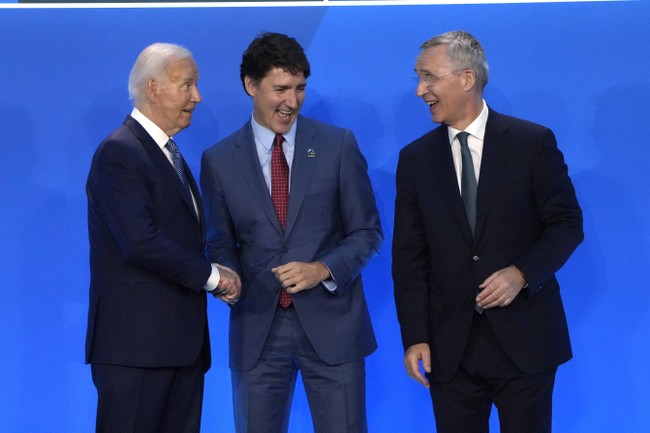
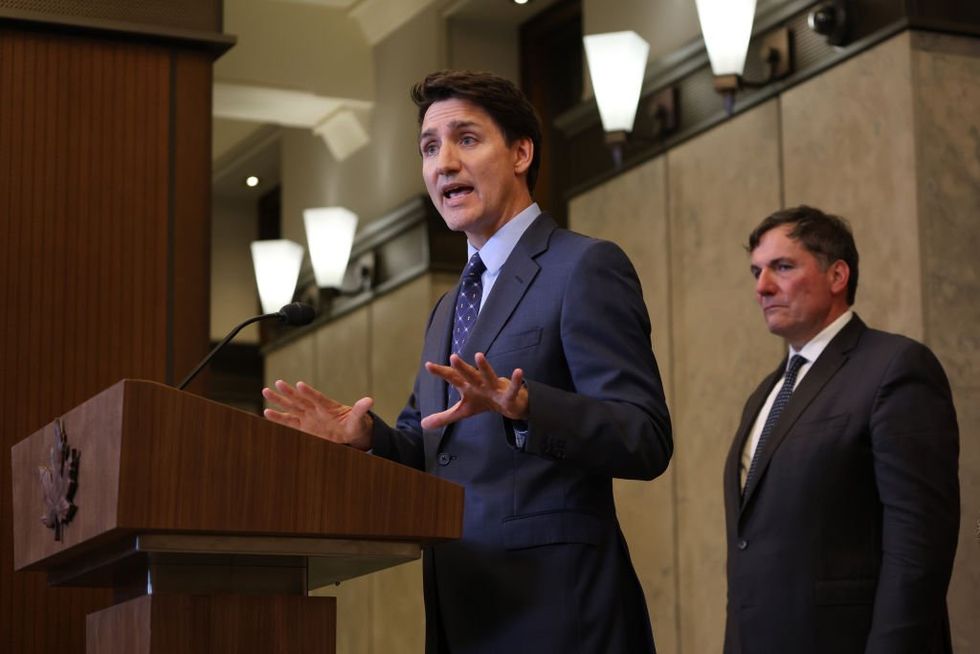
"Sunny ways, my friends. Sunny ways," Justin Trudeau told his countrymen when elected Canada's prime minister in 2015. "This is what positive politics can do." It appears that dark days are ahead for the leftist prime minister. After nine years marked by personal scandals, tax hikes, an unprecedented influx of immigrants, a spike in illegal immigration, rising crime, unanswered church burnings, a housing crisis, coercive medicine, and the rise of state-facilitated suicide as a leading cause of death nationally, Trudeau now faces a disapproval rating of 68% and a Canadian dollar trading at a five-year low. Although Trudeau has survived multiple no-confidence votes in recent months with the help of socialist New Democrat Party and Bloc Québécois lawmakers, his Cabinet has begun to disintegrate before his eyes. Just weeks after Trudeau's foreign affairs minister Mélanie Joly effectively auditioned for his job in the pages of the New York Times, Trudeau's deputy and finance minister Chrystia Freeland called it quits. Freeland, a former journalist who did her best to alienate President-elect Donald Trump during his first term with passive-aggressive commentary, noted in a public letter to Trudeau that his alleged desire for her to migrate to a different role in his Cabinet was the last straw. 'The government of Canada itself is spiraling out of control.' "To be effective, a Minister must speak on behalf of the Prime Minister and with his full confidence," wrote Freeland. "In making your decision, you made clear that I no longer credibly enjoy that confidence and possess the authority that comes with it." Although Freeland was on board with Trudeau's unlawful decision to use martial law in 2022 to crush the peaceful trucker protests and cosigned his various other controversial decisions, she suggested that in recent weeks they have been "at odds about the best path forward for Canada" and condemned his "costly political gimmicks." Built into Freeland's letter was an apparent pitch for a new national direction, signaling the outgoing Cabinet minister's possible interest in competing against Joly, former Bank of Canada governor Mark Carney, and other ambitious liberals for Trudeau's position. Freeland noted further that while she was resigning her Cabinet position, she would keep her seat in Parliament and run again in the next federal election. Conservative Party leader Pierre Poilievre stated at a press conference Monday, "The government of Canada itself is spiraling out of control right before our eyes and at the very worst time." 'I can say we're not united.' "Justin Trudeau has lost control and yet he clings to power. We cannot accept this kind of chaos, division, weakness, while we are staring down the barrel of a 25% tariff from our biggest trading partner and closest ally, which, by the way, is headed by a newly elected president with a strong and fresh mandate — a man who can spot weakness from a mile away," added Poilievre. "Ms. Freeland has been Mr. Trudeau's most trusted minister now for a decade — for nine years. She knows him better than anyone, and she knows that he's out of control." Trump, who has done little to conceal his dislike for Freeland over the years, noted on Truth Social, "The Great State of Canada is stunned as the Finance Minister resigns, or was fired, from her position by Governor Justin Trudeau. Her behavior was totally toxic, and not at all conducive to making deals which are good for the very unhappy citizens of Canada. She will not be missed!" Shortly after Freeland threw in the towel, Trudeau appointed his safety minister, Dominic LeBlanc, to the role of finance minister. Hours after Freeland's resignation Monday, the Trudeau Liberal government released its fall economic statement, which proved to be more bad news. Despite Freeland's promise of fiscal responsibility and "guardrails" earlier this year, the Liberal government overshot its deficit target by over $20 billion, ending up with a federal deficit of $61.9 billion for 2023-24. Following Freeland's shock resignation and the deficit announcement, members of Trudeau's Liberal Party of Canada held a mutinous caucus meeting, with numerous parliamentarians urging the prime minister to step down, reported Canadian state media. "I can say we're not united," Liberal parliamentarian Chad Collins told reporters after the caucus meeting. "There's still a number of our members who think we need a change in leadership and I'm one of them." "I think the only path forward for us is to choose a new leader and present a new plan to Canadians with a different vision," added Collins. Wayne Long, another Liberal parliamentarian, suggested that one-third of the sitting members of Trudeau's party want him to resign, one-third are fence-sitters, and the remainder are loyalists. Trudeau reportedly noted at a Christmas party Monday for Liberal donors that it had "not been an easy day" but otherwise remained mum on the topic of his abandonment. Trudeau's day was likely made worse by his party's third federal by-election loss in recent months after Conservative Tamara Janset beat out a Liberal for a federal swing seat in British Columbia by a landslide. Polls indicate that in the event of a snap election, the Liberal Party will similarly be demolished at the ballot box nationwide. A December 8 Ipsos poll indicated the Conservative Party of Canada would easily defeat Trudeau's Liberal Party. The CPC was leading in the polls with 44%. The NDP and the Liberal Party are both tied for second place with 21% each. Like Blaze News? Bypass the censors, sign up for our newsletters, and get stories like this direct to your inbox. Sign up here!
Like
Comment
Share
The Blaze Media Feed
1 y

15-year-old girl named as shooter who killed at least 2 at Christian school, police say
Favicon 
www.theblaze.com

15-year-old girl named as shooter who killed at least 2 at Christian school, police say

Police said Natalie Rupnow, a 15-year-old girl, was the shooter who killed at least two people Monday at Abundant Life Christian School in Madison, Wisconsin, the New York Times reported. Police added that Rupnow died from what appeared to be a self-inflicted gunshot wound, the Times said. Police said the suspect — who was a student at the school — used a 9mm gun, and police were working to trace the gun, WBBM-TV reported.'But the trauma — it's a lot, because I'm sure they lost friends and a teacher, which is not OK. And I don't think they will be OK for a long time ...'Madison Police Chief Shon Barnes said the the shooter, who went by “Samantha,” opened fire in a study hall that included students from several grades, the paper said. The school serves students from grades K through 12. A teacher and a teenage student were killed, and five students and another teacher were injured, authorities told the paper. Two of the students with life-threatening injuries were in critical condition at a hospital, Barnes told the Times. Three students and a teacher were hospitalized with less serious injuries, and two of them have been discharged, he added to the paper.Barnes said a second-grade student called 911 just before 11 a.m. to report the shooting, WBBM reported.Barnes told the Times it appears there was only one shooter and that investigators searched the suspect’s home in Madison and spoke to her family members, who were cooperating. The chief didn't describe a motive, the paper said, adding that he noted that investigators were still trying to find out more information.More from the Times:Young women are much less likely to be suspects in school shootings. This year, according to the K-12 School Shooting Database, nine shooting suspects were female compared to 249 who were male when gender was identified. Abundant Life often served as a kind of refuge for children who had been bullied or struggled at other schools, because the staff were quick to put a stop to cruelty, said Rebekah Smith, 50, whose teenage daughter was in a physics class down the hall from where the shooting occurred. Ms. Smith said that members of the school community believed that the shooter was new to the private school this year and was among those who came in need of a life change. The school’s student population has grown dramatically since the pandemic, she said.All surviving students were reunited with their loved ones in the hours after the shooting, officials told WBBM. Students are escorted from a church next to the Abundant Life Christian School, Dec. 16, 2024, in Madison, Wisconsin.Photo by Scott Olson/Getty ImagesThe station said Mireille Jean-Charles — a mother of three boys who attend Abundant Life Christian School — spoke to WISC-TV in Madison: "It's sad, you know, to be home and then somebody calls you and says your kids' school [is] in lockdown — and you don't know where they are. And I was there since 11. I finally got them, and thank God they were safe. But the trauma — it's a lot, because I'm sure they lost friends and a teacher, which is not OK. And I don't think they will be OK for a long time, and I'm not."You can view a video report here about the shooting. Like Blaze News? Bypass the censors, sign up for our newsletters, and get stories like this direct to your inbox. Sign up here!
Like
Comment
Share
Twitchy Feed
Twitchy Feed
1 y

And Suddenly It ALL Makes Sense! Liz Wheeler DROPS SCOTUS Justice KBJ for Woke, Queer Broadway Appearance
Favicon 
twitchy.com

And Suddenly It ALL Makes Sense! Liz Wheeler DROPS SCOTUS Justice KBJ for Woke, Queer Broadway Appearance

And Suddenly It ALL Makes Sense! Liz Wheeler DROPS SCOTUS Justice KBJ for Woke, Queer Broadway Appearance
Like
Comment
Share
Showing 66421 out of 120507
  • 66417
  • 66418
  • 66419
  • 66420
  • 66421
  • 66422
  • 66423
  • 66424
  • 66425
  • 66426
  • 66427
  • 66428
  • 66429
  • 66430
  • 66431
  • 66432
  • 66433
  • 66434
  • 66435
  • 66436
Advertisement
Stop Seeing These Ads

Edit Offer

Add tier


Select an image
Delete your tier
Are you sure you want to delete this tier?

Reviews

In order to sell your content and posts, start by creating a few packages. Monetization

Pay By Wallet

Payment Alert

You are about to purchase the items, do you want to proceed?

Request a Refund