www.dailysignal.com
Building The Iron Dome
This is an excerpt from Victoria Coates’ new book, “The Battle for the Jewish State: How Israel—and America—Can Win.”
President Ronald Reagan’s rationale for launching SDI [the Strategic Defense Initiative] in his 1983 speech could have been written by any Israeli Prime Minister: “I’ve become more and more deeply convinced that the human spirit must be capable of rising above dealing with other nations and human beings by threatening their existence. Feeling this way, I believe we must thoroughly examine every opportunity for reducing tensions and for introducing greater stability into the strategic calculus on both sides.”
The year after Reagan announced SDI, the United States and Israel signed another MOU [Memorandum of Understanding] regarding missile defense cooperation. Given Israel’s location and threat profile, any such defensive capability was going to be tremendously appealing to the IDF. This MOU initiated an extraordinary period of joint research and development that was of great benefit to both countries. Philosophically, the inherently defensive nature of the endeavor was perfectly aligned with the strategy of both the United States and Israel. The trick was how to make it work.
The good news is that the systems that were developed through this cooperation over some four decades do indeed work. The bad news is that they have had to—some for the first time in the attacks on Israel that followed October 7.
The most famous component of the multilayered missile defense system that has been developed for Israel is the Iron Dome. Named in honor of Jabotinsky’s impenetrable “Iron Wall,” this mobile system protects against the kind of short- and medium-range projectiles that are typically used by the Iranian proxy groups Hezbollah and Hamas, both of which emerged as deadly threats to Israel and the United States in the 1980s.
The radical Shi’a Islamist Hezbollah, based in Lebanon, was formed during the long and torturous Lebanese civil war, which coincided with the revolution in Iran. In 1982, after the PLO launched a series of attacks on northern Israel from Lebanese territory, the IDF launched Operation Peace for Galilee. This invasion of southern Lebanon played out against an increasingly violent series of terrorist attacks on U.S. interests in Beirut, culminating in the October 23, 1983 bombing of the Marine barracks, which took the lives of 241 servicemen in what was then the worst terrorist attack in history against Americans. As intended, the attacks shook U.S. support for the Israeli invasion as the Reagan administration tried to chart a way out of an intractable situation.
The radical Sunni Islamist Hamas, which has murky origins in the Egyptian Muslim Brotherhood, is based in Gaza and carried out its first significant attack on Israel in 1989 when it abducted and murdered two Israeli soldiers. Hamas’s attacks quickly escalated, fueled by arms flowing into the Strip from Egypt and its growing partnership with Hezbollah, which shared the goal of eradicating Israel.
It might seem incongruous for Sunni and Shi’a terrorist organizations to be making common cause, and Hezbollah and Hamas do have different priorities as well as interpretations of Islam. Hezbollah focuses on weakening Israel by projecting Iranian power on its borders as well as by carrying out international terrorist attacks on Iran’s behalf, while Hamas’s purpose is to directly destroy Israel and replace it with a Palestinian state. But they had two powerful motives to coordinate: their hatred for both the United States and Israel, and their mutual patronage by the new regime in Tehran. Through its Islamic Revolutionary Guard Corps (IRGC), the Iranian military funneled increasingly sophisticated weapons to both groups, while their intelligence services and even diplomatic corps provided information and financial support.
Over time, both Hezbollah and Hamas developed political as well as paramilitary elements and burrowed into all aspects of Lebanese and Gazan civil society, expanding both their resources and their power base. Hezbollah has had an elected presence in the Lebanese parliament for years and even held the majority from 2018 to 2022. As we have seen, Hamas won the local elections in Gaza in 2006, part of the George W. Bush administration’s attempt to democratize the Middle East, and has governed the strip ever since.
Hezbollah and Hamas are both designated Foreign Terrorist Organizations (FTO) by the United States.
They deal regularly in abductions, torture, and assassinations, but they have recently used missile attacks on Israel to spread terror on a larger scale. During the Second Intifada, or “uprising,” which began in 2001, Hamas indiscriminately fired rockets at civilian areas, hoping to inflict maximum casualties on soft targets.
In 2006, Hezbollah fired rockets into northern Israel that hit the Jezreel Valley, close to the house of Chanoch Levin. Born in Tel Aviv in 1948, the year of Israel’s founding, Levin was an engineer for Rafael, one of Israel’s largest defense companies. After this harrowing experience, he went to his senior leadership with some ideas of how Rafael might develop a system to neutralize the projectiles before they struck. Levin later recalled the general skepticism that greeted his proposal: “What were the difficulties at the start of the Iron Dome project? There was not a single person or group who did not oppose it. The entire defense establishment: chief of staff, the defense minister, many senior officers all claimed it is a fantasy, it cannot be done. A waste of money. I’ll let you in on a secret. At the beginning, I also thought it was impossible. But we had to do it!”
With a small team and modest budget, Levin went to work. Despite all the misgivings, they developed an autonomized system of an interceptor known as Tamir, software and radar that could identify a missile and trace its trajectory to gauge if it might hit a populated area. If so, an IDF monitor could fire the interceptor to destroy it. It was something of a pick-up game, with parts taken from electronic toys, as well as from Israel’s most sophisticated technology producers. To make it mobile, Levin copied the design of the transport from industrial garbage trucks with their hydraulic lifts. This system became Iron Dome.
The United States was briefed on Iron Dome’s progress, but it was developed exclusively with Israeli resources, making it proprietary intellectual property. The first successful test of the system was in 2009, and it was deployed in the field in 2011. Going from conception to deployment in only five years, Iron Dome was the embodiment of necessity being the mother of invention.
The successful system also embodied President Reagan’s vision of saving lives instead of avenging them—on both sides of the conflict. As Iron Dome was being developed, Levin informed the Knesset that preventing Hamas’s missiles from striking Israeli targets would alleviate the pressure on the IDF to invade Gaza to destroy the missiles before they were fired. Hamas’s predilection for shielding their weapons with Palestinian citizens guaranteed disproportionate civilian casualties should such invasions be necessary.
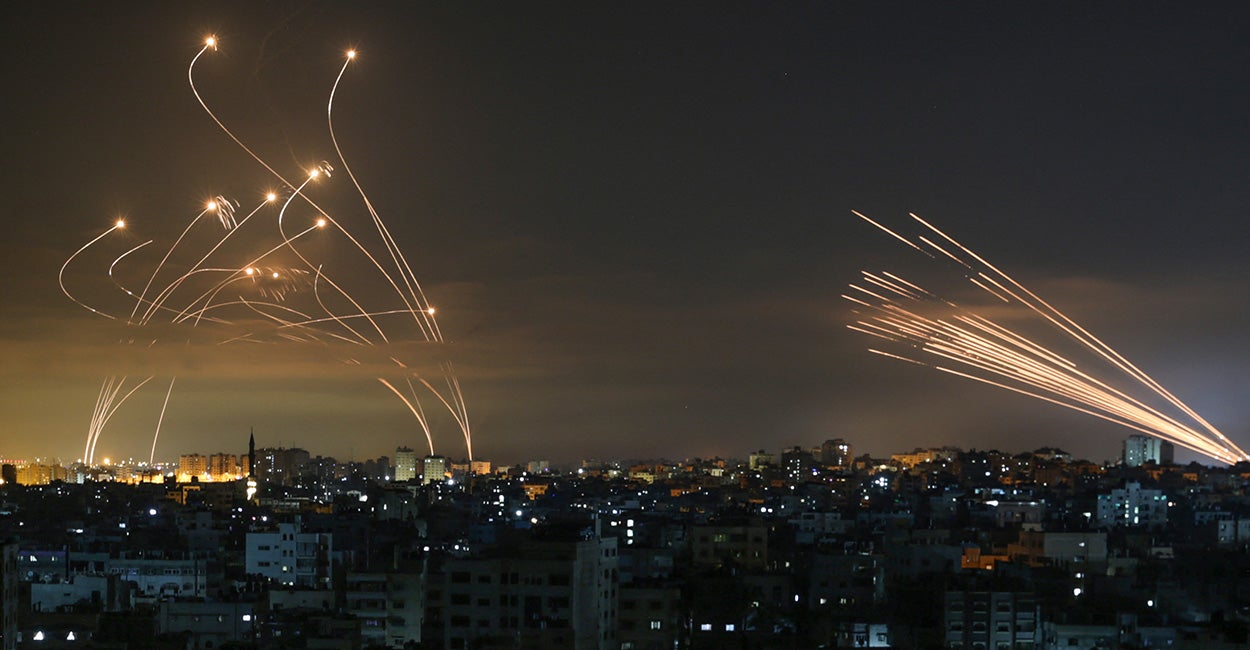
The Iron Dome “Tamir” interceptors were designed to leave a prominent smoke trail behind them as they pursued their targets, giving the system a strange aerial beauty. In 2012 when the system was activated to neutralize a barrage of rockets launched towards Beersheba, rather than scattering to bomb shelters the revelers at a local wedding continued to dance under the flashes of the interceptions as if they were fireworks.
The Iron Dome became the darling of the U.S. Congress, which started pouring resources into the program in 2011, and an agreement for technology sharing was signed in 2014. The system was followed by joint programs between Rafael and the U.S. defense contractor Raytheon to protect against longer-range missiles, such as David’s Sling and Arrow 2 & 3. An additional system, Arrow 4, is now in development. While the U.S. Army has purchased some Iron Dome interceptors, there are problems with interoperability because the system was developed independently. Systems recently developed jointly by the United States and Israel should not have such problems.
The reliable protection provided by this multilayered missile-defense system may, in some ways, have made Israel the victim of its own success. When Hamas fired more than two thousand rockets at Israel during the eleven-day Gaza war in 2021, for example, Iron Dome had a more than 90% success rate intercepting them, with press photographs capturing the gracefully spiraling interceptors destroying the rockets.
The Biden administration quickly demanded a ceasefire, and the Israeli government complied, judging that its reliable defenses made an incursion into Gaza unnecessary. In hindsight, that was the moment when Hamas’s leader Yahya Sinwar, realizing that the Iron Dome had rendered its missiles and rockets largely useless, started planning for a very different sort of attack on Israel.
The post Building The Iron Dome appeared first on The Daily Signal.









 New Posts (Home)
 ChatBox
 Popular Posts
  Game Zone
 Top PodCasts