www.dailysignal.com
George Washington’s Warning About Religion Still Matters
The United States may not be in the midst of a spiritual revival, as President Donald Trump touted during the State of the Union address, Feb. 24. The data is mixed, with religion being viewed as “very important” to less than half of Americans, as a recent Gallup survey found.
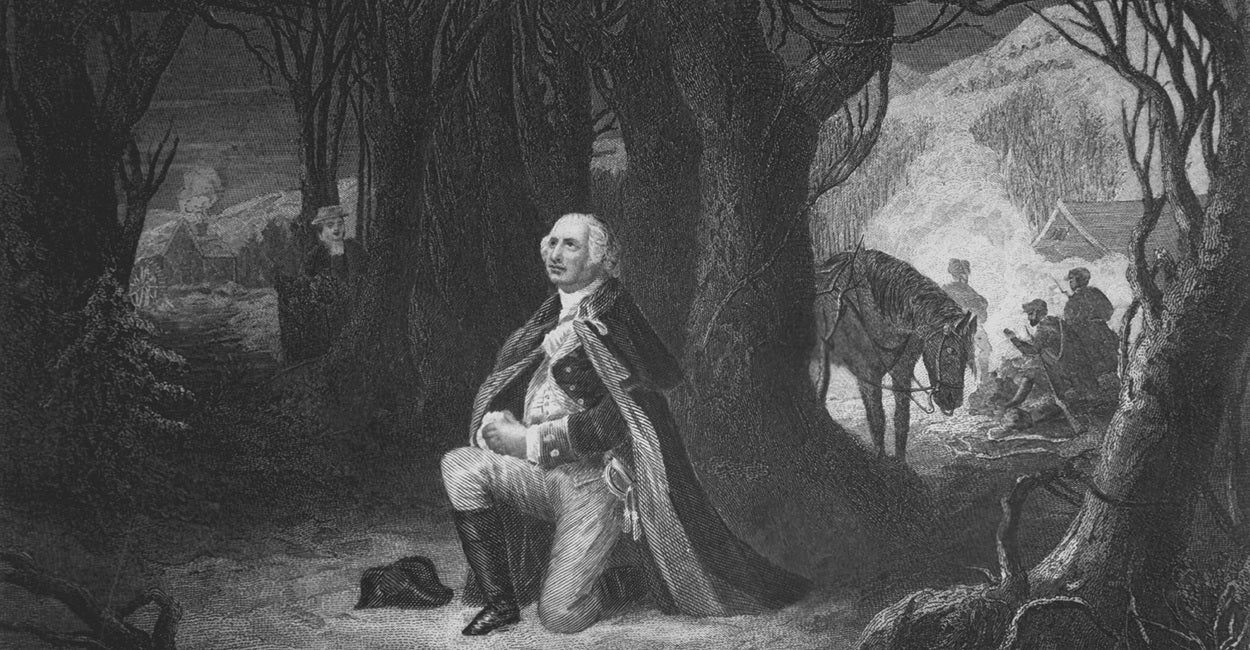
Nevertheless, for the nation to prosper and bind together, religiosity is not only a crucial aspect of civil society, but vital to its sustainability. This sentiment was expressed by none other than the country’s first president, George Washington.
Although private in his own religious convictions and skeptical of fanaticism, in his Farewell Address (1796), Washington’s clarion, prescient warning to contemporary and future Americans—on national and international affairs—definitively emphasized that “[o]f all the dispositions and habits which lead to political prosperity, religion and morality are indispensable supports.” Moreover, to “subvert” such “great pillars of human happiness”—like the freedom of religious expression—would be considered unpatriotic.
Indeed, Washington believed religiosity served as a bedrock for national stability and individual virtue, and a lack thereof would cripple cohesion, writing:
And let us with caution indulge the supposition that morality can be maintained without religion. Whatever may be conceded to the influence of refined education on minds of peculiar structure, reason and experience both forbid us to expect that national morality can prevail in exclusion of religious principle.
He was not the only Founding Father to stress religion’s intrinsic importance to the new republic. John Adams once reflected, “Our Constitution was made only for a moral and religious people. It is wholly inadequate to the government of any other.” Benjamin Franklin, likewise, considered religious practice important for developing virtue, and believed “[God] ought to be worshipped” and “the most acceptable service we render to him is doing good to his other children.”
Even Thomas Jefferson, the most notable deist among the Founding Fathers, warned about the consequences of abandoning religious conviction entirely. While advocating a “wall of separation” between church and state, he also stated:
God who gave us life gave us liberty. Can the liberties of a nation be secure when we have removed a conviction that these liberties are the gift of God?
Washington’s—or the other Founding Fathers’—rationale was not without historical precedent. For centuries, Christianity has served as the basis for establishing institutions that we take for granted, such as universities, hospitals, economic systems, and—most importantly—the philosophy undergirding the truth that “all men are created equal.” Indeed, as observed by Alexis de Tocqueville—a 19th-century political scientist—in “Democracy in America,” religion is the “companion of liberty” and a “safeguard” in preserving the “pledge of freedom.”
Today, however, American religiosity is struggling—and the consequences borne from this sociological trend have reverberated across civil society and political dynamics.
In the early 1950s, 75% of Americans found religion to be “very important” in their lives. Now, that is 47%. Moreover, the March Gallup survey shows that “in each year since 2022, 28% of Americans have said religion is ‘not very important’ in their lives,” which is the “highest proportion” in this trend and “more than double the rate seen as recently as the early 2000s.” Concurrently, as a recent Pew Research Center survey discovered, the United States is “the only place” where “more adults (ages 18 and older) describe the morality and ethics of others living in the country as bad (53%) than as good (47%).”
The relationship between these trends may not be purely coincidental. Religious affiliation has historically declined since the 21st century’s outset; meanwhile, the importance of one’s political party affiliation has risen and, in some cases, supplanted not only religion as an identifiable characteristic, but race, culture, and even language. Additionally, in recent years, Americans have shifted their self-defining characteristics to better align with their politics; in effect, a political platform has increasingly informed one’s values and principles, instead of one’s beliefs being rooted by families, churches, and communities.
Psychologically, this identity shift heightens emotional reactions toward political criticisms since debate—or opposition—now challenges the core of a person’s personality. Even brain activity confirms political conflict has a similar effect as being physically attacked and/or threatened. It should be unsurprising then, as a result, America has seen increased polarization and even violence against political adversaries.
At the same time, American civil society has receded. Fewer opportunities exist for neighbors to gather together, regardless of political affiliation, and pursue a common goal. In the past, religious organizations and charities were cornerstones for such activity; today, however, as religiosity fades—which had been a motivating impulse propelling communal outreach—a void has formed. Indeed, the less religious are less likely to be civically engaged.
This massive disconnect between an individual and society at-large presents an existential crisis in the modern United States. Civilizations cannot survive without a firm foundation. In an American context, morality was not borne from thin air nor from moral relativism—but formed by Western philosophy and the Judeo-Christian religions.
In response to this phenomenon, President Trump has launched several initiatives—such as “America Prays”—and established the White House Faith Office to reinvigorate religiosity. At the same time, there are signs Gen Zers and young adults are returning to church, but whether these developments signal a lasting trend remains uncertain.
Yet Washington’s fatherly advice in his Farewell Address remains relevant to modern audiences, and must be heeded: when religiosity disappears from the public square, the moral framework supporting civil society wanes and weakens. A transcendent set of principles, however, unifies and moors the nation in common principles.
As the country celebrates the 250th anniversary of America, the moment offers an opportunity to recommit to the “indispensable” pillars of society: prayer, worship, and charity. Faith alone may not reverse every sociological problem; indeed, people are not angels. But a revival of religious commitment could renew the civic bonds that sustain, safeguard, and preserve a free society.
So help us God, let us hope in a revival. In Him we must trust.
This article was originally published by RealClearReligion and made available via RealClearWire.
We publish a variety of perspectives. Nothing written here is to be construed as representing the views of The Daily Signal.
The post George Washington’s Warning About Religion Still Matters appeared first on The Daily Signal.








 New Posts (Home)
 ChatBox
 Popular Posts
  Game Zone
 Top PodCasts