YubNub Social YubNub Social
    #covid #music #bible #america #trombone #atw #militarymusic #armymusic #god #armyband #atw2026 #tyranny #jazz #quartet #trombonechoir
    Advanced Search
  • Login
  • Register

  • Night mode
  • © 2026 YubNub Social
    About • Directory • Contact Us • Developers • Privacy Policy • Terms of Use • shareasale • FB Webview Detected • Android • Apple iOS • Get Our App

    Select Language

  • English
Night mode toggle
Featured Content
Community
New Posts (Home) ChatBox Popular Posts Reels Game Zone Top PodCasts
Explore
Explore
© 2026 YubNub Social
  • English
About • Directory • Contact Us • Developers • Privacy Policy • Terms of Use • shareasale • FB Webview Detected • Android • Apple iOS • Get Our App
Advertisement
Stop Seeing These Ads

Discover posts

Posts

Users

Pages

Blog

Market

Events

Games

Forum

Entertainment News
Entertainment News
8 w

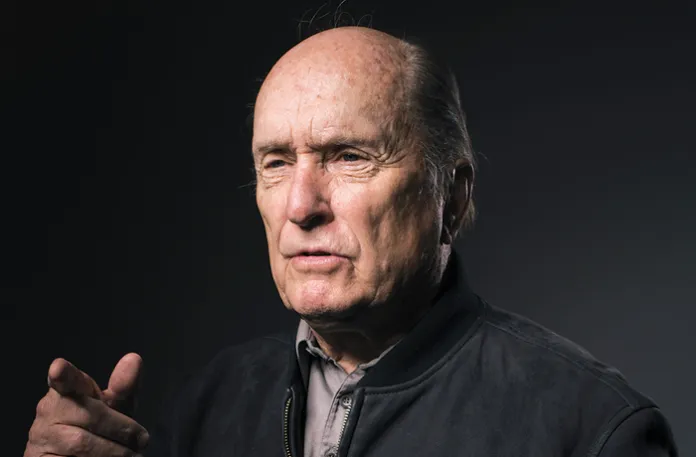
Robert Duvall, 1931–2026
Favicon 
www.washingtonexaminer.com

Robert Duvall, 1931–2026

Despite his impassive eyes, balding pate, and slit of a smile, Robert Duvall could be volcanic and melancholic, mysterious and straightforward, vengeful and merciful. Perhaps no modern American actor marshaled his gifts to such excitingly eclectic ends or with such a lack of concern for whether or not he was the featured player. In several of his most significant films, Duvall was far from being the star, but the intensity of his presence was such that he often eclipsed his betters.  Duvall, who died on Feb. 15 at age 95, demanded attention in such ensemble films as To Kill a Mockingbird (1962), M*A*S*H (1970), and Network (1976), and on no fewer than three occasions — first in The Chase (1966), then in The Godfather (1972), and finally in Apocalypse Now (1979) — his relentless ferocity contrasted nicely with the wandering naturalism of his more famous co-star, Marlon Brando. And when Duvall had the screen to himself, he took full advantage of it. It is hard to imagine a performance more relentlessly aggressive than his in The Great Santini (1979), nor one more meekly passive than his in Tender Mercies (1983), for which he won an Oscar as best actor — the only such win for Duvall amid a raft of nominations. Duvall was born in San Diego in 1931, and, perhaps unexpectedly, his upbringing provided him with raw material that he would later mine as a performer. He was the son of a Navy admiral — surely a man he had in mind when playing the combustible Marine pilot Bull Meechum in The Great Santini — and, while a youth, he was inculcated in the Christian Science faith, the same denomination as the author of two of his greatest screenplays, To Kill a Mockingbird and Tender Mercies: Horton Foote. Duvall chose to attend a Christian Science-affiliated school, Principia College, from which he graduated in 1953. Robert Duvall, 1931-2026. (Casey Curry/Invision/AP). There followed a long period during which Duvall racked up credits in regional theater and off-Broadway. He also became a fixture on television, where he would have been regularly encountered by loyal viewers of The Naked City and Route 66. By the time he turned up in To Kill a Mockingbird, Duvall already had the countenance of someone wise, strange, even middle-aged — perfect for his part of the often-spoken of but seldom-encountered Boo Radley. That part accelerated his career on the small and big screens, though he continued to hover in the background. He was decidedly not the star of Bullitt (1968), The Detective (1968), or True Grit (1969), and although he had a pivotal part and a sympathetic young director (Francis Ford Coppola) in 1969’s The Rain People, that female-centric movie belonged to its troubled heroine, played by Shirley Knight. Coppola, though, seized on Duvall and incorporated him into his company, American Zoetrope: Duvall was the star of the Zoetrope-produced, George Lucas-directed experiment in aesthetically minimalistic science-fiction, THX 1138 (1971), and he was utterly arresting as Tom Hagen in Coppola’s The Godfather — the first of his performances to merit an Oscar nomination. Coppola later prevailed upon Duvall to join him in the Philippines to make the Vietnam War epic Apocalypse Now, in which Duvall’s Col. Kilgore utters the heartless but unforgettable words “I love the smell of napalm in the morning.” He gives a more controlled performance than any of his co-stars, including Martin Sheen, Dennis Hopper, and Brando. Tellingly, Duvall was the only actor in Apocalypse Now to be Oscar-nominated. Coppola was not the only director to detect reserves of ruthlessness within Duvall. In Network, Sidney Lumet cast Duvall as Frank Hackett, a broadcast television executive who barks about his lack of principles loudly and often. More quietly vigorous was his performance in Tender Mercies. Duvall played Mac Sledge, a past-his-prime country-music singer ground down by personal problems but rejuvenated by the things he finds far from the limelight — namely, religious commitment (he is baptized midway through the film), and the promise of a new relationship with an ordinary woman played, majestically, by Tess Harper.  CATHERINE O’HARA, 1954-2026 Bolstered by Tender Mercies, Duvall attained a certain ubiquity — he was in big movies (1984’s The Natural), small ones (1988’s Colors), and even rather junky ones (1990’s Days of Thunder). He had integrity and commitment in each, and he was still given opportunities to walk away with a movie: he was a police officer achingly near retirement in Falling Down (1993), a fearsome newspaper editor in The Paper (1994), and a comically incoherent loon in The Gingerbread Man (1998), the last directed by Robert Altman, who had awarded him key early parts in Countdown (1968) and M*A*S*H. Duvall proved to be a competent, eloquent director with The Apostle (1997), and even his own senescence did not prevent him from logging good performances in such late-in-the-game efforts as The Judge (2014), co-starring with Robert Downey Jr. Duvall leaves in his wake many classic films to which he always contributed in abundance. Peter Tonguette is the film critic for the Washington Examiner magazine. 
Like
Comment
Share
Entertainment News
Entertainment News
8 w

A time for choosing
Favicon 
www.washingtonexaminer.com

A time for choosing

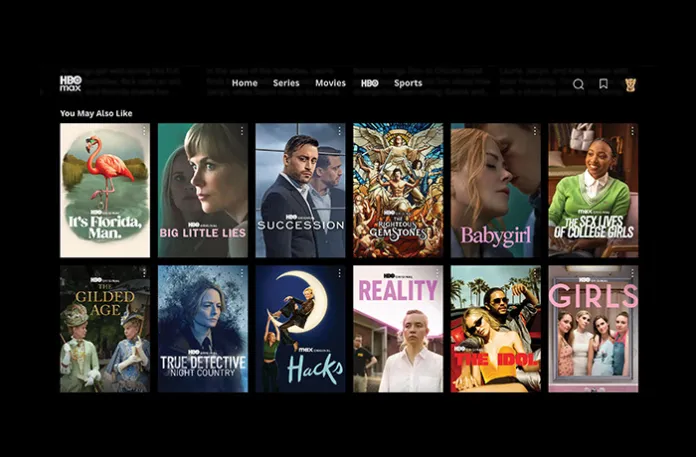
The other day, I mentioned to a new acquaintance my work as a TV critic for this magazine. I won’t elide the point: I was bragging. As sometimes happens, however, my boast spun around like a boomerang and knocked my teeth out. “There is much to criticize!” my friend replied with a laugh. That shut me up quickly enough, but it also captured the truths that make this corner of the reviewing business so thrilling and vexed.  There has never been a better time to watch television. Say what you will about shopping malls, pop music, or the fortunes of the American factory worker, TV is one realm in which those of us now living definitively haven’t missed the parade. In 1976, the Emmy for Best Drama went to Police Story, a campy procedural that claimed its prize by beating a Columbo “Sunday Mystery Movie” on NBC. Fifty years later, likely competitors for the award include Pluribus, The Pitt, and Slow Horses, entertaining and finely made choices all.  Of course, one needn’t sit through this year’s offerings to have a wonderful time. At a moment’s notice, those willing to subscribe to a streaming service can binge Mad Men, The Wire, Band of Brothers, and other classics of TV’s golden age. Obscurer but equally strong choices await the viewer willing to dig: Carnivàle, The Americans, Friday Night Lights, and many more. For better and worse, the energy that once belonged to the cineplex now buzzes on our small screens, with all of the industry consequences that that entails. Take the career of actress Carrie Coon. Two generations ago, the 45-year-old would have been a movie star, greatly beloved. Today, she is instead a superb but only half-famous TV performer. Does Coon herself regret the change? Few fans of The Leftovers, The White Lotus, or The Gilded Age do. The downside of all of these riches is the dross accompanying the gold. Each year, the nation’s streaming services dump literally hundreds of original drama and comedy series into our queues, to say nothing of the cartoons, stand-up specials, and multipart documentaries on offer. Armed only with flat-bottom pans, we stand in the river and try to catch the jewels drifting by. Though much has been made of audiences’ enslavement to the algorithm, I might suggest that an even stricter master might be best. At last check, the “TV for You” section of my Hulu account had a whopping 76 recommendations, many of which bear no conceivable relation to my viewing habits. (90 Day Fiancé? I’ll pass.) HBO’s “You May Also Like” function produces, as far as I can see, a mere listing of the app’s best-known shows. Why else tell fans of wholesome, earnest ER that they should be sure to check out Veep?  Into this confusion steps the TV critic, bleary-eyed and surly from too many hours on the couch. At his best, he is a godlike figure, delivering us from error by way of decrees. (“Thou shalt not watch the ponderous new Mark Ruffalo miniseries.”) At his worst, he is one more cry from an arrogant elite, assuring us that we will — or should, anyway — enjoy the latest scripted infotainment from the Left.  You already know the kind of show I’m talking about. Perhaps its incorporation of vogue ideas dazzles critics who might otherwise discern its awfulness (Amazon’s Transparent). Or perhaps “representative” casting and plotting blind commentators to all else (FX’s Reservation Dogs). To find an honest assessment of such a program in the American critical ecosystem is like spotting a unicorn … with roller skates … on Mars. Amazon’s The Underground Railroad (2021), a miniseries of almost indescribable spitefulness, didacticism, and hypocrisy, was hailed by reviewers as “necessary” (NPR), “graceful” (Los Angeles Times), and a “breathtaking achievement” (Time). Were those and other writers knowingly lying to maintain their standing on the progressive team? Yes. Yes, they were.  “There is much to criticize!” Returning to our theme, we must follow these nuisances to their conclusion. If algorithms fail and (most) commentators can’t be trusted, then how are audiences to wade through television’s rising flood? For many viewers, the answer involves the scroll session, a joyless tour of “what’s on” that serves as the contemporary equivalent of flipping channels. Cycling through the possibilities, one lingers or leaps ahead based on criteria one can barely define. Is that John Turturro? That thumbnail looks OK. Didn’t we just watch a murder of the week? Before one knows it, the time it takes to stream a pilot has passed, and one has nothing to show for it but a sore thumb.  MALICE’S HARD TRUTH  My own solution to this problem, admittedly specialized, is to play an offscreen version of “Six Degrees of Kevin Bacon.” If Liz Sarnoff wrote two of the best episodes of Deadwood, then maybe her forthcoming series Scarpetta will be pretty good. (Check this space next month to find out.) Surely executive producer Ronald D. Moore (For All Mankind, Outlander, Battlestar Galactica) will knock the next one out of the park, too. Needless to say, this method doesn’t always work: Fans of The Wire have followed creator David Simon from one disappointment (Show Me a Hero) to the next (The Deuce). Nevertheless, it is one path to cut through thick woods. If the television landscape is a forest, I want the trees that might bloom.  Writing for Quillette recently, journalist Harrison Kass asked what has happened to the middlebrow movie, “the kind of impeccably made, crowd-pleasing entertainment” that graced American screens for decades. To be sure, such films are still available if one knows where to find them. But their television equivalents come out nearly every month, gems in a wash of pebbles, pouring unceasingly past. For the TV sophisticate, and with apologies to the Gipper, we live today in a time for choosing. However you do it, choose carefully out there.  Graham Hillard is the TV critic for the Washington Examiner magazine and editor at the James G. Martin Center for Academic Renewal.
Like
Comment
Share
Entertainment News
Entertainment News
8 w

Killer maker: Review of ‘How to Make a Killing’
Favicon 
www.washingtonexaminer.com

Killer maker: Review of ‘How to Make a Killing’

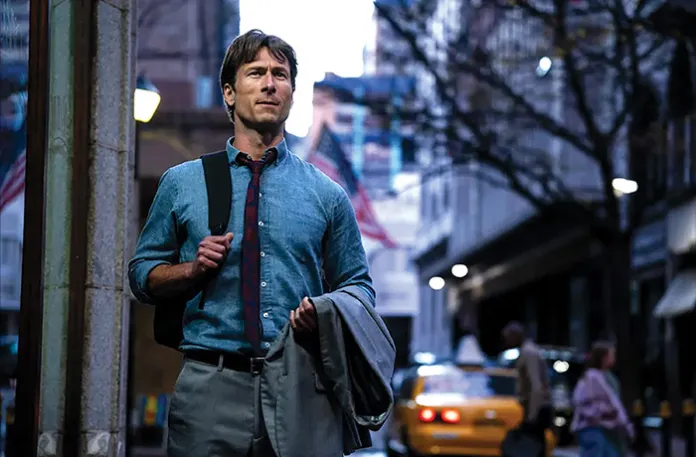
Gone are the days when stars seemed to go from strength to strength — when Tom Hanks, for instance, followed Philadelphia with Forrest Gump, and Forrest Gump with Apollo 13, and Apollo 13 with Toy Story. Far more common is the stop-and-start trajectory of even an actress as comely and appealing as Sydney Sweeney, whose megahit Anyone but You was followed by such less-than-megahits as Eden and Americana, until The Housemaid restored her promise. As it happens, Sweeney’s co-star in Anyone but You, Glen Powell, has had his own share of career oscillations: He seemed as close to a sure bet as any up-and-comer on the strength of that romantic comedy and the two films that followed, the crime caper Hit Man and the cyclone sequel Twisters. But his attempts to establish himself as a consistent hit-maker took a beating with last fall’s The Running Man and will not be helped by his new black comedy, How to Make a Killing. An entirely unnecessary, frequently enervated remake of the 1949 Ealing Studios classic Kind Hearts and Coronets, the film stars Powell as a son of privilege who, finding himself on the outs with his well-to-do family, seeks to grab hold of his fortune by means of murder. Unfortunately, writer-director John Patton Ford has little feel for the American class system, no discernible talent for writing good dialogue, and minimal competency with directing actors.  The film, which is never as jauntily dark as it means to be, begins in the death-row cell of Becket Redfellow (Powell), a convicted murderer of unusually refined manners and striking self-confidence. When a priest joins him to provide spiritual counsel, Becket proceeds to explain, first in person and then in increasingly interminable voice-over, how he arrived at his present state. This is a bad sign, since it means that the movie is likely to have an overelaborate plot in need of constant explication and a tendency to tell more than show. Both are the case here.  Glen Powell in “How to Make a Killing.” (Ilza Kitshoff/A24) As we come to learn, Becket is the only offspring of Mary Redfellow (Nell Williams), an heiress on Long Island whose family is said to be worth $28 billion — the sort of comically high figure indicative of the movie’s cartoonishness. Despite what is shown to be her family’s proclivity for bad behavior, Mary is excommunicated for shacking up with a working-class musician and bearing his child, a scenario that seems more befitting a backstory set in the 1950s than the 1980s (which, given Powell’s age, is the opening act’s likeliest setting). Driven out of the family mansion, mother and child relocate to the less auspicious Belleville, New Jersey — one of the film’s few genuinely funny touches — where Mary whiles away her days in the employ of the Bureau of Motor Vehicles.  Too conveniently, Mary is pushed off-stage with a sudden terminal illness, which enables Becket to take his rightful place in the narrative. In a fluke of estate planning, while Mary and Becket are persona non grata among their kith and kin, Becket could still come into possession of his family’s wealth were he to leapfrog various relatives — the film’s central, ultimately murderous conceit. On her deathbed, Mary exhorts her son to take advantage of this situation in grotesquely self-serving terms at odds with the movie’s overall soak-the-rich ethos. “Promise me that you won’t quit,” she tells him, “until you have the right kind of life.” When he grows up to become Glen Powell, Becket works, apparently not unhappily, at a men’s store, but he is reminded of his unfulfilled potential when he encounters Julia (Margaret Qualley), an allegedly high-born acquaintance from youth. The character of Julia is a reminder that no contemporary American filmmaker besides Whit Stillman can credibly write for WASPs. The movie has Julia say, upon encountering Becket for the first time in ages, “No f***ing way” — which sounds more like the words of a profane Valley Girl than a resident of, say, Glen Cove. Qualley remains a coarse, unrefined presence throughout, making her an imperfect representative of the station to which Becket aspires. Inexplicably, given Becket’s social background and Powell’s equable manner, Becket marshals his sense of monetary entitlement and class envy to become a killer: if he dispatches with his older cousins, and a few spare aunts or uncles, Becket can be reunited with his billions. “If I were to prune a few branches of the family tree, where would I start?” Becket asks. This is the plot point that most explicitly borrows from Kind Hearts and Coronets, and while writer-director Ford has surely seen that great film starring Alec Guinness, the evidence here suggests that he is far more familiar with the lesser works of Wes Anderson.  From Anderson, Ford borrows annoyingly centered tracking shots, aggressively executed whip pans, and above all, a penchant for neato montages to set up secondary characters. In this case, that means the various relations of Becket, who are sketched as unsubtly as a New Yorker cartoon panel: among Becket’s soon-to-be-offed family members, there’s a party animal (Raff Law), a supercilious would-be artist (Zach Woods), and, most unaccountably, a hot-tempered megachurch minister (Topher Grace). Who ever imagined such a group as belonging to anything like a noble family? A real-life super-rich family like the Kennedys has enough black sheep for a dozen movies, so why does Ford insist on making his super-rich family so preposterously and randomly over-the-top? Worst of all may be Ed Harris as Becket’s grandfather Whitelaw, a man who appears to live in Wayne Manor, wears a cravat, and says the following line far too seriously: “I want to show you something before Charles brings out the pudding.” VIRTUAL UNREALITY  The movie never finds a perspective on the ease with which Becket wills himself to become a serial killer. Is it simple greed, a consequence of social exclusion, or a reflection of some hidden aspect of his character? The most that the film can offer in the way of moral complexity is a subplot revolving around Becket’s late cousin Noah’s girlfriend, a manic pixie dreamgirl called Ruth (Jessica Henwick). Evidently, Ruth is meant to represent all that is good and pure for eschewing the luxe life for the smaller ambition of being a high school English teacher.  But to embark on a moral analysis of How to Make a Killing is to give it undue importance. Simply put, this is a dumb movie, and making it was a dumb move on the part of its aspirant star. Peter Tonguette is the film critic for the Washington Examiner magazine.
Like
Comment
Share
Entertainment News
Entertainment News
8 w

Left-wing late night and the law: The latest Colbert controversy highlights dated broadcast regulations
Favicon 
www.washingtonexaminer.com

Left-wing late night and the law: The latest Colbert controversy highlights dated broadcast regulations

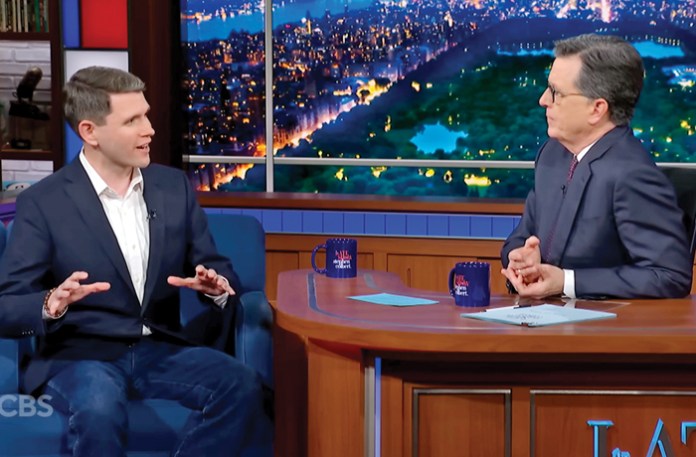
At a time when the Federal Communications Commission faces genuinely difficult questions about broadband expansion, spectrum allocation, and the future of communications infrastructure, Washington instead found itself consumed by a late-night comedy segment that never even aired. The spark was simple enough. Late Show host Stephen Colbert revealed that CBS would not broadcast an interview with Texas state Rep. James Talarico, a Democratic candidate in a closely contested U.S. Senate primary. Network lawyers reportedly worried that airing the segment could trigger the FCC’s “equal time” requirement, which would require the station to offer comparable airtime to Talarico’s primary opponents. Rather than navigate that minefield, CBS declined to run it on broadcast television and released the interview online instead. What might once have been a minor regulatory footnote quickly became a political spectacle. And that spectacle says more about the FCC’s uneasy place in the modern media ecosystem than about any single candidate or talk show. Democratic Texas state Rep. James Talarico, left, with CBS late night host Stephen Colbert in an interview relegated by network executives to YouTube only, Feb. 17, 2026. (CBS via YouTube) The reaction followed a familiar script. Democrats framed the decision as proof of creeping censorship under a Republican-led FCC. Anna Gomez, the commission’s lone Democrat, accused the network of “corporate capitulation” in the face of a broader campaign to chill speech. The implication was clear: An agency charged with regulating communications was now indirectly shaping political discourse. Republicans countered just as forcefully. FCC Chairman Brendan Carr argued that equal time rules exist to prevent broadcasters from tilting elections toward favored candidates. The statute, he noted, was designed to prevent “media elites” from serving as partisan gatekeepers. To Carr and his allies, the Colbert controversy was a manufactured crisis and a convenient narrative for a campaign eager to turn regulatory caution into political capital. Each side saw what it expected to see. Either the FCC had revived the spirit of heavy-handed speech control, or liberal media figures were staging a melodrama to gin up outrage. But focusing only on that exchange obscures something more revealing: how a rule designed for a 1930s media landscape collides awkwardly with one for 2026. The equal time provision did not emerge from nowhere. It traces back to the Radio Act of 1927, which was later incorporated into the Communications Act of 1934 and signed by Franklin D. Roosevelt. It seems odd to be fighting legislative battles from nearly a century ago, but at the time, it might have been necessary. The logic behind it was what courts later called the “scarcity rationale.” The broadcast spectrum was limited. Only so many frequencies could exist. Because the airwaves were public property licensed to private stations, the government imposed conditions to ensure no single political voice monopolized them. Over the decades, Congress has repeatedly revisited communications law and amended rate structures, ownership rules, and licensing procedures. What remains unresolved is whether the scarcity rationale remains relevant in an age of cable, satellite, and easy broadband internet access (for most people). Lawmakers have left the equal-time framework largely intact, even as the technological assumptions beneath it have eroded. The result is a statute built for a world of rotary dials, operating in a world defined by fiber optics and streaming platforms. Federal Communications Commission Chairman Brendan Carr testifies on Capitol Hill, Jan. 14, 2026. (Jose Luis Magana/AP) That original scarcity logic also justified a broader regulatory architecture, including the now-defunct Fairness Doctrine. The doctrine required broadcasters to present contrasting viewpoints on controversial public issues. When the FCC repealed it in 1987 under President Ronald Reagan, critics warned that political discourse would polarize. Supporters argued the opposite: Government supervision of speech had outlived its constitutional and practical justification. However, in the early ’90s, with the rise of conservative talk radio, most notably Rush Limbaugh, Democrats had a change of heart and introduced legislation to reinstate the Fairness Doctrine. For many Republicans, the Fairness Doctrine became shorthand for regulatory overreach. And ever since then, GOP lawmakers have insisted that the FCC has no business policing viewpoint balance. The present dispute sits squarely in that lineage. But equal time itself is narrower than many assume. It does not require identical coverage of every candidate. It does not mandate editorial neutrality. It simply requires that legally qualified candidates for the same office be given comparable opportunity if one is granted access to a broadcast station’s facilities. People make the incorrect assumption that it applies to the particular show, as if someone would have to appear with Colbert, but that is not the case. Bona fide news interviews are generally exempt. Entertainment programming historically was as well. It was never an issue when hosts like Johnny Carson, Jay Leno, and David Letterman largely avoided partisan advocacy. That has changed. Hosts like Colbert and Jimmy Kimmel use their platforms for overt political advocacy, even as they mix comedy, commentary, and celebrity. That gray area, rather than any sweeping new statute, is what animated the Colbert controversy. The episode also illustrates a different principle, and one that is less legal than technological. Efforts to suppress or avoid content now tend to amplify it. CBS may have sought to avoid triggering equal-time obligations on its broadcast signal, but the interview did not vanish. It simply migrated to a place where the FCC has no authority and was posted to Colbert’s Late Show YouTube channel. Within days, it reached more than 8 million views, more than triple Colbert’s nightly network audience. Talarico’s campaign reported a surge in online engagement and fundraising in the immediate aftermath. The rule intended to ensure balance created an advantage. A segment that would have aired once on CBS became a viral artifact, replayed, shared, clipped, and monetized across platforms that the FCC does not regulate. That is largely structural. Equal-time obligations apply to broadcast licensees using public spectrum. They do not apply to Netflix, YouTube, Spotify, podcasts, or cable networks. A political candidate appearing on a streaming platform faces no comparable statutory requirement. The result is that the only outlets chilled by equal-time concerns are the very ones already losing audience share. Consider recent scrutiny of daytime talk shows such as The View, which has also drawn complaints about candidate appearances. The regulatory shadow falls unevenly. The broadcast signal remains governed by mid-20th century assumptions, while the digital ecosystem operates under an entirely different set of rules. That is not neutrality. It is fragmentation. Fragmentation, in turn, invites strategic behavior. Campaigns understand that controversy itself is currency. A threatened cancellation becomes a fundraising email, a viral campaign clip to share on social media, and a mere regulatory warning becomes “proof” of political persecution. Far from dampening political involvement, it feeds the incentive structure of online campaigning, using institutions as platforms where outrage travels faster than compliance memos. The larger problem is not that equal time exists or does not. It is that the political fight over it absorbs oxygen that might otherwise be spent on matters squarely within the FCC’s core mission. During the Biden administration, FTC Chair Lina Khan pursued an aggressive antitrust agenda that her supporters called long-overdue enforcement and her critics called politically motivated targeting, based on the lawsuits she brought against particular companies. One can agree or disagree. However, it follows a familiar pattern: A regulatory agency with legitimate authority becomes defined by its most contentious interventions, and institutional credibility erodes in the process. The commission oversees spectrum auctions, broadband deployment subsidies, rural connectivity programs, and emergency communications infrastructure. It administers billions of dollars through the Universal Service Fund. It sets rules that determine how quickly new wireless technologies roll out and how resilient networks are during hurricanes, wildfires, and cyberattacks. It is also wrestling with complex questions about 5G and emerging 6G spectrum allocation, satellite broadband competition, and the implementation of federal broadband grant programs intended to bring high-speed internet to underserved communities. These are the technical, often unglamorous debates and policy decisions that justify the agency’s existence and the debates its appointees can have. Instead, Washington stages high-volume skirmishes over symbolic and petty conflicts. The Colbert-Talarico controversy became a convenient morality play. Democrats cast the FCC as an instrument of intimidation. Republicans cast themselves as referees protecting electoral fairness. Media outlets amplified the clash. Social media converted it into shareable outrage. But outside political media circles, how many Americans were meaningfully affected? The interview aired online. It involved a candidate, not in a national presidential election but in a Senate race. The candidate raised money. The commissioners traded statements. However, nothing about the nation’s communications infrastructure changed. That is the sense in which this was political theater performed in a half-empty house. The spectacle consumed attention while leaving underlying structural questions untouched. Does it make sense for broadcast television alone to bear equal-time burdens in an era when most political content flows through unregulated digital channels?  Perhaps it is finally time for Congress to revisit the scarcity rationale.  The FCC was created in an era when radio towers defined the limits of mass communication. Today, a candidate can reach millions with a smartphone and an algorithm. The Colbert episode did not prove that the agency is tyrannical or obsolete. It did, however, expose the mismatch between a regulatory framework built for airwave scarcity and a media environment defined by abundance and easy availability. If Congress believes equal time remains necessary, it should say so clearly and explain why broadcast speech alone warrants distinct treatment. If lawmakers believe the rule is an anachronism, they should modernize it rather than rely on shifting interpretations and episodic enforcement based on whatever party is in office. However, the current middle ground is unsustainable. It is one in which clearly outdated assumptions collide with contemporary technology, and each collision becomes a partisan battlefield. WE ARE ALL NIXONIANS NOW  Like other agencies that have slowly become agents in partisan political battles, the FCC continues to function as a prop rather than as a technocratic regulator focused on infrastructure, competition, and connectivity. Agencies endure not merely because of statute but because of public confidence that they are solving actual problems. The longer communication and technical policy are reduced to culture-war skirmishes over comedy segments, the harder it becomes to sustain that confidence. The show will go on. It always does. The question is whether the audience and the rest of the country would be better served if more energy devoted to political fights were spent on the less glamorous, but far more consequential, task of updating communications law for the world that actually exists. Jay Caruso (@JayCaruso) is a writer living in West Virginia.

Like
Comment
Share
Entertainment News
Entertainment News
8 w

Sports media don’t meet the moment
Favicon 
www.washingtonexaminer.com

Sports media don’t meet the moment

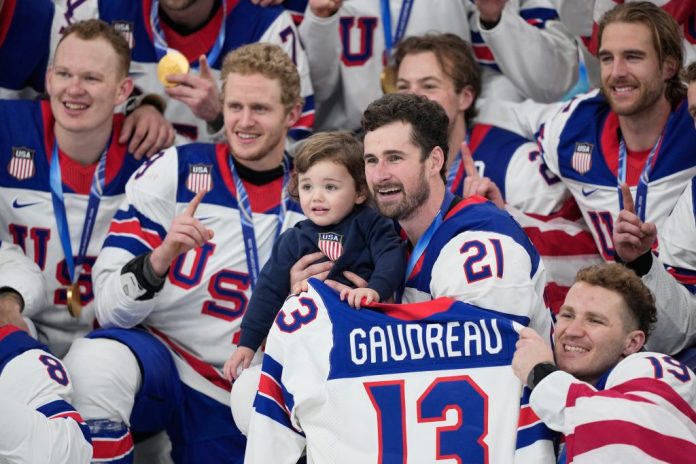
What feedback would you give to the American men’s hockey team that won a gold medal at the Winter Olympics for the third time in history and the first since the 1980 Miracle on Ice? That’s right: They failed to meet the moment. CRITICS OF OLYMPIANS AT STATE OF THE UNION ARE ‘WHOLE BOWL OF WRONG’: JOE CONCHA That is the takeaway from Mary Clark, writing for For The Win, the USA Today offshoot that is allegedly focused on sports. Yes, the United States men’s hockey team did not live up to her standards, not for anything they did on the ice, but for the crime they committed in the locker room: talking to the president and laughing at a joke. Yes, the men’s hockey team has morally failed the nation because it accepted a call from President Donald Trump after winning a gold medal in the most high-profile event of the 2026 Winter Olympics. Trump made a joke about how he would “have to” invite the women’s hockey team, which also won gold, to the White House along with the men, otherwise he would be impeached. The men laughed. That is enough to prove to Clark that these men are sexist moral failings who hate women and bring great shame to America. That one joke is enough to prove to her that all the support the men gave the women’s team, including attending the games and highlighting their achievements, was nothing more than lip service. After all, if they truly loved women, they would have told the president that the joke was not funny. At all. They would have given him some feminist literature to read over and thrown FBI Director Kash Patel out of the locker room while chanting “women’s rights are human rights,” or something to that effect. USA MEN’S HOCKEY TEAM GOLD MEDAL SOMEHOW BECOMES A POLITICAL FOOTBALL This has been the overwhelming response from national sports media, which are filled with liberals who don’t like sports as much as they dream of changing the course of politics and having their moment in the political sun. Writers for both the Atlantic and the Athletic have shamed the men’s team for not being progressive political allies and rejecting any interaction with the president. Liberal social media users, who deluded themselves into thinking hockey players are woke sports warriors, have flooded the mentions of the National Hockey League to whine about the American men. All the while, everyday Americans are proud of Team USA and their great golden victory, because normal people do not require their politics to be affirmed by athletes or celebrities to make themselves feel good. The American men’s hockey team met the moment. Liberal sports writers, on the other hand, did not.
Like
Comment
Share
Trending Tech
Trending Tech
8 w

Ultrahuman bets on redesigned smart ring to win back U.S. market after Oura dispute
Favicon 
techcrunch.com

Ultrahuman bets on redesigned smart ring to win back U.S. market after Oura dispute

Ultrahuman’s Ring Pro promises 15-day battery life and a $479 price tag as the wearables maker expands its health-tech push.
Like
Comment
Share
The Patriot Post Feed
8 w

From Clouds to 'Sonrise'
Favicon 
patriotpost.us

From Clouds to 'Sonrise'

If you and I will trust God in the storms of life, we will give Him the canvas on which He can paint a majestic sunrise after the storm has passed.
Like
Comment
Share
The Patriot Post Feed
8 w

Profiles of Valor: CW5 Eric Slover (USA)
Favicon 
patriotpost.us

Profiles of Valor: CW5 Eric Slover (USA)

Though badly wounded during Operation Absolute Resolve, Slover's regiment's motto is, "Night Stalkers Don't Quit," and he didn't.
Like
Comment
Share
The Patriot Post Feed
8 w

The Future of Nuclear Power Is Bright
Favicon 
patriotpost.us

The Future of Nuclear Power Is Bright

With the successful transport of micro reactors that power thousands of homes, we may be looking at a revolution in the energy industry.
Like
Comment
Share
Let's Get Cooking
Let's Get Cooking
8 w

15 Best New Aldi Finds Of March 2026
Favicon 
www.mashed.com

15 Best New Aldi Finds Of March 2026

Aldi Finds, the grocery chain's bargain aisle, already has a cult following, and in March, new and seasonal items will be released. These are the best ones.
Like
Comment
Share
Showing 7241 out of 118988
  • 7237
  • 7238
  • 7239
  • 7240
  • 7241
  • 7242
  • 7243
  • 7244
  • 7245
  • 7246
  • 7247
  • 7248
  • 7249
  • 7250
  • 7251
  • 7252
  • 7253
  • 7254
  • 7255
  • 7256
Advertisement
Stop Seeing These Ads

Edit Offer

Add tier


Select an image
Delete your tier
Are you sure you want to delete this tier?

Reviews

In order to sell your content and posts, start by creating a few packages. Monetization

Pay By Wallet

Payment Alert

You are about to purchase the items, do you want to proceed?

Request a Refund