allthatsinteresting.com
Inside The Remarkable Story Of Jack Johnson, The First Black Heavyweight Champion
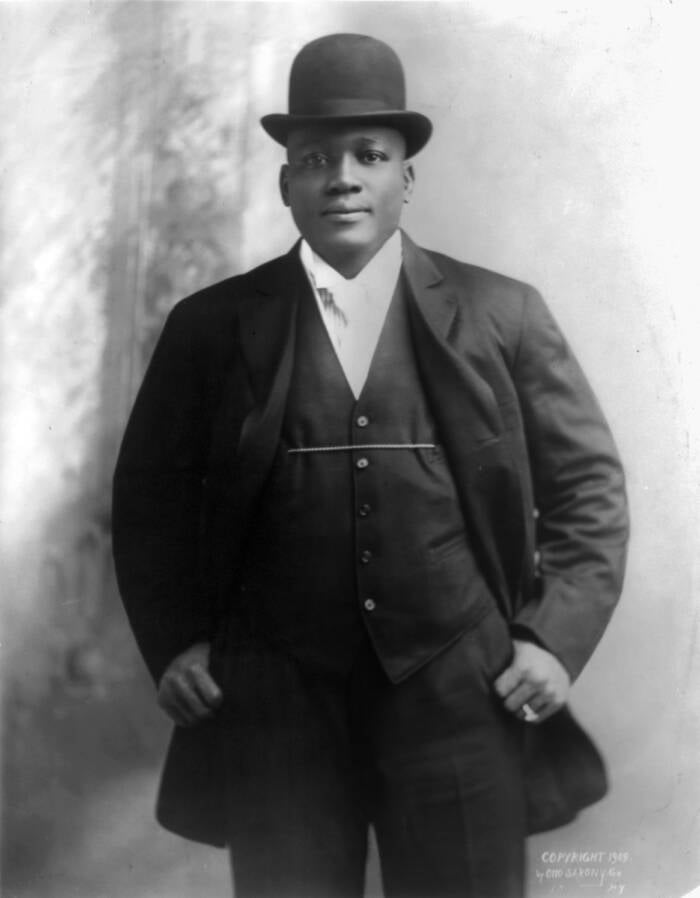
Public DomainThe famed boxer Jack Johnson, a.k.a. the “Galveston Giant.”
Few boxers fought as hard, in and out of the ring, as Jack Johnson. Standing more than six feet tall, and with exceptional reflexes, Johnson’s athletic prowess was a tour de force in boxing, but rising to prominence as a Black man in early 20th-century America often brought trouble — and that was certainly the case with Johnson.
After he became the first Black American world heavyweight champion, racists were outraged. They could not — would not — tolerate a Black man holding such a prestigious title. This ultimately led to the “Fight of the Century,” when Johnson faced a white former heavyweight boxer named Jim Jeffries, who had been coaxed out of retirement as the “Great White Hope.”
When Johnson knocked out Jeffries in the fight, race riots soon erupted.
And Johnson’s troubles didn’t end there. Outside of boxing, he continued to defy racial norms. He lived flamboyantly, displayed his wealth, and openly dated white women — which would ultimately land him in legal trouble for violating the Mann Act, forcing him to briefly flee the country and live as a fugitive abroad. Once he returned to serve his sentence, though, he was never able to regain his prominence in the boxing world.
Although he died in a car accident in 1946, his story did not end there. Justice for Jack Johnson would not come until 2018, long after he died.
Jack Johnson’s Early Life And Boxing Career
John Arthur Johnson, known as Jack Johnson or the “Galveston Giant,” was born in Galveston, Texas on March 31, 1878, to formerly enslaved parents. Growing up in Galveston’s racially diverse Twelfth Ward shielded him from experiencing significant racism during his formative years, especially since he belonged to a gang that included both Black and white people.
Johnson initially worked as a dockworker during his teenage years before leaving home and setting off on his own at 16.
Although he had made it as far as New York and Boston, it was actually in Texas, in Dallas specifically, where someone first recognized his potential as an athlete. At over six feet tall and 220 pounds, Johnson would make a great boxer, thought one Dallas shop owner. The man introduced Johnson to the sport in the late 1800s, and his hunch proved to be right.
There was one problem, though: Prizefighting was illegal in Texas. So, after he lost a fight to Joe Choynski in 1901, both fighters were arrested and sentenced to 23 days in jail for participating in the fight.
It ended up working in Johnson’s favor.
Public DomainJack Johnson, pictured in Vancouver in 1909.
Choynski used that time to teach Johnson defensive techniques that would have helped him in their fight. Those skills helped transform Johnson into one of the greatest defensive fighters in history.
From there, Johnson quickly rose through the boxing ranks, capturing the World Colored Heavyweight Championship in 1903. However, his white opponents consistently refused to fight him, denying him opportunities at the overall world title at that time. This changed on Dec. 26, 1908, when Johnson confronted reigning champion Tommy Burns in Sydney, Australia.
Here is what novelist Jack London wrote of the championship match:
“The fight; there was no fight. No Armenian massacre could compare with the hopeless slaughter that took place in the Sydney stadium today. It was not a case of ‘Too Much Johnson,’ but of all Johnson.”
Jack Johnson had just become the first Black man to hold the Heavyweight Championship of the entire world. And the racist white boxing opponents and fans who had initially written him off became furious.
Inside The “Fight Of The Century”
Public DomainThe legendary boxer Jack Johnson, pictured around 1910.
Outrage would be the best word to describe the white response. A Black man, they argued, should not be allowed to hold such a respected title.
Eventually, public pressure pushed a white former boxing champion, Jim Jeffries, to come out of retirement. Jeffries, who had vacated his title in 1904 after declaring, per Sports Illustrated, that he had defeated all “logical” challengers, re-emerged in 1910 to reclaim the title that Johnson held.
According to the Smithsonian National Museum of African American History and Culture, it was the novelist Jack London who dubbed Jeffries the “Great White Hope” who would put Jack Johnson in his place.
“Jeffries must emerge from his alfalfa farm and remove the golden smile from Johnson’s face,” London wrote. “Jeff, it’s up to you.”
The highly anticipated “Fight of the Century” took place on July 4, 1910, in Reno, Nevada. Tensions were high. There was more on the line than a belt. Boxing fans at the time viewed the sport through the lens of race; a white boxer defeating a Black opponent would seemingly prove to them that their ideas about white supremacy were correct. Reports even suggested that armed individuals in the crowd were prepared to kill Johnson should he win.
Public DomainJack Johnson and Jim Jeffries fighting in Reno in 1910.
Jeffries, however, was wholly unprepared for the match ahead. Johnson, dominating the out-of-shape former champ, pummeled him for 15 rounds before Jeffries’ group hopped into the ring and ended the match. And in the end, Jeffries, despite returning solely to prove that he was better than Johnson, had to admit that his opponent was simply the better fighter:
“On my best day, I couldn’t have beaten Jack Johnson.”
Outside the sport, Johnson was drawing just as much attention from racists. No one had stormed the ring to kill him, but there were other ways society could keep a Black man down — and many people certainly tried to do so.
Jack Johnson’s Controversies, Relationships, And Time Behind Bars
Jack Johnson had all the swagger befitting a champion boxer, and he was anything but humble. He was unapologetic, regularly defying social norms. Some people, particularly in the Jim Crow South, hated him for it. Others saw it as a sign of strength and resilience in the face of prejudice.
Either way, his personality made him a magnet for controversy. His personal relationships, for instance, especially offended his critics.
Not only had he been married three times — each time to white women — but some of the white women he was involved with were sex workers. One of the women with whom he was involved was a prostitute named Belle Schreiber. Schreiber accompanied Johnson on a trip from Pittsburgh to Chicago, which just so happened to provide a legal excuse to go after Johnson.
In 1912, Johnson was arrested for violating the Mann Act, also known as the White Slave Traffic Act, a law that was seemingly designed to fight forced prostitution. The Mann Act’s language about transporting women across state lines for “immoral purposes” was vague enough that it could be used to target even people who participated in fully consensual encounters.
Public DomainThe boxer Jack Johnson and his first wife, Etta Duryea.
Consensual relationships that were deemed morally questionable at the time were often the most at risk of leading to legal trouble. And in Jim Crow America, the idea of a Black man romantically pursuing or marrying a white woman was often seen as highly controversial among many racist people.
1912 was a rough year for Johnson, to say the least. In September, his first wife, Etta Duryea, who had long struggled with depression, had died by suicide. Shortly after, he married his second wife Lucille Cameron, who was known to have been a prostitute. As authorities prepared to bring charges against Johnson, they had surely realized that prosecuting a man who had two consensual mixed-race marriages was dubious at best, even considering Cameron’s past as a sex worker. And Cameron refused to cooperate with authorities against Johnson anyway.
But there was someone willing to testify against Johnson: Belle Schreiber.
Despite Schreiber’s relationship with Johnson having taken place years prior, her testimony led an all-white jury to convict Johnson of the charges. He was sentenced to one year and one day in prison.
Johnson did not accept this conviction.
Public DomainJack Johnson and his second wife, Lucille.
He fled the country, seeking refuge in places like Europe, South America, and Mexico. It wasn’t until 1920 that he voluntarily surrendered to U.S. officials.
He reportedly fought several times after completing his prison sentence, but his career never returned to its former glory.
Then, on June 10, 1946, he tragically died in a car accident due to reckless driving at the age of 68. The crash reportedly occurred after he angrily sped away from a segregated diner near Franklinton, North Carolina, which had just refused him service. And that was very nearly the end of the story.
However, in 2018, President Donald Trump posthumously pardoned Jack Johnson from his conviction, acknowledging the racial motivation behind his conviction and righting a historical wrong. This pardon was supported by a bipartisan group of politicians, boxing champions, and civil rights leaders.
“Congress has supported numerous resolutions calling for Johnson’s pardon,” Trump remarked. “Went through Congress numerous times. No President ever signed it, surprisingly. They thought it was going to be signed in the last administration and that didn’t happen.”
He continued, “So I am taking this very righteous step, I believe, to correct a wrong that occurred in our history, and to honor a truly legendary boxing champion, legendary athlete, and a person that, when people got to know him, they really liked him and they really thought he was treated unfairly as a human being and unfairly as a champion.”
After reading about the boxer Jack Johnson, learn about Harry Haft, the Jewish boxer forced to fight for his life during the Holocaust. Then, discover 29 facts about Muhammad Ali that reveal the truth about “The Greatest.”
The post Inside The Remarkable Story Of Jack Johnson, The First Black Heavyweight Champion appeared first on All That's Interesting.









 New Posts (Home)
 ChatBox
 Popular Posts
  Game Zone
 Top PodCasts