YubNub Social YubNub Social
    #virginia #astronomy #police #humor #nightsky #moon #crime #treason #animalbiology #supermoon #perigee #commies #zenith #loonyleft #lawenforcement
    Advanced Search
  • Login
  • Register

  • Day mode
  • © 2025 YubNub Social
    About • Directory • Contact Us • Developers • Privacy Policy • Terms of Use • shareasale • FB Webview Detected • Android • Apple iOS • Get Our App

    Select Language

  • English
Install our *FREE* WEB APP! (PWA)
Night mode toggle
Community
New Posts (Home) ChatBox Popular Posts Reels Game Zone Top PodCasts
Explore
Explore
© 2025 YubNub Social
  • English
About • Directory • Contact Us • Developers • Privacy Policy • Terms of Use • shareasale • FB Webview Detected • Android • Apple iOS • Get Our App
Advertisement
Stop Seeing These Ads

Discover posts

Posts

Users

Pages

Blog

Market

Events

Games

Forum

History Traveler
History Traveler
8 hrs

Recently-Discovered Dinosaur Named ‘Star Lizard’ In Honor Of David Bowie
Favicon 
allthatsinteresting.com

Recently-Discovered Dinosaur Named ‘Star Lizard’ In Honor Of David Bowie

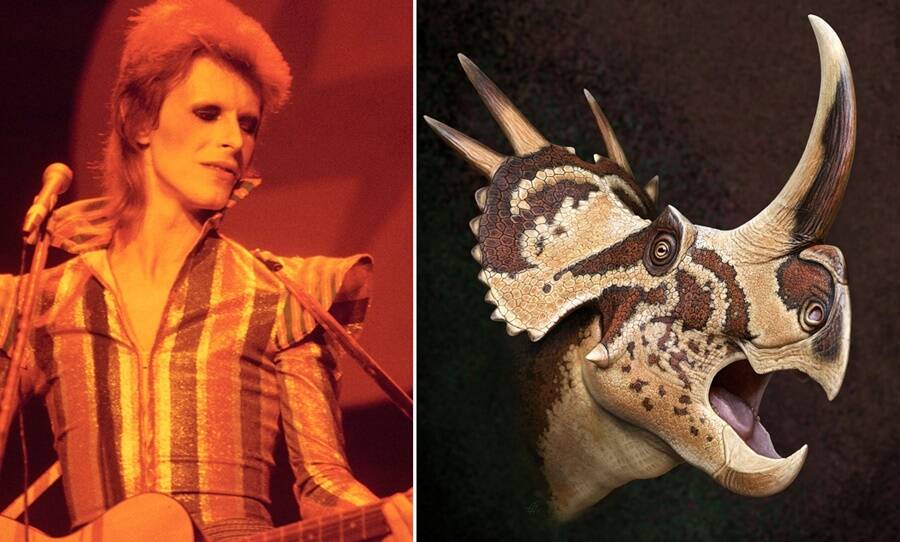
Getty/South West News ServiceThe Stellasaurus is a new species of dinosaur possessing ornate horns and a star-shaped skull. It’s no secret scientists take personal liberties in naming their discoveries. For a newly discovered dinosaur that sported some flamboyant headgear, scientists chose the name Stellasaurus or “star lizard” in honor of the true Starman himself, David Bowie. According to the Daily Mail, fossils unearthed in Montana belonged to a dinosaur that roamed the territory some 75 million years ago. The dinosaur possessed a parrot-like beak, a horn on its nose, bony frills, and a ‘star-like’ skull. The dinosaur genus was given the name Stellasaurus ancellae. The first word is derived from a combination of the Latin word ‘stella’ meaning ‘star’ and ‘saurus’ which is Greek for ‘lizard.’ It will henceforth be the first member of the new genus of Stellasaurus. A study on the new star lizard was published in Royal Society Open Science. The Stellasaurus belongs to the ceratopsians, a group of plant-eating beaked dinosaurs which includes the similar-looking Triceratops. During the Cretaceous period, Stellasaurus stomped around the Earth alongside other ferocious dinosaurs like the Tyrannosaurus rex and raptors. Wilson et alAn isolated partial skull of the ceratopsid with the main bone in the frill at the back of the head. A 20-foot long body that weighed roughly two tons and unique horn features — an important tool for attracting potential mates — distinguished this newly discovered species. “The skull ornamentation is astonishing – almost star-like,” said paleontologist Jack Wilson at Montana State University’s Department of Earth Sciences who is a self-professed fan of British rock. The name of the new dinosaur is a reference to its star-like features and an homage to Bowie, whose song “Starman” was a 1972 hit. Like Bowie’s glam fashions, this dinosaur’s skull was covered with intricate ornaments that were sure to attract attention. Its skull featured a long, upright horn above the nose, pointed horns above the eyes, and a frill at the back of the head with four spikes. “Ceratopsids evolved many different forms of ornamentation on their heads including horns above the nose, eyes and large bony frills which projected from the back,” Wilson said. Their horns and frills were unique and varied between different individuals, he explained, similar to peacocks that each have their own unique set of tail feathers to attract a mate. Wikimedia CommonsStyracosaurus which later evolved into the Stellasaurus. The fossils of the Stellasaurus were first discovered in the town of Cut Bank, near the border between U.S. and Canada in 1986 by paleontologist Carrie Ancell. However, like many fossil artifacts that remain unexamined in museum archives, this ‘Bowie dino’ is only just being reexamined and was finally declared a new species. The Stellasaurus also represents a missing link in the dinosaur family tree. It was preceded by a dinosaur called Styracosaurus albertensis, a heavily-spiked ceraptopsian, which eventually evolved into the Stellasaurus. After that, the Stellasaurus, in turn, evolved into the Einiosaurus. “The ornamental horns and spiky frills on the skulls of these animals are what changed the most through evolution,” Wilson said. “The new species has skull ornamentation which is intermediate…This gives us evidence these species are members of a single, evolving lineage – this type of evolution is called anagenesis.” This hypothesis of evolution was first proposed by the famous paleontologist Jack Horner in 1992. But his theory was not confirmed until the discovery of the Stellasaurus. “The science of Stellasaurus is remarkable and tells the story of millions of years of unbroken evolutionary change within a single lineage,” Wilson said. So you can add evolution to the list of things the Stellasaurus shares with its namesake — an unforgettable artist whose career went through many “ch-ch-changes.” After learning about the newly-discovered Stellasaurus dinosaur named after rock icon David Bowie, read about the largest dinosaur footprint ever found. Then, learn about the Nodosaur dinosaur ‘mummy’ unveiled with its skin and guts intact. The post Recently-Discovered Dinosaur Named ‘Star Lizard’ In Honor Of David Bowie appeared first on All That's Interesting.
Like
Comment
Share
History Traveler
History Traveler
8 hrs

Archaeologists Near Alexandria Just Found A 115-Foot Party Boat Once Enjoyed By Ancient Egyptian Elites
Favicon 
allthatsinteresting.com

Archaeologists Near Alexandria Just Found A 115-Foot Party Boat Once Enjoyed By Ancient Egyptian Elites

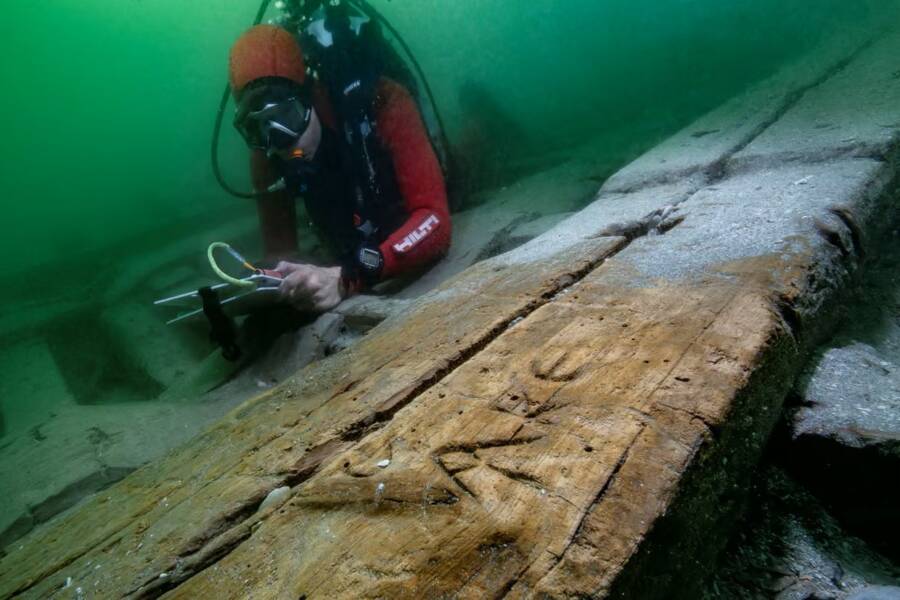
Christoph Gerigk & Franck Goddio/Hilti FoundationThe wreck is about 2,000 years old and matches descriptions of ancient Egyptian pleasure barges written by the Greek historian Strabo. Archaeologists have discovered the 2,000-year-old wreck of an ancient Egyptian pleasure boat off the coast of Alexandria. A type of party barge known as a thalamagos, this vessel dates back to the early years of the first century C.E. It was found in what used to be Alexandria’s ancient port, near the now-submerged island of Antirhodos. Furthermore, the wreck was found about 160 feet from Alexandria’s legendary Temple of Isis, which is currently undergoing excavation. And these are far from the only ancient finds made in this storied setting. However, the boat remains a special discovery, as this is the first ancient Egyptian pleasure barge ever uncovered, despite the fact that scholars had known about their existence for centuries. The Ancient Egyptian Party Barge Found Off The Coast Of Alexandria Christoph Gerigk & Franck Goddio/Hilti FoundationThe boat was designed to be very wide in order to accommodate a center pavilion and cabin. Archaeologists uncovered the boat’s hull, which was more than 115 feet long and 23 feet wide, according to a statement from the European Institute for Underwater Archaeology (IEASM), which organized this underwater excavation. The vessel was extremely wide in order to accommodate a pavilion and an elaborately decorated cabin at its center. Based on the flat design of the hull, the boat was likely used to traverse shallow and calm waters, rather than the open sea. The vessel likely required at least 20 rowers, who moved the boat forward using oars. Archaeologists also uncovered graffiti written in Greek on the boat’s central carling. While the actual message has yet to be deciphered, researchers were able to date it back to the first half of the first century C.E., making the graffiti approximately the same age as the boat. The graffiti also helped archaeologists deduce that the ship was likely made locally in Alexandria, famous for its lighthouse, one of the Seven Wonders of the Ancient World. Christoph Gerigk & Franck Goddio/Hilti FoundationA scan of the full length of the shipwreck. “It’s extremely exciting because it’s the first time ever that such a boat has been discovered in Egypt,” IEASM founder Franck Goddio told the Guardian. Archaeologists concluded that the ship likely sank during a catastrophic series of earthquakes and tidal waves in 50 C.E., when the nearby Temple of Isis was also destroyed. There are several hypotheses as to what the boat was used for. One possibility is that it was used to traverse the canals of Alexandria, probably as a pleasure vessel, but perhaps also for cargo. The other theory is it held some ritual importance and may have belonged to the Temple of Isis. How This Find Fits Into The Submerged History Of Ancient Alexandria Wikimedia CommonsThe Palestrina mosaic features boats similar to the one just found near Alexandria. Goddio added that large pleasure boats such as this one show up in iconography like the famed Palestrina mosaic, a 2,000-year-old Roman work of art depicting scenes of ancient Egypt. A boat like the one found in the wreck was also described by ancient Greek historian Strabo when he visited Alexandria between 29 B.C.E. and 25 B.C.E. “These vessels are luxuriously fitted out and used by the royal court for excursions; and the crowd of revellers who go down from Alexandria by the canal to the public festivals; for every day and every night is crowded with people on the boats who play the flute and dance without restraint and with extreme licentiousness,” Strabo wrote in Geography. This isn’t the first time that archaeologists from the IEASM have uncovered remarkable ancient finds in the waters surrounding Alexandria. In 2000, the team located the submerged city of Thonis-Heracleion. Amongst the numerous finds were two colossal statues of a Ptolemaic queen and king. More recently, in 2019, the team found another shipwreck near the sunken city. This ship matched descriptions written by Greek historian Herodotus. And now, Goddio and his team are excavating the Temple of Isis, located not far from the shipwreck. While research into the wreck is still in its beginning stages, archaeologists are confident that there is much to learn from this astonishing sunken vessel. That said, there are no plans to bring the ship to the surface, as doing so might damage it. But even with the boat still sitting in its watery grave, it may shed much more light on one of the lesser-studied corners of ancient Egyptian history. After reading about the 2,000-year-old boat found near Alexandria, check out the giant blocks from the lighthouse of Alexandria that were pulled out of the Mediterranean Sea. Then, learn about the rise and fall of the Library of Alexandria. The post Archaeologists Near Alexandria Just Found A 115-Foot Party Boat Once Enjoyed By Ancient Egyptian Elites appeared first on All That's Interesting.
Like
Comment
Share
History Traveler
History Traveler
8 hrs

Archaeologists In Virginia Have Uncovered Long-Lost Native American Settlements Described By John Smith In 1608
Favicon 
allthatsinteresting.com

Archaeologists In Virginia Have Uncovered Long-Lost Native American Settlements Described By John Smith In 1608

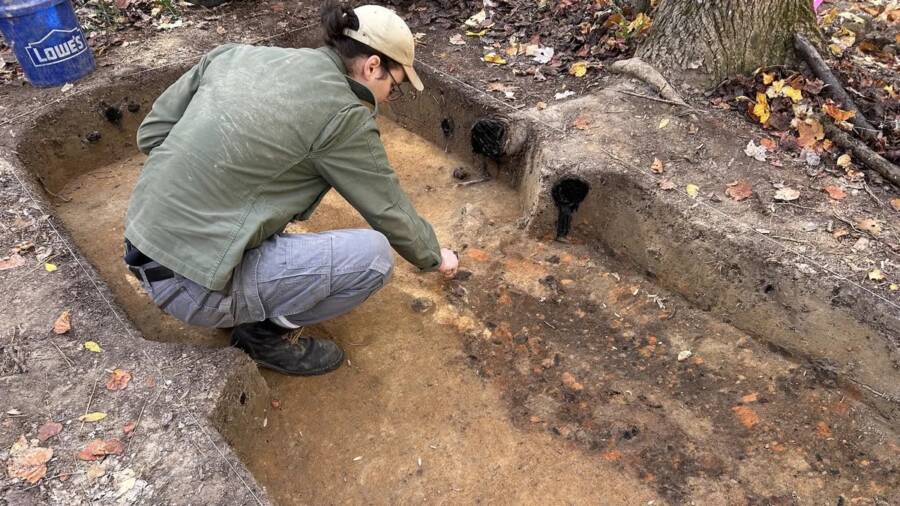
Julia KingA team from St. Mary’s College of Maryland has unearthed 11,000 Indigenous artifacts along the Rappahannock River. Over 400 years ago, English explorer John Smith wrote of several Indigenous settlements along a river in modern-day Virginia. Smith’s journals also described an attack on his men by Native Americans from one of these villages. Yet, no evidence of them had ever turned up. Some scholars disputed Smith’s claims outright. Now, however, archaeologists may have vindicated the explorer’s records. For months, a team of researchers from St. Mary’s College of Maryland has been surveying the land around the Rappahannock River for signs of these early settlements. At first, their work seemed like a lost cause. Then, this summer, the team unearthed thousands of artifacts, including beads, pieces of pottery, stone tools, and tobacco pipes. In total, they uncovered around 11,000 objects that may corroborate John Smith’s journal entries. Lost Villages On Rappahannock Tribal Land When Captain John Smith explored the Rappahannock River in 1608, he wrote down his observations of the land belonging to the Rappahannock tribe. Smith’s journals describe a thriving civilization with at least 14 villages mapped along the river’s northern banks, including three heavily fortified towns atop Fones Cliffs: Wecuppom, Matchopick, and Pissacoack. Smith noted the tribe’s sophisticated use of the terrain, describing villages surrounded by “flat fields” and “cleaner” gardens than those in England. Despite initial hostilities — including an ambush at Fones Cliffs in which warriors camouflaged as bushes rained arrows upon Smith and his men — relations eventually warmed through the mediation of Mosco, a Native American guide. Public DomainEnglish explorer John Smith wrote extensively of Native American tribes in Virginia. As the Washington Post notes, the U.S. government only formally recognized the Rappahannock tribe in 2018. The tribe had been trying to reclaim its ancestral land for years, but that effort proved to be difficult. “Indian people have long known of the land and our history and presence here,” said Rappahannock chief Anne Richardson. “But so often things aren’t considered ‘real’ until they’re found or ‘discovered.'” John Smith was meticulous in keeping records of his travels across America. He spent much of his time mapping the land and writing about the Native American groups he encountered. But he was also a notorious self-promoter. Most historians agree that his maps and basic observations were largely accurate, but other journal entries — such as his encounters with Pocahontas — are clear embellishments, if not outright fabrications. Public DomainSmith’s map of Virginia, which shows Native American territories. This has caused some scrutiny to be applied to his records in more recent years, which has, in part, contributed to the erasure of some of the Rappahannock tribe’s history. Smith wrote about their villages along the river, but since modern researchers had not found any physical evidence to back that up, Smith was dismissed — even when oral histories of the tribe corroborated his account. “My people have lived here since the beginning,” Richardson explained on the podcast Tribal Truths back in 2022. “Rappahannocks would have been able to look down both sides of the river here and see potential enemies or guests coming before they ever got here. And so this was a very strategic place for them to live, for many reasons.” The oral history of the tribe was often dismissed as well. “Oral history gets a bad rap in some quarters because memories are not perfect, but documents aren’t either,” Julia King, a professor of anthropology at St. Mary’s College of Maryland who led the recent excavations at Fones Cliffs, told Live Science. “The strategy is to read both with and against the grain of both sources and to question everything.” As frustrating as that has been for the Rappahannocks, though, new discoveries between 2022 and 2025 have supported their oral history and Smith’s account. Thousands Of Artifacts Found Along The Rappahannock River Julia KingA collection of some of the artifacts unearthed along the Rappahannock River. King and her fellow excavation team members looked both to old documents and the tribe’s oral history to identify the locations of centuries-old villages along the river. They trekked through the woods, dug shallow pits, and hunted for physical proof of the Rappahannock tribe’s presence. Finally, after months of searching, they started to find Rappahannock artifacts — thousands of them. “The presence of these artifacts confirms both oral histories and documents that suggested settlements were located here in 1608, when Captain John Smith spent several weeks mapping the Rappahannock River,” King said. Nearly 11,000 artifacts were uncovered during their excavations, ranging from small beads and shards of painted pottery to stone tools and pipes. All of it was found on land the Rappahannocks have been trying to reclaim — land that John Smith correctly identified as the tribe’s more than 400 years ago. After reading about the Indigenous artifacts unearthed along the Rappahannock River, learn about Jamestown Colony’s “Starving Time.” Then, go inside the story of John Rolfe, the English colonist who married Pocahontas. The post Archaeologists In Virginia Have Uncovered Long-Lost Native American Settlements Described By John Smith In 1608 appeared first on All That's Interesting.

Like
Comment
Share
Twitchy Feed
Twitchy Feed
8 hrs

Parish Erects Nativity Scene With Jesus Replaced by ‘ICE Was Here’ Sign; Christ Child in Zip-Ties
Favicon 
twitchy.com

Parish Erects Nativity Scene With Jesus Replaced by ‘ICE Was Here’ Sign; Christ Child in Zip-Ties

Parish Erects Nativity Scene With Jesus Replaced by ‘ICE Was Here’ Sign; Christ Child in Zip-Ties
Like
Comment
Share
Twitchy Feed
Twitchy Feed
8 hrs

Justice Ketanji Brown Jackson Argues It’s in Americans’ Best Interest to Defer to 'Experts'
Favicon 
twitchy.com

Justice Ketanji Brown Jackson Argues It’s in Americans’ Best Interest to Defer to 'Experts'

Justice Ketanji Brown Jackson Argues It’s in Americans’ Best Interest to Defer to 'Experts'
Like
Comment
Share
RedState Feed
RedState Feed
8 hrs

Shooting at Kentucky State University, One Suspect in Custody
Favicon 
redstate.com

Shooting at Kentucky State University, One Suspect in Custody

Shooting at Kentucky State University, One Suspect in Custody
Like
Comment
Share
RedState Feed
RedState Feed
8 hrs

New Poll Says Local Officials See Political Polarization, Too - Here's How They Are Combating It
Favicon 
redstate.com

New Poll Says Local Officials See Political Polarization, Too - Here's How They Are Combating It

New Poll Says Local Officials See Political Polarization, Too - Here's How They Are Combating It
Like
Comment
Share
NEWSMAX Feed
NEWSMAX Feed
8 hrs

EU Fires Back After Trump Labels Europe 'Weak'
Favicon 
www.newsmax.com

EU Fires Back After Trump Labels Europe 'Weak'

European leaders are pushing back after President Donald Trump slammed the continent as "weak" and in a state of decay.
Like
Comment
Share
NEWSMAX Feed
NEWSMAX Feed
8 hrs

Senate Faces Vote Next Week to Block Trump on Venezuela
Favicon 
www.newsmax.com

Senate Faces Vote Next Week to Block Trump on Venezuela

A Democrat-led effort in the Senate to restrict President Donald Trump's ability to take military action against Venezuela could be headed for a vote next week.
Like
Comment
Share
NEWSMAX Feed
NEWSMAX Feed
8 hrs

Newsom Eases 3rd Trump Term Talk, Flags 2028 Concerns
Favicon 
www.newsmax.com

Newsom Eases 3rd Trump Term Talk, Flags 2028 Concerns

California Gov. Gavin Newsom is downplaying the odds of a third term for President Donald Trump, citing the president's age, even as he accuses Republicans of preparing to "rig" the 2028 race by elevating a Trump-aligned successor.
Like
Comment
Share
Showing 34 out of 102012
  • 30
  • 31
  • 32
  • 33
  • 34
  • 35
  • 36
  • 37
  • 38
  • 39
  • 40
  • 41
  • 42
  • 43
  • 44
  • 45
  • 46
  • 47
  • 48
  • 49
Advertisement
Stop Seeing These Ads

Edit Offer

Add tier


Select an image
Delete your tier
Are you sure you want to delete this tier?

Reviews

In order to sell your content and posts, start by creating a few packages. Monetization

Pay By Wallet

Payment Alert

You are about to purchase the items, do you want to proceed?

Request a Refund