www.thegospelcoalition.org
Bart Ehrman Gives One Cheer for Christianity
Christian ethics, grounded in both the Old and New Testaments, have dramatically shaped Western culture. As Jeremiah Unterman argues in Justice for All, “The Jewish Bible not only changed the course of ethical thought, but advanced it far beyond ancient Near Eastern society and religion in key ethical areas.” Similarly, historian Tom Holland explains in his popular book Dominion “why, in a West that is often doubtful of religion’s claims, so many of its instincts remain—for good and ill—thoroughly Christian.”
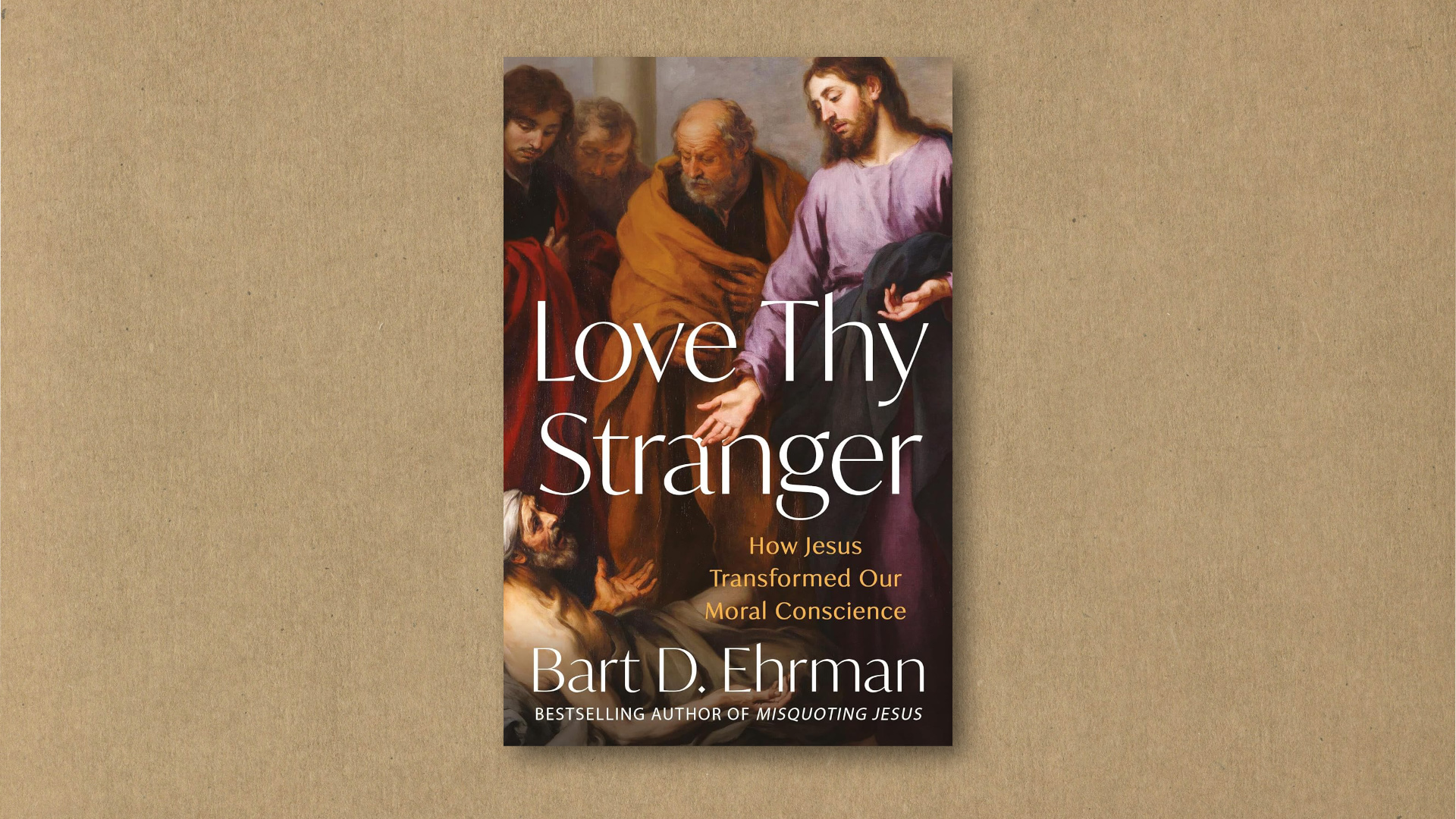
Bart Ehrman, recently retired as professor of religious studies at the University of North Carolina at Chapel Hill, makes a similar case in Love Thy Stranger: How the Teachings of Jesus Transformed the Moral Conscience of the West. He writes, “The impulse to help strangers in need is embedded in Western moral conscience because of the teachings of Jesus. As Christianity spread throughout the ancient world, it revolutionized the understanding of ethical obligation, leading to a fundamental transformation in the moral conscience of the West” (2).
To the extent that Ehrman stays focused on his main thesis, he makes an engaging argument. However, that thesis is often crowded out by Ehrman’s conspiratorial theories about Christianity’s history and complaints that Christians aren’t living up to his narrow interpretations of Scripture.
One Cheer for Christianity
“Thank God for Christianity” (198). Those are words I never expected to read in a book by Bart Ehrman.
Yet when we consider Christianity’s influence on Western culture and the entire world, there’s good reason to be thankful. Though many prosocial aspects of ethics “have been broadly transmitted in our shared genetic code,” Ehrman notes that Christianity brought about a radical shift toward altruistic love of the stranger (44). Other ancient cultures had a code of ethics, but that code generally focused on the good of the family or tribe over a love for the outsider.
Christianity brought about a radical shift toward altruistic love of the stranger.
Ehrman squeezes some solid evidence for his main thesis between jabs at Christians and arguments against the Bible’s truthfulness. For example, he notes that Christianity reshaped the world’s view of the poor: “It was only with Christianity that poverty and hunger broadly came to be seen as problems that required solutions” (68).
Furthermore, he acknowledges, “Today we take for granted that societies will provide hospitals, orphanages, food kitchens, poorhouses, and old person’s homes.” The histories of these institutions began with the commitment of early Christians “to the commands of Jesus” (196). These histories are well attested in books like Rodney Stark’s The Rise of Christianity, Peter Brown’s Through the Eye of a Needle, and Helen Rhee’s Loving the Poor, Saving the Rich.
Ehrman gives at least one qualified cheer for Christianity as he tries to “explain and even celebrate some of the good brought into the Western world by the Christian movement” (219). Coming from one of Christianity’s most persistent public critics, that concession matters, even if he immediately follows it with the reminder that “there were prominent Nazi theologians” (220).
Logical Two-Step
Love Thy Stranger belongs among Ehrman’s popular works. Thus, the lack of meaningful engagement with differing views isn’t surprising. But the mismatch between Ehrman’s handling of Christianity and other worldviews is striking.
I was astonished when, about 100 pages into the book, Ehrman inserts a cautious endnote: “Scholars among my readers will realize how I’m simplifying things here to keep matters clear” (237). My surprise wasn’t about the simplification, which makes perfect sense. Rather, it’s odd that after presenting a caricature of Christian theology for a third of the book, he felt he had to admit to a garden-variety simplification of complicated Jewish perspectives.
Yet that’s par for the course in Ehrman’s oeuvre. He frequently beats the stuffing out of Christian straw men. A college sophomore raised on quarterly church attendance will find many of his arguments convincing. It doesn’t help that, by my count, roughly half of Ehrman’s endnotes are either parenthetical asides or references to his own earlier arguments.
Regarding Ehrman’s previous works, evangelical New Testament scholars like Daniel Wallace, Darrell Bock, and Andreas Köstenberger have highlighted the ways he shifts the ground of arguments, states his preferred perspectives as unchallenged fact, and seems to intentionally misread biblical texts to support his case. Even Larry Hurtado—no evangelical—notes in a charitable review of Ehrman’s 2014 book, How Jesus Became God, that “at points his argument is either somewhat misinformed or dubious.” On his blog, Hurtado more critically notes that “on several matters [Ehrman] seems to rely on now discredited views, or over-simplify or misunderstand things.”
Ehrman’s misrepresentation of Christianity is even more striking in Love Thy Stranger because he fairly, though critically, engages with other ancient philosophical sources in chapters on Greek and Roman ethics. Aristotle’s Nicomachean Ethics gets handled as a text with integrity. Early Christian texts besides the Bible also generally get treated as coherent documents. It’s only biblical texts like the Gospel of Mark that are treated as if they were compiled by illiterate peasants incapable of recognizing obvious contradictions.
Three-Card Monte
A detailed critique of Ehrman’s various arguments would require a book much longer than the one he wrote. I’ll examine one example of his methodology, which relies on an assumed hermeneutic and circular logic to help him make his case.
Assumed Hermeneutic
Ehrman repeatedly states that forgiveness from God without atonement “stood at the forefront of Jesus’s teaching” (199). Though he promotes aspects of E. P. Sanders’s theology, he also argues that early Christians, including Paul, clearly taught the need for atonement for the remission of sin. However, Ehrman insists that Jesus never actually connected himself to atonement.
As someone who has studied Scripture for decades, I was puzzled by this argument. Not least because Jesus states that he came to “give his life as a ransom for many” (Mark 10:45) and that his blood would be “poured out for many” (14:24).
Ehrman anticipated my confusion: “It is interesting to consider why most readers have never noticed that whereas Jesus teaches the forgiveness of sins based on repentance—with no requirement for atonement—Paul, the apostles before him, and most Christians never do.” This confusion, he notes, involves “a kind of academic shorthand scholars use when speaking about the ‘teaching of Jesus.’ When they use that phrase they are referring to the teachings of the historical Jesus, which are not necessarily the words Jesus is recorded as saying in the Gospels” (201). In other words, Ehrman draws a hard line between what he thinks Jesus said and what he believes are other fictional teachings recorded in the Bible.
Suddenly, it makes sense: Ehrman’s argument depends on acceptance of some version of the quest for the historical Jesus. This subtle terminological distinction between what he thinks Jesus said and what the Gospels record is load-bearing in Ehrman’s hermeneutical approach. That distinction should’ve been made explicit sooner.
To be fair, Ehrman’s views on the authenticity of the Bible are confidently stated from the beginning: “Christian leaders adjusted Jesus’s teachings, often altering and almost always softening them for public consumption” (2). But the books early confidence seems to conflict with the caution of later statements. (Could we say there’s a deutero-Ehrman?) For example, “Knowing what Jesus actually said and did is not an easy task: we simply don’t have the kinds of sources historians need for high levels of certainty” (88). He doesn’t present much uncertainty about his views of Jesus throughout the book.
Circular Logic
More interesting to the careful reader, however, is how tightly circular Ehrman’s argument about Jesus’s words can be. Ehrman acknowledges, “If these were words [in Mark 10 and 14] he actually spoke, then [Jesus] would have seen his death as an atonement for sins.” Yet the first reason Ehrman lists to support his assertion that Jesus didn’t talk about atonement is that “if Jesus really said an atoning sacrifice was necessary to appease the anger of God, it would have made no sense for him simultaneously to claim that God freely forgave people when they repented . . . The concepts simply do not gel” (202).
Reading Ehrman is often like watching three-card monte—you have to pay close attention to see where the sleight of hand comes in. He never admits that the problem might be that he’s forcing his definition on the text and that, even if we don’t assume the inerrancy of the Gospels, they should still be read as literary wholes.
Reading Ehrman is often like watching three-card monte—you have to pay close attention to see where the sleight of hand comes in.
Furthermore, the conundrum he’s highlighting is easily resolved by recognizing that a sacrifice always leads to atonement in forgiveness. If my child repents of writing on the wall with crayon and I forgive her without requiring payment from her, then I’m paying the penalty for her disobedience because I have to repair the damage. The atonement comes from my sacrifice.
There’s no necessary conflict between Jesus’s teaching of forgiveness based on repentance and atonement in the Gospel of Mark, either. The triune God of the universe forgives because Jesus Christ, who is God incarnate, atoned for our sin on the cross. When we repent, God forgives without exacting a penalty from us, the offender, because he himself paid the penalty for our sin.
I recognize that Ehrman denies many of the preconditions that harmonize the standard Christian understandings of atonement, repentance, and forgiveness—most notably, that Jesus is God incarnate. Ehrman is entitled to believe Christians are wrong, but he begs the question by presenting Christianity as incoherent because he’s imported contestable and often unstated assumptions. Instead of admitting his disagreement, he represents opposing perspectives as unintelligible.
Forthright Explanation for Christianity’s Rise
The most intriguing aspect of Ehrman’s argument is that he seems to long for a culture infused with a Christian ethic even as he denies the Christian metaphysic. I agree with Ehrman that “Jesus, in the end, transformed the moral conscience of the West” (222). But it’s worth meditating on why that transformation occurred.
One possible explanation is that Jesus’s early followers compiled an amalgam of forged and authentic teachings that obviously conflict with one another so they could be ostracized by their families and communities. Meanwhile, key Christian leaders crafted a religion to gain power while ordinary Christians ignored the inconsistencies and inconveniences of their faith because they were promised an eternal life for which they had no evidence, natural or supernatural. These same people intentionally adopted an ethic that disadvantaged them relative to competing groups, yet they still managed to gain dominance in society and then changed the world for the good.
However, a more forthright explanation is that Jesus transformed the world because he’s actually the Son of God, he rose from the dead on the third day, and the triune God is still at work in this world. Perhaps Jesus’s followers confessed this truth and sought to live their lives accordingly, however imperfectly. And, perhaps, the Bible makes a lot more sense when read as an integral whole rather than a collection of manuscript fragments.
I assigned Ehrman’s Misquoting Jesus to high schoolers in our homeschool New Testament survey. That book is useful because the prose is well written and a consistent theme runs throughout. It also presents many of the popular arguments against the truthfulness of the Gospels in the words of a skeptic. Sifting through Ehrman’s arguments in Misquoting Jesus is helpful as we examine what assumptions he’s making, how his evidence stacks up against Christian rebuttals, and where the logical fallacies hide. Reading books we disagree with drives us to reevaluate our own positions and think more carefully.
Unfortunately, Love Thy Stranger isn’t as useful or as well written as many of his earlier popular works. The further Ehrman moves from his expertise—New Testament textual criticism—the weaker his arguments get. Instead of cleanly arguing for his thesis that Christianity shaped the ethics of the Western world, Love Thy Stranger presents a tangled knot of assumptions and asides that distract from the book’s theme.








 New Posts (Home)
 ChatBox
 Popular Posts
  Game Zone
 Top PodCasts