YubNub Social YubNub Social
    #racism #elections #conservatives #gerrymandering
    Advanced Search
  • Login
  • Register

  • Night mode
  • © 2026 YubNub Social
    About • Directory • Contact Us • Developers • Privacy Policy • Terms of Use • shareasale • FB Webview Detected • Android • Apple iOS • Get Our App

    Select Language

  • English
Night mode toggle
Featured Content
Community
New Posts (Home) ChatBox Popular Posts Reels Game Zone Top PodCasts
Explore
Explore
© 2026 YubNub Social
  • English
About • Directory • Contact Us • Developers • Privacy Policy • Terms of Use • shareasale • FB Webview Detected • Android • Apple iOS • Get Our App
Advertisement
Stop Seeing These Ads

Discover posts

Posts

Users

Pages

Blog

Market

Events

Games

Forum

YubNub News
YubNub News
1 y

Movie Adds Muslims to Story of ‘William Tell’ for Diversity
Favicon 
yubnub.news

Movie Adds Muslims to Story of ‘William Tell’ for Diversity

Switzerland needs to be more diverse and apparently a movie about the life of William Tell also needs to be more diverse. Someone took a look at the legend of William Tell and decided, “this needs more…
Like
Comment
Share
Science Explorer
Science Explorer
1 y

A Man Fated to Get Alzheimer's Avoided It For Decades. But How?
Favicon 
www.sciencealert.com

A Man Fated to Get Alzheimer's Avoided It For Decades. But How?

We can learn from his story.
Like
Comment
Share
Science Explorer
Science Explorer
1 y

Incredible Discovery Shows Mice Trying to Revive Fallen Companions
Favicon 
www.sciencealert.com

Incredible Discovery Shows Mice Trying to Revive Fallen Companions

Mouse-to-mouse resuscitation?
Like
Comment
Share
Conservative Voices
Conservative Voices
1 y

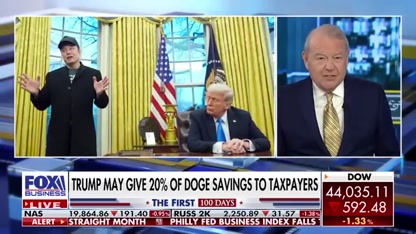
Government should be good stewards of taxpayer money, GOP rep stresses
Favicon 
www.brighteon.com

Government should be good stewards of taxpayer money, GOP rep stresses

Follow NewsClips channel at Brighteon.com for more updatesSubscribe to Brighteon newsletter to get the latest news and more featured videos: https://support.brighteon.com/Subscribe.html
Like
Comment
Share
Conservative Voices
Conservative Voices
1 y

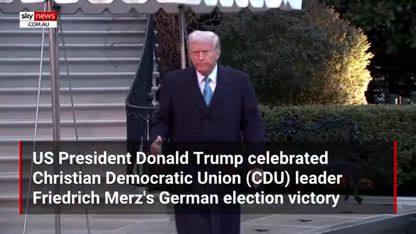
President Trump celebrates Germanys conservative party win
Favicon 
www.brighteon.com

President Trump celebrates Germanys conservative party win

Follow NewsClips channel at Brighteon.com for more updatesSubscribe to Brighteon newsletter to get the latest news and more featured videos: https://support.brighteon.com/Subscribe.html
Like
Comment
Share
Conservative Voices
Conservative Voices
1 y

We Can, and Should, Negotiate with Putin
Favicon 
www.theamericanconservative.com

We Can, and Should, Negotiate with Putin

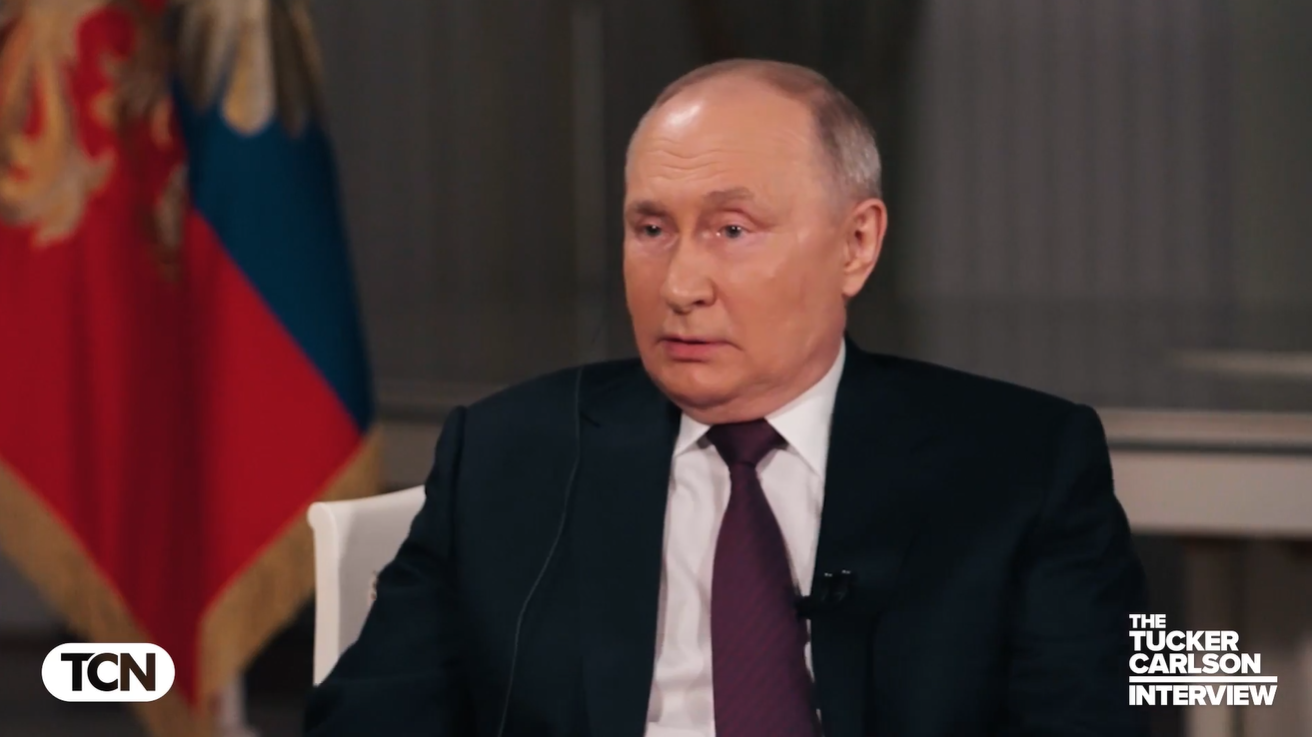
Foreign Affairs We Can, and Should, Negotiate with Putin The West has long tried to delegitimize the Russian president and the nation he leads. One thing at least is now indisputable. We live in a multipolar world. Secretary of State Marco Rubio admitted as much during his wide-ranging interview in January with Megyn Kelly. The recognition that multipolarity is now the kind of world we live in came about, in the first instance, because Russia has not been defeated in Ukraine. Rather the reverse.  To be sure, acceptance of the fact of multipolarity does not dictate the nature of our response to it. Secretary Rubio’s preferred response, as he made clear during his interview, is to embrace—one is tempted to say relearn how to do—the “hard work of diplomacy.”    Other responses are certainly possible. A team writing for Foreign Affairs last fall suggested reinstating a far-going policy of containment of Russia, such as existed during the first Cold War. Former British defense secretary Ben Wallace, for his part, went considerably further: he suggested, in an article published in January, placing Russia “in a prison” and “building the walls high.”  Which path is the right one? Rubio’s strikes me as the best approach, especially if supplemented by what is sometimes termed civilizational realism, a school that does not—as the pure realists are sometimes prone to do—exclude moral considerations from the practice of foreign affairs. Civilizational realists accept the necessity of virtue, but they also have the sophistication to recognize that liberal democracies are not the only states capable of practicing it. As for the idealists, their problem is a tendency to get divorced from reality, and they have an annoying habit of imposing their own version of morality on everyone everywhere—or at least, trying to.  The Catholic theologian and neoconservative political writer George Weigel, in an open letter published shortly after Trump’s re-election last November, outlined the case against Vladimir Putin. It is, perhaps, unfair to single out here only Mr. Weigel, who was simply presenting what has long since become the party line that one can hear repeated on all the cable news channels or read in the Washington Post. His open letter nonetheless conveniently summarizes in one place all the usual accusations against the Russian leader and lays out the usual definition of who Putin supposedly is. Weigel’s letter was addressed to J.D. Vance, then the newly elected vice president. It accused Vance, in effect, of feeling insufficient hatred for the Russian leader, which is immoral.  From Weigel’s perspective, Vladimir Putin: … is a pathological autocrat whose warped worldview and homicidal treatment of political opponents were formed in the moral cesspool of the Soviet Union’s security services. [Vladimir Putin] has openly declared his intention to reverse history’s verdict on the Soviet system. He is conducting a genocidal war in Ukraine to further that ambition. Like the aggressors of the 1930s, he will not stop until he is stopped. The notion that Vladimir Putin intends to keep rolling westward until Russia occupies Poland is easily dealt with. There is no evidence, first of all, for any such wish, which could only come at fantastic cost and without any clear gain. Those who claim to know better than Putin himself his own thoughts can, of course, assert whatever they like.  The emptiness of this charge is nonetheless strongly suggested by the repeated willingness of Vladimir Putin to forego Russian expansion even into Ukraine—other than the retention of Crimea – so long as its critical security concerns, such as no NATO in Ukraine, are observed. We saw this first with the Minsk Accords of Feb. 2015 (Minsk II), and then, I would argue, with the April 2022 peace agreement that was nearly finalized in Istanbul. Had the first of these agreements been honored by Ukraine and its Western backers, and the second not rejected by them, then the Donbas likely wouldn’t be Russian territory today, as Moscow was willing to recognize the region’s autonomous status within Ukraine.   Of perhaps greater interest are the rhetorical devices used by Weigel to associate Putin in the reader’s mind with Hitler and the USSR. He does so by such phrases as “like the aggressors of the 1930s” and by stating that Putin’s thought world was wholly formed “in the moral cesspool of the Soviet Union’s security services.” To drive this same point home, Weigel refers to what he terms Putin’s “homicidal treatment” of his enemies. There have been cases of known enemies of Putin coming to a violent end; and some of those cases may well be traceable to the Kremlin. In the case of Yevgeny Prigozhin, we can be virtually certain of such a connection. In the case of Boris Nemtsov, it appears that Chechen forces at least potentially aligned with the Kremlin were involved. But in a surprising number of other supposedly cut-and-dried cases, including even that of Sergei Magnitsky, the facts are far less clear.  Today, after the West’s repeated rejection of terms of settlement that likely would have prevented the deaths of hundreds of thousands of Ukrainian and Russian men, by the simple device of permitting a neutral Ukraine, there is something simply grotesque about leveling this particular charge against the Russian leader.  For Mr. Weigel, as for the neocon crowd generally, all one needs to know about Putin is that he began his career in the Soviet Union’s security services, the KGB. Reference to this fact about the Russian president’s biography triggers the desired Pavlovian response of fear and loathing, which is why it is constantly repeated, and why the subsequent steps in Putin’s long career are studiously ignored. Let’s fill in some of those lacunae.  After the USSR collapsed, Putin served as first deputy to Anatoly Sobchak, the liberal mayor of St. Petersburg and one of Putin’s former law school professors. When efforts were made to restore the Soviet system in 1991, and then to overthrow Yeltsin in 1993, in both cases Putin stood with those who wanted to continue the process of moving away from the Soviet experience. While serving under Sobchak, Putin became known, as even the harsh Putin critic Masha Gessen has acknowledged, as one of those rare well-placed public servants who never accepted bribes. Philip Short’s 800-page biography of Putin, though not particularly flattering, does not support Weigel’s portrait of a morally corrupt Russian leader allegedly obsessed with restoring the Soviet system. The canard that Putin “openly declared” his “intention to reverse history’s verdict on the Soviet system” traces to the endlessly repeated phrase from Putin’s April 25, 2005 speech to the Federal Assembly. It was here that he famously referred to the collapse of the USSR as a great (or the greatest) geopolitical catastrophe of the 20th century. The Russian language has no definite or indefinite articles, and so the wording is ambiguous and does not make clear whether Putin meant ‘a very great’ or ‘the greatest’ catastrophe.  In any case, for many Russians, it was indeed very great. As Putin immediately stated, explaining his characterization, it was after this collapse that tens of millions of Russians were rendered aliens in foreign countries. After the collapse of state authority, and of the economic system as a whole, and of nearly all institutional structures, the majority of Russians suddenly found themselves destitute and without bearings. This was indeed a most catastrophic experience for his Russian listeners. And yet, the upshot of Putin’s April 2005 speech was that Russia had successfully come through this terrible trial, that it was now a new country committed to democracy and individual freedom. Crucially, this new Russia, Putin emphasized, rejected the Bolshevik idea of engaging in social experiments. “We are not implementing any innovations here,” Putin said. “We are striving to use everything that has been accumulated by European civilization.”  Earlier in that same speech, Putin summarized Russia’s goals in the international arena: border security and favorable external conditions for solving Russia’s internal problems. Putin later, in an interview with German reporters, offered his position on the USSR: “any Russian who does not regret the shattering of the Soviet Union has no heart, but anyone who thinks it can be restored has no brain.” In March 2014, in the immediate aftermath of the Maidan coup, Putin famously urged his governors to read, along with books by more mainstream Russian philosophers, a work called Our Tasks by Ivan Ilyin (1883–1954), the conservative Hegelian and legal scholar.   In it, Ilyin cautions Russia’s future leaders about the dangers that will arise for Russia after the USSR ceased to exist—something he was certain would eventually happen. The rest of the world, in its ignorance of the consequences, would seek the breakup of Russia and, to this end, would provide lots of development assistance and ideological encouragement to those willing to carry out this assignment. These same outside forces would encourage civil wars and bring about all sorts of crises, including for world peace. To avoid that fate, Russian leaders, Ilyin counseled, would need to embrace authoritarian rule for a time, thereby preserving the unity of the state and providing a breathing space for Russia to recover. The political evolution of Putin between 2005 and 2014 is clear enough: He became more hostile to the U.S.-led West. Also clear are the reasons for his growing suspicions. Pressure from the West, including but not restricted to the pressures of an expanding NATO (both de facto and de jure) pushed not only Vladimir Putin, but Russia’s political order more generally, back into a ‘czarist’ framework that has, for centuries, come naturally.   Now, by using the word czarist, I mean to emphasize, mainly, the Russian political order’s hierarchical, vertical, and centralizing logic—not the literal restoration of the czarist order per se, which likely will never return. Democracy too is a noteworthy feature of political life in Russia today, contrary to the confident pronouncements of American cold warriors, though admittedly it exists in an unstable balance with other elements, including that of Christianity, as I have explored elsewhere.   What if Nicholas II was still in power, along with a weak parliament, the Russian Orthodox Church, and even one Pyotr Stolypin hard at work modernizing Russia’s economy? As it happens, such a scenario is surprisingly similar to the Russia we see right now, under Vladimir Putin. Granted, Putin’s Russia is not a liberal, secular democracy. But why should that be a problem for us? It isn’t, and Trump and J.D. Vance are to be congratulated for recognizing that Russia can be dealt with diplomatically to resolve the Ukraine war, and indeed, perhaps even to end a Cold War that seemed to rear its monstrous head during the Biden years. The post We Can, and Should, Negotiate with Putin appeared first on The American Conservative.

Like
Comment
Share
Conservative Voices
Conservative Voices
1 y

The Moralistic Risk for Trump’s Foreign Policy
Favicon 
www.theamericanconservative.com

The Moralistic Risk for Trump’s Foreign Policy

Foreign Affairs The Moralistic Risk for Trump’s Foreign Policy Mirroring liberal interventionist pieties is not the way forward for American diplomacy. As the new Trump Administration turns a critical eye to the priorities of government spending, one target of its investigations seems to be delivering an endless supply of questionable practices for scrutiny. USAID, long theorized to be part of a global soft regime change network by many opposed to the status quo of foreign policy, has been proven to be exactly that. This ranges from manufacturing opposition to the Cuban government, to using progressive identitarian groups to affect elections in Bangladesh, and even to create a feedback loop where American media cites supposedly independent activists abroad (who are funded by USAID)  in order to justify distorting the narrative at home. None of this is particularly surprising to those of us who have been skeptical of the softer side of endless interventionism. Two and a half years ago I published Woke Imperium: The Coming Confluence of Social Justice and Neoconservatism, which made the case that the increasingly messianic nature of progressivism served the cause of moral justification for a foreign policy of endless interventionism abroad; it provides a built-in excuse to be involved in as many foreign countries as possible. Through everything from non-governmental organizations supporting ethnic minorities in geopolitical fault lines to the funding of media that pushes a North American–style cultural vanguardism onto very different societies, a changing domestic audience could be brought into the quest for global domination through a self-flattering moralism. That process is hardly unique to the liberal faction of politics, however. The George W. Bush administration was obsessed with democracy promotion and nation-building as a part of its plan to combat terrorism. It also had a reputation for conflating its own conservative Christian fixation on culture war with foreign policy, such as when its plans to combat AIDS in Africa were tied to abstinence-only education and a ban on condoms, reflecting the administration’s domestic obsession with similar policies at home. It was under such conditions that foreign governments could reasonably claim that American missionaries were tied at the hip to intelligence operations. The present Trump administration’s willingness to question old talking points about foreign policy being a moral project are laudable but inconsistent. In the transactional worldview that Trump emphasized on campaign, there can be little room for such sentiments, yet already there are signs that he is willing to lean into domestic culture war in order to justify unnecessary interventions abroad. Any plan to remake war-shattered Gaza by acquiring it in a real estate deal facilitated by the United States reflects a long line of interventionist thought about the United States playing some kind of providential role in transforming the Middle East. Indeed, USAID itself once cooked up a potential plan for the relocation of Palestinians into new settlements in Egypt. Trump has also made multiple statements opposing South Africa’s prospective land reform legislation which could disproportionately impact ethnically white farmers in the country. This even includes prioritizing white South Africans as potential refugees to the United States, something the administration seems hostile to when applied to other groups of people. Such stated goals, even if purely rhetorical, echo the longstanding trend of American presidents citing the plight of foreign minorities to change domestic policies of sovereign foreign states. Coupled with invoking War on Terror–reminiscent methods to combat cartels, such a posture serves to  manufacture consent for more interventionism, but now in a conservative- rather than liberal-coded way. Likewise, Vice President J.D. Vance’s recent speech at the Munich Security Conference seems to be replicating a new conservative version of the very liberal hubris it appears to decry, admonishing European nations for domestic policies separate from what should be the transactional concerns of their foreign policy positions. Trump’s proposed antisemitism task force risks replicating the same policies of bringing censorship of foreign affairs back home that USAID once proposed as well. By targeting the right to free expression and opposition to conflicts which the U.S. is involved in, it makes universities complicit in a dubious conflation of the actual prejudice of antisemitism with that of opposition to the U.S.-Israeli alliance, a keystone in the world view of bipartisan interventionism. Coupled with recent domestic priorities singling out “anti-Christian bias” for special attention, the possibility that the large and powerful network of pro-Israel Christian conservatives could monopolize discussion on Middle Eastern affairs in a way distracting from an objective national interest. And it is this national interest, divorced from the culture-wars of the United States as well as the domestic policies of foreign nations, that should be upheld first and foremost when pursuing a foreign policy around realist principles. The transactional nature of world affairs, something that Trump has shown he is fully capable of understanding when it suits him, means that seeking a permanent moral ideal or constituency is likely to meet with disappointment, if not a disastrous commitment to an unnecessary engagement. No less a pivotal figure in American history than George Washington once cautioned against ephemeral ideologies and permanent attachments in his Farewell Address of 1796: The great rule of conduct for us in regard to foreign nations is, in extending our commercial relations to have with them as little political connection as possible. So far as we have already formed engagements let them be fulfilled with perfect good faith. Here let us stop. If there is to be a guiding principle in America’s relations with foreign countries it is that of sovereignty, upholding its own independence and ability to pick and choose its engagements of interest, while acknowledging that others also share in this reciprocal right of self-determination. As the internal factions of the Trump Administration debate the future going forward, it would be wise for them to keep this in mind. The post The Moralistic Risk for Trump’s Foreign Policy appeared first on The American Conservative.

Like
Comment
Share
Conservative Voices
Conservative Voices
1 y

The Inside Story of DOGE’s State Department Reforms
Favicon 
www.theamericanconservative.com

The Inside Story of DOGE’s State Department Reforms

Politics The Inside Story of DOGE’s State Department Reforms A radical shift in paradigm and power is afoot at Foggy Bottom. The DOGE tsunami is about to strike the U.S. Department of State, as well as other agencies. Let’s see what that means. The day the music died was January 28, when nearly everyone at State, along with over two million other federal civilian employees, received an email referring to “A Fork in the Road.” The email offered qualifying diplomats and civil servants a choice ahead of planned Reductions in Force (RIFs, layoffs): resign now under a special program, don’t come to work for a few months while being paid, and then in September become eligible for whatever retirement benefits you would otherwise be eligible for, if any. State offers its diplomats a full retirement with pension after age 50 and 20 years of service, similar to the military, and after 30 years for civil servants, all with exceptions of course. Despite the general sense that the buyout was some sort of trick (workers questioned what legal authority allowed State and other federal agencies to pay people who technically resigned, then bring them back into the system to retire), across the government some 77,000 people signed up for the deal before it was brought to a pause by court action. For those with a long way toward formal retirement, it seemed like good enough; ahead of being RIFed, they’d pocket some seven months’ salary on top of whatever severance package might await them when actually let go. The Fork program, as it was commonly now called (alongside the new expression “to get forked”), acquired a formal name, “deferred resignation,” and the paid time off without working became “administrative leave.” An involuntary retirement is called the Orwellian “Discontinued Service Retirement.” The American Federation of Government Employees (AFGE) and others sued to block the “deferred resignation” program, arguing that its chaotic rollout and shifting legal justifications constituted violations of the Administrative Procedure Act’s protections against “arbitrary and capricious” decision-making, and the promise to pay employees past the March 14 possible government shutdown deadline could constitute an Anti-Deficiency Act violation. On February 12 the federal judge who had temporarily blocked the plan reversed course, ending the temporary restraining order upon concluding he lacked jurisdiction in the case. The deferred resignations would be allowed to go forward (though the sign-up deadline has now passed) reducing headcount at State and other federal agencies if everything went as planned. In his decision, U.S. District Judge George O’Toole wrote that the unions’ challenges are of the type Congress “intended for review within the statutory scheme,” referring to the need to file administrative appeals before going to court. There were doubts the Trump administration would or legally could follow through as stated. Everett Kelley, president of the American Federation of Government Employees, called the plan “an unfunded IOU from Elon Musk.” Then things started to get really interesting at State. Trump issued an Executive Order (EO) February 12, stating, inter alia,  The Secretary [of State] shall, consistent with applicable law, implement reforms in recruiting, performance, evaluation, and retention standards, and the programs of the Foreign Service Institute, to ensure a workforce that is committed to faithful implementation of the President’s foreign policy… In implementing the reforms identified in this section, the Secretary shall, consistent with applicable law, revise or replace the Foreign Affairs Manual and direct subordinate agencies to remove, amend, or replace any handbooks, procedures, or guidance…. Failure to faithfully implement the President’s policy is grounds for professional discipline, including separation. Many at State read this as implementation of a “loyalty test” for continued employment. The full scope of the EO will depend on the actual steps taken after its signing, especially the admonition to revise or replace the Foreign Affairs Manual, the set of rules State functions under administratively and policy-wise. It could pave the way for a massive restructuring of State, consolidating power under political appointees and away from diplomatic staff. Then things got really interesting. Nearly concurrent with the February 12 EO, Foggy Bottom HQ sent out a message to all embassies and consulates warning outposts around the world to start planning for staff reductions, according to ABC News. Senior embassy officials were asked to provide comprehensive lists of all employees and their employment status as part of the process, sources said, explaining that the request includes tenured, untenured, and temporary duty assignments. Embassies will be required to cut both American staff and employees hired locally, sources added. The edicts followed a Rubio’s decision not to extend contracts for civilian personnel services contractors (PSC) who provide housekeeping and maintenance at embassies. But PSCs also supplement diplomatic security; roughly half of the Bureau of Diplomatic Security’s contractors fall under the new directive. Contracts in the process of being signed are to be halted and any job postings made after the inauguration of Donald Trump are to be rescinded. Only State’s domestic passport PSC operations staff are exempted (a smart move in that it limits direct public impact from an otherwise nearly totally foreign-facing organization.) Trump wasn’t finished. In another EO, he declared,  Agency Heads shall promptly undertake preparations to initiate large-scale reductions in force (RIFs), consistent with applicable law, and to separate from Federal service temporary employees and reemployed annuitants working in areas that will likely be subject to the RIFs. All offices that perform functions not mandated by statute or other law shall be prioritized in the RIFs, including all agency diversity, equity, and inclusion initiatives; all agency initiatives, components, or operations that my Administration suspends or closes; and all components and employees performing functions not mandated by statute or other law who are not typically designated as essential during a lapse in appropriations as provided in the Agency Contingency Plans on the Office of Management and Budget website. This subsection shall not apply to functions related to public safety, immigration enforcement, or law enforcement. The uniformed military and postal service employees are also exempt. That means State, along with other agencies, is going to have to soon start firing people. The EO led directly to State’s diplomatic union issuing an urgent message to its members, explaining,  Agencies have 30 days to submit reorganization plans to the Office of Management and Budget (OMB). The implementation of these plans will include RIFs. The executive order does not specify when RIFs will begin… Section 611 of the Foreign Service Act allows for RIFs. This section also requires the creation of rules for letting go of career and career candidate members under Chapter 3 of the Act. The regulations note that the retention hierarchy in the event of a RIF should be based on the following: organizational changes; employee knowledge, skills, or competencies; tenure of employment; employee performance, and military preference. Regulations allow for 120 days notice to the RIFed employee though note under some special circumstances the notice need be only 30 days. They go on to say while an employee may file a grievance against the RIF, the grievance will not delay separation and is limited only to cases of reprisal, interference in the conduct of the member’s official duties or similarly inappropriate use of RIF authority. The current understanding is that RIFed employees, if otherwise eligible, can receive their retirement pensions. Ineligible RIFed employees will likely lose their healthcare and life insurance as best as things are understood. But this is far from over and no one knows how it will end. “We do need to delete entire agencies, as opposed to leave part of them behind. Just leave part of them behind. It’s easy. It’s kind of like leaving a weed,” Elon Musk said. “If you don’t remove the roots of the weed, then it’s easy for the weed to grow back.” Everything is in flux at present and no one should make any decisions based on this or any other article. But what is clear is that this time Trump means business. Unlike the small-scale RIF which took place at State during the Clinton administration, this time it’s for real, a seemingly determined effort to downsize the State Department both at home and abroad while at the same time likely increasing the authority of political appointees. It is both a paradigm shift and a power shift away from a more-or-less independent State Department (and other agencies) toward a concentration of power higher in the executive branch. The post The Inside Story of DOGE’s State Department Reforms appeared first on The American Conservative.

Like
Comment
Share
Strange & Paranormal Files
1 y ·Youtube Paranormal

YouTube
Watch scary videos LIVE!
Like
Comment
Share
BlabberBuzz Feed
BlabberBuzz Feed
1 y

GOP Rep Sounds The Alarm On Trump's EOs!
Favicon 
www.blabber.buzz

GOP Rep Sounds The Alarm On Trump's EOs!

Like
Comment
Share
Showing 58147 out of 121026
  • 58143
  • 58144
  • 58145
  • 58146
  • 58147
  • 58148
  • 58149
  • 58150
  • 58151
  • 58152
  • 58153
  • 58154
  • 58155
  • 58156
  • 58157
  • 58158
  • 58159
  • 58160
  • 58161
  • 58162
Advertisement
Stop Seeing These Ads

Edit Offer

Add tier


Select an image
Delete your tier
Are you sure you want to delete this tier?

Reviews

In order to sell your content and posts, start by creating a few packages. Monetization

Pay By Wallet

Payment Alert

You are about to purchase the items, do you want to proceed?

Request a Refund