www.civilwarmonitor.com
Voices at Triune
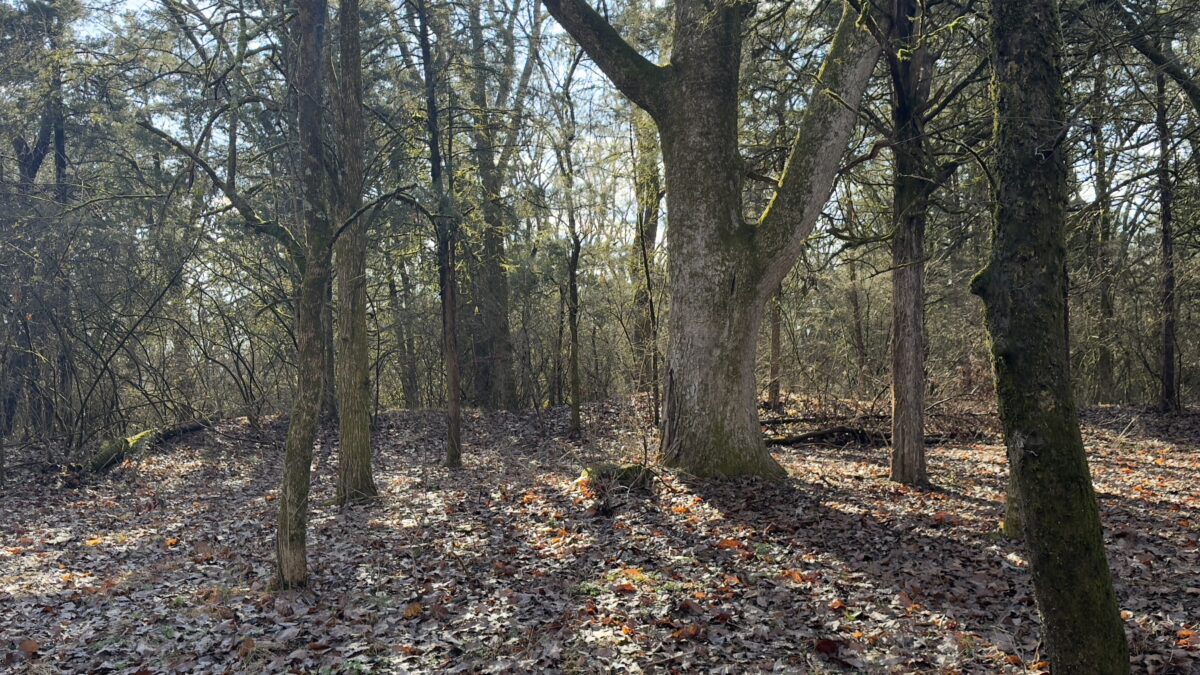
John BanksRemnants of Union earthworks at Triune, Tennessee.
When tramping the unheralded Triune earthworks—a 20-minute drive east of Franklin, Tennessee—it helps to listen. To the clatter of construction from nearby million-dollar homes. To leaves rustling underfoot. To the low, distant rumble of a passing train.
And if you listen long enough, you may hear something else: the echoes of the Civil War, the murmured voices of soldiers from Pennsylvania, Iowa, Minnesota, and beyond. Built by the Union army in early 1863, these defenses endure as a quiet but powerful testament to what’s left of Middle Tennessee’s wartime past.
A Pennsylvania cavalryman captured Triune’s importance then. “Yesterday your correspondent had occasion to visit Triune, the centre of the Army of the Cumberland,” he wrote that spring. “The place is well defended by nature’s handwork, and made doubly strong by the aid and ingenuity of man.”1
More than 160 years later, man’s ingenuity is at work here again: a developer is carving roads and lots where rifle pits once ran, erasing earthworks to make way for mansions. “Like putting a tent in a church,” my fellow tramper Jack Richards says.
But not all is lost. Working with the developer, the Battle of Franklin Trust has saved more than 14 acres. Eric Jacobson, CEO of the trust, told me, “Our goal was to save what we could of the historic landscape. From there, we’ll open it to the public occasionally. It was one of the easiest preservation efforts ever—the developer donated this land.”
But before it is transformed into a gated community, we hike the same hills thousands of soldiers once did.
Library of CongressUnion general James B. Steedman
Under the direction of Brigadier General James B. Steedman, Union troops raised the Triune earthworks between January and March 1863, shaping a chain of defenses across three hilltops roughly a mile and a half north of town. Three redoubts (log-and-earthen forts) crowned the heights. Artillery positions and powder magazines stood ready. Trenches and rifle pits stitched the hills together.
Triune’s geography made it indispensable. Throughout 1863, the area saw near-constant military activity. The fortifications served as a signal post between Franklin and Murfreesboro.
“You get a sense here that we’re on top of the world,” Richards says as we stand inside a redoubt site. Along nearby Nolensville Pike, a strategic wartime artery, traffic hums in the present day.
“Look at the hole,” I say, pointing near the base of a massive oak—perhaps a witness tree. “Must be diggers.”
Relic hunters have scoured the ground for more than a century, unsurprising considering the thousands of troops who encamped in the area. What remains on the surface now tells a quieter, stranger story: a child’s rusted toy wagon, an old engine block, barbed wire, a tire with a tree growing straight through its center—modern debris resting atop ground once shaped for war.
I’m less interested in what artifacts may lie here, above or below the surface, than in the stories—some mundane, some not—of those who once called this place home. Soldiers like Mathias Jacob Sontag, a German-born private in the 2nd Minnesota Infantry.
Somewhere at Triune in 1863, Sontag dreamed he would be shot but spared through a prayer from his aunt to the Virgin Mary. The dream lingered. He counted the days.
Then came marching orders, extra rations, and double ammunition. One morning, as his regiment advanced toward the sound of artillery and halted at the foot of a mountain, a shell burst nearby. An iron fragment as “big as a man’s hand” passed over Sontag and a comrade and dropped harmlessly on an oilcloth between them.2
A prayer may have saved Sontag in 1863. Fifty years later, and long the stepfather of his wife’s two sons (who grew up to become notorious train robbers), Sontag died at 81 in a cyclone that hit his home in Eagle Butte, South Dakota.3
Another Union soldier wrote of how comrades treated the enemy out here in the wilds at Triune, 30 miles south of Nashville. “The 1st East Tennessee Cavalry (U.S.) are perfect whales, and are the pets of this division,” wrote “Felix” to an Ohio newspaper in late winter 1863. “They handle the rebels without gloves on all occasions; they go on the principle ‘that those who are not for me are against me,’ and deal with them accordingly. Their idea is to put down the rebellion; everything that is useful to the enemy is taken or destroyed, whether of any benefit to us or not.”4
We move through the woods the way soldier skirmishers might have, walking briskly, stopping, listening, changing direction, slipping past windblown limbs and picking our way across steep ground.
“Remember our No. 1 rule,” Richards jokes. “No one gets killed on these adventures.”
Brambles tug at my sweatshirt while history tugs at my soul. I think strange thoughts: Where the hell did they put the latrines? And I wonder what became of the East Tennessee man who wrote from Triune of the war’s immense toll.
“Our homes are in the hands of a bloody and cruel enemy,” that Union soldier said in a letter published in The Nashville Daily Union. “We know not how soon the fiends incarnate may murder our fathers, and brothers, and even our mothers and sisters, that we have left behind us.”5
Exploring earthworks near a modern road, our guide Greg Wade and I lament the 21st century’s jabbing a sharp elbow into the 19th century’s midsection.
“That’s hard to look at right there,” he says, pointing toward a mega-mansion under construction in the near distance. “Soldiers camped in that field where they’re building that house.” Perhaps a soldier named “Harry” was among them.
“Here at Triune are fields so large that divisions can drill together,” he wrote to his hometown newspaper in Ohio, “and Captain Southwick takes the three batteries of his command and drills them together. It is a splendid and exciting spectacle to witness.”6
John BanksA large house being constructed near the Triune earthworks
Deep in the woods, the earthworks wind like a giant, unruly serpent. Some rise only two or three feet. Others tower above me. We search for the remains of a powder magazine, spied by Wade years ago, but come up empty. He speculates that Union soldiers may have formed for review on a flat stretch of ground near our parking spot. That pond in the woods? Perhaps that’s where soldiers bathed themselves and watered their horses.
Besides the risk of disease, the army endured another, quieter malady: boredom. “Everything quiet along our front this morning,” a Union soldier wrote from his Triune camp in April 1863. “The pickets bask in the warm sunshine undisturbed.”7
No major battles were fought at Triune—but not for a lack of trying. Skirmishes flared at least 11 times between March and June 1863. Cavalry patrols rode the surrounding roads, watching and waiting.“
There has been some cannonading in front to-day, but nothing serious or startling has occurred,” a 99th Ohio Infantry soldier wrote from his Triune camp in early June 1863. “‘Rosey’ [Union general William Rosecrans] is trying to draw them out of their entrenchments, and if he succeeds you will hear of one of the ‘big fights’ of the war. Everybody here is anxious to have it come off soon, as the warm season is rapidly approaching, when it will be very uncomfortable to fight, and much more so to nurse a wounded leg or arm.”8
At a clearing, fresh pavement for a circle drive and a real estate sign announce the future. The clatter of construction serves as a countdown clock in my head. Time is running out on much of the Triune earthworks—300 acres of Civil War history.
What disappears here won’t be just dirt and timber, redoubts and rifle pits. It will be the chance to stand where they stood, to hear what they heard, to feel what this ground once meant. Most of all, Triune risks fading far deeper into memory.
John Banks is author of A Civil War Road Trip of a Lifetime and two other Civil War books. A longtime journalist (The Dallas Morning News, ESPN, The History Channel), he is secretary-treasurer of The Center for Civil War Photography. He lives in Nashville with his wife, Carol.
The post Voices at Triune appeared first on Civil War Monitor.








 New Posts (Home)
 ChatBox
 Popular Posts
  Game Zone
 Top PodCasts