YubNub Social YubNub Social
    #jesuschrist #christmas #christ #merrychristmas #christmas2025 #princeofpeace #achildisborn #noël #sunrise #morning
    Advanced Search
  • Login
  • Register

  • Day mode
  • © 2025 YubNub Social
    About • Directory • Contact Us • Developers • Privacy Policy • Terms of Use • shareasale • FB Webview Detected • Android • Apple iOS • Get Our App

    Select Language

  • English
Install our *FREE* WEB APP! (PWA)
Night mode toggle
Community
New Posts (Home) ChatBox Popular Posts Reels Game Zone Top PodCasts
Explore
Explore
© 2025 YubNub Social
  • English
About • Directory • Contact Us • Developers • Privacy Policy • Terms of Use • shareasale • FB Webview Detected • Android • Apple iOS • Get Our App
Advertisement
Stop Seeing These Ads

Discover posts

Posts

Users

Pages

Blog

Market

Events

Games

Forum

History Traveler
History Traveler
1 y

Treaty of Tordesillas: Division of the “New World”
Favicon 
www.historydefined.net

Treaty of Tordesillas: Division of the “New World”

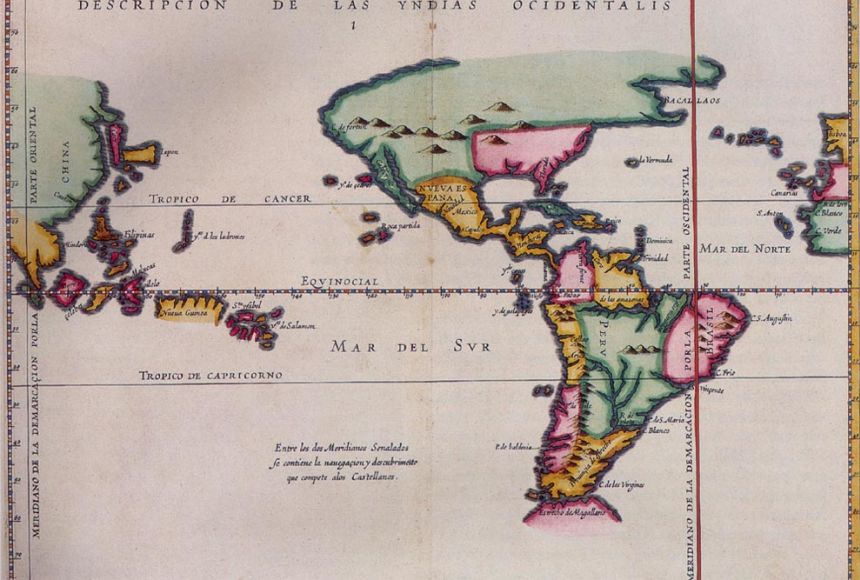
It’s hard to imagine a time when the U.S. was just a pawn in another country’s machinations. But that was exactly what happened in the Treaty of Tordesillas, which was signed on June 7, 1494.  Back then, there was no United States of America. Instead, there was a “New World” and it was to be divided between two superpowers, Spain and Portugal.  Let’s take a look at the events leading to the Treaty of Tordesillas and its impact on the world.  Background It’s hard to determine the oldest country in the world because there are different criteria. However, Portugal is considered the oldest nation in Europe based on when it set up its borders sometime in 1139 BCE. Portuguese explorers traveled the world and colonized Atlantic islands in the 1400s.  Not to be outdone, Spain, which already had a larger territory than Portugal, also set off to conquer territories around the world. By the 1500s, Spain had become a dominant European power.  It all started when Italian explorer Christopher Columbus reached the Americas on a voyage sponsored by the Crown of Castile, which was the most powerful kingdom in the Iberian Peninsula at that time. He departed Palos de la Frontera on August 3, 1492, with three ships under his command, the Santa Maria, Pinta, and Niña.  The voyage reached the following lands: Bahamas  Cuba  Hispaniola Haiti  Dominican Republic All along Columbus thought he had reached Asia, which was always his intended destination, not the Americas. When Columbus wrote a letter to the Spanish court about his discovery, King Ferdinand II and Queen Isabella I of Castile and Aragon immediately sought papal support to prevent Portugal from interfering with their claim on the New World.  Pope Alexander VI responded positively with papal bulls that set up a demarcation line about 100 leagues or 320 miles west of Cape Verde Islands. Based on the papal bulls, Spain had exclusive rights over newly discovered and yet-to-be-discovered lands west of the line.  Columbus’ letter to the Spanish crown spread like wildfire throughout Europe. Plus, Columbus also stopped by Lisbon before returning to Spain. He spoke to Portuguese King John II about the islands southwest of the Canary Islands. King John II was miffed when he heard about the papal bulls because these implied that Portuguese exploration would have to be limited to the east of the line. It did not sit well with Portugal as it left the country with little leeway to continue the exploration of Africa.  In a threatening letter to the Spanish monarchs, King John II said that all the islands that Columbus discovered belonged to Portugal by virtue of the Treaty of Alcacovas.  What Is the Treaty of Alcacovas? Before Columbus’ exploration, there was already an agreement between Castile and Aragon on one hand and Portugal on the other regarding the distribution of territories. Castile and Aragon were two provincial kingdoms in Spain. Representing Spain were the Catholic Monarchs of Castile and Aragon while Portugal authorized then-Prince John.  The Treaty of Alcacovas treated many disputes that involved different groups. One of the issues it dealt with was the agreement signed on September 4, 1479. It divided the Atlantic Ocean into two zones of influence.  Under the earlier treaty, Portugal owned most of the disputed territories. Castile had rights over the Canary Islands while Portugal had navigation rights over all Atlantic Ocean territories south of the Canary Islands.  To settle the renewed territorial dispute, the parties met in Tordesillas.  The Treaty of Tordesillas The Spanish town of Tordesillas was the venue for the meeting between the leaders of Spain and Portugal. Together, they would decide on the delineation of territories.  The Treaty of Tordesillas followed the principle of dividing the New World territories. Western territories were given to Portugal and the eastern territories went to Spain. However, they amended Pope Alexander VI’s demarcation line to make things fairer for both parties.  On June 7, 1494, ambassadors and barristers representing King Ferdinand II and Queen Isabella on one side and King John II on the other met in Tordesillas. After much discussion, the demarcation line was moved to 370 leagues to the west of Cape Verde Islands.  For those wondering why Brazilians speak Portuguese, the Treaty of Tordesillas is the answer. It fell within the territories of Portugal while most of the other Latin American countries spoke Spanish.  What Portugal was really protecting in the Treaty of Tordesillas was the route that led to India.  The border wasn’t strictly enforced and Spain didn’t try to contradict Portugal when it expanded Brazil across the meridian. It was hard to be strict with demarcations when it was only mentioned in the agreement. The parties also didn’t know the exact circumference of the earth. The best way to fairly divide the assets was through a joint exploration. However, the planned joint voyage never happened.  Treaty of Zaragoza As both nations continued their exploration and discovery of the world, they realized the need to amend the earlier Treaty of Tordesillas.  The Treaty of Zaragoza was another peace agreement between Castile and Portugal signed on April 22, 1529, or close to 35 years since the agreement in Tordesillas. This time, the treaty established the superpowers’ territories in Asia.  It all started when Portugal conquered the city-state of Malacca in 1511 and established a trading route that included the Maluku Islands or the Spice Islands. It was called the Spice Islands because of the cloves, mace, and nutmeg that exclusively grew in the area at that time. Portugal controlled the spice trade in the Spice Islands. Spain got wind of the activities because it was also exploring Asia.  Between 1525 and 1528, both countries explored the areas surrounding those islands. More territories were discovered in the process. During this time, Portugal was ruled by King John III while Spain was ruled by King Charles V who was concurrent Holy Roman Emperor and Archduke of Austria.  Instead of continuing to fight over territories, the two parties chose to form alliances through marriage and treaties. King John III married King Charles V’s younger sister, Catherine of Austria on February 10, 1525. King Charles V also married King John III’s sister, Isabella of Portugal on March 11, 1526.  The Treaty of Zaragoza was signed on April 22, 1529, with the two kings representing their countries.  The Agreement Under the Treaty of Zaragoza, the demarcation line was 297.5 leagues east of the Maluku Islands. The islands remained under Portuguese control in exchange for 350,000 gold ducats, the European currency at that time. Since both parties were friendly with one another, there was a clause that the agreement could be revoked if either of them wished and the money would be refunded.  The treaty was never revoked because Charles V needed the money as Austria and Spain were in the middle of the War of the League of Cognac. It didn’t even matter that the portion was purportedly unequal. Portugal controlled almost all of Asia, at least, those that were discovered at that time. Spain had most of the Pacific Ocean.  While the Philippines was not implicitly mentioned in the treaty, it was supposed to be west of the line, which means that it belonged to Portugal. However, Spain successfully established control over the country without opposition from Portugal because of the lack of spices in the Philippines.  Treaty of Madrid Just as they established a solid agreement with the Treaty of Zaragoza, another treaty was signed on January 13, 1750, 271 years since the first agreement in Alcacovas.  The Treaty of Madrid erased the demarcation lines established in the earlier Treaties of Tordesillas and Zaragoza. The 1750 treaty settled many disputes: It established boundaries between Portuguese Brazil and Spanish colonial territories in Latin America. Spain agreed to the Brazil expansion fixed by Portugal. Portugal recognized Spain’s claim to the Philippines Both parties agreed to support each other in case a third power attacked or conquered their American colonies  Treaty of Tordesillas on Display The United Nations Education, Scientific, and Cultural Organization or UNESCO has preserved the Treaty of Tordesillas through its Memory of the World Programme. The original copies of the treaty are stored at the General Archive of the Indies in Spain and the Torre do Tombo National Archive in Portugal.  What Is the Relationship Between Spain and Portugal Today? Based on the treaties mentioned, Spain and Portugal had a hot and cold relationship that was akin to sibling rivalry. While both are located in the Iberian Peninsula, each has distinct characteristics. Spain is geographically larger than Portugal by a large margin. As the bigger sibling, Spain was somewhat condescending toward its smaller sibling.  As a Washington Post article from 1983 read, “Spaniards display the same kind of condescension toward Portugal that the French show toward Spain: a big-brother attitude toward a smaller, more backward neighbor.”  While Spain and Portugal will always have a rivalry, they continue to deepen their bilateral relations. They are no longer in conflict and there will never be another Treaty of Tordessilas that sets demarcation lines again. Besides, Spain and Portugal are no longer the superpowers they used to be. The post Treaty of Tordesillas: Division of the “New World” first appeared on History Defined.

Like
Comment
Share
Conservative Voices
Conservative Voices
1 y ·Youtube Politics

YouTube
Druze Lives Matter | Real Talk
Like
Comment
Share
Conservative Voices
Conservative Voices
1 y

After Assassination Attempt on Trump, Some Want to Hold Gun Owners Responsible for Government Failures
Favicon 
www.dailysignal.com

After Assassination Attempt on Trump, Some Want to Hold Gun Owners Responsible for Government Failures

Almost immediately after a gunman tried to kill Donald Trump as he spoke July 13 at a campaign rally in Butler, Pennsylvania, gun control zealots twisted the assassination attempt into an opportunity to blame the Second Amendment and lawful gun owners. They, as they so often do in the aftermath of any national news story involving the criminal misuse of firearms, immediately demanded restrictive gun control. Some journalists even went so far as to insinuate that the former president essentially brought this on himself because of his pro-Second Amendment stance when he was president. Perhaps they should have waited for just a few breaths before making fools of themselves. Now, over two weeks later, we know that it wasn’t the Second Amendment or Pennsylvania’s allegedly lax gun laws that almost got Trump killed. Rather, it was government ineptitude. The number of inexplicable decisions and unanswered questions about Trump’s Secret Service security detail that day is long and seems to be growing with every news cycle. And so far, this appears to be one of the most egregious failures in the history of government-provided personal protection. It rivals the night that President Abraham Lincoln’s security guard left his post outside the President’s Box at Ford’s Theatre and got roaring drunk at a bar across the street. This is, of course, far from the first time that gun control activists have sought to leverage an emotionally charged atmosphere to further their own agenda. These efforts typically occur in the aftermath of mass public shootings, but high-profile political assassinations have successfully been used to garner support for gun control legislation. Federal law today generally prohibits the importation of foreign-made firearms for civilian sales, in large part because the gunman who fatally shot President John F. Kennedy in 1963 used a bolt-action rifle initially designed and manufactured for the Italian army and later imported as a military surplus weapon to be sold on the civilian market. Similarly, the foundation of the current federal background-check system for gun sales was put into place in 1993 and named after James Brady, the White House press secretary left partially paralyzed during the 1981 assassination attempt on President Ronald Reagan. Reagan’s shooter had a significant history of serious mental health issues and weapons-related criminal offenses that prohibited him from legally purchasing or possessing firearms. This is something that, under the Brady Act’s mandatory background check required for licensed dealers, would’ve been detected by the pawn shop at which the shooter purchased the gun with which he shot Reagan. During these previous assassination-based pushes for more gun control, activists’ demands were at least related (if only nominally, in the case of Kennedy’s assassin) to how the gunman acquired his weapon. That’s clearly not the case here. Forget, for just a minute, the serious constitutional concerns inherent with so many of these policies. Forget, too, that basing national gun policy on preventing the rarest forms of gun violence is an irrational and ineffective way to do public policy. The simple reality is that not one of the policies demanded by gun control activists in the wake of the Trump shooting would meaningfully affect the dead suspect’s ability to carry out his plan. This wasn’t about a lack of “universal” background checks. The shooter’s father legally purchased the weapon over a decade ago from a federally licensed gun store, where he would have been required to pass a background check. Officials initially believed that the 20-year-old shooter asked to borrow the gun on the day of the Trump shooting, something to which his father agreed and didn’t find out of the ordinary. Officials now believe that the suspect had, at some point, legally purchased the gun from his father. It doesn’t matter. Even if the shooter legally purchased the weapon through a private intrastate sale—the only type of sale for which background checks currently aren’t required under federal law—imposing a mandatory background check on that sale wouldn’t have changed anything. The shooter wasn’t a prohibited person whose attempt to purchase a gun would have been prevented by a failed background check. FBI officials confirmed that he had no prior criminal history, and there’s no indication he struggled with serious mental health issues that would have legally disqualified him from gun ownership. This is only reinforced by the fact that he’d recently passed a background check for his job as a dietary aide at a nursing home. Nor was this a problem with Pennsylvania’s open-carry laws, as some have suggested. Yes, the state generally allows ordinary, law-abiding adults to carry rifles openly in public spaces. But state and federal law enforcement can (and routinely do) set up secure perimeters around special events and prohibit people from carrying weapons in the vicinity of campaign rallies. There’s absolutely no evidence at this point that open-carry laws were in any way relevant to any security decisions made by the Secret Service or local police that day in Pennsylvania. The gunman wasn’t exactly walking around with his rifle visible, but rather appears to have concealed his rifle in a backpack until he climbed atop the roof from which he shot at Trump. Some sources say they believe that he’d stashed the weapon on the roof days in advance. And let’s be honest: If the shooter had openly carried a firearm, there’s simply no world in which a rifle-wielding civilian standing just outside the perimeter of a presidential campaign rally isn’t going to be treated as a serious threat. In fact, this is precisely why bystanders were so concerned when they saw a man on the roof with a rifle and tried so hard to alert police. Open-carry laws don’t magically prevent rational people from comprehending atypical and unusually threatening circumstances.   And this shooting certainly wouldn’t have been prevented if Pennsylvania banned the possession of so-called assault weapons. The simple reality is that none of the cosmetic features that distinguish an “assault weapon” from a “non-assault weapon” were relevant to the shooter hitting his target. If anything, had the gunman used a more traditional “precision” hunting rifle with a larger caliber round, longer barrel, and a bipod attachment, he may well have been more accurate from that distance. A lack of “assault weapon” features hasn’t stopped previous would-be assassins, in the slightest. Kennedy was fatally shot with a bolt-action rifle that ironically wouldn’t be condemned today by gun control advocates as an “assault weapon” or “weapon of war,” despite having been literally produced for military arsenals. Similarly, the man who killed the Rev. Martin Luther King Jr. in April 1968 used a pump-action rifle that, despite firing a far more powerful round than the rifle used to shoot at Trump, would escape “assault weapon” designations. Both the man who killed Sen. Robert F. Kennedy in May 1968 and the man who attempted to kill Reagan 13 years later used revolvers. Handguns also were used in the 2002 assassination of New York City Councilman James E. Davis; the 2008 mass shooting at a Kirkwood, Missouri, City Council meeting that killed Mayor Mike Swoboda and five others; and the 2011 shooting in Tucson, Arizona, that killed a federal judge and seriously wounded Rep. Gabby Giffords. The list of utterly irrelevant gun control restrictions proposed in the aftermath of the attempted assassination of Trump goes on. Magazine capacity limits? The suspect fired fewer than 10 rounds, as has been the case in virtually every successful or attempted assassination involving a firearm in the nation’s history. Waiting periods? The shooter didn’t use a recently purchased weapon and this seems to have been anything but a spur-of-the-moment decision. Safe storage laws? Trump’s shooter was a 20-year-old adult who used his own legally possessed firearm, not a minor or prohibited person who accessed another gun owner’s unsecured weapon. Raising the age of commercial gun sales to 21? While such a law would prohibit gun stores from selling to individuals under age 21, they wouldn’t prohibit mere possession for law-abiding young adults. Such laws also universally allow for parents to transfer long guns to their non-prohibited adult children—the exact type of transfer that happened here. It doesn’t matter how you spin it. Pennsylvania’s gun laws are completely irrelevant to the attempt to assassinate Trump. That’s because, at the end of the day, this isn’t a story about failed gun laws. This is a story about a series of government failures—failures for which gun control activists now want to punish ordinary, peaceable gun owners.    We ought not let them. The post After Assassination Attempt on Trump, Some Want to Hold Gun Owners Responsible for Government Failures appeared first on The Daily Signal.
Like
Comment
Share
Conservative Voices
Conservative Voices
1 y

Despite Publicly Hyping Kamala Harris, Democrats Are Singing a Different Tune in Private: Report
Favicon 
www.westernjournal.com

Despite Publicly Hyping Kamala Harris, Democrats Are Singing a Different Tune in Private: Report

The Democrats and their allies in the media may be singing Kamala Harris's praises in public, but don't be fooled. As it turns out, they don't like old "Laughin' Kamala" any more than the rest of us. In fact, a new report revealed Harris' allies are singing an altogether different,...
Like
Comment
Share
Conservative Voices
Conservative Voices
1 y ·Youtube Politics

YouTube
Joe Biden Wants to DESTROY the Supreme Court
Like
Comment
Share
100 Percent Fed Up Feed
1 y

Court Order Forces Biden Administration To Resume Construction Of Border Wall, Republican Attorney General Says
Favicon 
100percentfedup.com

Court Order Forces Biden Administration To Resume Construction Of Border Wall, Republican Attorney General Says

Missouri Attorney General Andrew Bailey revealed a court order by the Fifth Circuit Court of Appeals that forces the Biden administration to resume constructing the border wall. “I obtained a court order forcing border czar @KamalaHarris and @JoeBiden to finish President Trump’s border wall. They decided NOT to appeal, making our win FINAL,” Bailey said. “The rest of President Trump’s border wall is going up because of this lawsuit,” he added. BREAKING: I obtained a court order forcing border czar @KamalaHarris and @JoeBiden to finish President Trump’s border wall. They decided NOT to appeal, making our win FINAL. The rest of President Trump’s border wall is going up because of this lawsuit. — Attorney General Andrew Bailey (@AGAndrewBailey) July 30, 2024 “Missouri Attorney General Andrew Bailey obtained a court order forcing the Biden Administration to use congressionally appropriated funds to construct a barrier along the southern border,” a press release from Bailey’s office said. “The Biden Administration has failed to abide by the law to finish the construction of a wall along the southwest border,” Bailey commented. “Joe Biden refuses to carry out his constitutionally mandated responsibilities, so we took him to court to force him to do his job. This is a huge step forward in the fight to secure our border at a key moment in our nation’s history,” he added. #BREAKING: MO @AGAndrewBailey has just received a court order FORCING Biden & Border Czar Harris to finish President Trump’s border wall Biden & Harris ILLEGALLY diverted funds appropriated for the wall for purely political reasons. WHY WON’T MORE REPUBLICAN AGs STEP UP TO… pic.twitter.com/7Xlb0DYsBJ — Nick Sortor (@nicksortor) July 30, 2024 Per Andrew Bailey: In FY 2020, Congress passed a law explicitly requiring the President to construct barrier systems at the southern border to keep unauthorized individuals out of our country. The law provided $1.4 billion to build the border wall and explicitly stated the money “shall only be available for construction of barrier systems along the southwest border.” The Biden Administration refused to comply with Congress’ command. When asked why the Biden Administration “did not build a barrier, such as a wall, to keep migrants out,” it replied that “[i]t is not the policy of this administration” because “[w]e do not agree with the building of a wall.” DHS expressed its intention to “end wall expansion.” The Administration even “call[ed] on Congress to cancel remaining border wall funding” because they knew that without congressional action, they would need to use the appropriated funds for their specified purpose: finish the construction of President Trump’s border wall. Yet when Congress did not capitulate to its demands, the Biden Administration ignored its constitutional obligations to abide by Congress’ appropriations laws and opted not to use the funding for the purpose Congress directed. Missouri, alongside Texas, immediately filed suit. The Biden Administration attempted to argue General Bailey did not have standing to challenge its refusal to use the funds, but the Fifth Circuit Court of Appeals ruled that states can indeed bring a challenge. “Congrats,” Elon Musk commented. Congrats — Elon Musk (@elonmusk) July 30, 2024 Read the full court order HERE. In related news, Bailey filed a lawsuit against Joe Biden and Kamala Harris for allegedly flying illegal immigrants into Missouri. Republican Attorney General Files Lawsuit Against Joe Biden And Kamala Harris For Allegedly Flying Illegal Immigrants Into State, “Not On My Watch”
Like
Comment
Share
Classic Rock Lovers
Classic Rock Lovers  
1 y

"The band were just so pumped and on it every night that it was a joy": Bruce Dickinson releases Resurrection Man video as a thank you to fans
Favicon 
www.loudersound.com

"The band were just so pumped and on it every night that it was a joy": Bruce Dickinson releases Resurrection Man video as a thank you to fans

The Iron Maiden frontman's Mandrake Project tour wrapped up earlier this month
Like
Comment
Share
One America News Network Feed
1 y ·Youtube News & Oppinion

YouTube
Fine Point - With Chanel Rion
Like
Comment
Share
One America News Network Feed
1 y ·Youtube News & Oppinion

YouTube
Fine Point - What Is the Endgame in Ukraine? - With Andrii Telizhenko
Like
Comment
Share
One America News Network Feed
1 y ·Youtube News & Oppinion

YouTube
Fine Point - Restoring America - With Terry Schilling
Like
Comment
Share
Showing 67974 out of 104142
  • 67970
  • 67971
  • 67972
  • 67973
  • 67974
  • 67975
  • 67976
  • 67977
  • 67978
  • 67979
  • 67980
  • 67981
  • 67982
  • 67983
  • 67984
  • 67985
  • 67986
  • 67987
  • 67988
  • 67989
Advertisement
Stop Seeing These Ads

Edit Offer

Add tier


Select an image
Delete your tier
Are you sure you want to delete this tier?

Reviews

In order to sell your content and posts, start by creating a few packages. Monetization

Pay By Wallet

Payment Alert

You are about to purchase the items, do you want to proceed?

Request a Refund