YubNub Social YubNub Social
    #freedom #americanhistory #amercia250
    Advanced Search
  • Login
  • Register

  • Night mode
  • © 2026 YubNub Social
    About • Directory • Contact Us • Developers • Privacy Policy • Terms of Use • shareasale • FB Webview Detected • Android • Apple iOS • Get Our App

    Select Language

  • English
Night mode toggle
Featured Content
Community
New Posts (Home) ChatBox Popular Posts Reels Game Zone Top PodCasts
Explore
Explore
© 2026 YubNub Social
  • English
About • Directory • Contact Us • Developers • Privacy Policy • Terms of Use • shareasale • FB Webview Detected • Android • Apple iOS • Get Our App
Advertisement
Stop Seeing These Ads

Discover posts

Posts

Users

Pages

Blog

Market

Events

Games

Forum

History Traveler
History Traveler
7 w

Inside The Tragic Soyuz 11 Disaster In Outer Space — And What Really Caused It
Favicon 
allthatsinteresting.com

Inside The Tragic Soyuz 11 Disaster In Outer Space — And What Really Caused It

Sovfoto/UIG via Getty ImagesThe crew of the Soyuz 11 mission (left to right: Vladislav Volkov, Georgi Dobrovolski, and Viktor Patsayev), pictured on the day of the launch. June 6, 1971. On June 30, 1971, a Soviet retrieval team anxiously awaited the return of the Soyuz 11 cosmonauts in a remote region of Kazakhstan. A nearby recovery helicopter spotted the scorched parachute of the spacecraft’s descent module as it plummeted toward Earth. After the team made their way to the crashed module, the would-be rescuers opened the hatch and discovered a gruesome and horrific sight: the dead bodies of cosmonauts Georgi T. Dobrovolski, Vladislav N. Volkov, and Viktor I. Patsayev. By all accounts, until that moment, the Soyuz 11 mission had gone perfectly. The team had spent about 23 days in space, during which time they had established the first experimental space station in Earth orbit. Their successful mission would stand as a triumphant answer to the U.S. accomplishment of putting men on the Moon. The Soviets would regain the international fame they had not enjoyed since the historic launch of Sputnik, history’s first artificial satellite, on Oct. 4, 1957. However, these hopes dissolved into infamy in 1971, as the Soyuz 11 cosmonauts and would-be heroes had all returned to Earth dead. What Happened During The Soyuz 11 Mission? NASASoviet cosmonauts Georgi T. Dobrovolski, Vladislav N. Volkov, and Viktor I. Patsayev, pictured during the Soyuz 11 mission. To this day, one of the most famous moments from the space race was when American astronauts Neil Armstrong and Edwin “Buzz” Aldrin became the first men to walk on the Moon on July 20, 1969. Though the Soviets had been planning their own lunar landing, they canceled those plans and decided to pursue a new goal. They decided to focus their energy and resources on setting up the first experimental space station in Earth orbit, leading to the launch of the Salyut space station. Soon after, the Soviets sent a crew of cosmonauts on the Soyuz 10 mission to help establish the station and perform experiments there, but the Soyuz 10 crew had trouble docking with the station, cutting their mission short. Enter the Soyuz 11 mission, made up of cosmonauts Georgi T. Dobrovolski, Vladislav N. Volkov, and Viktor I. Patsayev. By this point, Soviet engineers had redesigned the docking probe so that the new team could dock without any issues in June 1971. Indeed, the new mission seemed to be going according to plan. The cosmonauts ultimately spent a record-breaking 23 days at the world’s first space station. The men conducted a variety of experiments, including nurturing plants like Chinese cabbage and bulb onions, taking spectrograms of stars, and monitoring the state of their health while aboard the station. These experiments were featured almost daily on Soviet television, with many of their countrymen tuning in to see them. But when the cosmonauts began to make their return to Earth, something went horribly wrong. What Caused The Deaths Of The Soyuz 11 Cosmonauts? NASAThe Soyuz 11 capsule appeared to be in good shape upon its return to Earth, but tragically, the three cosmonauts inside were already dead. After the Soyuz 11 module landed on Earth on June 30, 1971, the Soviet retrieval team excitedly knocked on the capsule, eager to greet the cosmonauts. Chillingly, all they heard was an eerie silence. After they opened the hatch, they were shocked and horrified to find Georgi T. Dobrovolski, Vladislav N. Volkov, and Viktor I. Patsayev all dead on arrival. The cosmonauts’ faces were covered with bruise-like spots, and blood was trickling from their ears and noses. Volkov and Patsayev were already cold, and while Dobrovolski was reportedly still warm, efforts to revive him tragically failed. The three cosmonauts were the first — and, so far, only — men to die in outer space before their planned reentry into the Earth’s atmosphere. So what happened? The sudden and untimely deaths of Dobrovolski, Volkov, and Patsayev quickly became the subject of intense debate. Tom Stafford, the chief of NASA’s astronaut corps, believed that the physiological stress of their long flight was what caused the cosmonauts’ demise. Meanwhile, the NASA physician Chuck Berry theorized that it was not a physiological cause, but that a toxic substance of some kind found its way into the descent module. However, the United States would not learn the official reason why the Soyuz 11 cosmonauts died until The Washington Post reported on the mission in October 1973. Wikimedia CommonsA Soviet stamp honoring the three cosmonauts who died during the doomed Soyuz 11 mission. Ultimately, the conclusion was that a faulty breathing valve had broken open before the cosmonauts could make their return to Earth. This caused the men to die of decompression, which is the result of a sudden, large drop in air pressure, causing the air in your lungs to expand and tear the delicate tissue of the vital organs. Decompression also vaporizes the water in the soft tissues of your body, thus producing a certain amount of swelling. The continued leakage of gas and water vapor would lead to a dramatic cooling of the mouth and airways. The water and dissolved gas would create bubbles that impede blood flow. After about a minute, blood circulation would come to a stop, your brain would be starved of oxygen, and you would fade into unconsciousness. What the Soyuz 11 cosmonauts experienced in their final moments would not have been a painless end. The unexpected drop in pressure would have exposed them to the vacuum of space, and since none of them had been wearing pressure suits at the time, they had no chance of surviving such a sudden and significant change. Although the official autopsies from the Burdenko Military Hospital remain classified, it is not difficult to surmise what symptoms they would have suffered. First, they would have felt an intense pain in their chests, abdomens, and heads. Then, their eardrums would have ruptured, and blood would have begun spilling out of their ears and mouths. During this, the men would have remained conscious for about 60 seconds. With the men dead, Soyuz 11’s impeccable landing was completely automatic, as the capsule ran a programmed reentry with no need for living pilots. Their deaths transpired 104 miles above the atmosphere, cementing their status as the only human beings to have ever died in space — and marking one of the most tragic chapters of the space race. After this look at the Soyuz 11 disaster, go inside the tragic story of the Space Shuttle Columbia disaster. Then, read about the horrific death of Vladimir Komarov, the cosmonaut whose space capsule smashed into Earth. The post Inside The Tragic Soyuz 11 Disaster In Outer Space — And What Really Caused It appeared first on All That's Interesting.
Like
Comment
Share
History Traveler
History Traveler
7 w

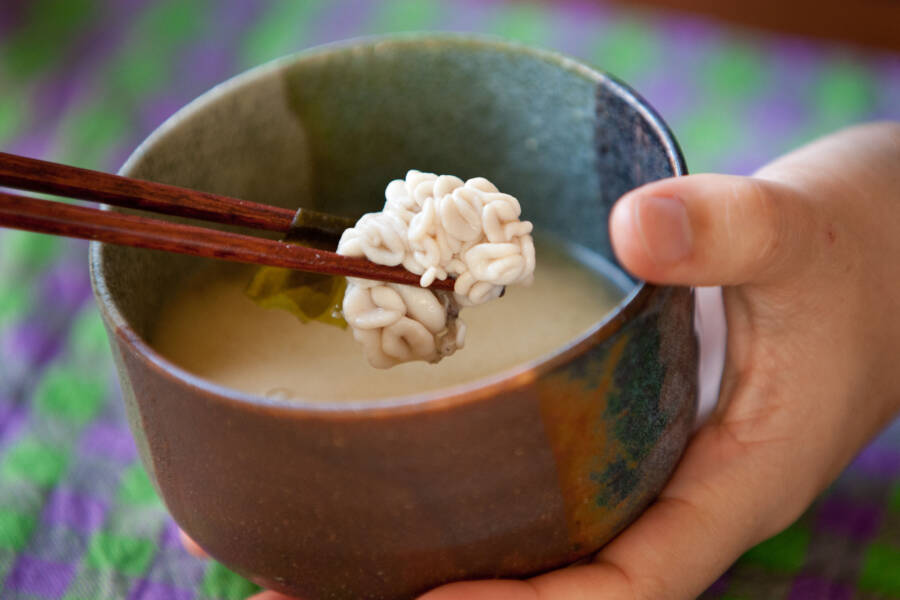
All About Shirako, The Japanese Fish Sperm Delicacy That Tastes Like ‘Sea Air’
Favicon 
allthatsinteresting.com

All About Shirako, The Japanese Fish Sperm Delicacy That Tastes Like ‘Sea Air’

jeremy sutton-hibbertHere, shirako — fish sperm — is used in a miso soup. The creamy white delicacy known as shirako in Japan translates to “white children.” This translation is somewhat apt. Shirako, a popular dish in the country, is made from fish semen. Specifically, shirako is made from the sperm sacs of male fish. Depending on how full the sperm sac is, shirako can be either a pale pearly pink, or white as fresh snow. There are many ways to serve it, and those who enjoy the delicacy often compare the taste to custard. And while shirako may seem odd to some, fish semen — or milt — is actually a popular ingredient in cuisines across the world. Russians, Czechs, and Italians also have various ways of enjoying fish sperm. This is everything you need to know about shirako, the Japanese seafood delicacy made of fish semen. What Is Shirako? The History And Taste Of The Japanese Delicacy Though the exact origins of shirako are unknown, it’s been a staple of Japanese cuisine for a long time. It likely comes from the Japanese practice of using every part of the fish, and became a popular delicacy in the country during the Meiji period (1868 to 1912). The Japanese believe that shirako promotes anti-aging and it is indeed packed with fatty acids like omega-3 and vitamin B12 — though it also contains high levels of cholesterol. So what is shirako exactly? The delicacy comes from the sperm sacs, or milt, of male fish. Often cod fish is used, but shakiro can also be harvested from anglerfish, salmon, squid, and even pufferfish. Wikimedia CommonsShirako, garnished with green onions and roe. But while made from fish semen, shirako is not a liquid. (Though its fluid can be mixed with other ingredients.) Rather, the delicacy is usually served whole, with the sac intact, which gives it the appearance of a brain. It can be translucent white or pink (if the fish’s sperm sacs were depleted) or more of a creamy white (if the fish’s sperm sacs were full). As to the taste? While this can depend on how shirako is prepared, most people describe the delicacy as having a custard-y taste. Jessica Thompson, writing about shirako for USA Today in 2021, reported that fans of the delicacy have also described its taste as “the sweetness with sea air.” However, its taste depends somewhat on how shirako is served. From Raw To Tempura: How Shirako Is Served Chris Chen 陳依勤/FlickrA bowl of shirako in Tokyo, Japan. Some compare the appearance of shirako to brains, and the taste to custard. As an ingredient, shirako is incredibly versatile. In its purest form, shirako is served raw as shirako ponzu. The raw shirako is doused in ponzu (a mix of citrus and soy sauce), and is often topped with finely grated daikon or shiso, or chopped scallion. Eaten like this, the shirako often tastes creamy and fishy, like fresh seafood. However, shirako can also be served as a tempura dish. Like anything with tempura, the shirako is fried in batter, then served. This gives it a crispy exterior, and a creamy, fishy interior, and this variation could be a good choice for those who may have reservations about trying shirako raw. Shirako diners will also have their choice of shirako served as gunkanmaki, or “battleship sushi.” In this variation, the shirako is wrapped in nori (seaweed) atop a rice ball. It can also be grilled or pan-fried, which firms the exterior, but keeps the interior creamy. And shirako can also be included in nabe, or hotpots, or into chawanmushi, an egg-and-seafood custard. Wikimedia Commons“Gunkanmaki”, or “battleship sushi,” which used shirako as its prime ingredient. As to when to eat shirako? It is best consumed during the winter months, which is when shirako is harvested from the Sea of Japan. It’s served in seafood restaurants and sushi bars, and is best enjoyed with warm sake. How Fish Sperm Is Used In Other Cuisines While Japan is famous for its fish sperm delicacy, shirako, many cultures around the world also use fish semen — or milt — as an ingredient. In Sicily and Sardinia, for example, diners often enjoy tuna lattume, which is made from tuna sperm (though fish sperm is often also harvested from herring, mackerel, cuttlefish, and sea bass in Italy). One option is to simply boil the milt and top it with lemon; another is to sauté tuna lattume, then toss it with pasta, parsley, and tomatoes. Meanwhile, Romanians also eat the sperm of carp and other freshwater fish. Known as lapți this delicacy is usually fried and served as a garnish to other foods, or on its own. Meanwhile, Russians also consume milt. They pickle herring milt, which is known as moloka. British chefs also often fry milt in butter, which is then eaten on toast, whereas Koreans often add milt to spicy soups or stews. (Milt is popular in Korea — it’s also often fried, poached, or enjoyed raw.) And Czechs consume a soup made of carp milt (mlíčí) on Christmas Eve, whereas Jewish cuisine uses milt to make a sauce known as kratsborscht. bryansjs/FlickrDaegu-iri-tang, or cod milt soup, in South Korea. As such, dishes like shirako may seem unusual to some tastes, but milt is a popular food enjoyed across the world. Creamy and fishy, it’s a versatile ingredient that can be enjoyed raw, fried, in soups, or in sushi. So if you happen to find yourself in Japan on a cold winter night, it might be to your advantage to find a cozy sushi bar, where you can order shirako ponzu or another shirako dish, and enjoy it alongside a hot cup of steaming sake. After reading about the many ways to eat shirako, the Japanese delicacy made from fish semen, learn about ortolan, the forbidden French dish that involves drowning ortolan birds in brandy and then eating them in a single bite. Or, discover balut, the popular but controversial street food in southeast Asia which is made of a partially developed duck fetus. The post All About Shirako, The Japanese Fish Sperm Delicacy That Tastes Like ‘Sea Air’ appeared first on All That's Interesting.

Like
Comment
Share
History Traveler
History Traveler
7 w

Archaeologists In Spain Believe They’ve Uncovered The First-Ever Remains Of The Elephants That Hannibal Used Against The Romans
Favicon 
allthatsinteresting.com

Archaeologists In Spain Believe They’ve Uncovered The First-Ever Remains Of The Elephants That Hannibal Used Against The Romans

Agustín López and Rafael MartínezThe small bone found in Spain came from the ankle on the right foreleg of an elephant, though researchers aren’t sure which species. “Elephants, when tamed, are employed in war,” the Roman writer Pliny wrote in the first century C.E. “They tread under foot whole companies, and crush the men in their armour.” Now, a rare bone that likely came from of one of these war elephants has been found in Spain. The bone, only the size of a baseball, appears to belong to an elephant who marched near Córdoba, Spain, some 2,200 years ago. Researchers believe that the elephant was one of the creatures brought to the European continent by the Carthaginian general Hannibal Barca during the Punic Wars, before he famously took them over the Alps and into Italy. The Ancient Bone Found In Spain That May Have Come From One Of Hannibal’s Famous Elephants Agustín López and Rafael MartínezThe elephant bone was found during excavations in Spain, at the site of an ancient fortified village. According to a new study published in the Journal of Archaeological Science: Reports, the bone was a mystery when it was first unearthed in 2020 near Córdoba, as it didn’t appear to match any native species. Ultimately, researchers realized that the bone was an elephant’s right carpal bone. So where did the elephant come from? Researchers believe that the elephant may have been one of the animals brought to Europe by the Carthaginian general Hannibal. The bone is roughly 2,200 years old, which suggests that the elephant died during the Second Punic War (218 B.C.E to 201 B.C.E.) which was fought between Rome and Carthage. It was also found at the site of an ancient fortified Iberian village known as an oppida, and the discovery of 12 spherical stones, likely ammunition for Carthaginian catapults, further suggests that a battle took place in the area. Agustín López and Rafael MartínezTwelve spherical stones at the site are likely ammunition for Carthaginian catapults — and evidence of a battle between the Romans and the Carthaginians. The elephant seemingly died during the battle, and its right carpal bone either survived because it was buried under a piece of collapsed wall, or because it had been taken as a war trophy. The sample is so small that the species of elephant is difficult to determine, though researchers think it’s possibly a species of extinct elephant that Hannibal and the Carthaginians used in their wars against the Romans and others. War Elephants In The Ancient World Long before Hannibal brought war elephants to Europe, the animals were used in other, even more ancient conflicts. They were seemingly first deployed in combat during the Battle of Gaugamela in 330 B.C.E. between Alexander the Great and Persian King Darius III, and again a few years later, when Alexander faced off against King Porus in India. The Romans first encountered elephants between 280 and 275 B.C.E., when the Greek King Pyrrhus (from whom we get the phrase “Pyrrhic victory”) used the animals against Rome. War elephants were both powerful work animals and psychological weapons meant to strike fear into the hearts of opponents. And the Carthaginians eventually began to use elephants in battle as well. Hannibal is best known for crossing the Alps with 37 elephants to invade Rome, but the elephant bone from Spain is not from that campaign. The researchers wrote, “Carthaginian forces frequently deployed elephants during the Punic Wars, particularly in the second, which was fought primarily in Iberia, southern Gaul, the Maghreb, and the Italian Peninsula.” Public DomainA depiction of war elephants in the Battle of Zama (202 B.C.E.), the final, decisive battle of the Second Punic War, in which Rome triumphed. Despite the terror that the animals caused, however, Carthage was ultimately defeated by Rome in the Second Punic War. Roughly a century later, Carthage collapsed during the Third Punic War. But Carthage’s elephants have never been forgotten. That said, little archaeological evidence of these fabled creatures has been unearthed, which makes the discovery of the elephant bone in Spain especially astounding. Somehow preserved over the centuries, it’s a relic from a time when the Iberian peninsula thundered with the roar of war elephants and catapults, as Carthage and Rome battled for control over the Mediterranean. After reading about the elephant bone found in Spain that may have belonged to a Carthaginian war elephant during the Second Punic War, learn about how Rome, though triumphant over Carthage, eventually fell. Then, go inside the catacombs of Rome that snake beneath the city to this day. The post Archaeologists In Spain Believe They’ve Uncovered The First-Ever Remains Of The Elephants That Hannibal Used Against The Romans appeared first on All That's Interesting.

Like
Comment
Share
RedState Feed
RedState Feed
7 w

Senate Begins Probe of Mamdani Over Antisemitic 'Concerns,' Billions in Gov't Funds Could Be on the Line
Favicon 
redstate.com

Senate Begins Probe of Mamdani Over Antisemitic 'Concerns,' Billions in Gov't Funds Could Be on the Line

Senate Begins Probe of Mamdani Over Antisemitic 'Concerns,' Billions in Gov't Funds Could Be on the Line
Like
Comment
Share
RedState Feed
RedState Feed
7 w

SBA's Loeffler Suspends 111,620 California Business in $8.6 Billion Fraud Scam
Favicon 
redstate.com

SBA's Loeffler Suspends 111,620 California Business in $8.6 Billion Fraud Scam

SBA's Loeffler Suspends 111,620 California Business in $8.6 Billion Fraud Scam
Like
Comment
Share
NEWSMAX Feed
NEWSMAX Feed
7 w

Canada Plants Flag, Opens Consulate in Greenland
Favicon 
www.newsmax.com

Canada Plants Flag, Opens Consulate in Greenland

Canada formally opened a new consulate Friday in Greenland's capital of Nuuk, raising its flag as Ottawa moves to signal solidarity with the Danish territory while carefully navigating relations with Washington amid President Donald Trump's continued interest in the island,...
Like
Comment
Share
NEWSMAX Feed
NEWSMAX Feed
7 w

Ransom Note Suggests Nancy Guthrie Not in Arizona
Favicon 
www.newsmax.com

Ransom Note Suggests Nancy Guthrie Not in Arizona

A ransom note demanding millions of dollars in bitcoin for the safe return of Nancy Guthrie suggests she may no longer be in Arizona, TMZ reported.
Like
Comment
Share
YubNub News
YubNub News
7 w

What’s Next in Springfield, Ohio, After Judge Pauses End of Immigration Protection for Haitians
Favicon 
yubnub.news

What’s Next in Springfield, Ohio, After Judge Pauses End of Immigration Protection for Haitians

Welcome to Springfield signage is displayed on the Interstate 70 overpass in Springfield, Ohio, on Sept. 16, 2024. Luke Sharrett/Getty ImagesHaitian immigrants, community leaders, and residents in Springfield,…
Like
Comment
Share
Survival Prepper
Survival Prepper  
7 w

Moltbook will start the AI Apocalypse?
Favicon 
prepping.com

Moltbook will start the AI Apocalypse?

#Moltbook #AI #artificialintelligence #shtfpreparation #shtfsurvival Moltbook is a social network created for AI to communicate with other AI My links are sometimes affiliate links, so I may earn a small commission. Please know that this cost is absorbed by the seller, it never adds to your cost. In fact, some of these brands allow you to add in my personal discount code, so you may actually get it CHEAPER by going through my links! Thanks for supporting the channel! Want to buy silver from the most reliable online dealer? https://apmex.sjv.io/BnmZWL #apmex #preciousmetals #gold #silver #bullion @APMEX #apmexpartner Need an emergency supply of antibiotics? Ivermectin? Use my affiliate link! (They now also can prescribe a year long supply of meds for chronic conditions like asthma, diabetes, high cholesterol and many more chronic health issues!!) https://rstr.co/jasemedical/4402 (You will now need to use that link to get the discount!) Jase Long term emergency food supply: https://rstr.co/jasemedical/4402 It is now necessary to use that above link to get the discount. As an Amazon Associate, I earn from qualifying purchases. NEBO Poppy Lantern: https://amzn.to/3Y0KJDm Augason Farms Freeze Dried Food: https://amzn.to/3Wdduwd Family Sized Life Straw Water Purification: https://amzn.to/3whRSnC Mission Darkness Faraday Kits for EMP protection: https://amzn.to/3vynDIh Oupes Solar Generators and Panels: https://amzn.to/48U2ARL This is the Foraging book I recommend! https://amzn.to/4bN9UOb Grayl GeoPress Hiking Water Filter System: https://amzn.to/4h9iMPY MIRA SAFETY Gas Masks & Filters: https://amzn.to/3XxWOza Rhino Rescue First Aid Kits: https://rhinorescuestore.com/PREPPING_WITH_SARGE DISCOUNT CODE: PREPPING_WITH_SARGE Black Beard Fire Starters: https://blackbeardfire.com/Sarge DISCOUNT CODE: SARGE (10% off) Wazoo Survival Gear (Foraging Bandana, Viking Whetstone, Fire Starter Necklace etc) https://www.wazoosurvivalgear.com?aff=sarge USE COUPON CODE: "SARGE2022" FOR 5% OFF YOUR ORDER! Need Garden Seeds? Check out Pinetree Garden Seeds https://www.superseeds.com Discount Code: SARGE15 for 15% off - enter the code at checkout, cannot be combined, and is not valid on gift certificates or previous orders. One use per customer. Code expires 12/31/2026 Holtzman Gorilla Survival Knives Discount code “SARGE” for 10% off https://holtzmansurvival.com/?ref=Sarge Glow Rhino Knives with Glow in the Dark Tritium Inserts: https://alnk.to/d3Dkl83 Odenwolf Knives Discount Code: SARGE10 for 10% off: https://odenwolf.us/r?id=2ar1v0 Slicknives Discount Code: Sarge10 for 10% off: https://slicknives.com/preppingwithsarge Exodus Knife and Tool Discount Code: preppingwithsarge at https://www.exodusknifeandtool.com/?ref=PREPPINGWITHSARGE *** DISCLAIMER: Opinions are my own.Any images used were either AI generated or were found on copyright free public domain site, or used under the Fair Use Act allowed for commentary, but if you believe they belong to you and would like credit or removal, please email me with proof of ownership.Occasionally I may display links that earn me a commission, or show a product that was given to me to review for the audience.By watching my videos you agree to the following: This LLC have provided the material contained in this content for entertainment purposes only.The provider assumes no liability for errors in content. In no event shall the provider be held liable for any special, direct, indirect, consequential or incidental damages or any damages whatsoever- whether in a personal action, or in an action of contract, negligence or other tort- arising out of or in connection with the use of the content.The provider reserves the right to make additions, deletions, or modifications to the content at any time without prior notice.The provider does not provide medical, legal, financial or any other type of advice.Viewers whenever necessary, & where permissible by law should enlist the services of experts versed in the specific matters they are concerned with.My channel is for entertainment purposes only.The viewer agrees that the content creator is not liable nor will ever be held liable for the decisions the viewer makes after watching this video & the viewer agrees to forfeit all legal recourse against the content creator.
Like
Comment
Share
Survival Prepper
Survival Prepper  
7 w

Prepper Food Storage: Turning $1 Pasta into 30-Year Survival Food
Favicon 
prepping.com

Prepper Food Storage: Turning $1 Pasta into 30-Year Survival Food

Not all pasta is created equal — especially when it comes to long-term food storage. Some pasta lasts 2 years… and some can last 25–30 YEARS when packaged correctly. In this video, Kylene and her granddaughter Allie show you exactly why pasta shelf life matters and how to properly package pasta for long-term emergency food storage using Mylar bags, oxygen absorbers, and secondary containers. Need oxygen absorbers or Mylar bags. We recommend PackFreshUSA https://packfreshusa.com/?rfsn=7503114.ecc85c Use promo code PROVIDENT to receive 10% off your order. You’ll learn: ✅ Which types of pasta store the longest ✅ Why whole wheat and gluten-free pasta have shorter shelf lives ✅ How to package pasta in Mylar for 25–30 year storage ✅ Oxygen absorber sizing and placement ✅ Why secondary containers matter (rodent protection) ✅ How to label and rotate food storage correctly ✅ Budget-friendly long-term food storage strategies ✅ How to turn $1 grocery store pasta into long-term survival food ✅ A simple emergency garlic parmesan pasta recipe using shelf-stable ingredients This is real-life prepper food storage—practical, affordable, and designed for families who want to build long-term emergency preparedness without expensive specialty products. Whether you're building a prepper pantry, planning for grid-down scenarios, or simply want food security for your family, this video gives you a proven system you can use right now. If you don’t have pasta in your long-term food storage yet — you’ll want to after watching this. #LongTermFoodStorage #PrepperFoodStorage #EmergencyPreparedness #SurvivalFood #MylarBags #OxygenAbsorbers #FoodSecurity #PrepperPantry #GridDown #DisasterPreparedness #TheProvidentPrepper #EmergencyFood #ShelfLife #FoodStorageTips Visit our Amazon Storefront to support our channel. Thanks! https://www.amazon.com/shop/theprovidentprepper Follow us! *TheProvidentPrepper.org *Instagram – theprovidentprepper https://www.instagram.com/theprovidentprepper/ *Facebook – The Provident Prepper: Building Your Family Ark https://www.facebook.com/ProvidentPrepper *Pinterest – The Provident Prepper https://www.pinterest.com/TheProvidentPrepper/ DISCLAIMER: This video is for entertainment and educational purposes only. We provide no medical, financial, legal, or professional advice. Emergency preparedness activities involve inherent risks. Always consult qualified professionals and follow safety guidelines. You are solely responsible for your actions and any consequences. Affiliate Links: We may earn a small commission from affiliate links at no additional cost to you, which supports our channel. We participate in the Amazon Associates Program and other affiliate programs, and we are compensated for referring traffic and business to these companies. Copyright: All content is copyrighted by The Provident Prepper. Written permission is required for any use or reproduction. Liability: The Provident Prepper is not liable for any damages, injuries, or losses resulting from information in this video. Follow food safety regulations and participate at your own risk. By watching, you agree to this disclaimer.
Like
Comment
Share
Showing 6989 out of 115924
  • 6985
  • 6986
  • 6987
  • 6988
  • 6989
  • 6990
  • 6991
  • 6992
  • 6993
  • 6994
  • 6995
  • 6996
  • 6997
  • 6998
  • 6999
  • 7000
  • 7001
  • 7002
  • 7003
  • 7004
Advertisement
Stop Seeing These Ads

Edit Offer

Add tier


Select an image
Delete your tier
Are you sure you want to delete this tier?

Reviews

In order to sell your content and posts, start by creating a few packages. Monetization

Pay By Wallet

Payment Alert

You are about to purchase the items, do you want to proceed?

Request a Refund