YubNub Social YubNub Social
    #freedom #law #civilrights #ai #fourthamendment #utah #privacy #lawenforcement #warrant #environmentalscience #surveillancestate #eff #alpr #flocksafety #licenseplate
    Advanced Search
  • Login
  • Register

  • Night mode
  • © 2026 YubNub Social
    About • Directory • Contact Us • Developers • Privacy Policy • Terms of Use • shareasale • FB Webview Detected • Android • Apple iOS • Get Our App

    Select Language

  • English
Community
New Posts (Home) ChatBox Popular Posts Reels Game Zone Top PodCasts
Explore
Explore
© 2026 YubNub Social
  • English
About • Directory • Contact Us • Developers • Privacy Policy • Terms of Use • shareasale • FB Webview Detected • Android • Apple iOS • Get Our App
Advertisement
Stop Seeing These Ads

Discover posts

Posts

Users

Pages

Blog

Market

Events

Games

Forum

SciFi and Fantasy
SciFi and Fantasy  
1 y

Edge of Tomorrow: If At First You Don’t Succeed, Die and Die Again
Favicon 
reactormag.com

Edge of Tomorrow: If At First You Don’t Succeed, Die and Die Again

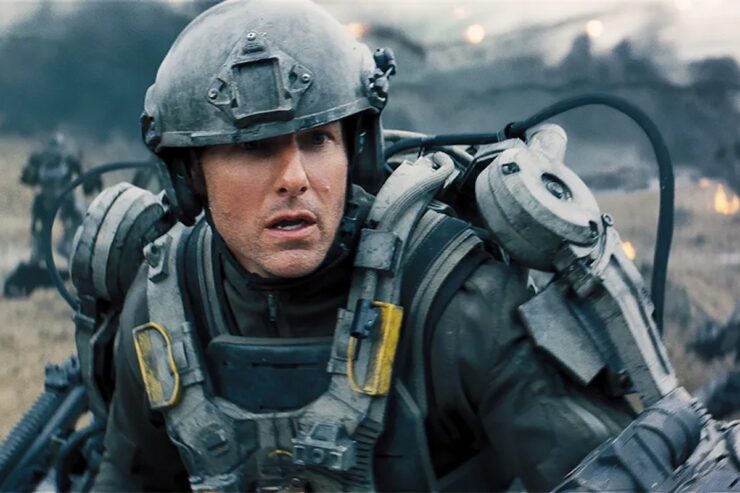
Column Science Fiction Film Club Edge of Tomorrow: If At First You Don’t Succeed, Die and Die Again A perfect blending of video game mechanics, blockbuster action, and sci fi storytelling. By Kali Wallace | Published on January 8, 2025 Credit: Warner Bros. Pictures Comment 0 Share New Share Credit: Warner Bros. Pictures Edge of Tomorrow (2014) Directed by Doug Liman. Written by Christopher McQuarrie, Jez Butterworth, and John-Henry Butterworth, based on the novel All You Need Is Kill by Hiroshi Sakurazaka and illustrator Yoshitoshi Abe. Starring Tom Cruise, Emily Blunt, Bill Paxton, and Brendan Gleeson. Let’s get one thing out of the way: All You Need Is Kill is a superior title. They shouldn’t have changed it. The novel All You Need Is Kill was first published in 2004, written by Hiroshi Sakurazaka and illustrated by Yoshitoshi Abe. In its initial form, it’s an illustrated light novel—a fairly short novel aimed at a teen or young adult audience. It has been adapted, translated, and released a few different times since then, including a manga adaptation written by Ryōsuke Takeuchi and illustrated by Takeshi Obata (you might recognize Obata’s artistic style from Death Note) and an English graphic novel written by Nick Mamatas and illustrated by Lee Ferguson. This is a pretty normal life cycle for a light novel; they are often wildly popular, widely read, and get adapted multiple times into manga, anime, and other formats. A somewhat less normal stage of the life cycle is an adaptation into a big-budget Hollywood movie from a major studio, starring one of the biggest movie stars of all time. That’s not usually how it goes, but I’m glad it did in this case, because I love this movie. I was one of the many people who only saw it because of the very long tail of word-of-mouth buzz that continued years after its somewhat lackluster release, which means I have also transformed into one of those people who flails around and says, “No, really, go watch it, it’s great, trust me.” All You Need Is Kill caught the attention of Hollywood after it was translated into English and published by Viz Media (the company behind many English-language manga publications) in 2009. What followed is a typically convoluted Hollywood production story: an insane amount of money thrown around on spec, input and rewrites from one million writers (only a slight exaggeration; I counted at least eight), the inevitable reimagining of the main character when they cast a fifty-something actor instead of the book’s twenty-something young man, nine companies working on the special effects, and a filming schedule that was well underway before they figured out how the movie would end. Edge of Tomorrow follows the story of William Cage (Tom Cruise), an ad exec turned military PR shill who spends his time recruiting people into the multinational force that is fighting against—and very badly losing to—an alien invasion. Due to a series of contrivances and shenanigans on the part of a general (played by Brendan Gleeson), he is placed with the front-line infantry under the command of the most-clichéd-master-sergeant-ever, Master Sergeant Farell (Bill Paxton, having fun chewing all the scenery). It’s the eve of what everybody hopes will be a decisive battle against the aliens, and Cage has no idea what he’s doing. He doesn’t even know how to use the armored battle suit they stick him into. The aliens are called Mimics thanks to their uncanny ability to predict and counter everything the human forces do—which is exactly what happens at this big battle. The Mimics know the attack is coming. It immediately turns into an all-out slaughter. Cage dies within minutes. Then he wakes up a day in the past and does it all again. All the usual time loop elements are here: Cage tries to tell others what’s going on, he tries to change the outcome, he tries to survive the battle. Things only really change a few loops in, after a battlefield encounter with star soldier Rita Vrataski (Emily Blunt). Right before they both die, she tells him to find her when he wakes up—because she knows about the time looping. It turns out she’s already been through what he’s going through, and that’s why she was able to make such a heroic showing at a previous battle. Time loop stories tend to fall into two broad categories: those that never explain the mechanism and those that do. Harold Ramis’ Groundhog Day (1993) is the type specimen of the first kind, those time loop stories where the how of the time loop is not really relevant. Edge of Tomorrow sits at the opposite end of the spectrum, where the science fictional mechanism causing the time loop is a major pillar of the plot. The sci fi details are actually dispatched pretty quickly: Vrataski and her physicist friend Carter (Noah Taylor) explain that the Mimics are able to control time, which is how they have managed to trounce humanity so soundly during their invasion. When Cage, like Vrataski before him, killed a certain type of Mimic, the alien’s blood gave him the ability to loop time as well. The finer details are not important for our purposes here, and I’m not sure I would be able to explain them without resorting to alpha/omega jokes. What matters is that they have to kill the main Mimic, the big boss who can reset time for the aliens’ advantage, in order to save Earth from the invasion. Here’s the thing about this movie: None of this is particularly new or deep or innovative. But it doesn’t matter because it’s such great fun. It’s such a fun movie to watch. It’s fast-paced, frenetic, and funny. Director Doug Liman had developed his action movie style on The Bourne Identity (2002) and Mr. and Mrs. Smith (2005), so Edge of Tomorrow’s mix of serious and silly feels like a natural evolution. The action—and it’s pretty much all action, start to finish—combines moments of visceral, Saving Private Ryan-style horrors of war with moments of pure slapstick hilarity. The aliens are nicely creepy, the science fictional elements explored only as much as they need to be, and the time loops never stick on any particular repetition long enough to outstay their welcome. There are a few specific things, I think, that make this film work so well. The first is that it utilizes the combination of CGI and practical effects pretty well, thanks to the work of visual effects supervisor Nick Davis. Because, yes, the movie was filmed almost entirely against green screen, and it is obvious in places—but there are enough practical elements mixed in there that give it the right sort of weight when necessary. For example, the armored suits are real costumes, the actors are actually wearing them, and a lot of work went in to making them look and feel like what real armored suits would look like if aliens invaded in 2015 and the world’s militaries had been desperately throwing untrained infantry at them for five miserable years. They look bulky, clunky, and uncomfortable because they were bulky, clunky, and uncomfortable. There were models for the alien Mimics, but for the most part the movie specifically avoids showing the aliens with many close or lingering shots. We aren’t given a chance to understand the alien anatomy because the characters don’t get that chance. It makes the fight scenes chaotic and hard to follow, but that’s the point. For all that Sergeant Farell waxes rhapsodic about the purifying crucible of war, there is nothing elegant or meaningful or glorious about this battle. It’s a shitshow. It’s a disaster. The humans get slaughtered in every single time loop. The only way Cage and Vrataski survive is to escape the battlefield. The fact that the aliens exist almost entirely as impossibly fast bursts of whiplike tentacles, without providing us or the characters much more to focus on, helps to emphasize the futility of trying to beat them in direct combat. That brings me to the second thing that makes this movie work so well, and that’s it wholehearted embrace of video game structure as a storytelling method. Both Sakurazaka and Liman have mentioned being inspired by the dying and respawning device of video games, and it shows in how the time loops are utilized. It’s most obvious in the scenes when Cage and Vrataski are trying to figure out how to escape the battle on the beach to reach the dam where they believe the omega Mimic is hidden; anybody who has ever had fifty tries at a particularly grueling boss battle in a video game will recognize the fussy, frustrating process as they discuss how they have to step this way and dodge that way. For all that people love to dismiss many blockbuster action movies as being too much like video games, capturing that feeling deliberately and using it to the film’s advantage is actually quite rare and challenging. In this movie, it’s obvious that a lot of thought went into deciding how much of each loop to show, how to portray the progression of the action, how to vary the tone to balance the humor and darkness—and, most importantly, how to use all of those elements to tell an engaging story that leads to a satisfying conclusion. It works because the filmmakers recognize that the stylized action and mechanics are part of what make video games appealing, but the storytelling is just as important. Looking cool isn’t enough. The audience has to want to go along for the ride to find out what happens next.   Liman started filming the movie without really knowing how to approach it or having any idea how it would end. Apparently this is not unusual for him; he has a reputation for making it up as he goes along. And screenwriter Christopher McQuarrie has talked about discussions with Liman and Cruise where they went back and forth on how to end the movie. Most stages of writing had a much darker ending, and it wasn’t until they decided to embrace the humor inherent in the premise that they settled on what is a pretty bright and optimistic ending. Cruise was a particular advocate for going all-in on the Wile E. Coyote-style violence in his character’s many, many deaths. I think it works, because I think the humor is one of the movie’s best features, and because giving the main character and the world a happy ending, even in the context of that one final time loop reset, doesn’t mean none of the story happened. And that brings me to the third and final thing I want to talk about, which is the casting of the main characters. I don’t know what Edge of Tomorrow would look like if different actors had been cast in the lead roles, but I’m glad we never had to find out, because Tom Cruise and Emily Blunt are freaking perfect and a huge part of why the movie is so great. Look, we all know that when you cast Tom Cruise in a movie, you are going to have a Tom Cruise movie, no matter what it’s about, no matter who directs it, no matter how well-written the plot and character are. This has been true for decades. It’s what happens when you have a blockbuster movie star who has spent much of his career defining what it even means to be a blockbuster movie star. The fact that Cruise is actually a very good actor often feels irrelevant; nobody can ever forget who they are watching on screen. But what’s fun about Edge of Tomorrow is about how it uses those decades of moviegoing expectation as part of how we experience we story. Expecting an action hero? The character we meet is a smarmy, pathetic coward. Expecting cool, badass moves? He dies in so many stupid ways it’s hard to keep track. Expecting him to save the world? Well, eventually, but he has to earn it. The counterpoint to Cruise’s character is Emily Blunt’s stone-cold badass Rita Vrataski. She’s absolutely fantastic, and there is additional cleverness in casting an actor who was not at the time known for or expected to showcase action or badassery at all. Vrataski had to earn her skills, the same way Cage has to earn his, but all of that happens off-screen, before the movie begins. It’s a familiar action movie trope for the badass character to have a traumatic backstory that informs the current action, although it’s not always so direct as it is here. Part of what makes or breaks such characters is whether we can believe that past without directly seeing it. We believe it here because Blunt is so good at showcasing Vrataski’s hope and fear and grief and frustration and everything else that comes from getting an unexpected second chance, however slight, to win the war. The movie also does well in developing a rapport between the characters even when their connection is, thanks to the time loop, not quite one-sided but strongly imbalanced. It works because we’ve got two great actors carrying the film—which is, all in all, very well made and a lot of fun. As I was rewatching this movie, and enjoying it just as much as I did the first time, I was thinking about how glad I am that I picked this to start out the new year. There will be plenty of time for us to dig into all the sci fi movies out there that have deeper messages and more complex themes. For now, I’m happy to enjoy a film that embraces the fun and the spectacle of sci fi cinema. Edge of Tomorrow is a movie that that accomplishes exactly what it sets out to do, which is nothing more and nothing less than making us laugh and gasp and worry and cheer our way through an alien invasion. And I love that. What do you think of Edge of Tomorrow? Where does it rank for you among that odd little subgenre of movies that use video game mechanics to tell a story? Has anybody read the original light novel or any of the translations and adaptions? Next week: We’re falling into some timey-wimey confusion on an entirely different scale with Nacho Vigalondo’s low-budget Spanish film Timecrimes. Watch it on Hoopla, Amazon, Tubi, Apple, and others.[end-mark] The post <i>Edge of Tomorrow</i>: If At First You Don’t Succeed, Die and Die Again appeared first on Reactor.

Like
Comment
Share
Daily Signal Feed
Daily Signal Feed
1 y

Supreme Court Could Send Message on Climate Change Lawsuits
Favicon 
www.dailysignal.com

Supreme Court Could Send Message on Climate Change Lawsuits

The U.S. Supreme Court will soon decide whether to hear cases with major impacts for the separation of powers and for left-leaning states’ and municipalities’ ability to use their state courts as pawns to establish national climate change policy. To preserve federalism, the stability of the rule of law, and separation of powers in our Republic, it is imperative that the Supreme Court grant certiorari to take the cases.  The climate-change suits percolating across the country, of which these petitions for certiorari are representative, feature an alliance between fee-driven plaintiffs’ attorneys and frustrated environmental activists. They want to get de facto regulation and retroactive liability imposition illegitimately from activist courts that they know would be impossible to get in the sunlight of the democratic process.  Together, these lawyers and activists are seeking to unconstitutionally turn courts into climate policymakers.  These are not cases principally about climate change. They are about the separation of powers and the proper division of authority between the federal and state governments. The plaintiff in the appeal, the city and county of Honolulu, Hawaii, is seeking damages from industry for emissions all over the world. Honolulu is effectively setting itself up as an international energy regulator. The Constitution and the Clean Air Act do not allow states to interfere with federal prerogatives and the policy preferences of their sister states.  We entered into a federalist union in order to entrust certain interstate and global matters to a federal government rather than allowing meddling by states. Issues like energy policy and sensitive decisions about geopolitical issues of climate change require complex balancing decisions that are exclusively within the purview of Congress and federal policymaking authorities, not state courts.  By granting cert, the Supreme Court has a chance to make that clear and put a stop to the dangerous proliferation of climate-change lawsuits. In so doing, the Supreme Court can protect constitutional limits by explaining that courts may not invent law to make climate change policy. And it can concomitantly clarify that federalism requires that some issues be available for Congress to claim as exclusively federal, lest we have a chaotic mix of state approaches that risk interfering with an effective, unified process to solve the very climate problems the activist plaintiffs seek to abate. If the Supreme Court does not grant cert, the plaintiffs will have leverage to extract settlements from defendants who could easily see the costs of defending even meritless litigation too high to justify spending money, even when their rights and actions would ultimately be vindicated. That is especially true when, as here, denial requires the defendants to defend actions in scores of courtrooms across the country simultaneously. A cert denial would also be a dangerous signal that it is open season for these lawsuits in city and county courtrooms in every state across the United States. The financial incentives to bring these lawsuits guarantee the cases will continue to proliferate. Money-strapped states, counties, and municipalities see damages awards as a way to solve their budgetary problems. And the plaintiffs’ attorneys can expect a fortune in fees.  These petitions give the Supreme Court the chance to decide if the law allows such chaos. If the law does not allow it, as seems the more likely conclusion under our constitutional design, then the Supreme Court can protect Congress’s domain and stop the onslaught before it begins.  To grant cert would also mean rejecting the arguments recently made in a brief filed in December by the solicitor general of the United States, representing a legacy-seeking, midnight protestation to granting cert of the outgoing Biden administration. The Biden administration’s brief in the Honolulu case recognizes that the defendants may ultimately prevail on their federal law arguments–yet and still, the solicitor general claims that the defendants should be required to litigate the cases nonetheless. Those conclusions twist the issues the Supreme Court is being asked to decide. Preemption and federal exclusivity doctrines are both critical to preserving federalism but they also exist as threshold mechanisms to dismiss a case because they serve gatekeeping functions. They are meant to prevent litigation from leaving the gate lest a state court have the ability to impose substantial litigation and uncertainty costs on defendants and disrupt federal policies along the way. The Supreme Court understands this and should not be persuaded by this misplaced plea to let meritless cases proceed. They should see that brief for what it is. The policy preferences of the administration to feed its base, to punish energy companies, and to push changes it could never get through Congress have crowded out the solicitor general’s responsibility to use its unique briefing privilege to defend federal prerogatives and federal domain by defending federal preemption here.  Importantly, the Supreme Court has already disallowed federal common law nuisance claims relative to climate change. Justice Ruth Bader Ginsburg delivered that decision, AEP v. Connecticut, for a unanimous Court in 2011. That decision did not expressly disallow state common law claims of the kind Hawaii has brought here, namely nuisance and misrepresentation. The Court’s reasoning in AEP should make these pending cases quick and easy to dispose of, if the justices decide to take them. We publish a variety of perspectives. Nothing written here is to be construed as representing the views of The Daily Signal. The post Supreme Court Could Send Message on Climate Change Lawsuits appeared first on The Daily Signal.
Like
Comment
Share
Daily Signal Feed
Daily Signal Feed
1 y

Why America Is in So Much Trouble
Favicon 
www.dailysignal.com

Why America Is in So Much Trouble

Shortly before Milton Friedman’s death in 2006, I had the privilege of interviewing him over dinner in San Francisco. The last question I asked him was: What are the three things we have to do to make America more prosperous? His answer I have never forgotten: “First, allow universal school choice; second, expand free trade; third and most importantly, cut government spending.” That was long before Barack Obama and Joe Biden came along. There aren’t too many problems in America that can’t be traced back to the growth of big and incompetent government. It is notable that the two big bursts of inflation during modern times both occurred when government spending exploded. The first was the gigantic expansion of the Lyndon B. Johnson “war on poverty” welfare state in the 1970s with prices nearly doubling. Second was the post-COVID-19 spending blitz in the last year of Donald Trump’s first term, followed by the Biden $6 trillion spending spree, with the Consumer Price Index sprinting from 1.5% to 9.1%. Coincidence? Maybe. But I doubt it. The connection between government flab and the decline in the purchasing power of the dollar is obvious. In both cases the Washington spending blitz was funded by Federal Reserve money printing. The helicopter money caused prices to surge. (I still find it laughable that 11 Nobel Prize-winning economists wrote in the New York Times in 2021 that the Biden multitrillion-dollar spending spree wouldn’t cause inflation. Were they on hallucinogenic drugs?) The avalanche of federal spending hasn’t stopped even though the COVID-19 pandemic ended over a year ago. We are three months into the 2025 fiscal year and on pace to spend an all-time-high $7 trillion and borrow $2 trillion. If we stay on this course, the federal budget could reach $10 trillion over the next decade. This road to financial perdition cannot stand. It risks blowing up the Trump presidency. Upon entering office, Trump should on day one call for a package of up to $500 billion of rescissions–money the last Congress appropriated but has not been spent yet. Canceling the green energy subsidies alone could save nearly $100 billion. Why are we still spending money on COVID-19? We could save tens of billions of dollars by ending corporate welfare programs–such as the wheelbarrows full of tax dollars thrown at companies like Intel in the CHIPS Act. The Elon Musk Department of Government Efficiency is already identifying low-hanging fruit that needs to be cut from the tree. Along with extending the Trump tax cut of 2017, this erasure of bloated federal spending is critical for economic revival and for reversing the income losses to the middle class under Biden. This is especially urgent because the curse of inflation is NOT over. Since the Fed started cutting interest rates in October, commodity prices are up nearly 5%, and mortgage rates have again hit 7%, in part because the combination of cheap money and government expansion is a toxic economic brew–as history teaches us. Nothing could suck the oxygen and excitement out of the new Trump presidency more than a resumption of inflation at the grocery store and the gas pump. Trump’s record-high approval rating will sink overnight if the cost of everything starts rising again.  Cutting spending won’t be easy. The resistance won’t just come from Bernie Sanders Democrats. He will have to convince lawmakers in his own party–many of whom are already defending Green New Deal pork projects in their districts. Trump should borrow a line from Nancy Reagan: Just say no–to runaway government spending. Say yes to what Friedman titled his famous book: “Capitalism and Freedom.” COPYRIGHT 2025 CREATORS.COM The post Why America Is in So Much Trouble appeared first on The Daily Signal.
Like
Comment
Share
Homesteaders Haven
Homesteaders Haven
1 y

Picking Edible & Medicinal Plants – Must Know Rules
Favicon 
homesteading.com

Picking Edible & Medicinal Plants – Must Know Rules

Knowing edible & medicinal plants is important in self-sufficiency and if you plan to live off the grid. There are must know rules in picking them and I'm going to show you what they are. You don't have to guess what plant is edible or medicinal, you just have to follow a couple of rules and get familiar with them. As with every homesteading skill, you have to learn it to know it! Picking Edible & Medicinal Plants – Must Know Rules Next to mastering fire, a knowledge of picking edible & medicinal plants is considered one of the most difficult, complex and one of the truer signs of being a genuine expert in homesteading. There are other skills like hunting, fishing and trapping that are good marks of a woodsman and skills like navigation, orienteering and terrain association that are standard fair for an outdoor adventurer. But mankind has always had an interest in the plant world as even now, we are constantly learning about seemingly miraculous properties of plants through science that still feel like some sort of magic to most. And indeed, plants can be magical, but they can also be deadly. Perhaps that is why so many people have a fear of them. We see plants all around us, every day, but most of us do not know what most of them are. We may know a few from our personal experience but most people could not name 100 different plants that surround them daily and they have grown up with all their lives. It makes sense as there are literally millions of plants, it becomes a daunting task to learn them all.   Picking Edible & Medicinal Plants But like anything in life, we have to break it down into small steps we can handle and before long, we’ll have it mastered and have the confidence that comes with skills acquired through training and familiarization. I try to teach everything in the simplest terms I can as that helps me to remember not only what to teach when in a dynamic scenario, but it also helps me personally to remember when in a stressful situation. The main thing you have to start out with is setting realistic goals and expectations. There is no way you can learn all the plants in the world. That’s a good start. The next thing is to realize that you don’t need to know them all. I use some simple figures to put it into perspective. These are not scientifically proven, yet, as I don’t think anyone has ever had need to do this type of study, but here are my guidelines for plant edibility versus animal edibility. 90% of all animals are edible for humans. Only 10% of all plants are edible for humans. Again, I know these are not the finite facts, but think about it, in the absence of a report on the global edibility of everything, does this not resonate? Anyone with common sense and a bit of world knowledge can come to the same deduction, I can eat almost every type of animal and even insect, bird or fish, or reptile with few exceptions. BUT, I know most plants I can not eat, such as trees or bushes, vines or roots, all for one reason or another, maybe too fibrous and hard, or too noxious or toxic. That is why the few plants we can consume as humans, are so highly cultivated, farmed and used by man kind. Here's what you have to know about edible & medicinal plants.   Pretty AND edible. Check out this list of flowers you can eat! https://t.co/CLDcDxYQ6W pic.twitter.com/F7b0U3Nxmu — Homesteading (@HomesteadingUSA) July 1, 2016   Edible Plants I say all that to say this, you simply don’t need to master all the world’s plants, you only need master a few. Here are some guidelines I help use to help myself determine which plants to dedicate some time to learning, and even mastering. 1)    Make sure any plant you decide to learn and master is IDENTIFIABLE. I always look to see if there are any poisonous plants that look like a potential plant I want to learn. For example, cow parsley has a poisonous look-alike called poison parsley that requires a refined eye to differentiate. It’s simple enough if you study but a mistake can be disastrous. I tend to steer away from any plants that have poisonous look-a-likes, unless they simply are so abundantly around me, I could not logically forego mastering the identification of them. 2)    That is the next determining factor before I decide to dedicate time to studying a plant as potential for an emergency or survival food source- abundance. Is the plant PLENTIFUL? Meaning, are there lots of it about? It does little good to know the identity and edibility of some plant if it is so rare, you are likely never to encounter it, especially when needed most in desperate times.  So make sure there are lots and lots of it about. 3)    The other key to helping narrow down your choices of plants to master is DISPERSION. If the plant is only found in one region, or on one mountain or valley, chances are you won’t be in a hurt box in that specific location. And if you were, likely those plants would indicate where you are and you could then find your way out! The key here is how widely distributed are the plants? Are they found all over the world? Are they growing everywhere? These are crucial to the survivor as you want to make sure you have mastered a few plants and that the mastery will pay off in that when you need, you will find, because they are indeed, all over the place. So Remember: D.I.P. (Distribution, ID, Plentiful) Now that we have QUALIFIED the screening criteria let us take a D.I.P. into the world of QUANTIFYING our survival plant mastery stratagem. I like simple numbers, so I use 12 here for plants. My recommendation for how many to learn is this: MASTER 6 to 10 EDIBLE plants based on the criteria above and 2-6 MEDICINAL. Choose these from which ever environment is most important and likely to you for need- Home region, Work place, Travel Areas or anywhere you think you might need this knowledge. Most folks live and work in the same region but some people travel to remote areas for work and need that knowledge in case of emergencies while there. Some great plants to learn come in many variations, sometimes in over a hundred different forms, but they all basically are from the same family, look alike enough to be easily and readily identified and eaten almost year round in some form or another. A few common, edible plants: Dandelion Cat Tail Acacia Cactus Roses Acorns (Oak trees) Pine needles (Pine trees) Arrow root Bamboo/Reed/Cane Seaweed These are just some examples of plants that are found all over the world, in many varieties with almost no toxic similarities that are DISPERSED, IDENTIFIABLE & PLENTIFUL. BUT NOTE: Another significant factor often overlooked by most books and experts is one so simple but so important the lack of discussing and addressing can often lead to uncertainty and lost opportunity to thrive. The season! Everyone knows there are 4 seasons and that means a lot in the life cycle of plants. It is easy to identify a plant in its full glory of blooming fruit and flower, but what about in the spring, when only a bud, or in the fall, when key leaves may have fallen off, but some nut is perhaps ripe for eating or in the dead of winter when all above ground looks dead to the world above, but below the surface lies a great tuberous root waiting for the forager who knows how to identify the stem when all other signs have long gone.   Medicinal Plants Next, I recommend learning at least 2-3 MEDICINAL PLANTS but balance your mental garden of 12 plants total, that you master for your start point. Ideally, these can also be in the EDIBLE category, too, but simply prepared differently or using different parts like roots and leaves versus fruits or nuts from the same plant. One of my biggest guidelines for learning medicinal plants is to study the PREPARATION that is needed to render them as a medicine. Anything that requires boiling means a fire and a pot and water, often not available to a survivor. So, I recommend things you can chew or crush and apply as a “chew poultice” or direct dressing. The most common issues people have are fever, aches and pains. Anything like aspirin will help and it is the acetylsalicylic acid that makes aspirin work and similar properties like salicin can be found in many plants around you like willow and even oak tree barks. Another major issue is tummy upset and diarrhea. There are many plants that can helps sooth and stop these such as dandelion and cat tails. Notice, these are also from the suggested food list so that you can now master 12 food plants and some double as your medicine plants. The real trick to mastering plants is to simply narrow your focus to a dozen you can handle, then really learn them- all seasons, all parts, all ways to prepare and all uses. The secret to vanquishing fear in survival is by reducing the stress of ignorance by knowing a dozen plants in your environment that you can eat and use for medicine. In this way, you are well prepared and you can spend the rest of your life building on and expanding this knowledge, but you can learn these plants in a day, master them in a weekend. If you practice with those plants around you before you need them, it will ensure your skill sets and assure you the confidence in your abilities to choose wisely under duress, reducing stress, vanquishing fear and living to see another day and return to your loved ones. So, study your chosen plants from the perspective of all four seasons to enhance and ensure your ability to not only survive, but thrive. Pick 12, give it a day, own it and go hot!   Need more tips? Get more here from Ultimate Survival Tips:   Does this guide make you feel more confident picking out edible & medicinal plants? Let me know what you think below in the comments! Follow us on instagram, twitter, pinterest, and facebook! LIKE this? I'm sure you'll LOVE: The Top 5 Ultimate Medicinal Herbs For Your Bug Out Bag 32 Edible Flowers | The Complete List Of Flowers You Can Eat! Mother Nature's Best Home Remedies
Like
Comment
Share
Hot Air Feed
Hot Air Feed
1 y

Too Fun to Check: Did Sunny Hostin Rat Out Her Husband on The View?
Favicon 
hotair.com

Too Fun to Check: Did Sunny Hostin Rat Out Her Husband on The View?

Too Fun to Check: Did Sunny Hostin Rat Out Her Husband on The View?
Like
Comment
Share
Science Explorer
Science Explorer
1 y

First Ever Observation Of Whale Sharks' Mysterious Love Life Caught On Camera
Favicon 
www.iflscience.com

First Ever Observation Of Whale Sharks' Mysterious Love Life Caught On Camera

We still know relatively little about the courtship and mating behaviors of these ocean giants.
Like
Comment
Share
Science Explorer
Science Explorer
1 y

Orichalcum: Ancient Writers Spoke Of A Mysterious Metal Linked To City Of Atlantis
Favicon 
www.iflscience.com

Orichalcum: Ancient Writers Spoke Of A Mysterious Metal Linked To City Of Atlantis

Perhaps the elusive metal isn't so mysterious after all.
Like
Comment
Share
Science Explorer
Science Explorer
1 y

The Curious Case Of The Man With Two Hearts – And What Happened When Both Stopped Working
Favicon 
www.iflscience.com

The Curious Case Of The Man With Two Hearts – And What Happened When Both Stopped Working

It's not every day someone with a double heart rolls up to the emergency room.
Like
Comment
Share
Science Explorer
Science Explorer
1 y

90 Million Years Ago, Antarctica Had A Lush Rainforest And Dinosaurs
Favicon 
www.iflscience.com

90 Million Years Ago, Antarctica Had A Lush Rainforest And Dinosaurs

Despite zero sunlight in the winter, life found a way.
Like
Comment
Share
NewsBusters Feed
NewsBusters Feed
1 y

Woke of the Weak: Welcome to Wokeistan!
Favicon 
www.newsbusters.org

Woke of the Weak: Welcome to Wokeistan!

If you’re living in the Western world, particularly in a major city, take a look outside your window and ask yourself: Do you recognize this place? At one point these streets might’ve been familiar to you, but now everything seems so foreign. People from the United States and Europe didn't have to travel to get to the new state of life they are currently in. You didn’t really leave or go anywhere. You’re still home. And whether you blindly consented to it or not, at some point your progressive leaders allowed you to wake up to a “home” entirely changed. It’s a post-Western upside down where “terrorism” is as fluid of a term as the definition of a woman. Terrorists aren’t hostile foreigners mass murdering the citizens who were already here as a means to impose their 7th century way of life. Our leaders, media and cultural overlords have decided YOU are the true enemy. Your enemies are their new bosses, and therefore, more equal than you are.  In this week’s episode, I take you on a trip to Wokeistan, a place we used to call home.
Like
Comment
Share
Showing 70222 out of 126781
  • 70218
  • 70219
  • 70220
  • 70221
  • 70222
  • 70223
  • 70224
  • 70225
  • 70226
  • 70227
  • 70228
  • 70229
  • 70230
  • 70231
  • 70232
  • 70233
  • 70234
  • 70235
  • 70236
  • 70237
Advertisement
Stop Seeing These Ads

Edit Offer

Add tier


Select an image
Delete your tier
Are you sure you want to delete this tier?

Reviews

In order to sell your content and posts, start by creating a few packages. Monetization

Pay By Wallet

Payment Alert

You are about to purchase the items, do you want to proceed?

Request a Refund