YubNub Social YubNub Social
    #astronomy #nightsky #moon #fullmoon #planet #jupiter #pinkmoon #онлайн
    Advanced Search
  • Login
  • Register

  • Day mode
  • © 2026 YubNub Social
    About • Directory • Contact Us • Developers • Privacy Policy • Terms of Use • shareasale • FB Webview Detected • Android • Apple iOS • Get Our App

    Select Language

  • English
Night mode toggle
Featured Content
Community
New Posts (Home) ChatBox Popular Posts Reels Game Zone Top PodCasts
Explore
Explore
© 2026 YubNub Social
  • English
About • Directory • Contact Us • Developers • Privacy Policy • Terms of Use • shareasale • FB Webview Detected • Android • Apple iOS • Get Our App
Advertisement
Stop Seeing These Ads

Discover posts

Posts

Users

Pages

Blog

Market

Events

Games

Forum

Conservative Voices
Conservative Voices
1 y

Tax Trap | Sergeant Major’s Situation Report With John Gillette
Favicon 
www.rvmnews.com

Tax Trap | Sergeant Major’s Situation Report With John Gillette

Tax Trap | Sergeant Major’s Situation Report With John Gillette
Like
Comment
Share
Conservative Voices
Conservative Voices
1 y

Kamala and Bernie Exchange Jabs During Swearing-In Ceremony Before Bizarre Handshake [WATCH]
Favicon 
www.rvmnews.com

Kamala and Bernie Exchange Jabs During Swearing-In Ceremony Before Bizarre Handshake [WATCH]

Kamala and Bernie Exchange Jabs During Swearing-In Ceremony Before Bizarre Handshake [WATCH]
Like
Comment
Share
Conservative Voices
Conservative Voices
1 y

Thomas Massie & Juan Merchan: Two Peas in a Pod
Favicon 
townhall.com

Thomas Massie & Juan Merchan: Two Peas in a Pod

Thomas Massie & Juan Merchan: Two Peas in a Pod
Like
Comment
Share
Intel Uncensored
Intel Uncensored
1 y

WarRoom Battleground EP 679: Cybertruck Bomber’s Manifesto
Favicon 
www.sgtreport.com

WarRoom Battleground EP 679: Cybertruck Bomber’s Manifesto

from Bannons War Room: TRUTH LIVES on at https://sgtreport.tv/
Like
Comment
Share
History Traveler
History Traveler
1 y

10 Must-Visit Historic Mountain Towns in the US
Favicon 
www.thecollector.com

10 Must-Visit Historic Mountain Towns in the US

  The story of America’s mountain towns is one of resilience, adventure, and transformation. Many of these communities were born during the mining booms of the 19th century, where gold and silver lured settlers to the rugged wilderness. Over time, these once-bustling boomtowns have evolved, preserving their historic roots while becoming havens for outdoor enthusiasts. From Victorian streets to Wild West relics, these towns invite visitors to step into history while surrounded by stunning mountain landscapes. If you’re a fan of history, scenic beauty, or both, these ten mountain towns are a must-visit.   1. Aspen, Colorado Snow-covered mountains in Aspen, Colorado. Source: Pexels   Aspen, Colorado, founded in 1879 during the silver mining boom, nestles in the Rocky Mountains’ Sawatch and Elk ranges at an elevation just below 8,000 feet. It’s a must-visit historic ski town in America.   You can explore the Wheeler Opera House, built in 1889, which hosts various performances and events. The Wheeler–Stallard House, an 1888 Queen Anne-style Victorian mansion, now serves as a museum operated by the Aspen Historical Society, offering insights into the town’s past. Additionally, the Holden/Marolt Mining and Ranching Museum provides a glimpse into Aspen’s industrial heritage.   2. Park City, Utah Eagle Race arena at Park City Mountain Resort, Utah. Source: Wikimedia Commons   This historic mountain town was established in 1869, and you can find it in the Wasatch Range. Originally a silver mining hub, it has transformed into a premier ski destination while preserving its rich heritage.   The Park City Main Street Historic District, listed on the National Register of Historic Places, showcases architecture from the late 19th and early 20th centuries, reflecting the town’s mining era.   You’ll have the chance to see the Park City Museum to delve into the area’s mining past and cultural evolution.   Another notable site is the Glenwood Cemetery, established in 1885, which serves as the final resting place for many of the town’s early miners and pioneers. Additionally, the historic St. Mary of the Assumption Church, built in 1884, stands as Utah’s oldest extant Catholic church, offering insight into the diverse cultural fabric of the early community.   3. Lake Placid, New York Lake Placid, New York, Downtown, Main Street. Source: Flickr   Founded in the early 19th century, this historic town found in the Adirondack Mountains initially developed as an iron ore mining site. In 1845, philanthropist Gerrit Smith purchased land in the area and granted large tracts to former slaves, demonstrating his support of abolitionism. Abolitionist John Brown heard about Smith’s reforms and left his anti-slavery activities in Kansas to buy 244 acres of land in North Elba, near Lake Placid.   This parcel later became known as the “Freed Slave Utopian Experiment,” Timbuctoo. Brown’s farm remains preserved as the John Brown Farm State Historic Site, offering insights into his life and mission.   In the late 19th century, Lake Placid transformed into a resort destination, attracting the wealthy to its scenic beauty. Melvil Dewey, inventor of the Dewey Decimal System, established the Lake Placid Club in 1895, further promoting the area as a year-round resort and aiding the development of winter sports.   Lake Placid’s rich Olympic heritage is evident through its hosting of the Winter Games in 1932 and 1980. The Lake Placid Olympic Museum commemorates these events, showcasing memorabilia and stories from the Games.   Visitors can explore the Lake Placid-North Elba Historical Society Museum, housed in the historic train station built in 1904.   4. Stowe, Vermont Stowe, Vermont in winter. Source: Flickr   Chartered in 1763, Stowe is a historic mountain town nestled between Mount Mansfield and the Worcester Range. Its early economy was dominated by farming and lumber industries, with sheep farming being particularly prominent. By the mid-19th century, Stowe had become a well-known summer resort, attracting visitors to its mountain scenery.   The Stowe Village Historic District, listed on the National Register of Historic Places, showcases architecture from the 19th century, reflecting the town’s development as a resort center.   You’ll have the chance to visit the Vermont Ski and Snowboard Museum, which relocated to Stowe in 2000, to learn about the state’s rich skiing and snowboarding history.   The Gold Brook Covered Bridge, built in 1844 and also known as “Emily’s Bridge,” is another historic site notable for its unique Howe truss design and associated local legends.   5. Telluride, Colorado Telluride Ski Resort, Colorado. Source: Wikimedia Commons   Founded in 1878, Telluride quickly became a significant mining hub in the San Juan Mountains. Its name originates from tellurium, a mineral initially believed to be present in the area.   The Telluride Historic District, a National Historic Landmark, features 19th-century buildings like the New Sheridan Hotel, originally built in 1895. You can also explore the Telluride Historical Museum, located in a former hospital, which delves into the town’s rich past.   A unique claim to fame is Telluride’s association with Butch Cassidy, who robbed his first bank here in 1889. The site of this infamous event remains a point of interest.   Telluride’s location in a box canyon offers breathtaking views and outdoor activities.   6. Jackson, Wyoming Jackson, Wyoming. Source: Flickr   This mountain town was established in 1894 and incorporated in 1914. Notably, in 1920, Jackson made history by electing the nation’s first all-female town council, reflecting Wyoming’s progressive stance on women’s rights; the state was the first to grant women the right to vote, serve on juries, and hold public office.   The town’s historic Town Square, older than Jackson itself, began taking shape around 1900 when early settlers Maggie Simpson and Grace Miller plotted the first business lots, forming a central hub that evolved into the present-day square.   A notable historic site is the Van Vleck House and Barn, built between 1910 and 1911 by Roy Van Vleck, a prominent local businessman. This property is the only remaining residential structure near the Town Square and is listed on the National Register of Historic Places.   7. Asheville, North Carolina Biltmore Estate, Asheville, North Carolina. Source: Wikimedia Commons   Asheville is located in the Blue Ridge Mountains. Founded in 1797 and named after Governor Samuel Ashe, it has evolved from a modest settlement into a renowned cultural and historical hub.   The city’s development accelerated with the arrival of the Western North Carolina Railroad in 1880, transforming Asheville into a popular health retreat and summer resort.   Asheville boasts several historic sites that reflect its rich heritage. The Biltmore Estate, completed in 1895 by George W. Vanderbilt, stands as America’s largest privately-owned home, showcasing opulent architecture and gardens.   The Downtown Asheville Historic District features a variety of architectural styles, including Colonial Revival and Art Deco, with notable buildings like the Jackson Building and the Grove Arcade. The Thomas Wolfe House, the childhood home of the famous author, offers insights into his life and work.   Additionally, the Smith-McDowell House, built around 1840, is Asheville’s oldest surviving brick structure and now serves as a museum dedicated to regional history.   8. Leavenworth, Washington Looking southeast on 9th Street (Alpen Strasse) in Leavenworth, Washington. Source: Wikimedia Commons   Leavenworth is a distinctive mountain town nestled in the eastern foothills of the Cascade Range. Established in the early 1900s as a timber and railroad hub, the town faced economic decline when the railroad re-routed in the 1920s. In a remarkable transformation during the 1960s, community leaders revitalized Leavenworth by adopting a Bavarian village theme, drawing inspiration from its alpine surroundings.   Today, Leavenworth’s Bavarian architecture and cultural festivals attract visitors year-round. The Greater Leavenworth Museum offers insights into the area’s history, including its Native American heritage and the town’s evolution. It’s also known as being one of America’s most attractive historic Christmas towns   Visit the Leavenworth Ranger Station, which was built in 1936 by the Civilian Conservation Corps and is listed on the National Register of Historic Places.   9. Gatlinburg, Tennessee Aerial view of Gatlinburg, Tennessee. Source: Wikimedia Commons   Gatlinburg is located at the entrance to the Great Smoky Mountains National Park. Established in the early 1800s, it was originally known as White Oak Flats due to the abundance of white oak trees in the area. The town was later renamed after Radford C. Gatlin, who opened its second general store in 1854.   Gatlinburg’s rich history is reflected in several notable sites. The Ogle Cabin, constructed in 1807, holds the distinction of being the town’s first log home. Built by Martha Jane Ogle and her family, it stands as a testament to the early settlers’ resilience.   Another significant landmark is the Noah “Bud” Ogle Place, a well-preserved 19th-century homestead featuring a log cabin, barn, and tub mill. This site offers insights into the subsistence farming lifestyle prevalent in the Appalachian region during that era.   Additionally, the Walker Sisters Place, located in the Little Greenbrier section of the national park, is a historic log cabin built in the 1840s. It was home to the Walker Sisters, who famously maintained their traditional lifestyle well into the 20th century.   10. Bristol, Tennessee & Virginia State Street in downtown Bristol, Tennessee (left) and Bristol, Virginia (right). Source: Wikimedia Commons   Bristol, straddling the Tennessee-Virginia border, is a unique city with a rich history and vibrant cultural heritage. Founded in 1852 by Joseph R. Anderson, who foresaw the potential of the area due to the convergence of two railroads, Bristol was strategically established across the state line, fostering a unified community despite being administratively separate.   A distinctive feature of Bristol is State Street, where the state line runs down the center, with Tennessee on one side and Virginia on the other.   This unique arrangement has led to the city being known as “A Good Place to Live,” a slogan proudly displayed on the iconic Bristol Sign, erected in 1910 and now listed on the National Register of Historic Places.   Bristol’s rich musical heritage is celebrated at the Birthplace of Country Music Museum, a Smithsonian-affiliated institution that commemorates the historic 1927 Bristol Sessions, often referred to as the “Big Bang” of country music.   The city’s historic downtown district features a variety of architectural styles and cultural landmarks. The Paramount Center for the Arts, an art deco theater opened in 1931, continues to host performances and events, contributing to Bristol’s vibrant arts scene.

Like
Comment
Share
History Traveler
History Traveler
1 y

Are You Hot in That? A Brief History of Medieval Armor
Favicon 
www.thecollector.com

Are You Hot in That? A Brief History of Medieval Armor

  Little is more iconic than the image of a knight in ‘shining armor’. It might be a chainmail-clad warrior in a Pre-Raphaelite painting, a modern reenactor, a suit of historical armor in a museum, or an armor-clad hero (or heroine) in a video game. But why did people wear medieval armor, how effective was it, and how uncomfortable is it to wear?   Why Did Knights Wear Armor? Details from God Speed, by Edmund Blair Leighton. Source: Wikimedia Commons   Throughout history, from the earliest days of organized violence to the militaries of today, combatants have been concerned with the quality of their equipment; weapons to slay their enemies, and armor to protect themselves. At its simplest, then, armor is used for protection – to keep limbs attached and bodies intact.   However, people and history are anything but simple, and armor has other purposes too. Wearing armor tells a story, it marks its owner as a man (or, very occasionally, woman) of wealth and status. Armor is expensive, and the latest armor even more so. Ergo, anyone who is wearing modern or fashionable armor is likely to have wealth and land – they are someone worth capturing for ransom rather than slaying out of hand.    Moreover, if they have spent wealth on armor, they are likely leading other warriors, and are almost certainly skilled in battle. Whilst another knight (or knights – honor is for stories, not for battlefields) might seek to defeat and capture a wealthy peer, for a less well-equipped soldier the knight may be someone to avoid. The armor that keeps them safe from blows might encourage a soldier (especially a peasant pressed into armed service) to avoid them entirely!   How Did Medieval Armor Change Throughout Western Europe? Horses charging into battle, Bayeux Tapestry, 11th Century. Source: The Bayeux Museum, Normandy   Armor changed a lot during the high medieval period, which in England was from 1066 and the Battle of Hastings to 1485 and the Battle of Bosworth, though armor continued to be worn for centuries after that. A Norman knight at Hastings would have worn a shirt (byrnie or hauberk) of interlocking metal rings called maille (or sometimes chainmail, though that is a Victorian term).   Medieval armor would cover the body and extend to the middle of the thigh (or perhaps to the knee) and to the elbow (or perhaps as far as the wrist) and might include a hood (called a coif) over the head. It was worn with a metal helmet that covers the top of the head with a long bar over the nose. A long, ‘teardrop’ shaped shield (sometimes called a kite shield) offered excellent protection to a warrior fighting on horseback or on foot.   Maille was added to until a knight wore individual leg coverings (called chausses), had mittens or gloves, and might have larger and more complex helmets which totally enclosed the head. This was added to, with reinforcement over vulnerable or delicate parts – elbows and knees were covered with shaped plates (called cops), the body with a leather, wool, or tough canvas garment with overlapping plates riveted inside which protected the torso (a coat-of-plates), and even an additional helmet (a cervelliere or ‘secret’) under the maille coif or hood, worn inside the larger (great) helm.   Maille was gradually supplemented and then replaced with more and more shaped metal plates, particularly as the quality of iron and ability to make steel improved. By the fifteenth century maille was worn either under a full harness of plate, or only in patches (called voiders) which protected areas not enclosed with metal such as armpits, elbows, and knees, along with a collar (standard) and skirt (or occasionally ‘underpants’) of maille.    What About a ‘Knight in Shining Armor’?  The most complete surviving work of the Royal Almain Armouries, the garniture of the Third Earl of Cumberland, 1586. Source: The Metropolitan Museum of Art, New York   Armor could certainly be shiny, and the shiniest medieval armor was another signifier of wealth. Damp was and is a constant threat to iron and steel, and even a beautiful day without a drop of rain provides plenty of water in the form of sweat. Most armor was treated in some way to avoid or reduce rust. It might be ‘blackened’ or ‘blued’ with oil during the forging treatment, steel armor (including helmets for the Normans and their contemporaries) might be painted, armor might be dipped in vinegar or otherwise treated to allow only the surface to be rust (a process known as russeting).   A shining steel harness (never a ‘suit’, that term was introduced again by the Victorians) needs a great deal of care and attention, near-constant cleaning and polishing. Therefore, anyone with shining armor was either in a clean environment, perhaps guard to an important noble or royal, with time to polish, or they had the money to bring people to keep their armor gleaming when on campaign.    A knight in shining armor clearly had wealth, and was likely surrounded by their household of knights, and was worth keeping alive for ransom!   Does Wearing Armor Slow You Down? Two re-enactors wearing 15th-century plate armor engage in full-contact tournament combat. Source: Historical Medieval Battles International   Armor isn’t light and on average a harness of plate weights around 20-25kg (45-55lbs), but well-made and well-fitting armor distributes the weight around the body – and importantly, around a body which has been training for and is used to carrying it whilst marching, fighting, and generally doing violent things to other people.   It is undeniable that an additional twenty kilos of weight slow down a person, but in a fit and strong knight it is possible to do pretty much anything in (good, well fitting) armor that they could do out of it. One famous French knight, Jean de Maingre was said by Froissart (a famous chronicler) was able to “do a somersault armed in all his armor except his bascinet [helmet]”.   Why Wear Armor? Jacques de Lalaing Fighting the Lord of Espiry at the Passage of Arms of the Fountain of Tears, 1530. Source: The Met Museum, New York   Armor was clearly effective; it was expensive, heavy, needed training to use effectively, and took a lot of time to care for. It needs maintaining or it can break or jam in use, if you are unused to wearing it then it does slow down movement and make fighting difficult. Dr. Allan Williams made extensive tests of armor and judged that armor of the late fifteenth century was effectively sword and arrow proof, and largely crossbow resistant too.    However, ill-fitting armor, worn armor, lower quality metal, or luck could always play its part – and there are as many people who will demonstrate that arrows can go through plate steel as those who demonstrate its effectiveness at protecting from blows – but fundamentally people would not have paid sometimes vast sums (though relatively inexpensive and capable armor was available) and put up with discomfort if it was not useful on the battlefield.   Is Armor Heavy and Hot, or Not? Author dressed and armed in typical ‘white’ harness for Bosworth Fight (1485), image author’s own   I have worn armor of a variety of types, from the early medieval/post Roman/Anglo-Saxon period through to the seventeenth century and, well, yes. Well-fitting armor isn’t too uncomfortable, but it gets hot, it is heavy, and by the end of day you know you have been wearing it.   Author dressed and armed as a Norman knight ready for the Battle of Hastings, 1066. Image author’s own   But I’ve also fought in that armor and when the blood starts pumping and the swords (or axes, bills, spears, or maces) start swinging the weight goes away and you have other things to be concerned with than heat or discomfort. It’s heavy. It’s hot. But it’s a tool for a job, and it does that pretty well!   It is nice to take it off at the end of the day though.
Like
Comment
Share
Classic Rock Lovers
Classic Rock Lovers  
1 y

“We were the biggest of our generation of metal bands. We’d done it through hard graft and killer songs. None of that trendy image rubbish”:  How Saxon’s Wheels Of Steel turned them into the NWOBHM’s first stars
Favicon 
www.loudersound.com

“We were the biggest of our generation of metal bands. We’d done it through hard graft and killer songs. None of that trendy image rubbish”: How Saxon’s Wheels Of Steel turned them into the NWOBHM’s first stars

No band did more than Saxon to put the NWOBHM on the map
Like
Comment
Share
BlabberBuzz Feed
BlabberBuzz Feed
1 y

Trump’s Midnight Tweets Are Back—And They’re WILDER Than Ever!
Favicon 
www.blabber.buzz

Trump’s Midnight Tweets Are Back—And They’re WILDER Than Ever!

Like
Comment
Share
BlabberBuzz Feed
BlabberBuzz Feed
1 y

Rusted Manacles, Vanished Lives: Could This Syrian Prison Hold The KEY To Austin Tice’s Whereabouts? (Video)
Favicon 
www.blabber.buzz

Rusted Manacles, Vanished Lives: Could This Syrian Prison Hold The KEY To Austin Tice’s Whereabouts? (Video)

Like
Comment
Share
The Lighter Side
The Lighter Side
1 y

Meteorite Hunter Describes Exactly What Happens After A Find
Favicon 
www.inspiremore.com

Meteorite Hunter Describes Exactly What Happens After A Find

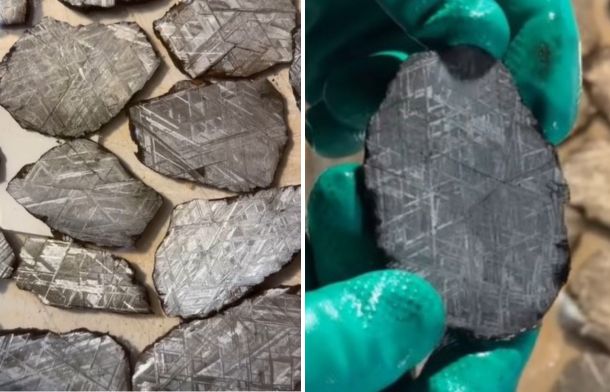
Meteorite hunting is a favorite hobby for some people. In the United States, the best place to find the elusive rocks is the southwest. Every meteorite hunter handles their finds differently. Some might opt to display the space stone as is. Others slice the meteorites into sections for display or selling. @stardust_eu This is mostly what I do with the meteorites I’ve found: cut them into slices to give people the chance to own something as old as our solar system and contemplate it every day. As I mention in the video, the pattern is impossible to replicate. But why? Because its formation took literally billions of years under outer space conditions, such as vacuum and the absence of gravity. When the meteorite was molten metal in space, it cooled at a rate of just one degree every million years. This incredibly slow process prevented the crystals of taenite and kamacite from mixing as they crystallized. Cool, right? What would you do if you found one? #meteorites #rocks #space #crystals #mineral #nature #spaceart #spaceexploration #galaxy ♬ sonido original – Meteorite Hunting ︎ When meteorite hunters Emil Davidsson and Alexandra Levchenkova get a new stone, they often slice it into smaller pieces. The slices are soaked in an acid bath for about 20 minutes. The bath permits the natural pattern of the meteorite to be more visible. As the team behind Stardust Meteorite Jewelry, the pair wants people to have the opportunity to own a piece of the solar system. Image from TikTok. Like a human fingerprint, the striation pattern of a meteorite cannot be duplicated. It takes billions of years to form a meteorite in the vacuum of space with no gravity. What begins life as molten metal cools slowly over millions of years. The slow cooling process creates natural, one-of-a-kind patterns called Widmanstätten patterns. The acid bath brings the patterns out, making them more visible. Becoming A Meteorite Hunter Stardust Meteorite Jewelry processes the cosmic stones to support their business. You can see more of their work and finished jewelry on their Instagram page. They are very knowledgeable about the space rocks and want to share them with the world. Stardust mines their stones globally and procures products from other meteorite hunters. They process stones in different ways depending on their needs. View this post on Instagram A post shared by Meteorite Jewelry | Meteorites | Meteorite hunting (@stardust_eu) There are plenty of public lands in the southwest where you can find meteorites. To become a meteorite hunter, you can research Bureau of Land Management (BLM) policies regarding collection. They allow the collection of meteorites without a permit for personal use. If you intend to use the meteorites commercially, you must obtain permits. Meteorite hunting is a fascinating and adventurous hobby if you enjoy exploring and digging. You can get started with little equipment or invest in a good metal detector to aid your search. Happy hunting! Please share. You can find the source of this story’s featured image here. The post Meteorite Hunter Describes Exactly What Happens After A Find appeared first on InspireMore.
Like
Comment
Share
Showing 60520 out of 116583
  • 60516
  • 60517
  • 60518
  • 60519
  • 60520
  • 60521
  • 60522
  • 60523
  • 60524
  • 60525
  • 60526
  • 60527
  • 60528
  • 60529
  • 60530
  • 60531
  • 60532
  • 60533
  • 60534
  • 60535
Advertisement
Stop Seeing These Ads

Edit Offer

Add tier


Select an image
Delete your tier
Are you sure you want to delete this tier?

Reviews

In order to sell your content and posts, start by creating a few packages. Monetization

Pay By Wallet

Payment Alert

You are about to purchase the items, do you want to proceed?

Request a Refund