YubNub Social YubNub Social
    #music #tew #tuba #militarymusic #armymusic #armyband #satire #democrats #loonylibs #iran #quintet #tew2026 #comedy #solocompetition #competition
    Advanced Search
  • Login
  • Register

  • Night mode
  • © 2026 YubNub Social
    About • Directory • Contact Us • Developers • Privacy Policy • Terms of Use • shareasale • FB Webview Detected • Android • Apple iOS • Get Our App

    Select Language

  • English
Night mode toggle
Featured Content
Community
New Posts (Home) ChatBox Popular Posts Reels Game Zone Top PodCasts
Explore
Explore
© 2026 YubNub Social
  • English
About • Directory • Contact Us • Developers • Privacy Policy • Terms of Use • shareasale • FB Webview Detected • Android • Apple iOS • Get Our App
Advertisement
Stop Seeing These Ads

Discover posts

Posts

Users

Pages

Blog

Market

Events

Games

Forum

The Blaze Media Feed
7 w ·Youtube News & Oppinion

YouTube
How Trump SHOCKED the Global Elites with His DECISIVE Speech at WEF in Davos
Like
Comment
Share
NEWSMAX Feed
NEWSMAX Feed
7 w ·Youtube News & Oppinion

YouTube
Clintons face legal scrutiny as Congress moves toward contempt vote | The Right Squad
Like
Comment
Share
The Conservative Brief Feed
7 w

Walz Confronted – “Are You a CCP SPY?!”
Favicon 
www.theconservativebrief.com

Walz Confronted – “Are You a CCP SPY?!”

The failed Harris campaign’s vetting team questioned whether Minnesota Governor Tim Walz had operated as an agent of the Chinese Communist Party during the 2024 vice presidential selection process, raising serious concerns about the judgment of Democrat leadership in choosing candidates with extensive foreign entanglements. Campaign Questioned Chinese Communist Party Connections Kamala Harris’s campaign team directly confronted Walz during the 2024 vetting process about whether he had ever served as an agent of the Chinese Communist Party. The questioning stemmed from Walz’s documented history of teaching in China during the late 1980s, shortly after the brutal Tiananmen Square crackdown, and his subsequent pattern of leading student groups on educational trips to the communist nation. Campaign officials conducted intensive scrutiny of these foreign entanglements, which spanned decades before Walz entered politics. The concerns were significant enough that aides felt compelled to ask direct questions about a potential CCP agency. Antisemitic Questions Targeted Jewish Candidate Simultaneously The vetting controversy extended beyond Walz to Pennsylvania Governor Josh Shapiro, whom Harris aides questioned about whether he was an “agent of the Israeli government.” Shapiro, who spent time on an Israeli kibbutz and volunteered on an Israeli army base, characterized these questions as offensive invocations of antisemitic “dual loyalty” tropes. Deborah Lipstadt, the Biden administration’s special envoy to combat antisemitism, explicitly identified the questioning as “classic antisemitism.” The parallel scrutiny of both candidates reveals a pattern where Harris’s team appeared more concerned with foreign government connections than with recognizing offensive questioning that undermined American citizens’ loyalty based on their backgrounds and religious identities. Campaign Dismissed Concerns Despite Red Flags Despite raising serious questions about Walz’s China connections, campaign officials ultimately concluded his ties “reflected his background in education rather than political or intelligence activity.” This rationalization enabled Harris to select Walz as her running mate, even after the vetting team raised serious concerns warranting direct questions about a Chinese government agency. The compressed timeline following Joe Biden’s withdrawal from the race put pressure on rapid vetting, but the decision to proceed with Walz despite these red flags demonstrates questionable judgment. For conservatives concerned about foreign influence and national security, the willingness to dismiss extensive China connections as merely educational raises troubling questions about Democrat priorities. Failed Campaign Faces Post-Election Scrutiny The Harris-Walz ticket lost decisively to President Donald Trump in the 2024 general election, and details of the controversial vetting process only emerged publicly through CNN reporting in January 2026. Shapiro has documented his experience in an upcoming memoir, characterizing the questions as offensive and noting his Jewish identity and pro-Israel positions appeared to draw particular scrutiny. The revelations damaged relationships between Harris’s campaign and Shapiro’s team, with Shapiro’s aides dismissing Harris’s post-election claims as “simply ridiculous.” The vetting controversy now stands as another example of the failed judgment that characterized the unsuccessful Democrat campaign, compounded by the apparent willingness to employ antisemitic questioning while simultaneously dismissing legitimate concerns about Chinese Communist Party connections. Sources: REPORT: Kamala Harris Had Concerns That VP Pick Tim Walz Was a Chinese Government Agent Harris Aides GRILLED Tim Walz Over China Ties Kamala Harris Aides Grilled Tim Walz Over China Ties
Like
Comment
Share
Classic Rock Lovers
Classic Rock Lovers  
7 w

Favicon 
www.classicrockhistory.com

An Interview With Tommy Bolan Of Warlock, Doro Pesch & N.Y.C.

Like many of us who are born and raised in New York, guitarist Tommy Bolan’s energy is undeniable. “I’m an overcaffeinated New Yorker,” Bolan tells ClassicRockHistory.com. “I am always a pedal to the metal, with a ‘get it done now’ kind of mentality. ” That style served Bolan well, as he found himself beside metal icon Doro Pesch in the late ‘80s, leading to a gig with German powerhouse Warlock and the recording of the now-classic 1987 album Triumph and Agony. Fans will remember the hit song, “All We Are,” from that record. It features Bolan’s hyper-charged style and defines The post An Interview With Tommy Bolan Of Warlock, Doro Pesch & N.Y.C. appeared first on ClassicRockHistory.com.
Like
Comment
Share
The Lighter Side
The Lighter Side
7 w

World’s Most Northern Electric Ferry Now Sailing in Frigid -13°F Temps (-25°C)
Favicon 
www.goodnewsnetwork.org

World’s Most Northern Electric Ferry Now Sailing in Frigid -13°F Temps (-25°C)

An all-electric passenger/car ferry in northern Norway has proven that brain-disabling cold can’t affect its service, despite running entirely on batteries. Whatever technology was encased within the batteries of our parents’ cars that would see them suffer in the cold is not what powers the M/F Vargsund, which links the two islands of Kvaløya and Seiland […] The post World’s Most Northern Electric Ferry Now Sailing in Frigid -13°F Temps (-25°C) appeared first on Good News Network.
Like
Comment
Share
Daily Signal Feed
Daily Signal Feed
7 w

From Rock to Tech, Talent Flees Taxes
Favicon 
www.dailysignal.com

From Rock to Tech, Talent Flees Taxes

California Democrats should listen to The Rolling Stones. The band famously fled England in the 1970s, heading into tax exile in the south of France. Mick Jagger and his mates weren’t alone—a generation of rock royalty abandoned the U.K. because of its steep taxes: David Bowie opted for Switzerland; Rod Stewart went to California. “We left England because we’d be paying 98 cents on the dollar. We left, and they lost out. No taxes at all,” Stones guitarist Keith Richards recalled to Fortune. Progressives are now transforming California into what Britain was before Margaret Thatcher—and it’s not celebrities who are leaving, but the billionaires who drive Silicon Valley’s economy, and therefore the state’s. The 2026 Billionaire Tax Act ballot measure is a recipe for reverse alchemy, turning the Golden State into lead. California’s descending into a vicious spiral all too familiar from other blue states and cities, whenever they try to make up for revenue lost as billionaires and businesses flee by raising taxes ever higher. But this is no ordinary tax on incremental gains—the Billionaire Tax is straight-up confiscation, a one-time seizure of 5% of a taxpayer’s assets. The law would hit anyone with $1 billion or more, which is admittedly a tiny population—fewer than 300 people—even in California. But if millions of people voting in a referendum can expropriate a few hundred people this time, what’s to stop them from doing it to a few thousand the next, or many thousands after that? What begins with the billionaires won’t end with them. Even Gov. Gavin Newsom, who’s no stranger to scaring money away from the state—just ask Elon Musk—thinks the Billionaire Tax goes too far. Or does he? He tells The New York Times he fears it would harm California’s competitiveness with other states, but a national confiscation wouldn’t be so bad: “It’s one thing to have a prism of the nation, and you can talk about 50 states,” he says. “It’s another when you’re competing against 49 other states.” A prism of the nation? It sounds like Newsom meant “a prison of the nation” where the prey can’t escape by just moving to Texas. Newsom has made his state a sanctuary for illegal immigrants while his policies encourage the nation’s most successful businesspeople to self-deport. The low-tax red states of Texas and Florida are booming thanks to exactly the opposite approach—they’re sanctuaries for entrepreneurs who create new jobs and whole industries. The tech-talent exodus had begun long before the Billionaire Tax arose on California’s horizon. But it’s hastening the rush out, and whether or not it passes, the initiative confirms Silicon Valley’s worst fears about where things are headed. So the billionaires are headed someplace else: Elon Musk left for Texas in 2020 and subsequently relocated Tesla, SpaceX, and other companies he owns. Peter Thiel is now a Florida resident and has shifted his operations out of California by stages. David Sacks has gone to Austin, and Google’s founders Sergey Brin and Larry Page are said to be cutting their ties to California, too. Even the billionaire owner of California’s iconic In-N-Out burger chain announced last July she was leaving for Tennessee. A June 2025 report by the Public Policy Institute of California notes the state lost 1.9% of its corporate headquarters between 2011 and 2021. The Los Angeles Times says California suffered a net emigration of 741 firms in 2022 and 531 in 2023 as well. Along with New York, California is the Democratic Party’s crown jewel at the state level. Yet both states are bleeding business because of high taxes and stifling regulations. “California and New York have, by far, the highest domestic outflow of domestic companies across the US” dating back to 2015, according to the Financial Times. These states, like other blue states and cities before them, are wrecking the very prosperity that makes their extensive social services and government benefits possible. And as in Illinois and so many other places, short-sighted unions are exacerbating California’s problems. The Billionaire Tax is being pushed by the Service Employees International Union-United Healthcare Workers West, which wants to make up for Trump administration cuts to federal services by sapping the wealthiest Californians. If that strikes fear into Newsom, so much the better—the union can use that fear to wring more concessions from him, his party and the state they control. Meanwhile, the men and women whose abilities and resources contribute the most to making California a place that would rank as the world’s fifth biggest economy if it were a country of its own aren’t waiting around to find out who’ll carve them for dinner. They’re following the Stones’ example and going wherever success isn’t punished. COPYRIGHT 2026 CREATORS.COM We publish a variety of perspectives. Nothing written here is to be construed as representing the views of The Daily Signal.   The post From Rock to Tech, Talent Flees Taxes appeared first on The Daily Signal.
Like
Comment
Share
Hot Air Feed
Hot Air Feed
7 w

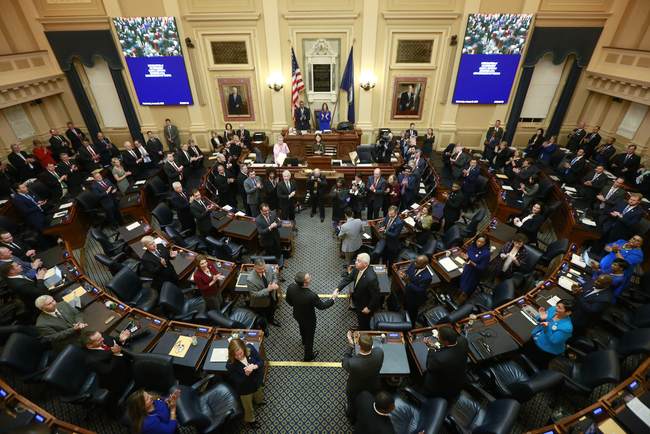
Virginia's 'Make Fraud Legal' Bill
Favicon 
hotair.com

Virginia's 'Make Fraud Legal' Bill

Virginia's 'Make Fraud Legal' Bill
Like
Comment
Share
Science Explorer
Science Explorer
7 w

Your Pet Dog Or Cat Doesn’t Have An Appendix, But Wombats And Koalas Do
Favicon 
www.iflscience.com

Your Pet Dog Or Cat Doesn’t Have An Appendix, But Wombats And Koalas Do

Star-nosed mole? Fossa? The list gets weirder.
Like
Comment
Share
Science Explorer
Science Explorer
7 w

Can Elephants Swim? Rajan The Elephant Shows These Giant Sea-Farers Are Not Strangers To Water
Favicon 
www.iflscience.com

Can Elephants Swim? Rajan The Elephant Shows These Giant Sea-Farers Are Not Strangers To Water

Elephants evolved from semi-aquatic ancestors related to dugongs and sea cows.
Like
Comment
Share
The Blaze Media Feed
7 w

How Americans can prepare for the worst — before it's too late
Favicon 
www.theblaze.com

How Americans can prepare for the worst — before it's too late

Imagine standing in a war-torn city overseas, as I have on numerous deployments, walking through communities shattered not just by bombs and sectarian conflict, but by the follow-on failure of basic systems — water, power, food, even the educational system.It's a stark reminder that resilience isn't abstract; it's the difference between chaos and recovery. Back home, over 20 million Americans reported in 2023 that they could last at home for a month or more without publicly provided water, power, or transportation, a rate more than double that reported in 2017.This trend is not occurring because of government guidance, but rather because of a perceived fear of government failure. Across the world, civil defense and national preparedness are surging in discussions, extending beyond disasters or war to encompass health, economics, energy, and the social, spiritual, and built environments of our communities.Civilians have an active role to play and should not passively wait for government salvation.The core question remains: Are we truly resilient?Identifying gapsIn 2019, Quinton Lucie, a former attorney for the Federal Emergency Management Agency, wrote a blistering academic piece in Homeland Security Affairs. He argued that America no longer has the institutional experience or framework required for civil defense, a large pillar in overall national resiliency. In his words, the U.S. “lacks a comprehensive strategy and supporting programs to support and defend the population of the United States during times of war.” Retired Air Force General Glen D. VanHerck, the former commander of the North American Aerospace Defense Command and U.S. Northern Command, recently commented that America needs to be able to “take a punch in the nose ... and get back up and come out swinging” regardless of whether the attack came in the cyber realm or something conventional.An all-inclusive plan is not optional. Presidential Executive Order 12656 mandates whole-of-government responsibilities for various national security emergencies. Article Three of the 1949 North Atlantic Treaty, which created NATO, stipulates resilience, focusing on continuity of government, essential services for citizens, and military support. Implicitly, it calls on individuals to step up too — not just for war, but for natural disasters, economic slumps, or grid failures.While non-binding, the 2020 NATO NSHQ Comprehensive Defence Handbook states that “resilience is the foundation atop the whole-of-society bedrock” and “is built through civil preparedness and is achieved by continually preparing for, mitigating, and adapting to potential risks well before a crisis.” The challenge is that civil preparedness requires this whole-of-society approach, not just a whole-of-government one. That is, we can’t have a strong nation without strong individuals and communities.Facing perils head-onWhat other perils might we confront? Food security is a prime example. During the U.S. government shutdown, food banks near bases experienced a 30%-75% surge from military families. This comes at a time when 42 million Americans are on food stamps and Secretary of War Pete Hegseth and Secretary of Health and Human Services Robert F. Kennedy Jr. push for a healthier fighting force and populace. Globally, a February 2025 report by the U.K.’s National Preparedness Commission indicated that civil food resilience is highly vulnerable to myriad shocks to the status quo and that the populace was underprepared.RELATED: Minneapolis ICE protesters are BEGGING for civil war — and we need to take them seriously Photo by DAVID PASHAEE/Middle East Images/AFP via Getty ImagesUtilities failures like water and electricity are another concern. In October 2025, the former top general of the National Security Agency warned of China's aggressive targeting of U.S. critical infrastructure. This aligns with China’s “Three Warfares” strategy, which seeks to manipulate or weaken adversaries via public opinion warfare, psychological warfare, and legal warfare. China’s gray-zone activities against the U.S. also include synthetic narcotics like fentanyl and online actions to deepen political fissures.Leaders are not sitting still. President Trump supports reshoring manufacturing capacity in the U.S. Onshoring and friend-shoring are hot topics among various industries, given rare-earth metal availability, tariffs, and general uncertainty. The U.S. Army is bolstering energy resilience, planning nuclear small modular reactors on nine bases by late 2028 and reclaiming a "right to repair" in contracts.Big business is also in on the action. Jamie Dimon, CEO of JPMorganChase recently announced a $1.5 trillion plan for a more resilient domestic economy, seeing it as an issue of national security. With two Federal Reserve rate cuts in 2025 potentially fueling inflation, hedge fund billionaire Ray Dalio advises 15% portfolio allocation to gold. Even Jan Sramek of California Forever is investing hundreds of millions to build a resilient city near San Francisco. Resilience, clearly, permeates every facet of life.Resilience is globalThis is not unique to the English-speaking world. Latvia, a small Baltic state bordering Russia and Russia’s ally Belarus, exemplifies a whole-of-society approach. The nation's 2020 State Defense Concept — currently in execution — is comprehensive in its approach, both to potential perils and responsibilities. Accidents, pandemics, war, severe weather, and cyberthreats all require a citizenry-to-parliament strategy. The church plays a major role, as does physical fitness, patriotism, and education, which is why state defense is now compulsory in Latvian schools. Germany is getting back into the bunker business and has earmarked €10 billion through 2029 for civil protection. Many Polish citizens do not see their governments doing enough and are taking matters into their own hands by building bunkers and attempting — unfortunately without much success — to establish neighborhood civil defense groups.What resilient citizens can doWhat should we take from this? First, preparedness is neither fringe nor irrational. It is a global movement involving politicians, billionaires, and everyday people. Second, there is no one-size-fits-all solution. Resilience spans the full human spectrum: social, physical, intellectual, emotional, and spiritual components, as I outline in my book "Resilient Citizens" through frameworks like the five archetypes (from Homesteaders to the Faithful) that show diverse, adaptable paths. Third, civilians have an active role to play and should not passively wait for government salvation. Tiered responsibility requires each echelon — from state to citizen — to play their parts, own up to their agency and responsibility, and act. Will you?

Like
Comment
Share
Showing 6334 out of 113572
  • 6330
  • 6331
  • 6332
  • 6333
  • 6334
  • 6335
  • 6336
  • 6337
  • 6338
  • 6339
  • 6340
  • 6341
  • 6342
  • 6343
  • 6344
  • 6345
  • 6346
  • 6347
  • 6348
  • 6349
Advertisement
Stop Seeing These Ads

Edit Offer

Add tier


Select an image
Delete your tier
Are you sure you want to delete this tier?

Reviews

In order to sell your content and posts, start by creating a few packages. Monetization

Pay By Wallet

Payment Alert

You are about to purchase the items, do you want to proceed?

Request a Refund