www.historyisnowmagazine.com
How the North and South Treated Minorities During the U.S. Civil War
During the U.S. Civil War, the North and South treated minority groups in different ways – and some of these may be surprising to readers. Here, Jeb Smith looks at how the North and South treated Catholics, Jews, and Native Americans during the Civil War period.
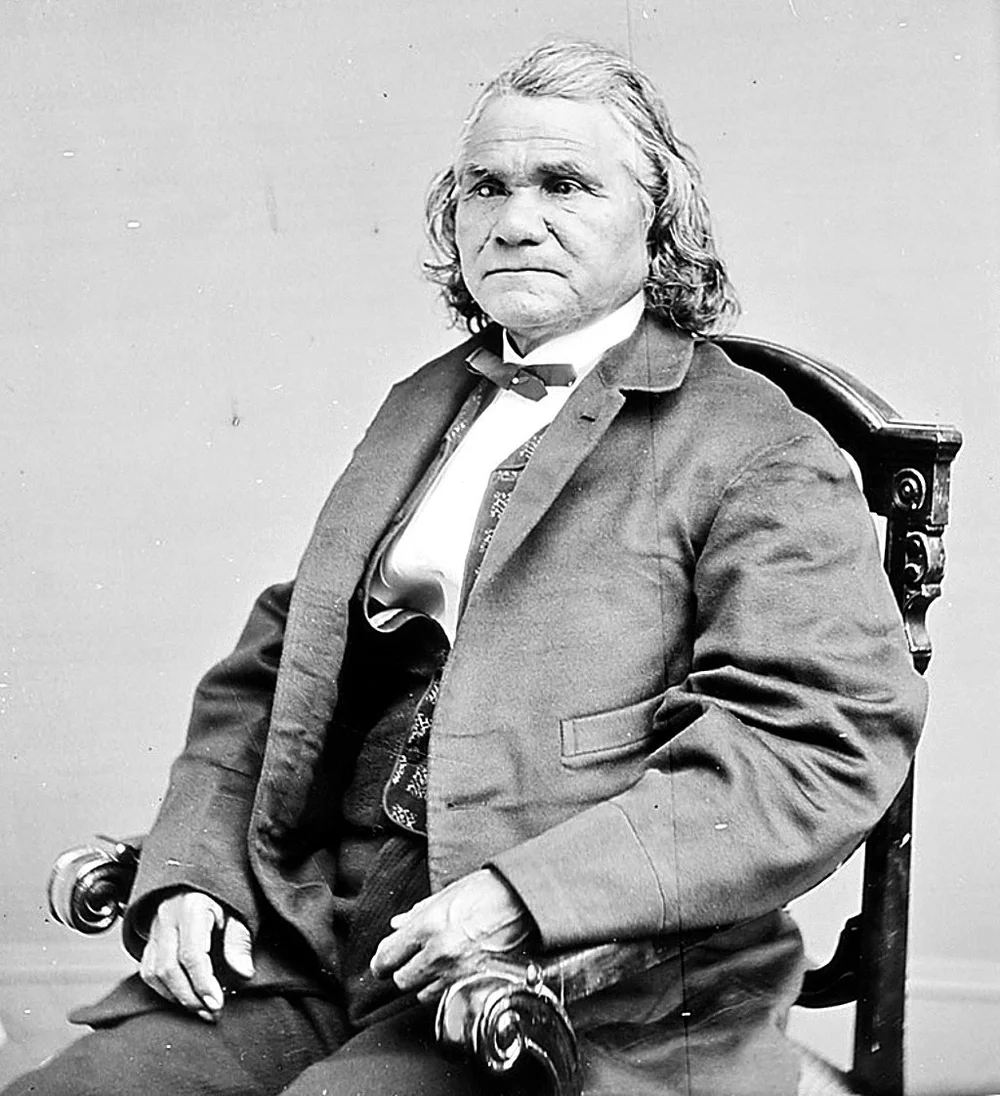
Brigadier General Stand Watie."Their clergy [Catholic]blessed the flags of Confederate regiments, and their opposition to the federal regime in New Orleans was more uncompromising than that of any other group...A Richmond editor wrote, "Catholic Hierarchy of the South… were warm supporters of the Southern cause, and zealous advocates of the justice upon which this war of defense….was conducted."-E Merton Coulter The Confederate States of America 1861-1865 Baton Rouge: The Louisiana State University Press 1950 Historian Phillip Tucker wrote, "The South in general was actually far more multicultural and more multiethnic than the North in 1860...the South was in general less racist towards ethnic groups, including the Irish and Jews, than the North." Minorities received better treatment in the South than in the North. Catholicism played a more significant role in the South and was more accepted by the population. Like the old South, traditional Catholicism honored hierarchy, aristocracy, chivalry, and other traditional values. Also, like the South, pre-Vatican II Catholics were traditionalists and rejected modernity. Traditional Catholics had more in common culturally and politically with the South than with the progressive North. CatholicsHistorian James McPherson shows that Catholics under Pope Pius the IX (Pope from 1846-1878) still maintained much of their older traditional identity. Pius was described as a "violent enemy of liberalism and social reform." In his 1864 Syllabus of Errors, he wrote that it was an error to think the Pope should agree with "progress, liberalism, and modern civilization." Pope Pius X commanded "all clergy, pastors, confessors, preachers, religious superiors, and professors in philosophical-theological seminaries" to take an "oath against modernism." In The Story of Christianity Volume II. Historian Justo Gonzalez observed "a growing gulf between mainstream modern thought and society on the one hand and Catholicism on the other."Further, nothing brings groups together like similar enemies. Robert Fogel shows that Republicans viewed "Catholicism and slavery as twin despotisms." They hated Catholics because "The Catholic church was in league with the pro-slavery democratic party to destroy the principles of free government," wrote an 1858 organ of the Republican party in Illinois. James McPherson wrote, "The Puritan war against popery had gone on for two and a half centuries and was not over yet...hostility to Romanism (as well as rum) remained a subterranean current within Republicanism."Like the Virginian theologian R.L Dabney, Archbishop John Hughes of N.Y. referred to abolitionists as "Red-republicans." Hughes condemned public schools as godless promoters of "Socialism, Red Republicanism, Universalism, Infidelity, Deism, Atheism, and Pantheism." And while Dabney was no friend of Catholic theology, they were kin in mind when it came to modernity. In Catholics Lost Cause, Adam Tate writes, "Catholics and southern conservatives viewed the North as the locus of American radicalism and took refuge in Jeffersonian conceptions of both the Union and the Constitution.""Protestants funded Catholic churches, schools, and hospitals, while Catholics also contributed to Protestant causes. Beyond financial support, each group participated in the institutions created by the other. Catholics and Protestants worshipped in each other's churches, studied in each other's schools, and recovered or died in each other's hospitals…Catholic-Protestant cooperation complicates the dominant historiographical view of interreligious animosity and offers a model of religious pluralism in an unexpected place and time."-Andrew Stern Southern Harmony: Catholic-Protestant Relations in the Antebellum South Cambridge University Press 2018 KinshipSoutherners felt a kinship with Catholics that was absent in the North. According to southern writer Daniel Hundley, "In Florida, Louisiana, Texas, and other portions of the far South, the progenitors of the Southern Gentleman were chiefly Spanish Dons and French Catholics." Compared to the North, Catholics had a much more significant influence on southern society. The Cavalier South was more tolerant and did not seek to conform others to their image as the Puritan North did. As a result, the South was admired by old-time Catholic conservatives like Lord Acton, Hilaire Belloc, and G.K Chesterton, who said: "Old England can still be faintly traced in Old Dixie."In Catholic Confederates, Gracjan Kraszewski notes that "Catholics made themselves virtually indistinguishable from their Protestant neighbors." He refers to the "Confederatization" of Catholics that occurred to a greater extent in the South than in the North. The South accepted Catholics, and Catholics accepted the South. They became one with each other. Kraszewski writes, "More than one hundred years before Vatican II and JFK, Catholics in the South were fully integrated members of society who, save for their religion, believed the same things and acted similarly to their well-known Protestant neighbors."When the separation came, southern Bishops almost universally sided with the South. After the fall of Fort Sumter, the local bishop, a rabid secessionist, led Catholics in the celebration by singing a Latin hymn. A number of Confederate generals were Catholics, including James Longstreet and the Confederacy's first general, Pierre Toutant Gustave Beauregard. The secretary of the Navy, Stephen Mallory, was also a Catholic and a member of Jefferson Davis's cabinet.When federals occupied Natchez, Mississippi, they ordered all pastors and priests to pray for Abraham Lincoln, but Catholic Bishop William Henry Elder refused. He was briefly imprisoned for his non-conformity and was heralded as a legend across the South. The most popular post-war poem among former Confederates was "The Conquered Banner." This poem -recited in southern schools for generations was composed by Catholic priest and Confederate army chaplain Abram Joseph Ryan.Catholic priests made devotionals for the soldiers used by all denominations, and nuns served in confederate hospitals. Some Catholic Confederate chaplains could not stay out of the war; despite it being against canon law, John Bannon fired a cannon at the Yankee hordes. The similarities between traditional Catholicism and the South provided an "easy symbiosis" for the thousands of southern Catholic soldiers, writes Kraszewski. When the Confederacy sent Father John Bannon to Ireland, it was his view that devout Catholics of Europe could find in the Confederacy the remnant of Christendom. In the North, Bannon stated, one could only find puritans and anti-Catholic prejudice."Roman Catholics and Jews found an accepted place, sometimes a very successful place, in the South when such was unknown in the North....at the time of the war, a high proportion of American Catholics and Jews were found in the South and were loyal confederates. Nearly all Catholics and Jews elected to public office in the U.S. were in the South. The two most famous anti-Catholic incidents in the pre-war period took place in Boston and Philadelphia...no such incidents occurred in the South. The letters of Lincoln supporters are full of anti-Semitic comments, and , notoriously, General Grant was to banish Jews from the Union army lines."-Clyde Wilson The Yankee Problem An American Dilemma Shotwell publishing 2016 JewsJews were clearly more accepted in the Southern states. Robert Rosen, in The Jewish Confederates, tells how the Southern Jewish population were among the most rabid secessionists. They were integrated into Confederate units, and some reached high ranks in the military, such as Col. Abraham C. Myers, quartermaster general of the Confederacy; Maj. Adolph Proskauer of the 12th Alabama; Maj. Alexander Hart of the Louisiana 5th; and Phoebe Levy Pember, chief matron at Richmond's Chimborazo Hospital, are some examples he gives. Judah Benjamin was a Senator from Louisiana before joining President Jefferson Davis' cabinet. He served as Attorney General, Secretary of War, and Secretary of State for the Confederacy. Rosen wrote, "the Confederate South was, contrary to popular belief, the exact opposite of the image of the Old South held by most contemporary Americans."Union General U.S Grant gave General Order No. 11, expelling all Jews from his military district. He had earlier ordered a subordinate to "Refuse all permits to come south of Jackson for the present. The Israelites especially should be kept out." The following day he issued another command to "Give orders to all the conductors on the [rail] road that no Jews are to be permitted to travel on the railroad southward from any point. They may go north and be encouraged in it; but they are such an intolerable nuisance that the department must be purged of them." Grant said the black-market cotton exports were done "mostly by Jews and other unprincipled traders." General Sherman wrote to the Union Army adjutant-general that "The country will swarm with dishonest Jews who will smuggle powder, pistols." And as with Jews and Catholics, so it was with Native Americans."In the Northern States the Cherokee people saw with alarm a violated Constitution, all civil liberty put in peril, and all the rules of civilized warfare and the dictates of common humanity and decency unhesitatingly disregarded. In States which still adhered to the Union a military despotism has displaced the civil power…Free speech and almost free thought became a crime. The right to the writ of habeas corpus, guaranteed by the Constitution, disappeared at the nod of a Secretary of State or a general of the lowest grade…Foreign mercenaries and the scum of cities and the inmates of prisons were enlisted and organized into regiments and brigades and sent into Southern States to aid in subjugating a people struggling for freedom, to burn, to plunder, and to commit the basest of outrages on women; while the heels of armed tyranny trod upon the necks of Maryland and Missouri, and men of the highest character and position were incarcerated upon suspicion and without process of law in jails, in forts, and in prison-ships, and even women were imprisoned by the arbitrary order of a President and Cabinet ministers; while the press ceased to be free, the publication of newspapers was suspended and their issues seized and destroyed ...The war now raging is a war of Northern cupidity and fanaticism against the institution of African servitude; against the commercial freedom of the South, and against the political freedom of the States, and its objects are to annihilate the sovereignty of those States and utterly change the nature of the General Government...the Cherokees, long divided in opinion, became unanimous, and like their brethren, the Creeks, Seminoles, Choctaws, and Chickasaws, determined, by the undivided voice of a General Convention of all the people, held at Tahlequah, on the 21st day of August , in the present year, to make common cause with the South and share its fortunes."-Tahlequah, C. N., October 28, 1861. THOMAS PEGG, President National Committee. JOSHUA ROSS, Clerk National Committee. Concurred. LACY MOUSE, Speaker of Council. THOMAS B. WOLFE, Clerk Council. Approved. J.N.O. ROSS. Native AmericansThe most significant discrepancy in the treatment of minorities is given when we look at Native Americans. The majority of the "civilized" Native American tribes sided with the South during the war. General Stand Watie of the Cherokee was the last Confederate general to surrender on June 23, 1865. He was the only Native American to be promoted to general on either side of the war. Native American tribes sent a higher percentage of their population to war than any state in the Confederacy and lost a higher percentage than any southern state. No one was more devoted to the Southern cause, not South Carolina or Virginia. They sacrificed the greatest and held out the longest.The Indian Territory mainly sided with the South and sent delegates to Richmond. Richmond sent government officials, food, money, and supplies to the Indian Territory to help and support them. The formation of an Indian State in the Confederacy was offered to the tribes if they desired it. However, the Confederacy gave them complete autonomy for their government and offered a postal service even if they remained autonomous."...the several Indian treaties that bound the Indian nations in an alliance with the seceded states, under the authority of the Confederate State Department.. an innovation, in fact, that marked the tremendous importance that the Confederate government attached to the Indian friendship. It was something that stood out in marked contrast to the indifference manifested at the moment by the authorities at Washington...The Confederacy was offering him [the Indian] political integrity and political equality."-Annie Heloise Abel Ph.D. The American Indian as Slaveholder and Secessionist an Omitted Chapter in the Diplomatic History of the Southern Confederacy Arthur H Clark Company Cleveland 1915 The Federals attacked and killed women and children of a neutral tribe during the war, driving even more support for the South. In response, the Confederacy sent financial support to displaced families under Union occupation. In General Stand Watie's Confederate Indians, Frank Cunningham quotes multiple tribal leaders' thankfulness for the treatment of their tribes by Richmond and President Davis.Historian Annie Heloise Abel tells how it was John Calhoun and other Southern men who desired the entire west to be shut off from whites and to allow the Native Americans self-governance, "Southern politicians, after his time, became the chief advocates of Indian territorial integrity, the ones that pleaded most often and most noisily that guarantees to Indians be faithfully respected." As with Catholics, the tribes had more in common with the South in culture and institutions. As slave owners and planters, they tended to be agrarian. For example, on January 29, 1861, Arkansas governor Henry Rector wrote to John Ross, Principal Chief of the Cherokee Nation, "Our people and yours are natural allies in war and friends in peace.""On behalf of the Creek people...the cause of the South is our cause, her hopes our hopes, and whatever her misfortunes may be it shall be our pleasure to bear them patiently with her, even unto death. If she falls we fall, and if she prospers we only desire it to be our privilege to enjoy her prosperity….we are enrolling every able-bodied man in service for war."-Samuel Checote, Creek Nation Heneha Mekko, "Principal Chief of the Seminoles," said:"The Confederate States have not deserted us, we have been provided for, our women and children are fed, our soldiers get all they should expect. The Government is engaged in a great war, she cannot do any more for us now then she is doing...assure the President the Seminoles are yet true and loyal. Their treaty stipulations are sacred. The destiny of your government shall be ours. If she falls we will go with her: if she triumphs no rejoicing will be more sincere than ours." The western "wild" plains Native Americans did not side with the South, but still fought against the North. The North sent General Pope to deal with the "savages' 'like the Sioux. Lincoln signed off on the hanging of 38 Native Americans in 1862 in Minnesota.Lincoln's attitude towards Native Americans might have been affected by an earlier time in his life. His close friend Ward Lamon tells of the great impact that the murder of Lincoln's grandfather by Native Americans had on the future president. Lincoln said, "The story of his death by the Indians, and of Uncle Mordecai, then fourteen years old, killing one of the Indians, is the legend more strongly than all others imprinted upon my mind and memory." Lincoln's uncle Mordecai "hated Indians ever after" and even was reputed to murder innocent Native Americans when he had the chance. Lamon tells us "Many years afterward, his neighbors believed that he was in the habit of following peaceable Native Americans as they passed through the settlements, to get surreptitious shots at them and it was no secret that he had killed more than one in that way." So it should not surprise us that aged 23, Abraham Lincoln volunteered for a chance to fight Native Americans in the Black Hawk War. Attacks from the NorthThe North then attacked and kicked the wild plains Native Americans off their land in pursuit of a transcontinental railroad to bring their territory under the domain of the industrialists and capitalists. In their book The South Was Right!James and Walter Kennedy document numerous cases of northern abuses of minorities. Federal General Pope ordered that the Native Americans "Are to be treated as maniacs or wild beasts, and by no means as people with whom treaties or compromises can be made." He declared, "It is my purpose to utterly exterminate the Sioux." Professor Thomas DiLorenzo quotes Lincoln's friend Grenville Dodge, Union general and railroad icon, who suggested using captive Native Americans as forced labor (I thought Republicans did not like slavery- though perhaps it was only when they were not master) on the railroads.Republicans did not care for Native American rights. In the Personal Memoirs of U.S Grant, among his ruminations on the consequences of the conflict was "It is probable that the Indians would have had control of these lands [west] for a century yet but for the war. We must conclude, therefore, that wars are not always evils unmixed with some good." So the taking of land from the Native Americans was such an excellent "good" that it helped justify the evils of the civil war to our former Republican President and civil war "hero."In Nothing Like it in the World: The Men Who Built The Transcontinental Railroad 1863-1869, Historian Stephen Ambrose quotes the Chicago Tribune newspaper as observing, "The railroad men...have an infallible remedy for the Indian trouble, that remedy is extermination. These men, most of them tender and gentle with the weak of their own race, speak with indifference of the wiping out of thousands of Papoos and Squaws." Ambrose then quotes General Sherman, "The more [Indians] we can kill this year, the less will have to be killed the next war, for the more I see of these Indians the more convinced I am that they all have to be killed or be maintained as a species of Paupers." Dodge said, "We've got to clear the dumb Indians out." Oliver Ames, President of the Union Pacific railroad, said, "I see nothing but extermination to the Indians as a result of their thieving disposition, and we shall probably have to come to this before we can run the [rail] road safely."Before the war, northern abolitionist Republicans like William Seward had declared the removal of the Native Americans was necessary. Arthur Ferguson, Union Pacific Railroad surveyor, said, "I have no sympathy for the red devils…. May their dwelling places and habitations be destroyed. May the greedy crow hover over their silent corpses. May the coyote feast upon their stiff and festering carcasses." Drunk on industrial power, Sherman told the Native Americans, "We build iron roads, and you can't stop the locomotive any more than you can stop the sun or moon, and you must submit...we now offer you this, choose your homes, and live like white men, and we will help you all you want."According to DiLorenzo in The Feds versus the Indians, "During an assault," Sherman instructed his troops, "the soldiers cannot pause to distinguish between male and female, or even discriminate as to age." He chillingly referred to this policy in an 1867 letter to Grant as "the final solution to the Indian problem," a phrase Hitler invoked some 70 years later." DiLorenzo said Phil Sheridan and Sherman popularized the phrase "a good Indian is a dead Indian." Sherman's ultimate objective was to eliminate the tribes. "We must act with vindictive earnestness against the Sioux," Sherman wrote to Ulysses S. Grant, "even to their extermination, men, women, and children." The Sioux must "feel the superior power of the Government."The U.S. superintendent of Indian affairs, Clark Thompson, revealed the mindset of Republicans towards Native Americans and how to make them worship the same god [money] as the Yankees do."Many plans proposed to bring about a change of their habits, customs, and mode of living...his whole nature must be changed. He must have a white man's ambition, to be like him…to change the disposition of the Indian to one more mercenary and ambitious to obtain riches and teach him to value the position consequent upon the possession of riches."-Clark W Thompson Superintendent Indian Affairs United States Congressional serial set, Volume 1117 The North could not allow anything or anyone, no matter what race, to get in its way of building an empire in the worship of its true god, progress. So, they would either exterminate or remake such culture that got in its way, either the South or the Native Americans. The South had experienced it from the Union and prophetically warned the Native Americans."Another, and perhaps the chief cause, is to get upon your rich lands and settle their squatters, who do not like to settle in slave States. They will settle upon your lands as fast as they choose, and the Northern people will force their Government to allow it. It is true they will allow your people small reserves—they give chiefs pretty large ones—but they will settle among you, overshadow you, and totally destroy the power of your chiefs and your nationality, and then trade your people out of the residue of their lands. Go North among the once powerful tribes of that country and see if you can find Indians living and enjoying power and property and liberty as do your people and the neighboring tribes from the South."-Quoted in Annie Heloise Abel Ph.D. The American Indian as Slaveholder and Secessionist An Omitted Chapter in the Diplomatic History of the Southern Confederacy Arthur H Clark Company Cleveland 1915 DistrustIt should be no wonder that the Native tribes distrusted the North and sided with the South when the war broke out."Resolved further.. We shall be left to follow the natural affections, education, institutions, and interests of our people, which indissolubly bind us in every way to the destiny of our neighbors and brethren of the Southern States upon whom we are confident we can rely for the preservation of our rights of life, liberty, and property, and the continuance of many acts of friendship, general counsel, and material support."-Choctaws Council Resolutions February 7, 1861 The Native Americans, Jews, Catholics, and the South were diverse cultures that held to a live and let live attitude. They did not seek to conform each other to their image but allowed for diversity and self-governance. This was unlike the Yankees, who puritanically thought themselves superior to all and through military force, government coercion, sheer numbers, and forced indoctrination eradicated opposing cultures' ideologies and brought them all under its dominion. There no longer is any such thing as self-governance unless you are a disciple of the Yankee empire in America. This subjugation of opposing cultures and forced conformity seems a perfectly intolerant and discriminatory practice. While Cash is speaking of the South here, it equally applied to all non-conforming societies the Yankee empire came into contact with."The Civil War and Reconstruction represent in their primary aspect an attempt on the part of the Yankee to achieve by force what he had failed by political means: first, a free hand in the nation for the thievish aims of the tariff gang, and secondly, and far more fundamentally, the satisfaction of the instinctive urge of men in the mass to put down whatever differs from themselves—the will to make over the South in the prevailing American image and to sweep it into the main current of the nation."-W. J. Cash The Mind of the South Vintage Books New York 1941 Jeb Smith is the author of Missing Monarchy: What Americans Get Wrong About Monarchy, Democracy, Feudalism, And Liberty (Amazon US | Amazon UK) and Defending Dixie's Land: What Every American Should Know About The South And The Civil War (written under the name Isaac. C. Bishop) - Amazon US | Amazon UKYou can contact Jeb at jackson18611096@gmail.com








 New Posts (Home)
 ChatBox
 Popular Posts
  Game Zone
 Top PodCasts