www.theamericanconservative.com
Does Burnham’s Political Salvation Run Through Ukraine?
UK Special Coverage
Does Burnham’s Political Salvation Run Through Ukraine?
The UK’s Starmer-era Ukraine policy has been refitted for the new prime minister.
UK Special Coverage
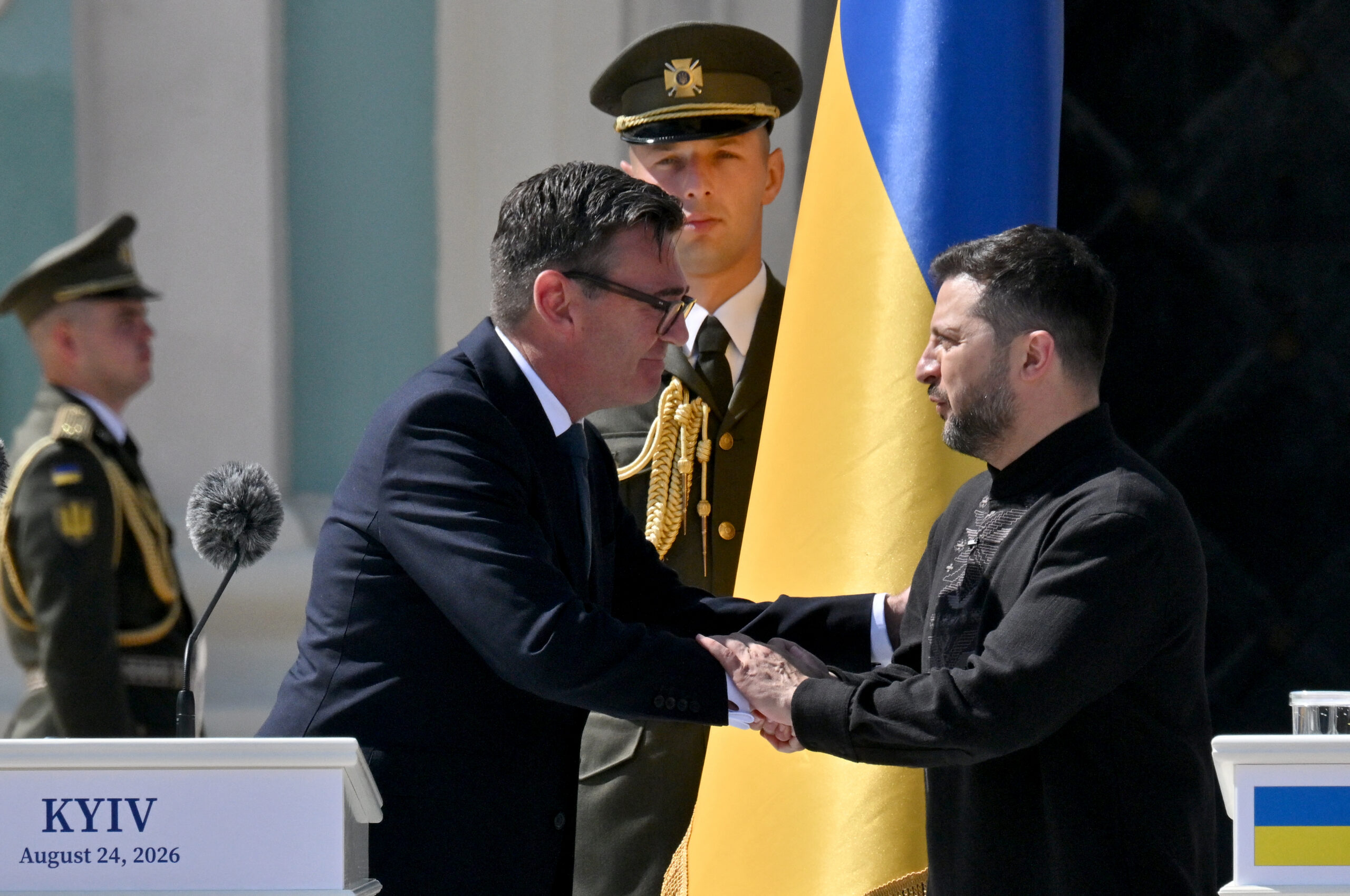
Photo by Sergei SUPINSKY / AFP via Getty Images
It’s tempting to regard Andy Burnham’s first visit to Kiev as the beginning of a new British approach toward Ukraine, not least because governments encourage such interpretations whenever continuity can profitably be dressed up as initiative. In the month or so since taking office, Burnham has made several high-profile commitments on this front: in addition to choosing Ukraine for his first foreign journey as prime minister, he also reaffirmed Britain’s leading position in “the Coalition of the Willing,” promised assistance with Ukrainian long-range missile production, and couched this all in language sufficiently emphatic to attract an angry response from Moscow.
Yet the most striking feature of Burnham’s Ukraine policy so far is how little of its substance is actually new. Britain was already among Ukraine’s most committed European supporters; Burnham’s predecessor Keir Starmer had accepted an unusually extensive British role in guaranteeing a postwar settlement and rebuilding Ukrainian military power; British Storm Shadow missiles were already being used by Ukraine; and the machinery for continuing support had largely been constructed before Burnham entered Downing Street. Even the assumption of a leading position in the Coalition of the Willing amounts less to the acquisition of a new British responsibility than to the continuation of the Starmer-era trajectory. Downing Street itself was explicit on the point when Burnham first spoke to Ukraine’s President Volodymyr Zelensky as prime minister: there would be “absolutely no change in the UK’s approach.”
Nevertheless, Burnham appears to be fitting Britain’s commitment to Ukraine into a rather different argument about Britain itself: one concerned with reindustrialization, defense production, regional employment, strategic autonomy, and, increasingly, a closer post-Brexit relationship with Europe. This does not yet amount to a distinctively Burnhamite doctrine toward Ukraine. It may, however, become something more consequential if the government successfully shifts the political valence of its Ukraine support from the fulfillment of an external obligation (albeit one justified by security and international principle) to a foundational component of a domestic political economy.
The decision to release classified technical information concerning British components of the Franco-British SCALP/Storm Shadow missile illustrates both the continuity and the change. Britain will assist the effort to establish long-range missile production in Ukraine, potentially giving Kiev greater ability to manufacture its own sophisticated weapons, rather than remaining indefinitely dependent on Western suppliers. The immediate military consequences should not be exaggerated: Establishing production lines for complicated weapons takes time, while Ukraine’s present requirements include the much less glamorous necessity of finding sufficient interceptors to prevent Russian missiles from destroying its cities. But the longer-term movement from supplying weapons to transferring some capacity to manufacture them is real.
Even here, however, Burnham is extending rather than revising Starmer’s policy. The previous government had already committed Britain to rebuilding Ukraine’s military capacity, developing new long-range weapons, and sustaining a Ukrainian force capable of deterring a future Russian attack. Burnham’s government had also begun sharing British defense intellectual property with Ukraine before the Kiev visit, allowing Ukrainian production of the British-developed Stone Cloak electronic-warfare system while explicitly connecting Ukrainian battlefield experience to the development of future British weapons. The distinction is consequently one of degree and emphasis. Governments naturally prefer the noun initiative to the verb continue, but much foreign policy consists of discovering new names for commitments for which the apparent costs of withdrawal exceed those of perseverance.
The domestic politics are more revealing. Burnham owes his recent elevation largely to problems at home: stagnant living standards, the North-South imbalance, inadequate public services, the decline of productive industry, and a political establishment that he portrayed, with some justice and considerable political usefulness, as removed from the everyday preoccupations of much of the country. Ukraine therefore presents an awkward inheritance. A government committed to large increases in defense expenditure and continuing substantial assistance abroad must explain how these priorities can be reconciled with an insistence that Britain’s ever-scarcer resources should be directed toward British economic reconstruction.
One solution, of course, is to deny that there is a contradiction. Defense expenditure can become industrial policy; support for Ukraine can become an instrument of defense production; defense production can sustain skilled employment, engineering, steel, electronics, aerospace, shipbuilding, and manufacturing outside the prosperous metropolitan economy. Money nominally devoted to security abroad can thereby acquire a new domestic utility. Downing Street has already begun making the connection explicit, describing the investment in defense as a means of producing “economic growth and opportunity in every postcode.” The proposition need not be cynical to be politically convenient. Successful governments generally prefer policies with strategic, economic, and electoral advantages that happen to point in approximately the same direction.
Such an argument particularly suits Burnham because it connects foreign policy to the political geography whence comes his political support. Much of Britain’s defense industry is concentrated outside London and its prosperous environs, residing instead in places like Lancashire, Barrow, and Sheffield further north. A missile assembled in Britain and destined for Ukraine remains foreign assistance, of course, but it is also an order book, a factory shift, an apprenticeship, an engineering career. This dynamic—the bedrock upon which military-industrial complexes are built—can appear crude when stated explicitly, but it is no less true for that (and this, of course, is one reason politicians rarely state it explicitly).
Ukraine also supplies Burnham with a means of approaching Europe without immediately reopening the Brexit wound. On the train to Kiev, he told European Council President António Costa that Britain should be “bolder” in seeking closer relations with the EU, treating existing defense and security cooperation as a foundation for closer collaboration more broadly. (Discussions with Luxembourg’s Luc Frieden also touched on ways to finance greater European defense expenditure.) That diplomatic opening may prove more consequential than anything Burnham has yet done specifically concerning Ukraine.
Brexit has left British governments with the familiar political problem of wanting some of the apparently enticing consequences of “ever closer” ties with the Continent without accepting the unpopular vocabulary, sclerotic institutions, clunky apparatus, and domestic arguments traditionally associated with achieving those ties. Defense offers an unusually convenient route around the difficulty. Britain can participate more deeply in weapons production, procurement, financing, intelligence, sanctions enforcement, military planning, and Ukrainian reconstruction without announcing a return to the European project. Each arrangement can be presented as a discrete and practical response to Russian aggression, or American unreliability, or the inadequacy of European military capacity; cumulatively, however, these moves could advance the reintegration of Britain into European structures, strategic and otherwise. Burnham’s insistence that Britain should become “bolder” with Europe suggests that he has at least noticed the opportunity.
Burnham’s useful domestic political geometry lies in recovering voters attracted to economic nationalism, regional investment, industrial policy, national resilience, and a less metropolitan conception of Labour politics without conceding that these positions necessarily entail either hostility toward Europe or the supposedly more accommodating attitude toward Russia found elsewhere in British populist politics. Defense allows several otherwise awkward positions to be reconciled. Burnham can favor a stronger state, domestic manufacturing, greater national self-sufficiency, tighter control of strategically important supply chains, and substantial government expenditure while simultaneously advocating close European cooperation and extensive support for Ukraine. Whether voters eventually find the synthesis compelling is another question; political coalitions always appear most coherent before somebody has to pay for them.
Burnham’s emphatic embrace of Ukraine also performs a more immediate function. Because his accession represented a rejection of Starmer and of significant elements of “Starmerism”, foreign governments and parts of the British establishment had reason to wonder how far the repudiation extended. Making Zelensky his first international guest and Kiev his first foreign destination answers the question with almost excessive clarity. Whatever else Burnham intends to change, Britain’s strategic alignment over Ukraine emphatically will not be on the agenda. Having demonstrated continuity where continuity reassures allies, markets, the security establishment, and much of his own party, he acquires rather more room for discontinuity elsewhere. Prime ministers seldom object to being thought unpredictable, provided everyone who needs reassuring has first been told where the unpredictability stops.
The test will therefore come not from further speeches in Kiev but from the less photogenic business of budgets, procurement contracts, factories, and European negotiations. If increased defense expenditure is deliberately directed toward regional industrial reconstruction; if Ukrainian assistance becomes increasingly tied to British production and technology transfer; if defense cooperation provides the leading edge of a wider rapprochement with the EU; and if Burnham consistently presents these policies as parts of an argument about restoring Britain’s productive and strategic capacity, something recognizably “Burnhamite” will have emerged.
But until then, Burnham’s Ukraine policy remains substantially Starmer’s. What has begun to change is the political story being told about why Britain should pursue it. And governments don’t alter the stories surrounding inherited policies merely for literary reasons: Once a policy acquires a different domestic constituency, serves different economic purposes, and becomes attached to a different conception of the national interest, the distinction between changing its justification and changing the policy itself eventually becomes somewhat difficult to sustain.
The post Does Burnham’s Political Salvation Run Through Ukraine? appeared first on The American Conservative.












 Bitchute
 New Posts (Home)
 ChatBox
 Popular Posts
  Game Zone
 Top PodCasts