www.dailywire.com
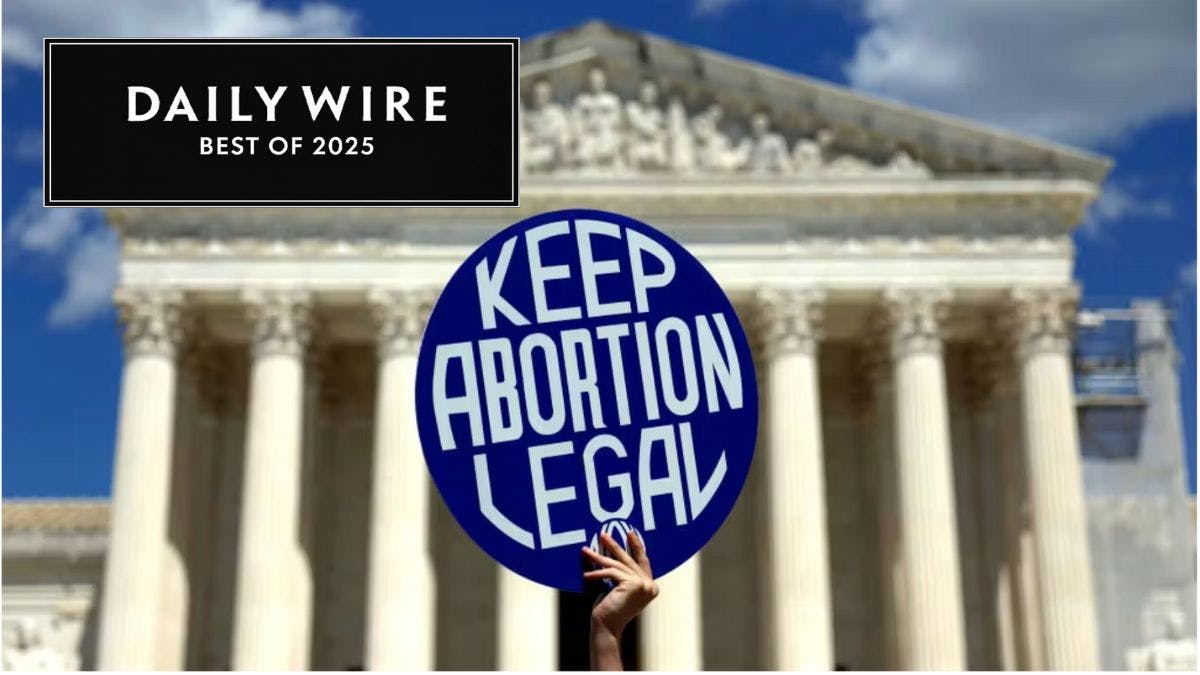
Best Of 2025: Inside The Conservative Debate On Criminalizing Abortion
Editor’s note: This week, we’re reprinting some of our best stories from the past year. In this piece, originally published in July, Leif Le Mahieu dives in to a contentious debate dividing the pro-life movement.
***
In 2016, then-Republican presidential candidate Donald Trump said during an MSNBC town hall that there should be “some form of punishment” for women who chose to abort their unborn children.
His comments erupted a firestorm of controversy among both pro-abortion and pro-life advocates, prompting a rapid backtrack. March For Life President Jeanne Mancini said Trump’s comments were “out of touch” and that “no pro-lifer would ever want to punish a woman who has chosen abortion,” while National Right to Life released an equally critical statement.
Though Trump quickly softened his position, some Republicans and conservative activists, increasingly emboldened by the end of Roe v. Wade and the rise of so-called “self-managed” abortions, are looking to criminalize abortion for anyone involved — including the woman.
They believe that criminalizing abortion will be an effective deterrent to the onslaught of illegal abortion pills being mailed across the country into states where medication abortion is supposed to be illegal. And despite some efforts by a few Republican attorneys general to target those sending abortion pills across the country, abortion pill activists continue to receive glowing profiles in legacy outlets like The New York Times and The Guardian.
While this position is still a minority among elected Republicans, it is gaining increasing national attention from left-leaning media outlets, who portray those who support criminalization as extreme. Advocates of criminalization often clash with traditional pro-life groups, who say that criminalization will drive more women to underground abortions and lead them to stop turning to crisis pregnancy centers for help.
This year, the debate has played out across the country — from North Dakota to Georgia, from Texas to Missouri — where Republican lawmakers have proposed “equal protection” bills that would criminalize abortion. According to the Foundation to Abolish Abortion, 16 criminalization bills have been introduced across 14 states so far this year, with support from 122 Republican lawmakers.
Those bills received four committee hearings, three committee votes, and one floor vote.
In February, a North Dakota proposal that would have expanded the current homicide law to encompass anyone who ends the life of an unborn child was voted down on the Republican-dominated House floor. The bill, HB 1373, would have amended the definition of “human being” in the homicide code to include an “individual living human child before birth from the beginning of biological development at the moment of fertilization upon the fusion of a human spermatozoon with a human ovum.”
As could be expected, Planned Parenthood and the ACLU vigorously lobbied against the bill. But it also divided pro-life groups.
During a committee hearing, Republican Rep. Lori Van Winkle, the author of the legislation, said that it would have made it clear in North Dakota law that unborn children are human and would “close a loophole that has allowed murder of innocent lives to continue in this state at will and on demand by any woman who desires to take a pill and kill her preborn child.”
Ultimately, the bill failed as the House Human Services Committee gave the legislation an 11-1 do not pass recommendation, and the full House voted 77-16 against advancing the proposal.
That came after an organization called North Dakota Can circulated a letter signed by a variety of conservative leaders. Amber Vibeto, the executive director of North Dakota Can, told The Daily Wire that the legislation was needed to crack down on the dramatic increase in so-called “self-managed abortions.”
“Abortion remains legal in all 50 states because even in pro-life states, pro-life legislation carves out special legal immunity for women to self-induce their own abortions,” she said. “And so women are self-inducing their own abortions and they have complete legal freedom to do so. And so there are no abortion bans in the United States.”
Vibeto said that the intent was not just to round up women and put them in prison, but to extend protections to the unborn.
“We just need to include the preborn in the homicide laws that we already have on the books. We just believe that the same laws that protect you and me from murder and homicide should protect the preborn as well,” she said. “Our constitution demands equal protection under the law to all persons, and it doesn’t have a qualifier that says ‘well, unless you live in a culture of lies that makes you a victim.’”
On the other side, a number of pro-life groups opposed the bill, saying that it would have done more harm than good. Both the North Dakota Catholic Conference and the North Dakota Family Alliance gave testimony urging lawmakers not to support the bill.
Mark Jorritsma, the executive director of the North Dakota Family Alliance, told The Daily Wire that while he believed the bill was “well-intentioned,” it was “not the right way to end abortion” in North Dakota.
“Fundamentally, you’re punishing the wrong person,” he said. “We do claim and agree that the mother is the second victim here. There is often undo pressure put on her, she’s in a state of mind where she’s not capable of making the right decisions given fear, or whatever else she may be dealing with.”
Jorritsma also said he had practical problems with the bill, saying that it would have led to a dramatic increase in prison population that wouldn’t be possible to maintain.
“Regardless of your ethical, moral, religious, philosophical bent on the issue, it’s just untenable. You cannot do it even if you wanted to,” he said. “You’re going to have law enforcement going out and arresting 18-year-old girls instead of stopping drunk drivers.”
David Tamisiea, the executive director of the North Dakota Catholic Conference, told The Daily Wire that he believed that pro-life lawmakers should focus on building a culture of life in the state instead of making women felons.
“Rather than going after women, supporting women in difficult circumstances so that abortion becomes unthinkable to them,” he said.
He also said that HB 1373 would have been immediately struck down because of a recent North Dakota Supreme Court decision that ruled that women have a “fundamental right” to abortion in certain circumstances.
A similar debate played out in Georgia, where lawmakers considered a similar bill, HB 441. That fight pitted groups like the Georgia Life Alliance against Georgia Right to Life.
The legislation, known as the Georgia Prenatal Equal Protection Act, was introduced by Rep. Emory Dunahoo. The proposal would have added protections for unborn babies under state homicide laws.
“Tens of thousands of babies, made in the image of God, continue to be murdered in our state every year, all within the bounds of the current law. That must be changed,” Dunahoo said during a March hearing on his legislation.
His proposal was supported by Georgia Right to Life, a Christian organization that doesn’t support any exceptions for abortion.
“Our homicide code in Georgia does not criminalize people, it criminalizes an act. Just as homicide is an act that is born out under a criminal law, abortion being murder should carry that same punishment,” Georgia Right to Life Executive Director Zemmie Fleck told The Daily Wire. “Our homicide code should apply to both of those because, for Georgia Right to Life, we recognize that a preborn child is a person at its very earliest beginnings, whether that be in the petri dish or whether that is natural conception.”
Fleck added that she understood the enormous impact of abortion on American culture, noting that an estimated 65 million babies have been aborted since 1973.
“Our hearts go out, our prayers go out to men and women who have been impacted by this abortion issue. The numbers are just staggering,” she said. “This has impacted our society to incredible levels.”
On the other side, the Georgia Life Alliance, which describes itself as the largest pro-life group in the state, sent a letter to lawmakers asking them to oppose the legislation. In their letter, they said that they had “grave concerns with the impact, consequences, and outcomes of the bill which conflicts with our organizational mission.”
These concerns included their belief that deterring abortion “requires compassionate support, not punitive measures,” that the bill could deter women from seeking medical care, and that criminalizing abortion could lead to more “unregulated abortions.”
“Regardless of one’s beliefs on access to abortion, women and girls should not be further traumatized from their abortion by the fear of criminal prosecution,” the group wrote. “We can love them both by pursuing ways to help women and children in desperate situations and take care not to pass laws that unintentionally encourage their further harm and additional trauma to women which is incentivized by HB 441.”
Ultimately, the bill did not get a committee vote. But it could be brought up again by the chair at a later time.
Similar battles have played out this year in states like Missouri, Texas, and Oklahoma. In Oklahoma, delegates to the state’s Republican Party convention recently voted to censor Republican lawmakers who opposed a proposal criminalizing abortion in the state.
Most national pro-life organizations oppose bills that would criminalize abortion, arguing that they harm the cause. In the lead up to the overturning of Roe, a coalition of top pro-life groups sent an open letter to state legislatures making clear their opposition to criminalizing abortion.
“Women are victims of abortion and require our compassion and support as well as ready access to counseling and social services in the days, weeks, months, and years following an abortion,” the leaders wrote in the letter. “As national and state pro-life organizations, representing tens of millions of pro-life men, women, and children across the country, let us be clear: We state unequivocally that we do not support any measure seeking to criminalize or punish women and we stand firmly opposed to include such penalties in legislation.”
Signatories included the leaders of National Right to Life, Americans United for Life, March for Life Action, Susan B. Anthony Pro-Life America, and many more.
Kelsey Pritchard, the political affairs communication director for Susan B. Anthony Pro-Life America, pointed out that none of the criminalization bills have been approved affirmatively by any GOP-led committees.
“SBA Pro-Life America does not support legislation to criminalize women and qualify them for the death penalty,” she said. “No state pro-life law criminalizes women, and that’s not changing as not a single one of these bills has passed out of committee.”
Pritchard also pointed to a study that said over 60% of women who had abortions reported experiencing some form of pressure or coercion.
“In a world where a predatory abortion industry embeds lies about the humanity of unborn children into our culture and enables abortion coercion, women with unplanned pregnancies need more support,” she said.
One prominent national leader who has changed her perspective on the issue is Abby Johnson. A former Planned Parenthood employee, Johnson runs And Then There Were None, an organization that supports people who want to leave the abortion industry, and ProLove Ministries, a group that aids expectant moms in crisis pregnancies.
She told The Daily Wire that she is skeptical of the position that women are victims of abortion, saying that she often sees women boasting and laughing about ending the life of their unborn child outside of abortion facilities.
“Holding people accountable for their actions is the right thing to do. It’s the conservative thing to do. It’s the lawful thing to do. It’s the biblical thing to do,” she said.
She believes that criminalizing abortion would deter women from seeking to terminate their pregnancies. Personally, she said that she would not have had two abortions or worked for Planned Parenthood if she had faced the threat of criminalization.
“What is actually going to effectively reduce the number of abortions?” she said. “It’s not the regulation. It’s not going after the abortion doctors. It’s going after the people who are ordering, who are taking the pills, who are flushing the babies down the toilet, it’s going after the consumer.”
Johnson said that while she disagrees with the approach many of her national pro-life counterparts have taken, she is still able to work well with them on specific issues and causes. Pro-life leaders in North Dakota who opposed the criminalizing bill there echoed that sentiment.
Mark Jorritsma of the North Dakota Family Alliance told The Daily Wire that he would be “more than happy” to talk to the other side, adding that “they’re on our side, they are not the enemy.”










 New Posts (Home)
 ChatBox
 Popular Posts
  Game Zone
 Top PodCasts