reasonstobecheerful.world
For Modern Foragers, This Map Reveals Urban Abundance
In a quiet corner of New York City, wild mint pushes up between the cracks of a rooftop, its scent carried on the wind. It’s an unlikely place for an edible plant to thrive, but for those who know where to look, the city is full of such hidden bounty. And thanks to a global movement called Falling Fruit, anyone can find and enjoy it.
FallingFruit.org is an interactive, open-source map that marks more than 1.6 million edible plants in urban spaces around the world, from Berlin’s apple orchards to the mulberry trees of Los Angeles. What began as a small-scale experiment by two friends — Caleb Philips and Ethan Welty — has grown into a vast global database, transforming the way people see the landscapes around them.
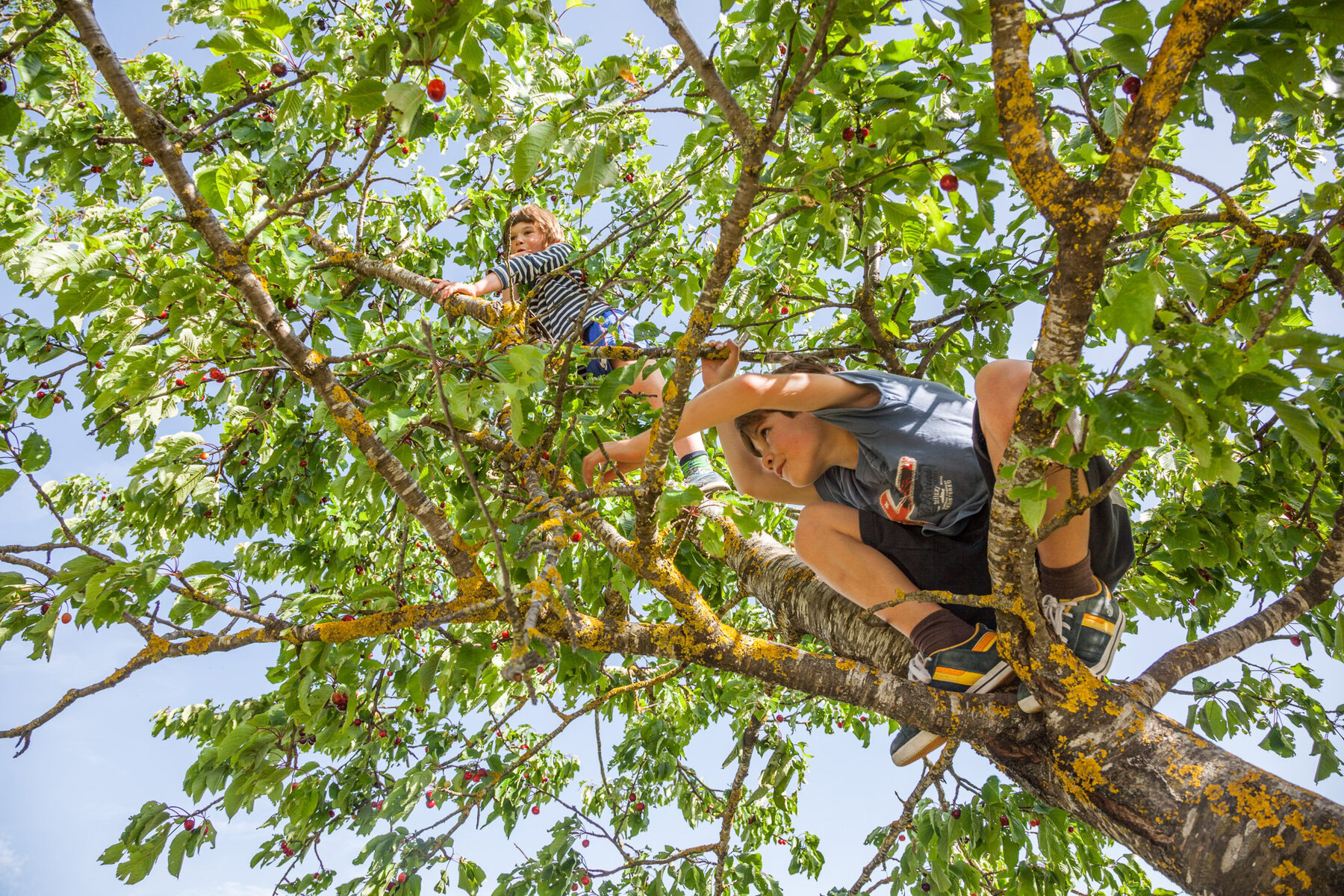
Boys climb a tree to pick sweet cherries at La ferme gabert in the Trièves region of France. Credit: Ethan Welty
For Welty, the project was deeply personal. “I grew up in France, and so I had a strong sense that place begets flavor,” he says. “There’s a lot about food in the landscape. I remember foraging for chestnuts, picking daffodils, mushroom hunting.” When his family moved back to Seattle, his connection to food and nature remained strong, but it wasn’t until he relocated to Boulder, Colorado, for graduate school that he began seeing cities as foraging grounds.
“There were apple trees in my backyard,” he recalls. “I got into home brewing, making cider, and I had the equipment from beer making. But then I wanted more apples.” That desire led him to look at the city differently — recognizing fruit trees overhanging bike paths, spotting neglected bounty in public parks. What seemed obvious to him was a revelation to others. “People were amazed or incredulous,” he says. “It was surprising to them that you could just harvest fruit in a city.”
Caleb Phillips picks mulberries from trees overhanging the sidewalk in Boulder, Colorado. Credit: Ethan Welty
Welty’s foraging soon took on a more structured form. A project at the University of Colorado in 2008 had introduced him to urban food mapping — analyzing how much food could be produced in a city by using small parcels of land for farming. “The City of Boulder sent me a bunch of data, including their tree inventory,” he says. At first, Welty was cutting out the trees because they blocked sunlight and got in the way of urban farming equipment. But later, when he started foraging, he realized those trees weren’t obstacles — they were opportunities.
His personal maps — scribbled notes and hand-drawn guides — became the foundation for what would soon become Falling Fruit. Then he met Caleb Philips, a fellow forager with a technical background and a shared fascination with the overlooked abundance in urban environments. “We met in January 2013, and we basically got right to work on Falling Fruit,” Welty says. They launched the first version of the site just three months later.
Weighed down by negative news?
Our smart, bright, weekly newsletter is the uplift you’ve been looking for.
[contact-form-7]
From the start, the duo wanted to go beyond their own knowledge and expand the map with existing data. “There were already 600 or so locations on the map when we launched, focusing on the U.S. and Canada.” Welty says. The platform quickly gained attention — not just from foragers but from urban planners, environmentalists and community groups interested in the intersection of food, sustainability and public space.
Today, Falling Fruit is more than just a foraging tool — it’s a challenge to rethink how food fits into urban life. The map includes everything from fruit trees and edible plants to beehives and even free-food dumpsters, reflecting a broader philosophy about minimizing food waste and sharing resources. The goal, Welty says, isn’t just to help people find free food, but to inspire cities to build “food forests”: public spaces filled with edible plants, integrated into the urban landscape as naturally as street trees and park benches.
This vision — of cities as abundant landscapes rather than sterile concrete jungles — is at the heart of the urban foraging movement. Instead of parks filled only with ornamental trees or sidewalks lined with purely decorative greenery, advocates like Christopher Macy of the Phoenix Urban Food Forest Initiative believe urban spaces should be designed to nourish people.
“I fell in love with the idea of bringing food into urban spaces,” Macy says. “I started on my own property, planting fruit trees and perennial vegetables. Once I proved to my neighbors that this was possible, more and more of them said yes.” The transformation started small: just a few trees, a handful of neighbors willing to experiment. But it quickly gained momentum. What was once an overlooked stretch of city property became a source of fresh produce, a meeting place, a way to bring people together. “Now, we’re on over 11 parkways with more than 90 fruit trees and over 100 perennial vegetable plants. By next year, it’ll be over 160. We can grow food and have food for our neighborhood,” says Macy. “It brings a little balance between urban and rural.”
The problem isn’t a lack of food — it’s how cities are designed. The U.S. alone throws away over one-third of the food it produces, worth an estimated $161 billion to $218 billion annually, even as millions struggle with food insecurity. Food forests and urban foraging initiatives, like the ones Macy and Welty are building, challenge the idea that city spaces should be purely decorative.
A Falling Fruit sticker on a discarded banana in a compost bin full of fresh produce behind a Walmart Supercenter in Lafayette, Colorado. These compost bins have since been replaced by a compactor, making food recovery impossible. Credit: Ethan Welty
“Almost every tree in a city was put there because of a human decision,” says Welty. “That means we have the power to reshape those decisions: to plant fruit trees instead of purely ornamental ones, to design spaces that nourish people instead of just looking nice.”
In some places, this shift is already underway. Billings, Montana, for example, has planted over 120 fruit trees in public parks, offering free apples, pears and plums to residents since 2018. Churches and businesses have followed suit, adding their trees to the Falling Fruit map and inviting people to harvest.
Foraging exists in a strange space — sometimes seen as survival, sometimes as a luxury. For some, it’s a necessity; for others, it’s an art form woven into fine dining.
Filip Forsberg, the executive chef at NH Collection Hotels in Helsinki, regularly incorporates foraged ingredients into his cooking and sees both sides of the spectrum. “We use small local producers and a lot of foraged products,” he says. “I pick herbs, berries, mushrooms, garnishes — it’s just part of what we do. We make lingonberry juice from foraged berries daily. In season, fresh chanterelles go into pasta dishes.”
Siobhan Shaw, co-founder and chair of Growing To Give, a nonprofit focused on sustainable food security, sees foraging as more than just a way to source ingredients: It’s a survival skill that modern society has largely forgotten. “Foraging satisfies something basic about being human,” she says. “It’s not just about food — it’s about self-sufficiency, understanding the land, and turning the world around you into a source of nourishment.”
Wait, you're not a member yet?
Join the Reasons to be Cheerful community by supporting our nonprofit publication and giving what you can.
Join
Cancel anytime
Leading foraging walks near his city, Forsberg witnesses the real transformation when people begin to recognize food growing all around them. “People are always surprised by how much food is actually here,” he says. “It’s just about opening their eyes to what’s been there all along.”
And that might be the real power of Falling Fruit and the urban food forest movement. It’s a way of seeing, a reminder that cities aren’t just places of consumption. They can be places of abundance, if only we choose to look.
The post For Modern Foragers, This Map Reveals Urban Abundance appeared first on Reasons to be Cheerful.









 New Posts (Home)
 ChatBox
 Popular Posts
  Game Zone
 Top PodCasts